Thank you for visiting SNEWPapers!
Sign up free
Letter to Editor
June 17, 1915
Missouri Valley Times
Missouri Valley, Harrison County, Iowa
What is this article about?
In a 1915 letter, F. W. Schwertley describes farming in the South observed on a train trip from St. Louis to New Orleans, noting primitive tools, thin crop stands of corn and cotton, yellowish soils, and yields far below Iowa's.
Clipping
OCR Quality
98%
Excellent
Full Text
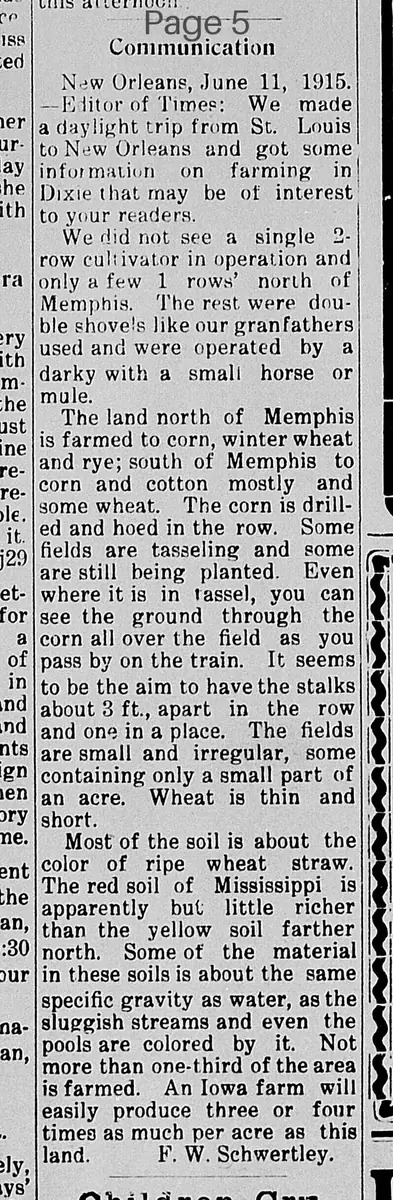
Communication
New Orleans, June 11, 1915.
Editor of Times: We made a daylight trip from St. Louis to New Orleans and got some information on farming in Dixie that may be of interest to your readers.
We did not see a single 2-row cultivator in operation and only a few 1-row north of Memphis. The rest were double shovels like our grandfathers used and were operated by a darky with a small horse or mule.
The land north of Memphis is farmed to corn, winter wheat and rye; south of Memphis to corn and cotton mostly and some wheat. The corn is drilled and hoed in the row. Some fields are tasseling and some are still being planted. Even where it is in tassel, you can see the ground through the corn all over the field as you pass by on the train. It seems to be the aim to have the stalks about 3 ft. apart in the row and one in a place. The fields are small and irregular, some containing only a small part of an acre. Wheat is thin and short.
Most of the soil is about the color of ripe wheat straw. The red soil of Mississippi is apparently but little richer than the yellow soil farther north. Some of the material in these soils is about the same specific gravity as water, as the sluggish streams and even the pools are colored by it. Not more than one-third of the area is farmed. An Iowa farm will easily produce three or four times as much per acre as this land.
F. W. Schwertley.
New Orleans, June 11, 1915.
Editor of Times: We made a daylight trip from St. Louis to New Orleans and got some information on farming in Dixie that may be of interest to your readers.
We did not see a single 2-row cultivator in operation and only a few 1-row north of Memphis. The rest were double shovels like our grandfathers used and were operated by a darky with a small horse or mule.
The land north of Memphis is farmed to corn, winter wheat and rye; south of Memphis to corn and cotton mostly and some wheat. The corn is drilled and hoed in the row. Some fields are tasseling and some are still being planted. Even where it is in tassel, you can see the ground through the corn all over the field as you pass by on the train. It seems to be the aim to have the stalks about 3 ft. apart in the row and one in a place. The fields are small and irregular, some containing only a small part of an acre. Wheat is thin and short.
Most of the soil is about the color of ripe wheat straw. The red soil of Mississippi is apparently but little richer than the yellow soil farther north. Some of the material in these soils is about the same specific gravity as water, as the sluggish streams and even the pools are colored by it. Not more than one-third of the area is farmed. An Iowa farm will easily produce three or four times as much per acre as this land.
F. W. Schwertley.
What sub-type of article is it?
Informative
Historical
What themes does it cover?
Agriculture
What keywords are associated?
Southern Farming
Dixie Agriculture
Corn Cultivation
Cotton Fields
Soil Quality
Outdated Tools
What entities or persons were involved?
F. W. Schwertley
Editor Of Times
Letter to Editor Details
Author
F. W. Schwertley
Recipient
Editor Of Times
Main Argument
reports observations on farming practices in the south, highlighting outdated tools, crop cultivation methods, soil characteristics, and lower productivity compared to iowa farms.
Notable Details
No 2 Row Cultivators Seen, Mostly Double Shovels Operated By 'Darky' With Small Horse Or Mule
Crops: Corn, Winter Wheat, Rye North Of Memphis; Corn, Cotton, Some Wheat South
Corn Drilled And Hoed, Thin Stands With Stalks 3 Ft. Apart
Soil Color Like Ripe Wheat Straw, Red Soil In Mississippi Not Much Richer
Only One Third Of Area Farmed, Iowa Produces 3 4 Times More Per Acre