Thank you for visiting SNEWPapers!
Sign up free
Staunton Spectator
Staunton, Virginia
What is this article about?
Description of the unchanged battlefield near New Orleans where the Battle of New Orleans occurred on January 8, 1815, highlighting preserved features, remnants like Jackson's quarters, Packenham's death site, scarred oaks, and old negroes' reminiscences and artifacts.
Clipping
OCR Quality
Full Text
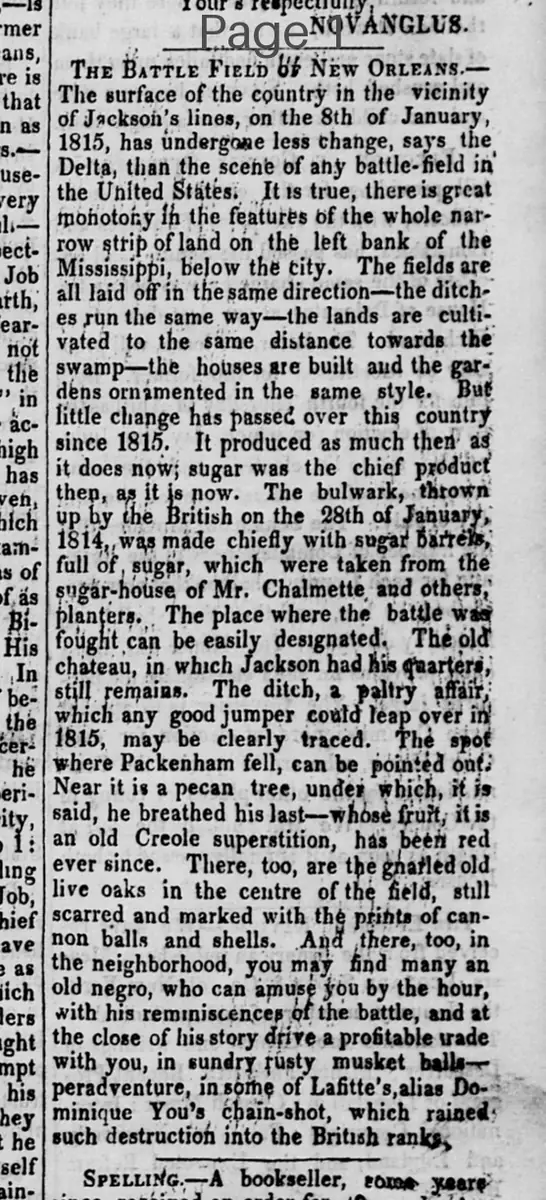
The surface of the country in the vicinity of Jackson's lines, on the 8th of January, 1815, has undergone less change, says the Delta, than the scene of any battle-field in the United States. It is true, there is great monotony in the features of the whole narrow strip of land on the left bank of the Mississippi, below the city. The fields are all laid off in the same direction—the ditches run the same way—the lands are cultivated to the same distance towards the swamp—the houses are built and the gardens ornamented in the same style. But little change has passed over this country since 1815. It produced as much then as it does now; sugar was the chief product then, as it is now. The bulwark, thrown up by the British on the 28th of January, 1814, was made chiefly with sugar barrels, full of sugar, which were taken from the sugar-house of Mr. Chalmette and other planters. The place where the battle was fought can be easily designated. The old chateau, in which Jackson had his quarters still remains. The ditch, a paltry affair, which any good jumper could leap over in 1815, may be clearly traced. The spot where Packenham fell, can be pointed out. Near it is a pecan tree, under which, it is said, he breathed his last—whose fruit, it is an old Creole superstition, has been red ever since. There, too, are the gnarled old live oaks in the centre of the field, still scarred and marked with the prints of cannon balls and shells. And there, too, in the neighborhood, you may find many an old negro, who can amuse you by the hour, with his reminiscences of the battle, and at the close of his story drive a profitable trade with you, in sundry rusty musket balls— peradventure, in some of Lafitte's, alias Dominique You's chain-shot, which rained such destruction into the British ranks.
What sub-type of article is it?
What themes does it cover?
What keywords are associated?
What entities or persons were involved?
Where did it happen?
Story Details
Key Persons
Location
Vicinity Of Jackson's Lines On The Left Bank Of The Mississippi Below New Orleans
Event Date
8th Of January, 1815
Story Details
The battlefield near New Orleans remains largely unchanged since the 1815 battle, with preserved features including Jackson's chateau, a traceable ditch, the site of Packenham's death under a pecan tree with red fruit per Creole superstition, scarred live oaks from cannon fire, and local negroes sharing reminiscences and selling battle artifacts like musket balls and chain-shot.