Thank you for visiting SNEWPapers!
Sign up free
Story
June 11, 1857
The Highland Weekly News
Hillsborough, Hillsboro, Highland County, Ohio
What is this article about?
J.O.B. Renick of Columbus, Ohio, agrees with A.B. Dickinson on the harmful effects of shade trees in pastures, citing reduced fattening, animal injuries, and health risks for cattle, advocating for open prairies instead.
Clipping
OCR Quality
88%
Good
Full Text
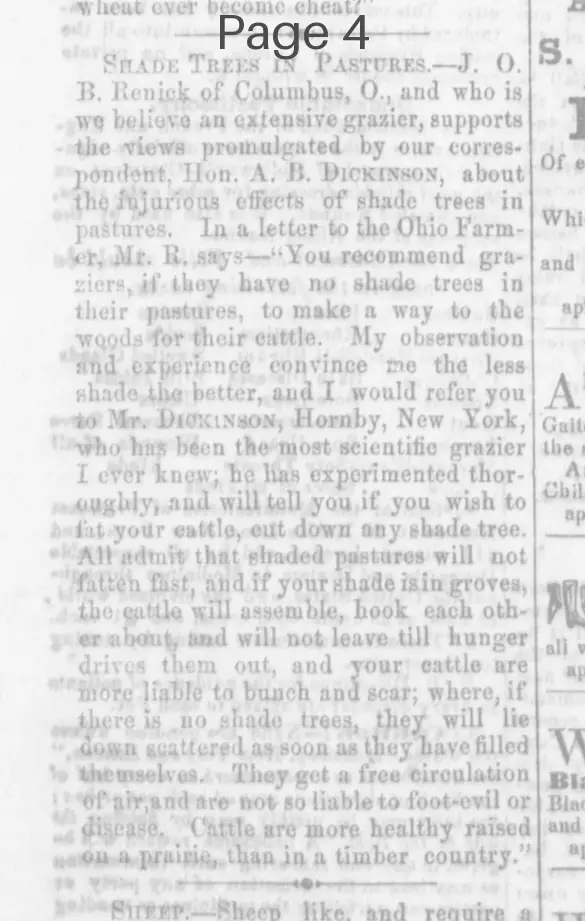
Shade Trees in Pastures.—J. O.
B. Renick of Columbus, O., and who is
we believe an extensive grazier, supports
the views promulgated by our corres-
pondent, Hon. A. B. Dickinson, about
the injurious effects of shade trees in
pastures. In a letter to the Ohio Farm-
er, Mr. R. says—“You recommend gra-
ziers, if they have no shade trees in
their pastures, to make a way to the
woods for their cattle.” My observation
and experience convince me the less
shade the better, and I would refer you
to Mr. Dickinson; Hornby, New York,
who has been the most scientific grazier
I ever knew: he has experimented thor-
oughly, and will tell you if you wish to
bring your cattle, cut down any shade tree.
All admit that shaded pastures will not
fatten fast, and if your shade is in groves,
the cattle will assemble, hook each oth-
er about, and will not leave till hunger
drives them out, and your cattle are
more liable to bunch and scar; where, if
there is no shade trees, they will lie
down scattered as soon as they have filled
themselves. They get a free circulation
of air and are not so liable to foot-rot or
disease, cattle are more healthy raised
on a prairie, than in a timber country.
B. Renick of Columbus, O., and who is
we believe an extensive grazier, supports
the views promulgated by our corres-
pondent, Hon. A. B. Dickinson, about
the injurious effects of shade trees in
pastures. In a letter to the Ohio Farm-
er, Mr. R. says—“You recommend gra-
ziers, if they have no shade trees in
their pastures, to make a way to the
woods for their cattle.” My observation
and experience convince me the less
shade the better, and I would refer you
to Mr. Dickinson; Hornby, New York,
who has been the most scientific grazier
I ever knew: he has experimented thor-
oughly, and will tell you if you wish to
bring your cattle, cut down any shade tree.
All admit that shaded pastures will not
fatten fast, and if your shade is in groves,
the cattle will assemble, hook each oth-
er about, and will not leave till hunger
drives them out, and your cattle are
more liable to bunch and scar; where, if
there is no shade trees, they will lie
down scattered as soon as they have filled
themselves. They get a free circulation
of air and are not so liable to foot-rot or
disease, cattle are more healthy raised
on a prairie, than in a timber country.
What sub-type of article is it?
Agricultural Advice
Farming Observation
What themes does it cover?
Nature
What keywords are associated?
Shade Trees
Pastures
Cattle Health
Grazing Practices
Foot Rot
Prairie Farming
What entities or persons were involved?
J. O. B. Renick
A. B. Dickinson
Where did it happen?
Columbus, O.; Hornby, New York
Story Details
Key Persons
J. O. B. Renick
A. B. Dickinson
Location
Columbus, O.; Hornby, New York
Story Details
Renick supports Dickinson's view that shade trees in pastures harm cattle by slowing fattening, causing injuries from bunching, and increasing disease risk; open prairies promote better health and circulation.