Thank you for visiting SNEWPapers!
Sign up free
Commercial
May 29, 1925
White Bluffs Spokesman
White Bluffs, Benton County, Washington
What is this article about?
The Boston & Maine Railroad faces low business on 40% of its mileage from branch lines, now dominated by automobiles and trucks, and plans to abandon 1,000 of 2,450 miles via a subsidiary to cut costs, pending approvals from stockholders, federal treasury (holding $40M bonds), and Interstate Commerce Commission. Precedent exists from a Middle Western railroad.
Clipping
OCR Quality
98%
Excellent
Full Text
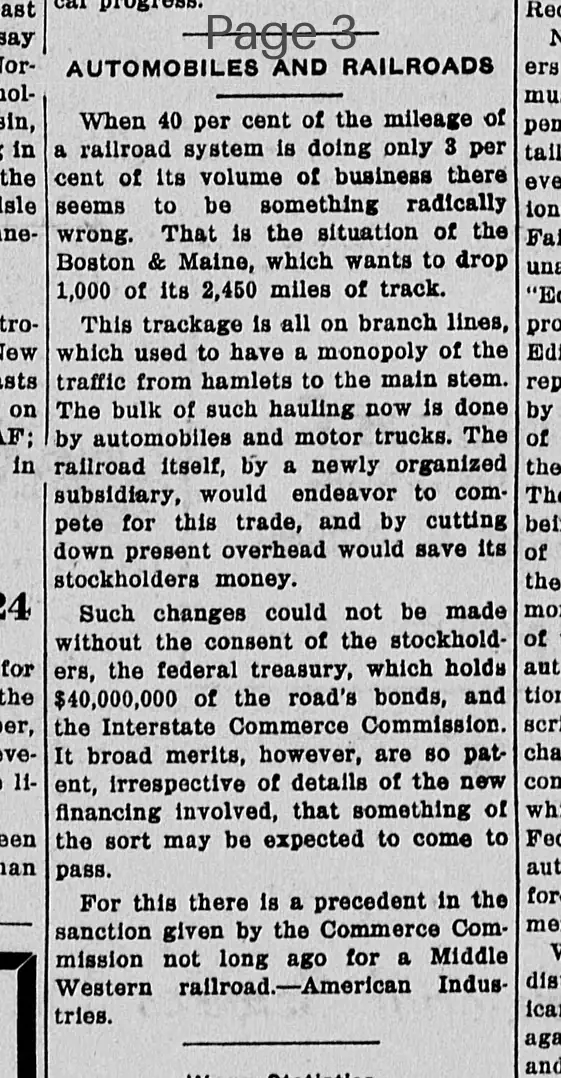
AUTOMOBILES AND RAILROADS.
When 40 per cent of the mileage of a railroad system is doing only 3 per cent of its volume of business there seems to be something radically wrong. That is the situation of the Boston & Maine, which wants to drop 1,000 of its 2,450 miles of track.
This trackage is all on branch lines, which used to have a monopoly of the traffic from hamlets to the main stem. The bulk of such hauling now is done by automobiles and motor trucks. The railroad itself, by a newly organized subsidiary, would endeavor to compete for this trade, and by cutting down present overhead would save its stockholders money.
Such changes could not be made without the consent of the stockholders, the federal treasury, which holds $40,000,000 of the road's bonds, and the Interstate Commerce Commission. It broad merits, however, are so patent, irrespective of details of the new financing involved, that something of the sort may be expected to come to pass.
For this there is a precedent in the sanction given by the Commerce Commission not long ago for a Middle Western railroad. American Industries.
When 40 per cent of the mileage of a railroad system is doing only 3 per cent of its volume of business there seems to be something radically wrong. That is the situation of the Boston & Maine, which wants to drop 1,000 of its 2,450 miles of track.
This trackage is all on branch lines, which used to have a monopoly of the traffic from hamlets to the main stem. The bulk of such hauling now is done by automobiles and motor trucks. The railroad itself, by a newly organized subsidiary, would endeavor to compete for this trade, and by cutting down present overhead would save its stockholders money.
Such changes could not be made without the consent of the stockholders, the federal treasury, which holds $40,000,000 of the road's bonds, and the Interstate Commerce Commission. It broad merits, however, are so patent, irrespective of details of the new financing involved, that something of the sort may be expected to come to pass.
For this there is a precedent in the sanction given by the Commerce Commission not long ago for a Middle Western railroad. American Industries.
What sub-type of article is it?
Railroads
Transportation
What keywords are associated?
Boston Maine Railroad
Branch Line Abandonment
Auto Truck Competition
Railroad Subsidiary
Icc Approval
What entities or persons were involved?
Boston & Maine
Interstate Commerce Commission
Federal Treasury
Where did it happen?
Boston & Maine
Commercial Details
Location
Boston & Maine
Key Figures
Boston & Maine
Interstate Commerce Commission
Federal Treasury
Notable Details
Drop 1,000 Of 2,450 Miles Of Track
Branch Lines
Competition From Automobiles And Motor Trucks
Newly Organized Subsidiary
Consent Of Stockholders
$40,000,000 Bonds
Precedent In Middle Western Railroad