Thank you for visiting SNEWPapers!
Sign up free
Literary
October 25, 1797
The New Hampshire Gazette
Portsmouth, Rockingham County, New Hampshire
What is this article about?
An essay advising on achieving justice by paying debts through diligence in business and frugality in expenses, drawing on biblical wisdom and practical moral guidance for personal and familial conduct.
Clipping
OCR Quality
95%
Excellent
Full Text
MORALIST
A.
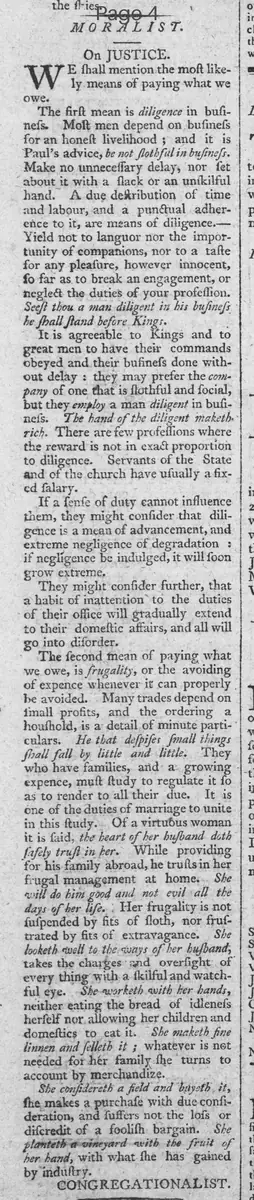
On JUSTICE.
I shall mention the most likely means of paying what we owe.
The first mean is diligence in business. Most men depend on business for an honest livelihood; and it is Paul's advice, be not slothful in business. Make no unnecessary delay, nor set about it with a slack or an unskilful hand. A due distribution of time and labour, and a punctual adherence to it, are means of diligence.— Yield not to languor nor the importunity of companions, nor to a taste for any pleasure, however innocent, so far as to break an engagement, or neglect the duties of your profession. Seest thou a man diligent in his business he shall stand before Kings.
It is agreeable to Kings and to great men to have their commands obeyed and their business done without delay: they may prefer the company of one that is slothful and social, but they employ a man diligent in business. The hand of the diligent maketh rich. There are few professions where the reward is not in exact proportion to diligence. Servants of the State and of the church have usually a fixed salary.
If a sense of duty cannot influence them, they might consider that diligence is a mean of advancement, and extreme negligence of degradation: if negligence be indulged, it will soon grow extreme.
They might consider further, that a habit of inattention to the duties of their office will gradually extend to their domestic affairs, and all will go into disorder.
The second mean of paying what we owe, is frugality, or the avoiding of expence whenever it can properly be avoided. Many trades depend on small profits, and the ordering a household, is a detail of minute particulars. He that despises small things shall fall by little and little. They who have families, and a growing expence, must study to regulate it so as to render to all their due. It is one of the duties of marriage to unite in this study. Of a virtuous woman it is said, the heart of her husband doth safely trust in her. While providing for his family abroad, he trusts in her frugal management at home. She will do him good and not evil all the days of her life. Her frugality is not suspended by fits of sloth, nor frustrated by fits of extravagance. She looketh well to the ways of her husband, takes the charges and oversight of every thing with a skilful and watchful eye. She worketh with her hands, neither eating the bread of idleness herself nor allowing her children and domestics to eat it. She maketh fine linen and selleth it; whatever is not needed for her family she turns to account by merchandize.
She considereth a field and buyeth it, she makes a purchase with due consideration, and suffers not the loss or discredit of a foolish bargain. She planteth a vineyard with the fruit of her hand, with what she has gained by industry.
A.
On JUSTICE.
I shall mention the most likely means of paying what we owe.
The first mean is diligence in business. Most men depend on business for an honest livelihood; and it is Paul's advice, be not slothful in business. Make no unnecessary delay, nor set about it with a slack or an unskilful hand. A due distribution of time and labour, and a punctual adherence to it, are means of diligence.— Yield not to languor nor the importunity of companions, nor to a taste for any pleasure, however innocent, so far as to break an engagement, or neglect the duties of your profession. Seest thou a man diligent in his business he shall stand before Kings.
It is agreeable to Kings and to great men to have their commands obeyed and their business done without delay: they may prefer the company of one that is slothful and social, but they employ a man diligent in business. The hand of the diligent maketh rich. There are few professions where the reward is not in exact proportion to diligence. Servants of the State and of the church have usually a fixed salary.
If a sense of duty cannot influence them, they might consider that diligence is a mean of advancement, and extreme negligence of degradation: if negligence be indulged, it will soon grow extreme.
They might consider further, that a habit of inattention to the duties of their office will gradually extend to their domestic affairs, and all will go into disorder.
The second mean of paying what we owe, is frugality, or the avoiding of expence whenever it can properly be avoided. Many trades depend on small profits, and the ordering a household, is a detail of minute particulars. He that despises small things shall fall by little and little. They who have families, and a growing expence, must study to regulate it so as to render to all their due. It is one of the duties of marriage to unite in this study. Of a virtuous woman it is said, the heart of her husband doth safely trust in her. While providing for his family abroad, he trusts in her frugal management at home. She will do him good and not evil all the days of her life. Her frugality is not suspended by fits of sloth, nor frustrated by fits of extravagance. She looketh well to the ways of her husband, takes the charges and oversight of every thing with a skilful and watchful eye. She worketh with her hands, neither eating the bread of idleness herself nor allowing her children and domestics to eat it. She maketh fine linen and selleth it; whatever is not needed for her family she turns to account by merchandize.
She considereth a field and buyeth it, she makes a purchase with due consideration, and suffers not the loss or discredit of a foolish bargain. She planteth a vineyard with the fruit of her hand, with what she has gained by industry.
What sub-type of article is it?
Essay
What themes does it cover?
Moral Virtue
What keywords are associated?
Diligence
Frugality
Justice
Business
Moral Duty
Debt Payment
Household Management
What entities or persons were involved?
Moralist A.
Literary Details
Title
On Justice
Author
Moralist A.
Subject
Means Of Paying What We Owe
Key Lines
Be Not Slothful In Business.
Seest Thou A Man Diligent In His Business He Shall Stand Before Kings.
The Hand Of The Diligent Maketh Rich.
He That Despises Small Things Shall Fall By Little And Little.
She Will Do Him Good And Not Evil All The Days Of Her Life.