Thank you for visiting SNEWPapers!
Sign up free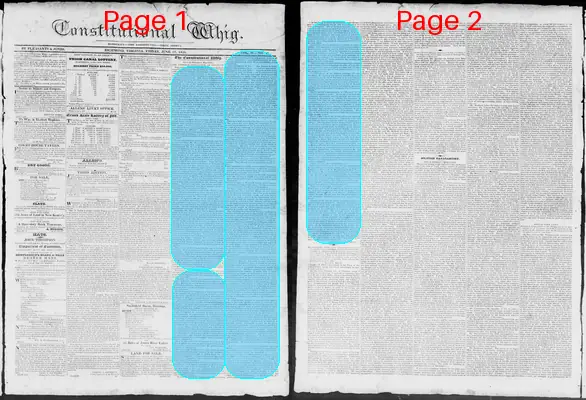
Constitutional Whig
Richmond, Virginia
What is this article about?
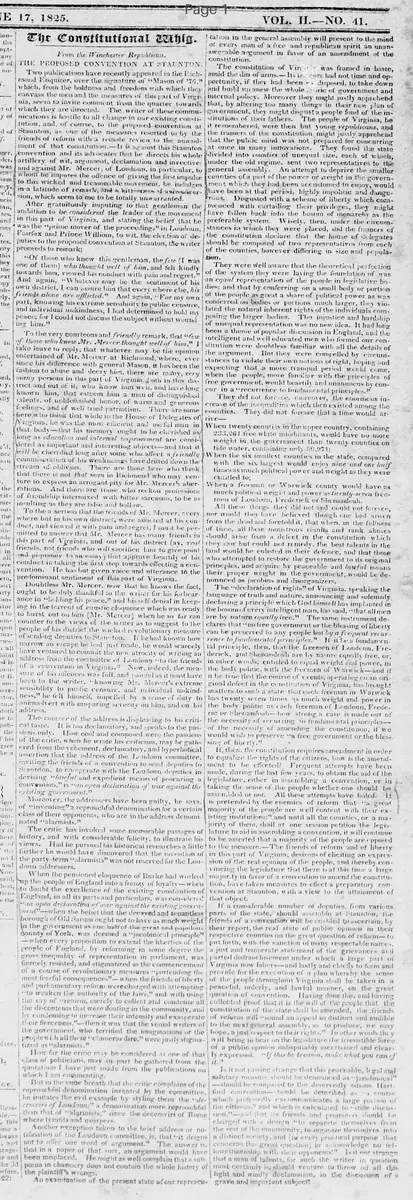
An editorial defends John Mercer and the proposed Staunton convention against critics like 'Mason of '76' in the Richmond Enquirer. It argues for constitutional reform to equalize representation in Virginia's assembly, highlighting disparities between counties and invoking fundamental principles of equality and liberty.
Merged-components note: The second component continues the editorial discussion on the Staunton convention and Mr. Mercer, spanning pages with sequential reading order.
Clippings
1 of 2
OCR Quality
Full Text
Two publications have recently appeared in the Richmond Enquirer, over the signature of "Mason of '76," which, from the boldness and freedom with which they canvass the men and the measures of this part of Virginia, seem to invite comment from the quarter towards which they are directed. The writer of these communications is hostile to all change in our existing constitution, and, of course, to the proposed convention at Staunton, as one of the measures resorted to by the friends of reform with a remote view to the amendment of that constitution.--It is against this Staunton convention and its advocates that he directs his whole artillery of wit, argument, declamation and invective: and against Mr. Mercer, of Loudoun, in particular, to whom he imputes the offence of giving the first impulse to this wicked and treasonable movement, he indulges in a latitude of remark, and a bitterness of animosity which seem to me to be totally unwarranted.
After gratuitously imputing to that gentleman the ambition to be considered the leader of the movement in this part of Virginia, and stating the belief that he was the "prime mover of the proceedings" in Loudoun, Fairfax and Prince William, to wit, the election of deputies to the proposed convention at Staunton, the writer proceeds to remark;
"Of those who knew this gentleman, the few (I was one of them) who thought well of him, and felt kindly towards him, viewed his conduct with pain and regret."
And again, "whatever may be the sentiment of his own district, I can assure him that every where else, his friends alone are afflicted." And again, "For my own part, knowing his extreme sensibility to public censure, and individual unkindness, I had determined to hold my peace; for I could not discuss the subject without wounding him."
To the very courteous and friendly remark, that "few of those who knew Mr. Mercer thought well of him," I take leave to reply, that whatever may be the opinion entertained of Mr. Mercer at Richmond, where, ever since his difference with general Mason, it has been the fashion to abuse and decry him, there are many, very many persons in this part of Virginia, both in this district and out of it, who know him well, and have long known him, that esteem him a man of distinguished talents, of unblemished honor, of warm and generous feelings, and of well tried patriotism. There are some here who think that while in the House of Delegates of Virginia, he was the most efficient and useful man in that body—that his memory ought to be cherished as long as education and internal improvement are considered as important and interesting objects—and that it will be cherished long after some who affect a friendly commiseration of his weaknesses have drifted down the stream of oblivion. There are those here who think that there is not that man in Richmond who may venture to express an arrogant pity for Mr. Mercer's aberrations. And there are those who reckon professions of friendship intermixed with bitter sarcasms, to be as insulting as they are false and hollow.
To the assertion that the friends of Mr. Mercer, everywhere but in his own district, were afflicted at his conduct, and viewed it with pain and regret, I must be permitted to answer that Mr. Mercer has many friends in this part of Virginia, and out of his district (ay, real friends, not friends who will sacrifice him to give point and piquancy to an essay that approve heartily of his conduct in taking the first step towards effecting a convention. He has but given voice and utterance to the predominant sentiment of this part of Virginia.
Doubtless Mr. Mercer, now that he knows the fact, ought to be duly thankful to the writer for his forbearance in "holding his peace," and his self-denial in keeping in the torrent of caustic eloquence which was ready to burst out on him (Mr. Mercer) when he so far ran counter to the views of the writer as to suggest to the people of his district the wicked revolutionary measure of sending deputies to Staunton. If he had known how narrow an escape he had just made, he would scarcely have ventured to commit the new atrocity of writing an address from the committee of Loudoun "to the friends of a convention in Virginia." Now, indeed, the measure of his offences was full, and painful as it must have been to the writer, "knowing Mr. Mercer's extreme sensibility to public censure, and individual unkindness," he felt himself, impelled by a sense of duty to animadvert with unsparing severity on him, and on his address.
The manner of the address is displeasing to his critical taste. It is too declamatory, and speaks to the passions only. How cool and composed were the passions of the critic, when he wrote his criticism, may be gathered from the vehement, declamatory, and hyperbolical assertion that the address of the Loudoun committee, inviting the friends of a convention to send deputies to Staunton, to co-operate with the Loudoun deputies in devising "lawful and expedient means of procuring a convention," is "an open declaration of war against the existing government."
Moreover, the addressers have been guilty, he says, of "inventing" a reproachful denomination for a certain class of their opponents, who are in the address denominated "alarmists."
The critic has invoked some memorable passages of history, and with considerable felicity, to illustrate his views. Had he pursued his historical researches a little further he would have discovered that the invention of the party-term "alarmists" was not reserved for the Loudoun addressers.
When the pensioned eloquence of Burke had worked up the people of England into a frenzy of loyalty—when to doubt the excellence of the existing constitution of England, in all its parts and particulars, was considered "an open declaration of war against the existing government"—when the belief that the decayed and tenantless borough of Old Sarum ought not to have as much weight in the government as one half of the great and populous county of York, was deemed a "jacobinical principle"—when every proposition to extend the liberties of the people of England, by reforming in some degree the gross inequality of representation in parliament, was fiercely resisted, and stigmatized as the commencement of a course of revolutionary measures "portending the most fearful consequences"—when the friends of liberty and parliamentary reform were charged with attempting "to weaken the authority of the laws," and with using the cry of "reform, merely to collect and condense all the discontents that were floating in the community, and by condensing to increase their intensity and exasperate their fierceness,"—then it was that the venial writers of the government, who terrified the imaginations of the people with all these "chimeras dire," were justly stigmatized as "alarmists."
How far the critic may be considered as one of that class of politicians, may in part be gathered from the quotations I have just made from the publications on which I am commenting.
But in the same breath that the critic complains of the reproachful denomination invented by the committee, he imitates the evil example by styling them the "decemviri of Loudoun." a denomination more reproachful than that of "alarmists," since the decemviri of Rome were tyrants and usurpers.
Another exception taken to the brief address or notification of the Loudoun committee, is, that "it deigns not to offer one word of argument." The answer is, that in a paper of that sort, an argument would have been misplaced. He might as well complain that a subpoena in chancery does not contain the whole history of the plaintiff's wrongs.
An examination of the present state of our representation in the general assembly will present to the mind of every man of a free and republican spirit an unanswerable argument in favor of an amendment of the constitution.
The constitution of Virginia was framed in haste, and the din of arms.—Its framers had not time and opportunity, if they had been so disposed, to take down and build up anew the whole fabric of government and internal policy. Moreover they might justly apprehend that, by altering too many things in their new plan of government, they might disgust a people fond of the institutions of their fathers. The people of Virginia, be it remembered, were then but young republicans, and the framers of the constitution might justly apprehend that the public mind was not prepared for concurring at once in many innovations. They found the state divided into counties of unequal size, each of which, under the old regime, sent two representatives to the general assembly. An attempt to deprive the smaller counties of a part of the power or weight in the government which they had been accustomed to enjoy, would have been at that period, highly impolitic and dangerous. Disgusted with a scheme of liberty which commenced with curtailing their privileges, they might have fallen back into the bosom of monarchy as the preferable system. Wisely, then, under the circumstances in which they were placed, did the framers of the constitution declare that the house of delegates should be composed of two representatives from each of the counties, however differing in size and population.
They were well aware that the theoretical perfection of the system they were laying the foundation of was an equal representation of the people in legislative bodies; and that by conferring on a small body or portion of the people as great a share of political power as was conferred on bodies or portions much larger, they violated the natural inherent rights of the individuals composing the larger bodies. The injustice and hardship of unequal representation was no new idea. It had long been a theme of popular discussion in England, and the intelligent and well educated men who formed our constitution were doubtless familiar with all the details of the argument. But they were compelled by circumstances to violate their own notions of right, hoping and expecting that a more tranquil period would come, when the people, more familiar with the principles of free government, would heartily and unanimously concur in a "recurrence to fundamental principles."
They did not foresee, moreover, the enormous increase of the inequalities which then existed among the counties. They did not foresee that a time would arrive—
When twenty counties in the upper country, containing 233,261 free white inhabitants, would have no more weight in the government than twenty counties on tide water, containing only 50,971;
When the six smallest counties in the state, compared with the six largest would enjoy nine and one half times as much political power and weight as they were entitled to;
When a freeman of Warwick county would have as much political weight and power as twenty-seven freemen of Loudoun, Frederick or Shenandoah,
All these things they did not and could not foresee, nor would they have believed though one had arisen from the dead and foretold it, that when, in the fulness of time, all these monstrous results and rank abuses should arise from a defect in the constitution which they saw but could not remedy, the best talents in the land would be enlisted in their defence, and that those who attempted to restore the government to its original principles, and acquire by peaceable and lawful means their proper weight in the government, would be denounced as jacobins and disorganizers.
The "declaration of rights" of Virginia, speaking the language of truth and nature, announcing and solemnly declaring a principle which God himself has implanted in the bosom of every intelligent man, has said, "that all men are by nature equally free." The same instrument declares that "no free government or the blessing of liberty can be preserved to any people but by a frequent recurrence to fundamental principles." If it be a fundamental principle, then, that the freemen of Loudoun, Frederick, and Shenandoah are by nature equally free, or, in other words, entitled to equal weight and power, in the body politic, with the freemen of Warwick—and if it be true that the course of events, operating on an original defect in the constitution of Virginia, has brought matters to such a state that each freeman in Warwick has twenty seven times as much weight and power in the body politic as each freeman of Loudoun, Frederick or Shenandoah—how strong a case is made out of the necessity of recurring to fundamental principles—of the necessity of amending the constitution, if we would wish to preserve "a free government or the blessing of liberty."
If, then, the constitution requires amendment in order to equalize the rights of the citizens, how is the amendment to be effected? Frequent attempts have been made, during the last few years, to obtain the aid of the Legislature, either in assembling a convention, or in taking the sense of the people whether one should be assembled or not. All these attempts have failed. It is pretended by the enemies of reform that "a great majority of the people are well content with their existing institutions;" and until all the counties, or a majority of them, shall at one session petition the legislature to aid in assembling a convention, it will continue to be asserted that a majority of the people are opposed to the measure.—The friends of reform and of liberty in this part of Virginia, desirous of eliciting an expression of the real opinion of the people, and thereby convincing the legislature that there is at this time a large majority in favor of a convention to amend the constitution, have taken measures to effect a preparatory convention at Staunton, with a view to the attainment of that object.
If a considerable number of deputies, from various parts of the state, should assemble at Staunton, the friends of a convention will be enabled to ascertain, by their report, the real state of public opinion in their respective counties on the great question of reform—to put forth, with the sanction of many respectable names, a just and temperate statement of the grievances and partial disfranchisement under which a large part of Virginia now labors—and lastly and chiefly to form and provide for the execution of a plan whereby the sense of the people throughout Virginia shall be taken in a peaceful, orderly, and lawful manner, on the great question of convention. Having done this, and having collected proof that it is the will of the people that the constitution of the state shall be amended, the friends of reform will "sound an appeal so distinct and audible to the next general assembly, as to produce, we may hope, a just respect to their rights.." In other words they will bring to bear on the legislature the irresistible force of a public opinion indisputably ascertained and clearly expressed. "If this be treason, make what you can of it."
Is it not passing strange that this peaceable, legal and salutary measure should be denounced as "jacobinical"—should be compared to the deservedly odious Hartford convention—should be described as a course which professedly excommunicates a large portion of the citizens." and which is calculated to stifle discussion."—and that its friends and promoters should be charged with a design "to separate themselves from the rest of the community, to organize themselves into a distinct society, and (to every practical purpose that concerns the great question) to acknowledge no fellowship with their opponents!" Is it not strange that a man of talents, for such the writer in question most certainly is, should venture to throw off all this light and windy declamation, in the discussion of a grave and important subject
Can anything be more idle than the censure thrown upon us for inviting the friends only of a convention to meet at Staunton? We of the larger counties, who are each of us but the twenty-seventh part of a free citizen, wish to rise to the dignity of units, by taking away, by just and legal means, from our fellow-citizens of Warwick, &c. the excessive and undue portion of political power which they now enjoy. And we, poor fractions, are gravely asked to invite the lordly units of Warwick to aid us in devising means of raising ourselves and depressing them!
And it is said that in excluding the enemies of a convention, "the assembly at Staunton now proposed differs most essentially from the meeting which was held at the same place in 1816. Tho the invitation was given to all men of whatsoever opinions." The writer has here fallen into a mistake in point of fact, as the annexed extract from the address "To the people of the commonwealth of Virginia," which produced the meeting at Staunton, will clearly show:
"The undersigned would therefore respectfully submit to their fellow citizens throughout the state, of both political parties (for there is no party question, and the framers of this address are of both political parties,) the following proposition:
"Let the people of the different counties, who are friendly to the objects of this address, assemble in county meetings, on the 4th of July next, or as soon thereafter as practicable, and depute from each county two respectable and intelligent individuals, to meet at Staunton, in Augusta county, on Monday the 19th day of August next, for the purpose of devising and adopting measures for effecting a convention of the people of this Commonwealth."
On the second communication of "Mason of '76," I have few remarks to make. By the aid of the bold and gratuitous assumption that the object of the proposed meeting at Staunton is to "obstruct the execution of the laws," and that "its real design is to direct, control, counteract or awe the regular deliberation or action of the constituted authorities," he has been enabled to show that the holding of such a meeting is incompatible with the sound and excellent principles contained in the "farewell address" of the father of his country. We disavow the intentions imputed and deny the application of the passage quoted.
There is one trait in the second publication which I feel myself constrained to notice. I mean the lofty and self-sufficient tone in which the writer has thought fit to indulge. Having given his first furious tirade against the Staunton convention and its promoters four days to operate on the public mind, he declares in his second publication that "he will not believe that the good people of Loudoun and Fairfax will have the wilfulness to persist in" the measure of sending deputies to Staunton. "I do confidently hope," he adds, "that at their approaching June county courts they will recall their deputies, to whom they have incautiously and unintentionally delegated their portion of the sovereignty."
That is to say, "Now that you understand what we in Richmond think of this matter, now that we have explained to you our notions of the impropriety of all such irregular proceedings as Staunton conventions, &c. we doubt not that you will see the folly you have been led into by the petty demagogues who have taken the lead in this matter, and will hasten to show yourselves duly penitent by cashiering these upstarts to whom you have incautiously and unintentionally delegated your portion of the sovereignty."
"Given at our palace at Richmond, &c."
In the same lofty tone he expresses his astonishment to see subscribers to the Loudoun address the names of Col. Ellzey, Messrs. R. H. Henderson & William Temme Thomas; and has the unheard of presumption to add, that "it is to be hoped that they too (alluding to Mr. Cuthbert Powell's disclaimer) may disclaim, if not the actual subscription, at least the intention to subscribe such sentiments: that if they subscribed this paper, it was only because they gave it a cursory examination to apprehend its exact import."
No this is your real "Camboyses' vein"--your real kingly tone--"an act of amnesty in favor of such of our misguided subjects as shall come in, confess their offences, and crave our royal mercy." I forbear all further remark, except this, that the presumption of such language, addressed to such men, beggars comment.
I cannot think that the writer has made a happy selection of his nom de guerre. The real "Mason of '76" was one of those true and enlightened friends of liberty who would not even submit to the theoretical assertion by the parliament of England, of a right to tax the colonies. His political creed was that "taxation and representation should go together."
The modern "Mason of '76" is the vehement advocate of the opposite doctrine. He thinks it no hardship that the county of Frederick should pay its full share of the taxes of the state, though she have not the tithe of her proper weight in the body that imposes the taxes. In the nineteenth century, in the bosom of a free republican community, he has broached anew the servile doctrine of the pensioned Johnson, who gave to his labored pamphlet in favor of English usurpations the title of "Taxation no Tyranny." It is to be hoped that such men and such counsels may not at length drive us to the doctrine of Franklin's responsive pamphlet,--"Resistance no rebellion."
A Friend of Equal Rights.
What sub-type of article is it?
What keywords are associated?
What entities or persons were involved?
Editorial Details
Primary Topic
Defense Of Staunton Convention For Constitutional Amendment On Representation
Stance / Tone
Strongly Pro Reform, Critical Of Anti Convention Critics
Key Figures
Key Arguments