Thank you for visiting SNEWPapers!
Sign up free
Literary
April 10, 1915
The Madison Journal
Tallulah, Madison County, Louisiana
What is this article about?
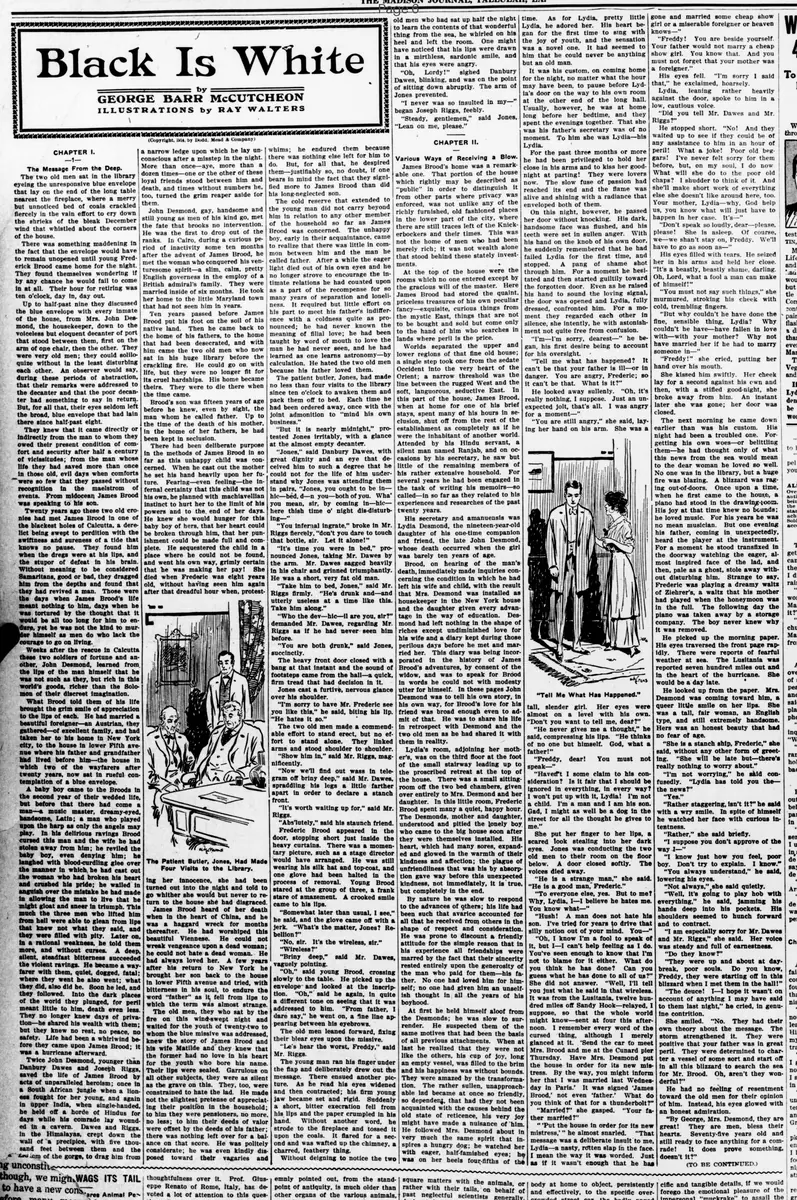
In James Brood's New York home, old friends Dawes and Riggs await a wireless message from him at sea, addressed to his estranged son Frederic. The message announces Brood's remarriage, shocking Frederic and threatening the household, including housekeeper Mrs. Desmond and her daughter Lydia, Frederic's lover. Backstory reveals Brood's betrayed marriage, adventures, and loyalties.
Clipping
OCR Quality
98%
Excellent
Full Text
The Message From the Deep.
The two old men sat in the library eyeing the unresponsive blue envelope that lay on the end of the long table nearest the fireplace, where a merry but unnoticed bed of coals crackled fiercely in the vain effort to cry down the shrieks of the bleak December wind that whistled about the corners of the house.
There was something maddening in the fact that the envelope would have to remain unopened until young Frederick Brood came home for the night. They found themselves wondering if by any chance he would fail to come in at all. Their hour for retiring was ten o'clock, day in, day out.
Up to half-past nine they discussed the blue envelope with every inmate of the house, from Mrs. John Desmond, the housekeeper, down to the voiceless but eloquent decanter of port that stood between them, first on the arm of one chair, then the other. They were very old men: they could soliloquize without in the least disturbing each other. An observer would say, during these periods of abstraction, that their remarks were addressed to the decanter and that the poor decanter had something to say in return.
But, for all that, their eyes seldom left the broad, blue envelope that had lain there since half-past eight.
They knew that it came directly or indirectly from the man to whom they owed their present condition of comfort and security after half a century of vicissitudes: from the man whose life they had saved more than once in those old, evil days when comforts were so few that they passed without recognition in the maelstrom of events. From mid-ocean James Brood was speaking to his son.
Twenty years ago these two old cronies had met James Brood in one of the blackest holes of Calcutta, a derelict being swept to perdition with the swiftness and sureness of a tide that knows no pause. They found him when the dregs were at his lips, and the stupor of defeat in his brain. Without meaning to be considered Samaritans, good or bad, they dragged him from the depths and found that they had revived a man. Those were the days when James Brood's life meant nothing to him, days when he was tortured by the thought that it would be all too long for him to endure, yet he was not the kind to murder himself as men do who lack the courage to go on living.
Weeks after the rescue in Calcutta these two soldiers of fortune and another, John Desmond, learned from the lips of the man himself that he was not such as they, but rich in this world's goods, richer than the Solomon of their discreet imagination.
What Brood told them of his life brought the grim smile of appreciation to the lips of each. He had married a beautiful foreigner-an Austrian, they gathered-of excellent family, and had taken her to his home in New York city, to the house in lower Fifth avenue where his father and grandfather had lived before him-the house in which two of the wayfarers after twenty years, now sat in rueful contemplation of a blue envelope.
A baby boy came to the Broods in the second year of their wedded life, but before that there had come a man-a music master, dreamy-eyed, handsome, Latin; a man who played upon the harp as only the angels may play. In his delirious ravings Brood cursed this man and the wife he had stolen away from him; he reviled the baby boy, even denying him; he laughed with blood-curdling glee over the manner in which he had cast out the woman who had broken his heart and crushed his pride; he wailed in anguish over the mistake he had made in allowing the man to live that he might gloat and sneer in triumph. This much the three men who lifted him from hell were able to glean from lips that knew not what they said, and they were filled with pity. Later on, in a rational weakness, he told them more, and without curses. A deep, silent, steadfast bitterness succeeded the violent ravings. He became a wayfarer with them, quiet, dogged, fatal; where they went he also went; what they did, also did he. Soon he led, and they followed. Into the dark places of the world they plunged, for peril meant little to him, death even less.
They no longer knew days of privation--he shared his wealth with them; but they knew no rest, no peace, no safety. Life had been a whirlwind before they came upon James Brood; it was a hurricane afterward.
Twice John Desmond, younger than Danbury Dawes and Joseph Riggs, saved the life of James Brood by acts of unparalleled heroism; once in a South African jungle when a lioness fought for her young, and again in upper India, when single-handed, he held off a horde of Hindus for days while his comrade lay wounded in a cavern. Dawes and Riggs, in the Himalayas, crept down the wall of a precipice, with five thousand feet between them and the bottom of the gorge, to drag him from a narrow ledge upon which he lay unconscious after a misstep in the night.
More than once --aye, more than a dozen times--one or the other of these loyal friends stood between him and death, and times without numbers he, too, turned the grim reaper aside for them.
John Desmond, gay, handsome and still young as men of his kind go, met the fate that brooks no intervention. He was the first to drop out of the ranks. In Cairo, during a curious period of inactivity some ten months after the advent of James Brood, he met the woman who conquered his venturesome spirit-a slim, calm, pretty English governess in the employ of a British admiral's family. They were married inside of six months. He took her home to the little Maryland town that had not seen him in years.
Ten years passed before James Brood put his foot on the soil of his native land. Then he came back to the home of his fathers, to the home that had been desecrated, and with him came the two old men who now sat in his huge library before the crackling fire. He could go on with life, but they were no longer fit for its cruel hardships. His home became theirs. They were to die there when the time came.
Brood's son was fifteen years of age before he knew, even by sight, the man whom he called father. Up to the time of the death of his mother, in the home of her fathers, he had been kept in seclusion.
There had been deliberate purpose in the methods of James Brood in so far as this unhappy child was concerned. When he cast out the mother he set his hand heavily upon her future. Fearing-even feeling-the infernal certainty that this child was not his own, he planned with Machiavellian instinct to hurt her to the limit of his powers and to the end of her days.
He knew she would hunger for this baby boy of hers, that her heart could be broken through him, that her punishment could be made full and complete. He sequestered the child in a place where he could not be found, and went his own way, grimly certain that he was making her pay! She died when Frederic was eight years old, without having seen him again after that dreadful hour when, protesting her innocence, she had been turned out into the night and told to go whither she would but never to return to the house she had disgraced.
James Brood heard of her death when in the heart of China, and he was a haggard wreck for months thereafter. He had worshiped this beautiful Viennese. He could not wreak vengeance upon a dead woman; he could not hate a dead woman. He had always loved her.
A few years after his return to New York he brought her son back to the house in lower Fifth avenue and tried, with bitterness in his soul, to endure the word "father" as it fell from lips to which the term was almost strange.
The old men, they who sat by the fire on this wind-swept night and waited for the youth of twenty-two to whom the blue missive was addressed, knew the story of James Brood and his wife Matilde and they knew that the former had no love in his heart for the youth who bore his name.
Their lips were sealed. Garrulous on all other subjects, they were as silent as the grave on this. They, too, were constrained to hate the lad. He made not the slightest pretense of appreciating their position in the household; to him they were pensioners, no more, no less; to him their deeds of valor were offset by the deeds of his father; there was nothing left over for a balance on that score.
He was politely considerate; he was even kindly disposed toward their vagaries and thoughtfulness over it.
The patient butler, Jones, had made four visits to the library since ten o'clock to awaken them and pack them off to bed. Each time he had been ordered away, once with the joint admonition to "mind his own business."
"But it is nearly midnight," protested Jones irritably, with a glance at the almost empty decanter.
"Jones," said Danbury Dawes, with great dignity and an eye that deceived him to such a degree that he could not for the life of him understand why Jones was attending them in pairs, "Jones, you ought to be in-hic-bed, d-n you-both of you. Wha' you mean, sir, by coming in-hic- here thish time o' night dis-disturb ing-"
"You infernal ingrate," broke in Mr. Riggs fiercely. "don't you dare to touch that bottle, sir. Let it alone!"
"It's time you were in bed," pronounced Jones, taking Mr. Dawes by the arm. Mr. Dawes sagged heavily in his chair and grinned triumphantly. He was a short, very fat old man.
"Take him to bed, Jones," said Mr. Riggs firmly. "He's drunk and-and utterly useless at a time like this. Take him along."
"Who the dey-hic-il are you, sir?" demanded Mr. Dawes, regarding Mr. Riggs as if he had never seen him before.
"You are both drunk," said Jones, succinctly.
The heavy front door closed with a bang at that instant and the sound of footsteps came from the hall-a quick, firm tread that had decision in it. Jones cast a furtive, nervous glance over his shoulder.
"I'm sorry to have Mr. Frederic see you like this," he said, biting his lip. "He hates it so."
The two old men made a commendable effort to stand erect, but no effort to stand alone. They linked arms and stood shoulder to shoulder.
"Show him in," said Mr. Riggs, magnificently.
"Now we'll find out wass in tele gram off briny deep," said Mr. Dawes, spraddling his legs a little farther apart in order to declare a stanch front.
"It's worth waiting up for," said Mr. Riggs.
"Abs'lutely," said his staunch friend.
Frederic Brood appeared in the door, stopping short just inside the heavy curtains. There was a momentary picture, such as a stage director would have arranged. He was still wearing his silk hat and top-coat, and one glove had been halted in the process of removal. Young Brood stared at the group of three, a frank stare of amazement. A crooked smile came to his lips.
"Somewhat later than usual, I see," he said, and the glove came off with a jerk. "What's the matter, Jones? Rebellion?"
"No, sir. It's the wireless, sir."
"Wireless?"
"Briny deep," said Mr. Dawes vaguely pointing.
"Oh," said young Brood, crossing slowly to the table. He picked up the envelope and looked at the inscription. "Oh," said he again, in quite a different tone on seeing that it was addressed to him. "From father, I dare say," he went on, a fine line appearing between his eyebrows.
The old men leaned forward, fixing their blear eyes upon the missive.
"Le's hear the worst, Freddy," said Mr. Riggs.
The young man ran his finger under the flap and deliberately drew out the message. There ensued another picture. As he read his eyes widened and then contracted; his firm young jaw became set and rigid. Suddenly a short, bitter execration fell from his lips and the paper crumpled in his hand.
Without another word, he strode to the fireplace and tossed it upon the coals. It flared for a second and was wafted up the chimney, a charred, feathery thing.
Without deigning to notice the two old men who had sat up half the night to learn the contents of that wonderful thing from the sea, he whirled on his heel and left the room. One might have noticed that his lips were drawn in a mirthless, sardonic smile, and that his eyes were angry.
"Oh, Lordy!" sighed Danbury Dawes, blinking, and was on the point of sitting down abruptly. The arm of Jones prevented.
"I never was so insulted in my-" began Joseph Riggs, feebly.
"Steady, gentlemen," said Jones, "Lean on me, please."
CHAPTER II.
Various Ways of Receiving a Blow.
James Brood's home was a remarkable one. That portion of the house which rightly may be described as "public" in order to distinguish it from other parts where privacy was enforced, was not unlike any of the richly furnished, old fashioned places in the lower part of the city, where there are still traces left of the Knickerbockers and their times. This was not the home of men who had been merely rich; it was not wealth alone that stood behind these stately investments.
At the top of the house were the rooms which no one entered except by the gracious will of the master. Here James Brood had stored the quaint, priceless treasures of his own peculiar fancy-exquisite, curious things from the mystic East, things that are not to be bought and sold but come only to the hand of him who searches in lands where peril is the price.
Worlds separated the upper and lower regions of that fine old house; a single step took one from the sedate Occident into the very heart of the Orient; a narrow threshold was the line between the rugged West and the soft, languorous, seductive East. In this part of the house, James Brood, when at home for one of his brief stays, spent many of his hours in seclusion, shut off from the rest of the establishment as completely as if he were the inhabitant of another world.
Attended by his Hindu servant, a silent man named Ranjab, and on occasions by his secretary, he saw but little of the remaining members of his rather extensive household. For several years he had been engaged in the task of writing his memoirs-so called-in so far as they related to his experiences and researches of the past twenty years.
His secretary and amanuensis was Lydia Desmond, the nineteen-year-old daughter of his one-time companion and friend, the late John Desmond, whose death occurred when the girl was barely ten years of age.
Brood, on hearing of the man's death, immediately made inquiries concerning the condition in which he had left his wife and child, with the result that Mrs. Desmond was installed as housekeeper in the New York house and the daughter given every advantage in the way of education. Desmond had left nothing in the shape of riches except undiminished love for his wife and a diary kept during those perilous days before he met and married her. This diary was being incorporated in the history of James Brood's adventures, by consent of the widow, and was to speak for Brood in words he could not with modesty utter for himself. In these pages John Desmond was to tell his own story, in his own way, for Brood's love for his friend was broad enough even to admit of that. He was to share his life in retrospect with Desmond and the two old men as he had shared it with them in reality.
Lydia's room, adjoining her mother's, was on the third floor at the foot of the small stairway leading up to the proscribed retreat at the top of the house. There was a small sitting-room off the two bed chambers, given over entirely to Mrs. Desmond and her daughter. In this little room, Frederic Brood spent many a quiet, happy hour.
The Desmonds, mother and daughter, understood and pitied the lonely boy who came to the big house soon after they were themselves installed. His heart, which had many sores, expanded and glowed in the warmth of their kindness and affection; the plague of unfriendliness that was his by absorption gave way before this unexpected kindness, not immediately, it is true, but completely in the end.
By nature he was slow to respond to the advances of others; his life had been such that avarice accounted for all that he received from others in the shape of respect and consideration. He was prone to discount a friendly attitude for the simple reason that in his experience all friendships were marred by the fact that their sincerity rested entirely upon the generosity of the man who paid for them--his father. No one had loved him for himself; no one had given him an unselfish thought in all the years of his boyhood.
At first he held himself aloof from the Desmonds; he was slow to surrender. He suspected them of the same motives that had been the basis of all previous attachments. When at last he realized that they were not like the others, his cup of joy, long an empty vessel, was filled to the brim and his happiness was without bounds.
They were amazed by the transformation. The rather sullen, unapproachable lad became at once so friendly, so dependent, that had they not been acquainted with the causes behind the old state of reticence, his very joy might have made a nuisance of him.
He followed Mrs. Desmond about in very much the same spirit that inspires a hungry dog; he watched her with eager, half-famished eyes; he was on her heels four-fifths of the time.
As for Lydia, pretty little Lydia, he adored her. His heart began for the first time to sing with the joy of youth, and the sensation was a novel one. It had seemed to him that he could never be anything but an old man.
It was his custom, on coming home for the night, no matter what the hour may have been, to pause before Lydia's door on the way to his own room at the other end of the long hall. Usually, however, he was at home long before her bedtime, and they spent the evenings together. That she was his father's secretary was of no moment. To him she was Lydia-his Lydia.
For the past three months or more he had been privileged to hold her close in his arms and to kiss her good-night at parting! They were lovers now. The slow fuse of passion had reached its end and the flame was alive and shining with a radiance that enveloped both of them.
On this night, however, he passed her door without knocking. His dark, handsome face was flushed, and his teeth were set in sullen anger. With his hand on the knob of his own door, he suddenly remembered that he had failed Lydia for the first time, and stopped.
A pang of shame shot through him. For a moment he hesitated and then started guiltily toward the forgotten door. Even as he raised his hand to sound the loving signal, the door was opened and Lydia, fully dressed, confronted him. For a moment they regarded each other in silence, she intently, he with astonishment not quite free from confusion.
"I'm-I'm sorry, dearest-" he began, his first desire being to account for his oversight.
"Tell me what has happened? It can't be that your father is ill-or in danger. You are angry, Frederic; so it can't be that. What is it?"
He looked away sullenly. "Oh, it's really nothing, I suppose. Just an unexpected jolt, that's all. I was angry for a moment—"
"You are still angry," she said, laying her hand on his arm. She was a tall, slender girl. Her eyes were almost on a level with his own.
"Don't you want to tell me, dear?"
"He never gives me a thought," he said, compressing his lips. "He thinks of no one but himself. God, what a father!"
"Freddy, dear! You must not speak-"
"Haven't I some claim to his consideration? Is it fair that I should be ignored in everything, in every way! I won't put up with it, Lydia! I'm not a child. I'm a man and I am his son. Gad, I might as well be a dog in the street for all the thought he gives to me."
She put her finger to her lips, a scared look stealing into her dark eyes. Jones was conducting the two old men to their room on the floor below. A door closed softly. The voices died away.
"He is a strange man," she said. "He is a good man, Frederic."
"To everyone else, yes. But to me? Why, Lydia, I-I believe he hates me. You know what-"
"Hush! A man does not hate his son. I've tried for years to drive that silly notion out of your mind. You-"
"Oh, I know I'm a fool to speak of it, but I-I can't help feeling as I do. You've seen enough to know that I'm not to blame for it either. What do you think he has done? Can you guess what he has done to all of us?"
She did not answer.
"Well, I'll tell you just what he said in that wireless. It was from the Lusitania, twelve hundred miles off Sandy Hook-relayed, I suppose, so that the whole world might know-sent at four this afternoon. I remember every word of the cursed thing, although I merely glanced at it. 'Send the car to meet Mrs. Brood and me at the Cunard pier Thursday. Have Mrs. Desmond put the house in order for its new mistress. By the way, you might inform her that I was married last Wednesday in Paris.' It was signed 'James Brood,' not even 'father.' What do you think of that for a thunderbolt?"
"Married?" she gasped. "Your father married?"
" 'Put the house in order for its new mistress,' " he almost snarled. "That message was a deliberate insult to me, Lydia-a nasty, rotten slap in the face. I mean the way it was worded. Just as if it wasn't enough that he has gone and married some cheap show girl or a miserable foreigner or heaven knows what."
"Freddy! You are beside yourself. Your father would not marry a cheap show girl. You know that. And you must not forget that your mother was a foreigner."
His eyes fell. "I'm sorry I said that."
Lydia, leaning rather heavily against the door, spoke to him in a low, cautious voice.
"Did you tell Mr. Dawes and Mr. Riggs?"
He stopped short. "No! And they waited up to see if they could be of any assistance to him in an hour of peril! What a joke! Poor old beggars! I've never felt sorry for them before, but, on my soul, I do now. What will she do to the poor old chaps? I shudder to think of it. And she'll make short work of everything else she doesn't like around here, too. Your mother, Lydia-why, God help us, you know what will just have to happen in her case. It's—"
"Don't speak so loudly, dear-please, please! She is asleep. Of course, we-we shan't stay on, Freddy. We'll have to go as soon as—"
His eyes filled with tears. He seized her in his arms and held her close.
"It's a beastly, beastly shame, darling. Oh, Lord, what a fool a man can make of himself!"
"You must not say such things," she murmured, stroking his cheek with cold, trembling fingers.
"But why couldn't he have done the fine, sensible thing, Lydia? Why couldn't he have--have fallen in love with-with your mother? Why not have married her if he had to marry someone in-"
"Freddy!" she cried, putting her hand over his mouth.
She kissed him swiftly. Her cheek lay for a second against his own and then, with a stifled good-night, she broke away from him. An instant later she was gone; her door was closed.
The next morning he came down earlier than was his custom. His night had been a troubled one. Forgetting his own woes-or belittling them-he had thought only of what this news from the sea would mean to the dear woman he loved so well.
No one was in the library, but a huge fire was blazing. A blizzard was raging out-of-doors.
Once upon a time, when he first came to the house, a piano had stood in the drawing-room. His joy at that time knew no bounds; he loved music. For his years he was no mean musician. But one evening his father, coming in unexpectedly, heard the player at the instrument. For a moment he stood transfixed in the doorway watching the eager, almost inspired face of the lad, and then, pale as a ghost, stole away without disturbing him. Strange to say, Frederic was playing a dreamy waltz of Ziehrer's, a waltz that his mother had played when the honeymoon was in the full.
The following day the piano was taken away by a storage company. The boy never knew why it was removed.
He picked up the morning paper. His eyes traversed the front page rapidly. There were reports of fearful weather at sea. The Lusitania was reported seven hundred miles out and in the heart of the hurricane. She would be a day late.
He looked up from the paper. Mrs. Desmond was coming toward him, a queer little smile on her lips. She was a tall, fair woman, an English type, and still extremely handsome. Hers was an honest beauty that had no fear of age.
"She is a stanch ship, Frederic," she said, without any other form of greeting.
"She will be late but-there's really nothing to worry about."
"I'm not worrying," he said confusedly. "Lydia has told you the news?"
"Yes."
"Rather staggering, isn't it?" he said with a wry smile. In spite of himself he watched her face with curious intentness.
"Rather," she said briefly.
"I suppose you don't approve of the way I-"
"I know just how you feel, poor boy. Don't try to explain. I know."
"You always understand," he said lowering his eyes.
"Not always," she said quietly.
"Well, it's going to play hob with everything," he said, jamming his hands deep into his pockets. His shoulders seemed to hunch forward and to contract.
"I am especially sorry for Mr. Dawes and Mr. Riggs," she said. Her voice was steady and full of earnestness.
"Do they know?"
"They were up and about at daybreak, poor souls. Do you know, Freddy, they were starting off in this blizzard when I met them in the hall!"
"The deuce! I-I hope it wasn't on account of anything I may have said to them last night," he cried, in genuine contrition.
She smiled. "No. They had their own theory about the message. The storm strengthened it. They were positive that your father was in great peril. They were determined to charter a vessel of some sort and start off in all this blizzard to search the sea for Mr. Brood. Oh, aren't they wonderful?"
He had no feeling of resentment toward the old men for their opinion of him. Instead, his eyes glowed with an honest admiration.
"By George, Mrs. Desmond, they are great! They are men, bless their hearts. Seventy-five years old and still ready to face anything for a comrade! It does prove something, doesn't it?"
(TO BE CONTINUED.)
The two old men sat in the library eyeing the unresponsive blue envelope that lay on the end of the long table nearest the fireplace, where a merry but unnoticed bed of coals crackled fiercely in the vain effort to cry down the shrieks of the bleak December wind that whistled about the corners of the house.
There was something maddening in the fact that the envelope would have to remain unopened until young Frederick Brood came home for the night. They found themselves wondering if by any chance he would fail to come in at all. Their hour for retiring was ten o'clock, day in, day out.
Up to half-past nine they discussed the blue envelope with every inmate of the house, from Mrs. John Desmond, the housekeeper, down to the voiceless but eloquent decanter of port that stood between them, first on the arm of one chair, then the other. They were very old men: they could soliloquize without in the least disturbing each other. An observer would say, during these periods of abstraction, that their remarks were addressed to the decanter and that the poor decanter had something to say in return.
But, for all that, their eyes seldom left the broad, blue envelope that had lain there since half-past eight.
They knew that it came directly or indirectly from the man to whom they owed their present condition of comfort and security after half a century of vicissitudes: from the man whose life they had saved more than once in those old, evil days when comforts were so few that they passed without recognition in the maelstrom of events. From mid-ocean James Brood was speaking to his son.
Twenty years ago these two old cronies had met James Brood in one of the blackest holes of Calcutta, a derelict being swept to perdition with the swiftness and sureness of a tide that knows no pause. They found him when the dregs were at his lips, and the stupor of defeat in his brain. Without meaning to be considered Samaritans, good or bad, they dragged him from the depths and found that they had revived a man. Those were the days when James Brood's life meant nothing to him, days when he was tortured by the thought that it would be all too long for him to endure, yet he was not the kind to murder himself as men do who lack the courage to go on living.
Weeks after the rescue in Calcutta these two soldiers of fortune and another, John Desmond, learned from the lips of the man himself that he was not such as they, but rich in this world's goods, richer than the Solomon of their discreet imagination.
What Brood told them of his life brought the grim smile of appreciation to the lips of each. He had married a beautiful foreigner-an Austrian, they gathered-of excellent family, and had taken her to his home in New York city, to the house in lower Fifth avenue where his father and grandfather had lived before him-the house in which two of the wayfarers after twenty years, now sat in rueful contemplation of a blue envelope.
A baby boy came to the Broods in the second year of their wedded life, but before that there had come a man-a music master, dreamy-eyed, handsome, Latin; a man who played upon the harp as only the angels may play. In his delirious ravings Brood cursed this man and the wife he had stolen away from him; he reviled the baby boy, even denying him; he laughed with blood-curdling glee over the manner in which he had cast out the woman who had broken his heart and crushed his pride; he wailed in anguish over the mistake he had made in allowing the man to live that he might gloat and sneer in triumph. This much the three men who lifted him from hell were able to glean from lips that knew not what they said, and they were filled with pity. Later on, in a rational weakness, he told them more, and without curses. A deep, silent, steadfast bitterness succeeded the violent ravings. He became a wayfarer with them, quiet, dogged, fatal; where they went he also went; what they did, also did he. Soon he led, and they followed. Into the dark places of the world they plunged, for peril meant little to him, death even less.
They no longer knew days of privation--he shared his wealth with them; but they knew no rest, no peace, no safety. Life had been a whirlwind before they came upon James Brood; it was a hurricane afterward.
Twice John Desmond, younger than Danbury Dawes and Joseph Riggs, saved the life of James Brood by acts of unparalleled heroism; once in a South African jungle when a lioness fought for her young, and again in upper India, when single-handed, he held off a horde of Hindus for days while his comrade lay wounded in a cavern. Dawes and Riggs, in the Himalayas, crept down the wall of a precipice, with five thousand feet between them and the bottom of the gorge, to drag him from a narrow ledge upon which he lay unconscious after a misstep in the night.
More than once --aye, more than a dozen times--one or the other of these loyal friends stood between him and death, and times without numbers he, too, turned the grim reaper aside for them.
John Desmond, gay, handsome and still young as men of his kind go, met the fate that brooks no intervention. He was the first to drop out of the ranks. In Cairo, during a curious period of inactivity some ten months after the advent of James Brood, he met the woman who conquered his venturesome spirit-a slim, calm, pretty English governess in the employ of a British admiral's family. They were married inside of six months. He took her home to the little Maryland town that had not seen him in years.
Ten years passed before James Brood put his foot on the soil of his native land. Then he came back to the home of his fathers, to the home that had been desecrated, and with him came the two old men who now sat in his huge library before the crackling fire. He could go on with life, but they were no longer fit for its cruel hardships. His home became theirs. They were to die there when the time came.
Brood's son was fifteen years of age before he knew, even by sight, the man whom he called father. Up to the time of the death of his mother, in the home of her fathers, he had been kept in seclusion.
There had been deliberate purpose in the methods of James Brood in so far as this unhappy child was concerned. When he cast out the mother he set his hand heavily upon her future. Fearing-even feeling-the infernal certainty that this child was not his own, he planned with Machiavellian instinct to hurt her to the limit of his powers and to the end of her days.
He knew she would hunger for this baby boy of hers, that her heart could be broken through him, that her punishment could be made full and complete. He sequestered the child in a place where he could not be found, and went his own way, grimly certain that he was making her pay! She died when Frederic was eight years old, without having seen him again after that dreadful hour when, protesting her innocence, she had been turned out into the night and told to go whither she would but never to return to the house she had disgraced.
James Brood heard of her death when in the heart of China, and he was a haggard wreck for months thereafter. He had worshiped this beautiful Viennese. He could not wreak vengeance upon a dead woman; he could not hate a dead woman. He had always loved her.
A few years after his return to New York he brought her son back to the house in lower Fifth avenue and tried, with bitterness in his soul, to endure the word "father" as it fell from lips to which the term was almost strange.
The old men, they who sat by the fire on this wind-swept night and waited for the youth of twenty-two to whom the blue missive was addressed, knew the story of James Brood and his wife Matilde and they knew that the former had no love in his heart for the youth who bore his name.
Their lips were sealed. Garrulous on all other subjects, they were as silent as the grave on this. They, too, were constrained to hate the lad. He made not the slightest pretense of appreciating their position in the household; to him they were pensioners, no more, no less; to him their deeds of valor were offset by the deeds of his father; there was nothing left over for a balance on that score.
He was politely considerate; he was even kindly disposed toward their vagaries and thoughtfulness over it.
The patient butler, Jones, had made four visits to the library since ten o'clock to awaken them and pack them off to bed. Each time he had been ordered away, once with the joint admonition to "mind his own business."
"But it is nearly midnight," protested Jones irritably, with a glance at the almost empty decanter.
"Jones," said Danbury Dawes, with great dignity and an eye that deceived him to such a degree that he could not for the life of him understand why Jones was attending them in pairs, "Jones, you ought to be in-hic-bed, d-n you-both of you. Wha' you mean, sir, by coming in-hic- here thish time o' night dis-disturb ing-"
"You infernal ingrate," broke in Mr. Riggs fiercely. "don't you dare to touch that bottle, sir. Let it alone!"
"It's time you were in bed," pronounced Jones, taking Mr. Dawes by the arm. Mr. Dawes sagged heavily in his chair and grinned triumphantly. He was a short, very fat old man.
"Take him to bed, Jones," said Mr. Riggs firmly. "He's drunk and-and utterly useless at a time like this. Take him along."
"Who the dey-hic-il are you, sir?" demanded Mr. Dawes, regarding Mr. Riggs as if he had never seen him before.
"You are both drunk," said Jones, succinctly.
The heavy front door closed with a bang at that instant and the sound of footsteps came from the hall-a quick, firm tread that had decision in it. Jones cast a furtive, nervous glance over his shoulder.
"I'm sorry to have Mr. Frederic see you like this," he said, biting his lip. "He hates it so."
The two old men made a commendable effort to stand erect, but no effort to stand alone. They linked arms and stood shoulder to shoulder.
"Show him in," said Mr. Riggs, magnificently.
"Now we'll find out wass in tele gram off briny deep," said Mr. Dawes, spraddling his legs a little farther apart in order to declare a stanch front.
"It's worth waiting up for," said Mr. Riggs.
"Abs'lutely," said his staunch friend.
Frederic Brood appeared in the door, stopping short just inside the heavy curtains. There was a momentary picture, such as a stage director would have arranged. He was still wearing his silk hat and top-coat, and one glove had been halted in the process of removal. Young Brood stared at the group of three, a frank stare of amazement. A crooked smile came to his lips.
"Somewhat later than usual, I see," he said, and the glove came off with a jerk. "What's the matter, Jones? Rebellion?"
"No, sir. It's the wireless, sir."
"Wireless?"
"Briny deep," said Mr. Dawes vaguely pointing.
"Oh," said young Brood, crossing slowly to the table. He picked up the envelope and looked at the inscription. "Oh," said he again, in quite a different tone on seeing that it was addressed to him. "From father, I dare say," he went on, a fine line appearing between his eyebrows.
The old men leaned forward, fixing their blear eyes upon the missive.
"Le's hear the worst, Freddy," said Mr. Riggs.
The young man ran his finger under the flap and deliberately drew out the message. There ensued another picture. As he read his eyes widened and then contracted; his firm young jaw became set and rigid. Suddenly a short, bitter execration fell from his lips and the paper crumpled in his hand.
Without another word, he strode to the fireplace and tossed it upon the coals. It flared for a second and was wafted up the chimney, a charred, feathery thing.
Without deigning to notice the two old men who had sat up half the night to learn the contents of that wonderful thing from the sea, he whirled on his heel and left the room. One might have noticed that his lips were drawn in a mirthless, sardonic smile, and that his eyes were angry.
"Oh, Lordy!" sighed Danbury Dawes, blinking, and was on the point of sitting down abruptly. The arm of Jones prevented.
"I never was so insulted in my-" began Joseph Riggs, feebly.
"Steady, gentlemen," said Jones, "Lean on me, please."
CHAPTER II.
Various Ways of Receiving a Blow.
James Brood's home was a remarkable one. That portion of the house which rightly may be described as "public" in order to distinguish it from other parts where privacy was enforced, was not unlike any of the richly furnished, old fashioned places in the lower part of the city, where there are still traces left of the Knickerbockers and their times. This was not the home of men who had been merely rich; it was not wealth alone that stood behind these stately investments.
At the top of the house were the rooms which no one entered except by the gracious will of the master. Here James Brood had stored the quaint, priceless treasures of his own peculiar fancy-exquisite, curious things from the mystic East, things that are not to be bought and sold but come only to the hand of him who searches in lands where peril is the price.
Worlds separated the upper and lower regions of that fine old house; a single step took one from the sedate Occident into the very heart of the Orient; a narrow threshold was the line between the rugged West and the soft, languorous, seductive East. In this part of the house, James Brood, when at home for one of his brief stays, spent many of his hours in seclusion, shut off from the rest of the establishment as completely as if he were the inhabitant of another world.
Attended by his Hindu servant, a silent man named Ranjab, and on occasions by his secretary, he saw but little of the remaining members of his rather extensive household. For several years he had been engaged in the task of writing his memoirs-so called-in so far as they related to his experiences and researches of the past twenty years.
His secretary and amanuensis was Lydia Desmond, the nineteen-year-old daughter of his one-time companion and friend, the late John Desmond, whose death occurred when the girl was barely ten years of age.
Brood, on hearing of the man's death, immediately made inquiries concerning the condition in which he had left his wife and child, with the result that Mrs. Desmond was installed as housekeeper in the New York house and the daughter given every advantage in the way of education. Desmond had left nothing in the shape of riches except undiminished love for his wife and a diary kept during those perilous days before he met and married her. This diary was being incorporated in the history of James Brood's adventures, by consent of the widow, and was to speak for Brood in words he could not with modesty utter for himself. In these pages John Desmond was to tell his own story, in his own way, for Brood's love for his friend was broad enough even to admit of that. He was to share his life in retrospect with Desmond and the two old men as he had shared it with them in reality.
Lydia's room, adjoining her mother's, was on the third floor at the foot of the small stairway leading up to the proscribed retreat at the top of the house. There was a small sitting-room off the two bed chambers, given over entirely to Mrs. Desmond and her daughter. In this little room, Frederic Brood spent many a quiet, happy hour.
The Desmonds, mother and daughter, understood and pitied the lonely boy who came to the big house soon after they were themselves installed. His heart, which had many sores, expanded and glowed in the warmth of their kindness and affection; the plague of unfriendliness that was his by absorption gave way before this unexpected kindness, not immediately, it is true, but completely in the end.
By nature he was slow to respond to the advances of others; his life had been such that avarice accounted for all that he received from others in the shape of respect and consideration. He was prone to discount a friendly attitude for the simple reason that in his experience all friendships were marred by the fact that their sincerity rested entirely upon the generosity of the man who paid for them--his father. No one had loved him for himself; no one had given him an unselfish thought in all the years of his boyhood.
At first he held himself aloof from the Desmonds; he was slow to surrender. He suspected them of the same motives that had been the basis of all previous attachments. When at last he realized that they were not like the others, his cup of joy, long an empty vessel, was filled to the brim and his happiness was without bounds.
They were amazed by the transformation. The rather sullen, unapproachable lad became at once so friendly, so dependent, that had they not been acquainted with the causes behind the old state of reticence, his very joy might have made a nuisance of him.
He followed Mrs. Desmond about in very much the same spirit that inspires a hungry dog; he watched her with eager, half-famished eyes; he was on her heels four-fifths of the time.
As for Lydia, pretty little Lydia, he adored her. His heart began for the first time to sing with the joy of youth, and the sensation was a novel one. It had seemed to him that he could never be anything but an old man.
It was his custom, on coming home for the night, no matter what the hour may have been, to pause before Lydia's door on the way to his own room at the other end of the long hall. Usually, however, he was at home long before her bedtime, and they spent the evenings together. That she was his father's secretary was of no moment. To him she was Lydia-his Lydia.
For the past three months or more he had been privileged to hold her close in his arms and to kiss her good-night at parting! They were lovers now. The slow fuse of passion had reached its end and the flame was alive and shining with a radiance that enveloped both of them.
On this night, however, he passed her door without knocking. His dark, handsome face was flushed, and his teeth were set in sullen anger. With his hand on the knob of his own door, he suddenly remembered that he had failed Lydia for the first time, and stopped.
A pang of shame shot through him. For a moment he hesitated and then started guiltily toward the forgotten door. Even as he raised his hand to sound the loving signal, the door was opened and Lydia, fully dressed, confronted him. For a moment they regarded each other in silence, she intently, he with astonishment not quite free from confusion.
"I'm-I'm sorry, dearest-" he began, his first desire being to account for his oversight.
"Tell me what has happened? It can't be that your father is ill-or in danger. You are angry, Frederic; so it can't be that. What is it?"
He looked away sullenly. "Oh, it's really nothing, I suppose. Just an unexpected jolt, that's all. I was angry for a moment—"
"You are still angry," she said, laying her hand on his arm. She was a tall, slender girl. Her eyes were almost on a level with his own.
"Don't you want to tell me, dear?"
"He never gives me a thought," he said, compressing his lips. "He thinks of no one but himself. God, what a father!"
"Freddy, dear! You must not speak-"
"Haven't I some claim to his consideration? Is it fair that I should be ignored in everything, in every way! I won't put up with it, Lydia! I'm not a child. I'm a man and I am his son. Gad, I might as well be a dog in the street for all the thought he gives to me."
She put her finger to her lips, a scared look stealing into her dark eyes. Jones was conducting the two old men to their room on the floor below. A door closed softly. The voices died away.
"He is a strange man," she said. "He is a good man, Frederic."
"To everyone else, yes. But to me? Why, Lydia, I-I believe he hates me. You know what-"
"Hush! A man does not hate his son. I've tried for years to drive that silly notion out of your mind. You-"
"Oh, I know I'm a fool to speak of it, but I-I can't help feeling as I do. You've seen enough to know that I'm not to blame for it either. What do you think he has done? Can you guess what he has done to all of us?"
She did not answer.
"Well, I'll tell you just what he said in that wireless. It was from the Lusitania, twelve hundred miles off Sandy Hook-relayed, I suppose, so that the whole world might know-sent at four this afternoon. I remember every word of the cursed thing, although I merely glanced at it. 'Send the car to meet Mrs. Brood and me at the Cunard pier Thursday. Have Mrs. Desmond put the house in order for its new mistress. By the way, you might inform her that I was married last Wednesday in Paris.' It was signed 'James Brood,' not even 'father.' What do you think of that for a thunderbolt?"
"Married?" she gasped. "Your father married?"
" 'Put the house in order for its new mistress,' " he almost snarled. "That message was a deliberate insult to me, Lydia-a nasty, rotten slap in the face. I mean the way it was worded. Just as if it wasn't enough that he has gone and married some cheap show girl or a miserable foreigner or heaven knows what."
"Freddy! You are beside yourself. Your father would not marry a cheap show girl. You know that. And you must not forget that your mother was a foreigner."
His eyes fell. "I'm sorry I said that."
Lydia, leaning rather heavily against the door, spoke to him in a low, cautious voice.
"Did you tell Mr. Dawes and Mr. Riggs?"
He stopped short. "No! And they waited up to see if they could be of any assistance to him in an hour of peril! What a joke! Poor old beggars! I've never felt sorry for them before, but, on my soul, I do now. What will she do to the poor old chaps? I shudder to think of it. And she'll make short work of everything else she doesn't like around here, too. Your mother, Lydia-why, God help us, you know what will just have to happen in her case. It's—"
"Don't speak so loudly, dear-please, please! She is asleep. Of course, we-we shan't stay on, Freddy. We'll have to go as soon as—"
His eyes filled with tears. He seized her in his arms and held her close.
"It's a beastly, beastly shame, darling. Oh, Lord, what a fool a man can make of himself!"
"You must not say such things," she murmured, stroking his cheek with cold, trembling fingers.
"But why couldn't he have done the fine, sensible thing, Lydia? Why couldn't he have--have fallen in love with-with your mother? Why not have married her if he had to marry someone in-"
"Freddy!" she cried, putting her hand over his mouth.
She kissed him swiftly. Her cheek lay for a second against his own and then, with a stifled good-night, she broke away from him. An instant later she was gone; her door was closed.
The next morning he came down earlier than was his custom. His night had been a troubled one. Forgetting his own woes-or belittling them-he had thought only of what this news from the sea would mean to the dear woman he loved so well.
No one was in the library, but a huge fire was blazing. A blizzard was raging out-of-doors.
Once upon a time, when he first came to the house, a piano had stood in the drawing-room. His joy at that time knew no bounds; he loved music. For his years he was no mean musician. But one evening his father, coming in unexpectedly, heard the player at the instrument. For a moment he stood transfixed in the doorway watching the eager, almost inspired face of the lad, and then, pale as a ghost, stole away without disturbing him. Strange to say, Frederic was playing a dreamy waltz of Ziehrer's, a waltz that his mother had played when the honeymoon was in the full.
The following day the piano was taken away by a storage company. The boy never knew why it was removed.
He picked up the morning paper. His eyes traversed the front page rapidly. There were reports of fearful weather at sea. The Lusitania was reported seven hundred miles out and in the heart of the hurricane. She would be a day late.
He looked up from the paper. Mrs. Desmond was coming toward him, a queer little smile on her lips. She was a tall, fair woman, an English type, and still extremely handsome. Hers was an honest beauty that had no fear of age.
"She is a stanch ship, Frederic," she said, without any other form of greeting.
"She will be late but-there's really nothing to worry about."
"I'm not worrying," he said confusedly. "Lydia has told you the news?"
"Yes."
"Rather staggering, isn't it?" he said with a wry smile. In spite of himself he watched her face with curious intentness.
"Rather," she said briefly.
"I suppose you don't approve of the way I-"
"I know just how you feel, poor boy. Don't try to explain. I know."
"You always understand," he said lowering his eyes.
"Not always," she said quietly.
"Well, it's going to play hob with everything," he said, jamming his hands deep into his pockets. His shoulders seemed to hunch forward and to contract.
"I am especially sorry for Mr. Dawes and Mr. Riggs," she said. Her voice was steady and full of earnestness.
"Do they know?"
"They were up and about at daybreak, poor souls. Do you know, Freddy, they were starting off in this blizzard when I met them in the hall!"
"The deuce! I-I hope it wasn't on account of anything I may have said to them last night," he cried, in genuine contrition.
She smiled. "No. They had their own theory about the message. The storm strengthened it. They were positive that your father was in great peril. They were determined to charter a vessel of some sort and start off in all this blizzard to search the sea for Mr. Brood. Oh, aren't they wonderful?"
He had no feeling of resentment toward the old men for their opinion of him. Instead, his eyes glowed with an honest admiration.
"By George, Mrs. Desmond, they are great! They are men, bless their hearts. Seventy-five years old and still ready to face anything for a comrade! It does prove something, doesn't it?"
(TO BE CONTINUED.)
What sub-type of article is it?
Prose Fiction
What themes does it cover?
Love Romance
Moral Virtue
Social Manners
What keywords are associated?
Family Drama
Remarriage Announcement
Loyal Friends
Forbidden Love
Household Secrets
Wireless Message
Adventurer's Past
Father Son Conflict
Literary Details
Title
The Message From The Deep.
Key Lines
"Send The Car To Meet Mrs. Brood And Me At The Cunard Pier Thursday. Have Mrs. Desmond Put The House In Order For Its New Mistress. By The Way, You Might Inform Her That I Was Married Last Wednesday In Paris."
"He Is A Strange Man," She Said. "He Is A Good Man, Frederic."
"By George, Mrs. Desmond, They Are Great! They Are Men, Bless Their Hearts. Seventy Five Years Old And Still Ready To Face Anything For A Comrade! It Does Prove Something, Doesn't It?"