Thank you for visiting SNEWPapers!
Sign up free
Editorial
June 18, 1810
Portland Gazette, And Maine Advertiser
Portland, Cumberland County, Maine
What is this article about?
This editorial, part of a series on French Influence, argues against the House of Representatives' constitutional power to impose secrecy on public documents communicated by the President, emphasizing the duty of publicity in informing Congress and the people about the state of the Union, distinct from treaty-making secrecy.
Clipping
OCR Quality
88%
Good
Full Text
Miscellaneous.
Letters upon French Influence.
NUMBER V.
To the People of the United States.
The question how far the House of Representatives possesses a constitutional power to bind its members to secrecy in respect to "Public Documents," is now open for examination.
"Documents," communicated by the President to Congress are called "Public," because we can naturally take no other view of this subject than that such communications are made in pursuance of that part of the constitution which makes it the duty of the President, "From time to time to give to the Congress information of the state of the Union." In discussing the President's power upon this point, it has already been remarked that the power to give information to Congress could not mean the same as to withhold information from the People. We may go farther, and say, with perfect confidence, that the framers of the constitution expressly contemplated publicity as the essential characteristic of this act of the President. The constitution is imperative. "He SHALL, from time to time, give to the Congress, &c." This provision is contained in a section of the constitution which prescribes the duties, rather than the powers of the Executive. The first section of the second article regulates the election of the President; the second gives him the powers of military command, of reprieves and pardons of making treaties, and of appointments; and the third commands him to give information to the Legislature, to recommend measures to their consideration, to receive ambassadors, and to execute the laws.
"He shall give to the Congress" —What? "Information." Respecting what? "The state of the Union." It is worthy of repeated remark, that, in the arrangement of executive powers and duties, this duty of communicating information is carefully kept distinct from the power of making treaties. The framers of the constitution anticipated no connexion between them. Those illustrious sages and patriots did not contemplate the purchase of an Arabia Desert, or even an Arabia Felix. They did not mean to make it the duty of the Executive to make treaties, to buy territories or to buy peace. Yet it is only upon the ground of an imaginary, but clearly extra-constitutional, connexion between the treaty making power, and the communication, by the department of the government which possesses that power, of "information" to Congress, in the shape of diplomatic documents, that the friends of administration pretend to justify even the House of Representatives in imposing a perpetual injunction of secrecy in relation to the contents of those documents. The present writer does not hesitate to deny, with at least equal boldness, and he hopes more cogent reasoning, than what Sir Francis Burdett has displayed in questioning the right of the British House of Commons to imprison a British subject, the constitutional and legal power of the House of Representatives to impose such an injunction. He has already totally denied the right of the President to exercise this power. He now denies its existence in the House of Representatives, as the constitution, the laws, and the rules of that House, have hitherto stood. But he does not affect to be wiser than seven men who can render a reason. He will not resort to
Arguings that are unintelligible,
And mysteries nice of quirk and quibble.
But will give the reasons for the political faith that is in him upon this subject, with his usual conciseness and simplicity.
It is certain that there are but two constitutional provisions which bear upon this point· That which is contained in the second clause of the fifth section of the first article, in these words, "Each House may determine the rules of its proceedings; punish its members for disorderly behaviour; and, with the concurrence of two thirds, expel a member." And that which follows in the very next clause, "Each House shall keep a journal of its proceedings; and, from time to time, publish the same, excepting such parts as may in their judgment require secrecy: And the yeas and nays, of the members of either House, on any question, shall, at the desire of one fifth of those present, be entered on the journal." Now, as the House might do business without any settled rule, except perhaps that of vesting the Speaker with a sort of absolute power, and is only permitted to "determine the rules of its proceedings," it is clear as light that this Permission to make rules of form, has no natural connexion with the command to keep a journal, which is a rule of substance prescribed by the constitution itself, and of course a necessary and indispensable one. The rules of proceedings are to govern members only, and only while members. The right to keep a part of the journal secret must bind all men at all times. If exercised conformably to the constitution, it must be a gross contempt of the House to purloin or copy that part of the journal for publication. But it is the 'journal' alone that is held sacred. It is those parts of the journal only which the House may determine (it would seem by an express vote) to be improper to be published, and not any other papers whatever, which are not entered on the journal, that are thus protected by the shield of the constitution, and screened forever from the vulgar gaze, What is a 'journal of proceedings? Certainly neither more nor less than a record of acts. The House, in Parliamentary phrase, 'proceeds to consider' this or the other matter, and the statement of its parliamentary phrase, 'proceeds to consider' this or the other matter, and the statement of its 'proceedings,' thrown into the form of a diary, constitutes the 'journal.' As it does not keep a journal of debates, it is neither required to publish its debates, nor can it prevent the publication of them, although they may have taken place with closed doors. For instance, when the House refused to publish the journal of its proceedings upon the secret proposition to buy Arabia the Sandy, (Florida), any member had a right to state what was said pro and con, upon the subject generally. if he stated no motion or vote. The distinction is obvious. Motions & votes are entered upon the journal, argument and eloquence are not. It seems that in England the exclusion of the populace from the galleries has not been considered as involving a denial of the right of the members to publish even the proceedings, as we learn by the following curious article from a late number of that celebrated publication, Bell's Weekly Messenger. We remember a time, during the administration of Lord North, when the gallery was once shut. Only 'once' in the reign of the Great Tory,' North? Our Whigs' of the West are not so scrupulous.] The report of the proceedings, however, went on in the newspapers as usual. They were furnished by members themselves. Till at length the good humoured Lord, in the blue ribbon, stepped across the House to Mr Fox, and said, Really, Mr. Fox, since we have turned reporters ourselves, the speeches are so clumsy, there is so much misrepresentation, and so much nonsense, that we must open the gallery door in our own defence.' This remark was better calculated for the meridian of London, than it would now be for that of Washington. The majority of our legislators must either be silent, or speak with closed doors, if they mean to be respected by the people. They can never be under the necessity of opening the galleries in defence of their own reputation as men of intellect. Enough however of this. Nor is it clear that we are obliged to adopt the common law of Parliament. But if that body, which is sometimes, with a spice of profaneness, called 'omnipotent,' does not presume to consider its unquestioned right to hold secret sessions as involving that of preventing the publication of its secret proceedings, it would seem to indicate a little arrogance in a Legislature whose powers are so limited as those of Congress, to presume to say that documents which form no part of its journal are not to be published, because it is permitted to keep a portion of the journal itself secret!
The task which the writer has undertaken may be a task of years. He hopes to be enabled religiously to perform his engagements to the People. But as he announces explicitly, as the result of long and deep reflection, that he considers himself entitled to make use of at least the substance of all the documents upon which Congress has acted, and of the whole of the debates of the House of Representatives, be they now public or be they yet private, even the 'uninitiated' will in a moment be satisfied that the field before him is voluminous and vast.' The torrent of popular passion is now so resistless, that if any good can ever be expected to result from these pages, it must be of a date at least as distant as the probable termination of them. The responsibility of the writer may be a tremendous one, but he assumes it with all the cheerfulness of Principle, and will meet its consequences with all the firmness of Patriotism.
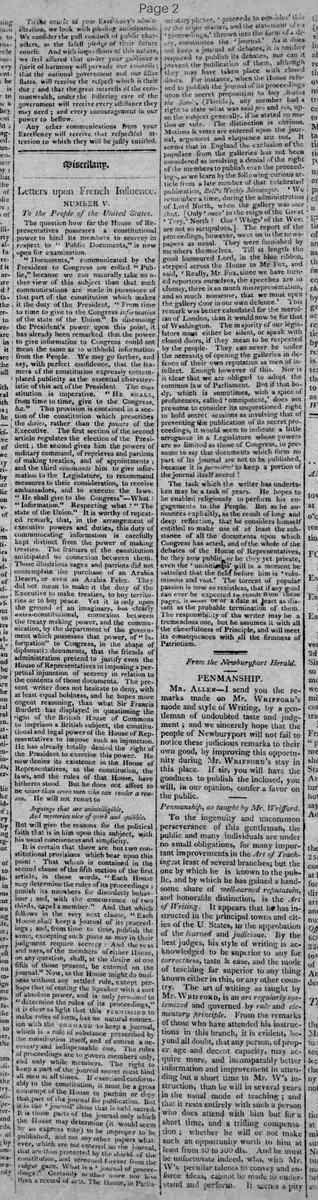
Letters upon French Influence.
NUMBER V.
To the People of the United States.
The question how far the House of Representatives possesses a constitutional power to bind its members to secrecy in respect to "Public Documents," is now open for examination.
"Documents," communicated by the President to Congress are called "Public," because we can naturally take no other view of this subject than that such communications are made in pursuance of that part of the constitution which makes it the duty of the President, "From time to time to give to the Congress information of the state of the Union." In discussing the President's power upon this point, it has already been remarked that the power to give information to Congress could not mean the same as to withhold information from the People. We may go farther, and say, with perfect confidence, that the framers of the constitution expressly contemplated publicity as the essential characteristic of this act of the President. The constitution is imperative. "He SHALL, from time to time, give to the Congress, &c." This provision is contained in a section of the constitution which prescribes the duties, rather than the powers of the Executive. The first section of the second article regulates the election of the President; the second gives him the powers of military command, of reprieves and pardons of making treaties, and of appointments; and the third commands him to give information to the Legislature, to recommend measures to their consideration, to receive ambassadors, and to execute the laws.
"He shall give to the Congress" —What? "Information." Respecting what? "The state of the Union." It is worthy of repeated remark, that, in the arrangement of executive powers and duties, this duty of communicating information is carefully kept distinct from the power of making treaties. The framers of the constitution anticipated no connexion between them. Those illustrious sages and patriots did not contemplate the purchase of an Arabia Desert, or even an Arabia Felix. They did not mean to make it the duty of the Executive to make treaties, to buy territories or to buy peace. Yet it is only upon the ground of an imaginary, but clearly extra-constitutional, connexion between the treaty making power, and the communication, by the department of the government which possesses that power, of "information" to Congress, in the shape of diplomatic documents, that the friends of administration pretend to justify even the House of Representatives in imposing a perpetual injunction of secrecy in relation to the contents of those documents. The present writer does not hesitate to deny, with at least equal boldness, and he hopes more cogent reasoning, than what Sir Francis Burdett has displayed in questioning the right of the British House of Commons to imprison a British subject, the constitutional and legal power of the House of Representatives to impose such an injunction. He has already totally denied the right of the President to exercise this power. He now denies its existence in the House of Representatives, as the constitution, the laws, and the rules of that House, have hitherto stood. But he does not affect to be wiser than seven men who can render a reason. He will not resort to
Arguings that are unintelligible,
And mysteries nice of quirk and quibble.
But will give the reasons for the political faith that is in him upon this subject, with his usual conciseness and simplicity.
It is certain that there are but two constitutional provisions which bear upon this point· That which is contained in the second clause of the fifth section of the first article, in these words, "Each House may determine the rules of its proceedings; punish its members for disorderly behaviour; and, with the concurrence of two thirds, expel a member." And that which follows in the very next clause, "Each House shall keep a journal of its proceedings; and, from time to time, publish the same, excepting such parts as may in their judgment require secrecy: And the yeas and nays, of the members of either House, on any question, shall, at the desire of one fifth of those present, be entered on the journal." Now, as the House might do business without any settled rule, except perhaps that of vesting the Speaker with a sort of absolute power, and is only permitted to "determine the rules of its proceedings," it is clear as light that this Permission to make rules of form, has no natural connexion with the command to keep a journal, which is a rule of substance prescribed by the constitution itself, and of course a necessary and indispensable one. The rules of proceedings are to govern members only, and only while members. The right to keep a part of the journal secret must bind all men at all times. If exercised conformably to the constitution, it must be a gross contempt of the House to purloin or copy that part of the journal for publication. But it is the 'journal' alone that is held sacred. It is those parts of the journal only which the House may determine (it would seem by an express vote) to be improper to be published, and not any other papers whatever, which are not entered on the journal, that are thus protected by the shield of the constitution, and screened forever from the vulgar gaze, What is a 'journal of proceedings? Certainly neither more nor less than a record of acts. The House, in Parliamentary phrase, 'proceeds to consider' this or the other matter, and the statement of its parliamentary phrase, 'proceeds to consider' this or the other matter, and the statement of its 'proceedings,' thrown into the form of a diary, constitutes the 'journal.' As it does not keep a journal of debates, it is neither required to publish its debates, nor can it prevent the publication of them, although they may have taken place with closed doors. For instance, when the House refused to publish the journal of its proceedings upon the secret proposition to buy Arabia the Sandy, (Florida), any member had a right to state what was said pro and con, upon the subject generally. if he stated no motion or vote. The distinction is obvious. Motions & votes are entered upon the journal, argument and eloquence are not. It seems that in England the exclusion of the populace from the galleries has not been considered as involving a denial of the right of the members to publish even the proceedings, as we learn by the following curious article from a late number of that celebrated publication, Bell's Weekly Messenger. We remember a time, during the administration of Lord North, when the gallery was once shut. Only 'once' in the reign of the Great Tory,' North? Our Whigs' of the West are not so scrupulous.] The report of the proceedings, however, went on in the newspapers as usual. They were furnished by members themselves. Till at length the good humoured Lord, in the blue ribbon, stepped across the House to Mr Fox, and said, Really, Mr. Fox, since we have turned reporters ourselves, the speeches are so clumsy, there is so much misrepresentation, and so much nonsense, that we must open the gallery door in our own defence.' This remark was better calculated for the meridian of London, than it would now be for that of Washington. The majority of our legislators must either be silent, or speak with closed doors, if they mean to be respected by the people. They can never be under the necessity of opening the galleries in defence of their own reputation as men of intellect. Enough however of this. Nor is it clear that we are obliged to adopt the common law of Parliament. But if that body, which is sometimes, with a spice of profaneness, called 'omnipotent,' does not presume to consider its unquestioned right to hold secret sessions as involving that of preventing the publication of its secret proceedings, it would seem to indicate a little arrogance in a Legislature whose powers are so limited as those of Congress, to presume to say that documents which form no part of its journal are not to be published, because it is permitted to keep a portion of the journal itself secret!
The task which the writer has undertaken may be a task of years. He hopes to be enabled religiously to perform his engagements to the People. But as he announces explicitly, as the result of long and deep reflection, that he considers himself entitled to make use of at least the substance of all the documents upon which Congress has acted, and of the whole of the debates of the House of Representatives, be they now public or be they yet private, even the 'uninitiated' will in a moment be satisfied that the field before him is voluminous and vast.' The torrent of popular passion is now so resistless, that if any good can ever be expected to result from these pages, it must be of a date at least as distant as the probable termination of them. The responsibility of the writer may be a tremendous one, but he assumes it with all the cheerfulness of Principle, and will meet its consequences with all the firmness of Patriotism.
What sub-type of article is it?
Constitutional
Foreign Affairs
Press Freedom
What keywords are associated?
Constitutional Secrecy
Public Documents
House Of Representatives
Presidential Information
Treaty Power
Journal Of Proceedings
Publication Rights
Diplomatic Documents
What entities or persons were involved?
House Of Representatives
President
Framers Of The Constitution
Friends Of Administration
Sir Francis Burdett
Lord North
Mr Fox
Editorial Details
Primary Topic
Constitutional Power Of House Of Representatives To Impose Secrecy On Public Documents
Stance / Tone
Strongly Against Secrecy And For Publicity Of Information
Key Figures
House Of Representatives
President
Framers Of The Constitution
Friends Of Administration
Sir Francis Burdett
Lord North
Mr Fox
Key Arguments
President's Duty To Give Information On State Of Union Implies Publicity To People
Communication Of Information Distinct From Treaty Making Power
House Rules Govern Proceedings But Journal Secrecy Limited To Journal Entries Only
Documents Not In Journal Not Protected By Secrecy Provisions
Members Free To Publish Debates And Substance Of Non Journal Documents
British Parliament Allows Publication Of Secret Proceedings Despite Closed Sessions