Thank you for visiting SNEWPapers!
Sign up free
San Andreas Independent
San Andreas, Calaveras County, California
What is this article about?
Extract from a July 8, 1859, U.S. State Department dispatch to the U.S. Minister in Berlin affirming the right of expatriation, full rights of naturalized citizens equivalent to native-born (except presidency), and limits on foreign claims over them, particularly regarding military service in German states.
Merged-components note: Merged sequential components as the text continues seamlessly from 'Rights of Naturalized Citizens' article; relabeled to 'domestic_news' as it discusses U.S. policy on citizenship and expatriation.
Clipping
OCR Quality
Full Text
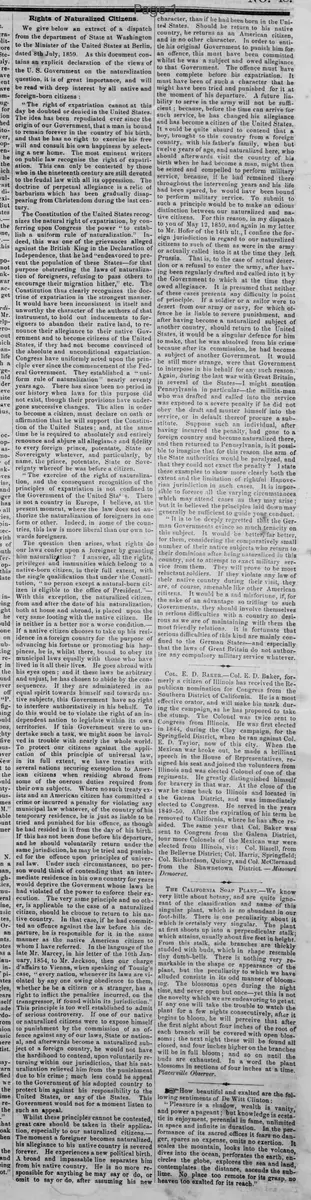
We give below an extract of a dispatch from the department of State at Washington to the Minister of the United States at Berlin, dated 8th July, 1859. As this document contains an explicit declaration of the views of the U. S. Government on the naturalization question, it is of great importance, and will be read with deep interest by all native and foreign-born citizens :
"The right of expatriation cannot at this day be doubted or denied in the United States. The idea has been repudiated ever since the origin of our Government, that a man is bound to remain forever in the country of his birth, and that he has no right to exercise his free will and consult his own happiness by selecting a new home. The most eminent writers on public law recognise the right of expatriation. This can only be contested by those who in the nineteenth century are still devoted to the feudal law with all its oppression. The doctrine of perpetual allegiance is a relic of barbarism which has been gradually disappearing from Christendom during the last century.
The Constitution of the United States recognizes the natural right of expatriation, by conferring upon Congress the power "to establish a uniform rule of naturalization." Indeed, this was one of the grievances alleged against the British King in the Declaration of Independence, that he had "endeavored to prevent the population of these States—for that purpose obstructing the laws of naturalization of foreigners, refusing to pass others to encourage their migration hither." etc. The Constitution thus clearly recognizes the doctrine of expatriation in the strongest manner.
It would have been inconsistent in itself and unworthy the character of the authors of that instrument. to hold out inducements to foreigners to abandon their native land, to renounce their allegiance to their native Government and to become citizens of the United States, if they had not become convinced of the absolute and unconditional expatriation.
Congress have uniformly acted upon the principle ever since the commencement of the Federal Government. They established a "uniform rule of naturalization" nearly seventy years ago. There has since been no period in our history when laws for this purpose did not exist, though their provisions have undergone successive changes. The alien in order to become a citizen, must declare on oath or affirmation that he will support the Constitution of the United States: and, at the same time he is required to absolutely and entirely renounce and abjure all allegiance and fidelity to every foreign prince, potentate, State or Sovereignty whatever, and particularly, by name, the prince, potentate, State or Sovereignty whereof he was before a citizen.
"The exercise of the right of naturalization, and the consequent recognition of the principles of expatriation is not confined to the Government of the United States. There is not a country in Europe, I believe, at the present moment, where the law does not authorize the naturalization of foreigners in one form or other. Indeed, in some of the countries, this law is more liberal than our own towards foreigners.
The question then arises, what rights do our laws confer upon a foreigner by granting him naturalization? I answer, all the rights, privileges and immunities which belong to a native-born citizen, in their full extent, with the single qualification that under the Constitution, "no person except a natural-born citizen is eligible to the office of President."— With this exception, the naturalized citizen, from and after the date of his naturalization. both at home and abroad, is placed upon the very same footing with the native citizen. He is neither in a better nor a worse condition.— If a native citizen chooses to take up his residence in a foreign country for the purpose of advancing his fortune or promoting his happiness, he is, whilst there, bound to obey its municipal laws equally with those who have lived in it all their lives. He goes abroad with his eyes open; and if these laws be arbitrary and unjust, he has chosen to abide by the consequences. If they are administered in an equal spirit towards himself and towards native subjects, this Government have no right to interfere authoritatively in his behalf. To do this would be to violate the right of an independent nation to legislate within its own territories. If this Government were to undertake such a task, we might soon be involved in trouble with nearly the whole world.
To protect our citizens against the application of this principle of universal law. in its full extent, we have treaties with several nations securing exemption to American citizens when residing abroad from some of the onerous duties required from their own subjects. Where no such treaty exists and an American citizen has committed a crime or incurred a penalty for violating any municipal law whatever, of the country of his temporary residence, he is just as liable to be tried and punished for his offence, as though he had resided in it from the day of his birth.
If this has not been done before his departure, and he should voluntarily return under the same jurisdiction, he may be tried and punished for the offence upon principles of universal law. Under such circumstances, no person would think of contending that an intermediate residence in his own country for years would deprive the Government whose laws he had violated of the power to enforce their execution. The very same principle and no other, is applicable to the case of a naturalized citizen, should he choose to return to his native country. In that case, if he had committed an offence against the law before his departure. he is responsible for it in the same manner as the native American citizen to whom I have referred. In the language of the late Mr. Marcy, in his letter of the 10th January, 1854, to Mr. Jackson, then our charge d'affaires to Vienna, when speaking of Tousig's case, "every nation, whenever its laws are violated by any one owing obedience to them, whether he be a citizen or a stranger, has a right to inflict the penalties incurred, on the transgressor, if found within its jurisdiction."
This principle is too well established to admit of serious controversy. If one of our native or naturalized citizens were to expose himself to punishment by the commission of an offence against any of our laws, State or national, and afterwards become a naturalized subject of a foreign country, he would not have the hardihood to contend, upon voluntarily returning within our jurisdiction, that his naturalization relieved him from the punishment due to his crime; much less could he appeal to the Government of his adopted country to protect him against his responsibility to the United States, or any of the States. This Government would not for a moment listen to such an appeal.
Whilst these principles cannot be contested, great care should be taken in their application, especially to our naturalized citizens.— The moment a foreigner becomes naturalized. his allegiance to his native country is severed forever. He experiences a new political birth. A broad and impassable line separates him from his native country. He is no more responsible for anything he may say or do, or omit to say or do, after assuming his new
character, than if he had been born in the United States. Should he return to his native country, he returns as an American citizen, and in no other character. In order to entitle his original Government to punish him for an offence, this must have been committed whilst he was a subject and owed allegiance to that Government. The offence must have been complete before his expatriation. It must have been of such a character that he might have been tried and punished for it at the moment of his departure. A future liability to serve in the army will not be sufficient ; because, before the time can arrive for such service, he has changed his allegiance and has become a citizen of the United States.
It would be quite absurd to contend that a boy, brought to this country from a foreign country, with his father's family, when but twelve years of age, and naturalized here, who should afterwards visit the country of his birth when he had become a man, might then be seized and compelled to perform military service, because, if he had remained there throughout the intervening years and his life had been spared, he would have been bound to perform military service. To submit to such a principle would be to make an odious distinction between our naturalized and native citizens. For this reason, in my dispatch to you of May 12, 1859, and again in my letter to Mr. Hofer of the 14th ult., I confine the foreign jurisdiction in regard to our naturalized citizens to such of them as were in the army or actually called into it at the time they left Prussia. That is, to the case of actual desertion or a refusal to enter the army, after having been regularly drafted and called into it by the Government to which at the time they owed allegiance. It is presumed that neither of these cases presents any difficulty in point of principle. If a soldier or a sailor were to desert from our army or navy, for which offence he is liable to severe punishment, and after having become a naturalized subject of another country, should return to the United States, it would be a singular defence for him to make, that he was absolved from his crime because after its commission, he had become a subject of another Government. It would be still more strange, were that Government to interpose in his behalf for any such reason.
Again, during the last war with Great Britain, in several of the States—I might mention Pennsylvania in particular—the militia-man who was drafted and called into the service was exposed to a severe penalty if he did not obey the draft and muster himself into the service, or in default thereof procure a substitute. Suppose such an individual, after having incurred the penalty, had gone to a foreign country and become naturalized there, and then returned to Pennsylvania, is it possible to imagine that for this reason the arm of the State authorities would be paralyzed, and that they could not exact the penalty? I state these examples to show more clearly both the extent and the limitation of rightful Hanoverian jurisdiction in such cases. It is impossible to foresee all the varying circumstances which may attend cases as they may arise; but it is believed the principles laid down may generally be sufficient to guide your conduct.
"It is to be deeply regretted that the German Governments evince so much tenacity on this subject. It would be better, far better. for them, considering the comparatively small number of their native subjects who return to their dominions after being naturalized in this country, not to attempt to exact military service from them. They will prove to be most reluctant soldiers. If they violate any law of their native country during their visit, they are, of course, amenable like other American citizens. It would be a sad misfortune, if, for the sake of an advantage so trifling to such Governments, they should involve themselves in serious difficulties with a country so desirous as we are of maintaining with them the most friendly relations. It is fortunate that serious difficulties of this kind are mainly confined to the German States—and especially that the laws of Great Britain do not authorize any compulsory military service whatever.
What sub-type of article is it?
What keywords are associated?
What entities or persons were involved?
Where did it happen?
Domestic News Details
Primary Location
Washington
Event Date
1859 07 08
Key Persons
Event Details
Extract from a U.S. State Department dispatch affirming the right of expatriation, full equality of naturalized citizens to native-born (except for presidency), severance of allegiance upon naturalization, and limitations on foreign governments' claims over naturalized U.S. citizens, particularly regarding pre-naturalization offenses and military service in German states.