Thank you for visiting SNEWPapers!
Sign up free
Virginia Argus
Richmond, Virginia
What is this article about?
Correspondence between US Consul William Lee in Bordeaux and the Prefect of the Gironde in October 1815 disputes the taxation of American merchant Mr. Andrews on his 'faculty and capital' for France's 100 million franc war contribution, arguing it violates treaties and laws of nations, as Andrews is not a French subject.
Clipping
OCR Quality
Full Text
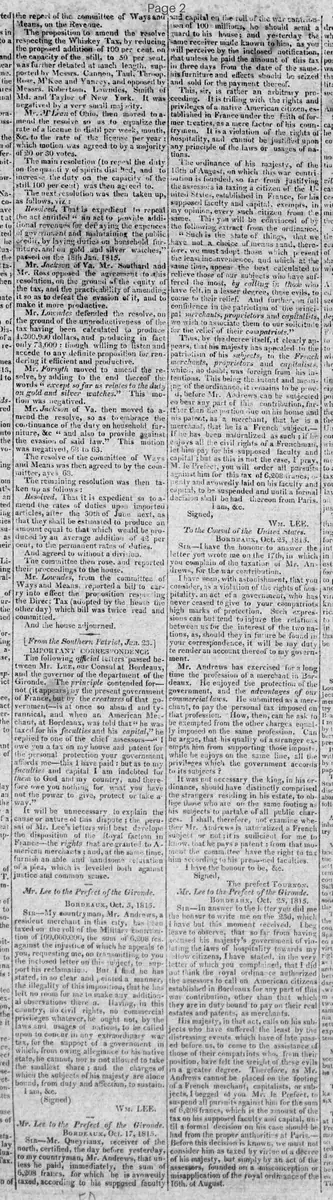
IMPORTANT CORRESPONDENCE
The following official letters passed between Mr. Lee, our Consul at Bordeaux, and the governor of the department of the Gironde. The principle contended for—not (it appears) by the present government of France, but by the creatures of that government—is at once so absurd and tyrannical, and when an American Merchant, at Bordeaux, was told that "he was taxed for his faculties and his capital," he replied to one of the chief assessors—“I owe you a tax on my house and patent for the personal protection your government affords me—this I have paid: but as to my faculties and capital I am indebted for them to God and my country, and therefore owe you nothing for what you have not the power to give, protect or take away."
It will be unnecessary, to explain the cause or nature of this dispute; the perusal of Mr. Lee's letters will best develope the disposition of the Royal faction in France—the rights that are granted to American merchants; and, at the same time, furnish an able and handsome refutation of a plea, which is levelled both against justice and common sense.
Mr. Lee to the Prefect of the Gironde.
Bordeaux, Oct. 5, 1815.
Sir—My countryman, Mr. Andrews, a resident merchant in this city, has been taxed on the roll of the Military contribution of 100,000,000, the sum of 6,208 francs, against the injustice of which he appeals to you, requesting me, on transmitting to you the inclosed letter on this subject, to support his reclamation. But I find he has stated, in so clear and pointed a manner, the illegality of this imposition, that he has left no room for me to make any additional observations there on. Having, in this country, no civil rights, no commercial privileges whatever, he ought not, by the laws and usages of nations, to be called upon to concur in any extraordinary war tax, for the support of a government in which, from owing allegiance to his native state, he cannot, nor is not allowed to take the smallest share; and the charges of which the subjects of his majesty are alone bound, from duty and affection, to sustain.
I am, &c.
(Signed) WM. LEE.
Mr. Lee to the Prefect of the Gironde.
Bordeaux, Oct. 17, 1815.
Sir—Mr. Queyriaux, receiver of the north, certified, the day before yesterday, to my countryman, Mr. Andrews, that unless he paid, immediately, the sum of 6,208 francs, for which he is avowedly taxed, according to his supposed faculty and capital on the roll of the war contribution of 100 millions, he should send a guard to his house; and yesterday the same receiver made known to him, as you will perceive by the inclosed notification, that unless he paid the amount of this tax in three days from the date of the same, his furniture and effects should be seized and sold for the payment thereof.
This, sir, is rather an arbitrary proceeding. It is trifling with the rights and privileges of a native American citizen, established in France under the faith of former treaties, as a mere factor of his countrymen. It is a violation of the rights of hospitality, and cannot be justified upon any principle of the laws or usages of nations.
The ordinance of his majesty, of the 16th of August, on which this war contribution is founded, so far from justifying the assessors in taxing a citizen of the United States, established in France, for his supposed faculty and capital, exempts, in my opinion, every such citizen from the same. This you will be convinced of by the following extract from the ordinance.
"Such is the state of things, that we have not a choice of means: and, therefore, we must adopt those which present the least inconvenience, and which at the same time, appear the best calculated to relieve those of our subjects who have suffered the most, by calling in those who have felt in a lesser degree, these evils, to come to their relief. And further, on full confidence in the patriotism of the principal merchants, proprietors and capitalists, we wish to associate them to our solicitude for the relief of their compatriots."
Thus, by the decree itself, it clearly appears, that his majesty has appealed to the patriotism of his subjects, to the French merchants, proprietors and capitalists, which, no doubt, was foreign from his intentions. This being the intent and meaning of the ordinance, it remains to be proved, before Mr. Andrews can be subjected to bear any part of this contribution, further than the portion due on his house and his patent, as a merchant, that he is a merchant, that he is a French subject.—If he has been naturalized as such: if he enjoys all the civil rights of a Frenchman, let him pay for his supposed faculty and capital: but as this is not the case, I pray, M. le Prefect, you will order all pursuits against him for this tax of 6,208 francs, openly and avowedly laid on his faculty and capital, to be suspended until a formal decision shall be had thereon from Paris.
I am, &c.
Signed, WM. LEE.
To the Consul of the United States.
Bordeaux, Oct. 25, 1815.
Sir—I have the honour to answer the letter you wrote me on the 17th, in which you complain of the taxation of Mr. Andrews, for the war contribution.
I have seen, with astonishment, that you consider, as a violation of the rights of hospitality, an act of a government, who has never ceased to give to your compatriots high marks of protection. Such expressions can but tend to injure the relations between us for the interest of the two nations, as, should they in future be found in your correspondence, it will be my duty to render an account thereof to my government.
Mr. Andrews has exercised for a long time the profession of a merchant in Bordeaux. He enjoyed the protection of the government, and the advantages of our commercial laws. He submitted as a merchant, to pay the personal tax imposed on that profession. How, then, can he ask to be exempted from the other charges equally imposed on the same profession. Can he argue, that his quality of a stranger exempts him from supporting those imposts, while he enjoys on the same line, all the privileges which the government accords to its subjects?
It was not necessary the king, in his ordinance, should have distinctly comprised the strangers residing in his estate, to oblige those who are on the same footing as his subjects to partake of all public charges. I shall, therefore, not examine whether Mr. Andrews is naturalized a French subject or not; it is sufficient for me to know, that he pays a patent: from that moment the committee have the right to tax him according to his presumed faculties.
I have the honour to be, &c.
Signed, The prefect Tounnon.
Mr. Lee to the Prefect of the Gironde.
Bordeaux, Oct. 25, 1815.
Sir—In answer to the letter you did me the honour to write me on the 25th, which I have but this moment received. I beg leave to observe, that so far from having accused his majesty's government of violating the laws of hospitality towards my fellow citizens, I have stated, in the very letter of which you complained, that I did not think the royal ordinance authorized the assessors to call on American citizens established in Bordeaux for any part of this war contribution, other than that which they are in duty bound to pay on their real estates and patents, as merchants.
His majesty, in that act, calls on his subjects who have suffered the least by the distressing events which have of late passed before us, to come to the assistance of those of their compatriots who, from their position, have felt the weight of these evils in a greater degree. Therefore, as Mr. Andrews cannot be placed on the footing of a French merchant, capitalist, or subject, I begged of you Mr. le Prefect, to suspend all pursuits against him for the sum of 6,208 francs, which is the amount of the tax on his supposed faculty and capital, until a formal decision on his case should be had from the proper authorities at Paris.—Before this decision is known, we must not consider him as taxed by virtue of a decree of his majesty, but simply by an act of the assessors, founded on a misconception or misapplication of the royal ordinance of the 16th. of August.
That you have a right to tax Mr. Andrews on his real estate, the house in which he lives, and his patent as a merchant, we do not question; we only contend, that you cannot tax him for his supposed faculty and capital, towards these war contributions, with any more justice than you can demand of him personal military services; and that for these reasons:
1st. He is not a French subject, but an American citizen.
2d. He is a American and not a French capitalist. the bulk of his fortune for which he is taxed being deposited in his own country, and not in France.
3d. He has no civil rights in France, not having the power to vote in any election, nor is eligible to any office.
4th. He has no French Commercial privileges: he cannot own a French ship nor can he be elected to any commercial offices—and on all the business he transacts with his own country, he pays your discriminating duties, as well on his ships as on their cargoes, &c.
5th. That as an American citizen, settled in Bordeaux as agent for American commercial houses, he cannot, by the laws of his own country, take the smallest share, directly or indirectly, in any war in which France is or may be engaged.
This being the actual position of Mr. Andrews, it was from duty that I supported his reclamations; and I trust it will be seen, that although he enjoys the protection of that government to a certain degree, he is far from partaking of all the advantages of the commercial laws of France; and that, consequently he ought to be exempted from many of the charges to which French merchants are liable, with whom he cannot be assimilated.
The laws of France draw a very distinct line between the subject and the foreigner who inhabits the country, and thus points sufficiently clear to the distinction which ought to be made between them in the levying of all war contributions. All the real estates which the citizens of the United States, hold in Bordeaux for the convenience of their commerce, or otherwise, may be imposed in the same ratio as these of the natives; and their patents as merchants, are, in the same manner, liable to augmentation; but when you touch on taxing their supposed faculty and capital you go further than the laws of France, the law of nations or even the royal ordinance, on which you found this imposition, will justify.
Thus you will observe, Mr. le Prefect, that the mode of apportioning and collecting this war contribution in the case before us, involves a question of the highest interest to American citizens, established in France as well as to French subjects established in the United States. I, therefore, hope, that you will have the goodness to present the same, with all its points and bearings, to the minister whose province it is to decide thereon, that we may know in future on what footing the American merchants established in Bordeaux is to be considered by your administration, in relation to his own government and to that of his majesty. I have the honour to be with highest consideration, &c.
Signed, WM. LEE.
What sub-type of article is it?
What keywords are associated?
What entities or persons were involved?
Where did it happen?
Foreign News Details
Primary Location
Bordeaux, Gironde, France
Event Date
October 1815
Key Persons
Outcome
ongoing dispute; lee requests suspension of tax collection on andrews' faculty and capital (6,208 francs) pending decision from paris; prefect defends taxation based on merchant patent.
Event Details
US Consul William Lee protests the taxation of American merchant Mr. Andrews on his supposed faculty and capital for France's 100 million franc war contribution under the royal ordinance of August 16, 1815. Lee argues Andrews, as a non-naturalized foreigner without full civil or commercial rights, is exempt beyond taxes on his house and patent, citing laws of nations and treaties. The Prefect counters that paying a merchant patent subjects Andrews to all related charges, warning against Lee's language on hospitality.