Thank you for visiting SNEWPapers!
Sign up free
Letter to Editor
April 13, 1769
The Virginia Gazette
Richmond, Williamsburg, Richmond County, Virginia
What is this article about?
In 1769, 'A British American' praises an English pamphlet on British-colonial relations and begins serializing it, arguing that Parliament cannot tax unrepresented colonies without violating charters and British rights, urging a just permanent system.
Clipping
OCR Quality
98%
Excellent
Full Text
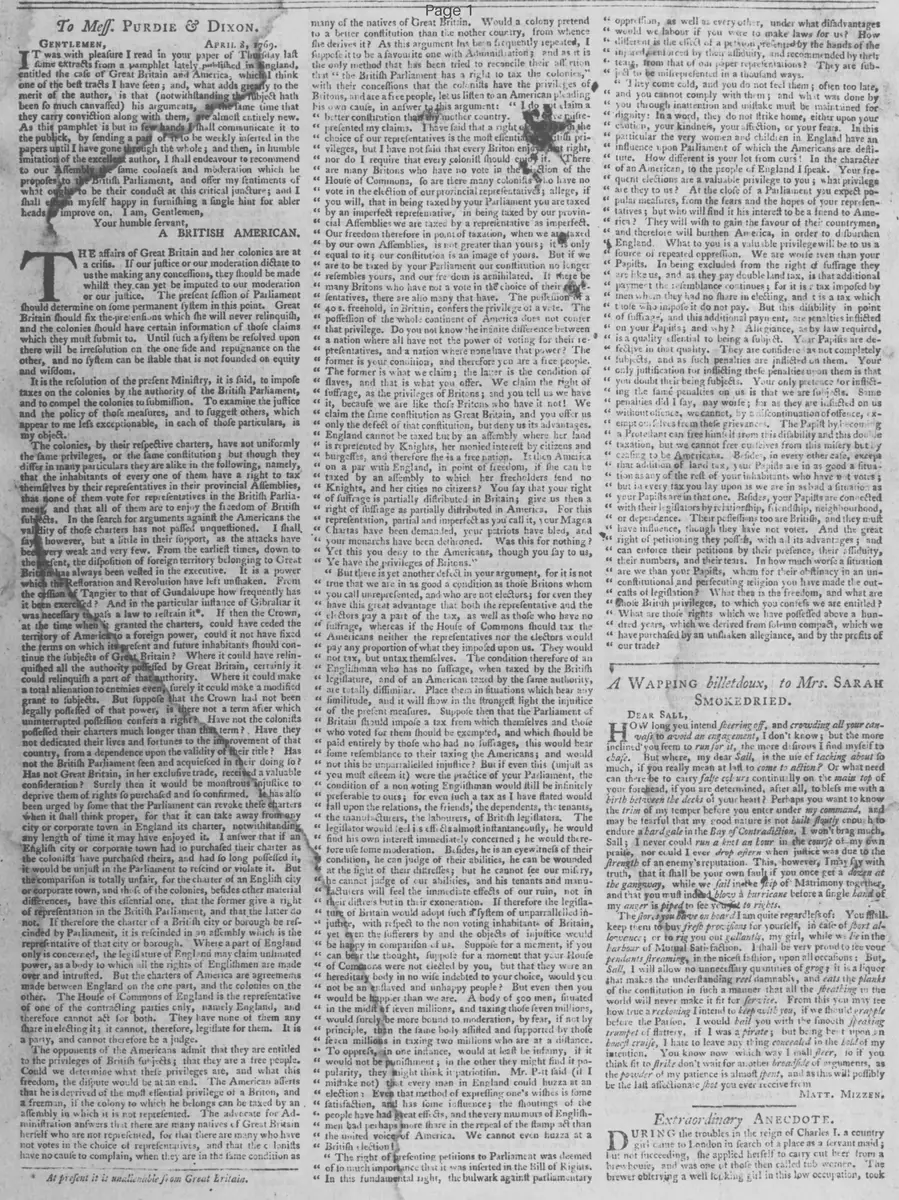
To Mess. Purdie & Dixon.
Gentlemen,
April 8, 1769.
It was with pleasure I read in your paper of Thursday last some extracts from a pamphlet lately published in England, entitled the Case of Great Britain and America, which I think one of the best tracts I have seen; and, what adds greatly to the merit of the author, is that (notwithstanding the subject hath been so much canvassed) his arguments, at the same time that they carry conviction along with them, are almost entirely new.
As this pamphlet is but in few hands I shall communicate it to the publick, by sending a part of it to be weekly inserted in the papers until I have gone through the whole; and then, in humble imitation of the excellent author, I shall endeavour to recommend to our Assembly the same coolness and moderation which he proposes to the British Parliament, and offer my sentiments of what ought to be their conduct at this critical juncture; and I shall esteem myself happy in furnishing a single hint for abler heads to improve on. I am, Gentlemen,
Your humble servant,
A BRITISH AMERICAN.
The affairs of Great Britain and her colonies are at a crisis. If our justice or our moderation dictate to us the making any concessions, they should be made whilst they can yet be imputed to our moderation or our justice. The present session of Parliament should determine on some permanent system in this point. Great Britain should fix the pretensions which she will never relinquish, and the colonies should have certain information of those claims which they must submit to. Until such a system be resolved upon there will be irresolution on the one side and repugnance on the other, and no system can be stable that is not founded on equity and wisdom.
It is the resolution of the present Ministry, it is said, to impose taxes on the colonies by the authority of the British Parliament, and to compel the colonies to submission. To examine the justice and the policy of those measures, and to suggest others, which appear to me less exceptionable, in each of those particulars, is my object.
The colonies, by their respective charters, have not uniformly the same privileges, or the same constitution; but though they differ in many particulars they are alike in the following, namely, that the inhabitants of every one of them have a right to tax themselves by their representatives in their provincial Assemblies, that none of them vote for representatives in the British Parliament, and that all of them are to enjoy the freedom of British subjects. In the search for arguments against the Americans the validity of those charters has not passed unquestioned. I shall say, however, but a little in their support, as the attacks have been very weak and very few. From the earliest times, down to the present, the disposition of foreign territory belonging to Great Britain has always been vested in the executive. It is a power which the Restoration and Revolution have left unshaken. From the cession of Tangier to that of Guadaloupe how frequently has it been exercised? And in the particular instance of Gibraltar it was necessary to pass a law to restrain it. If then the Crown, at the time when it granted the charters, could have ceded the territory of America to a foreign power, could it not have fixed the terms on which its present and future inhabitants should continue the subjects of Great Britain? Where it could have relinquished all the authority possessed by Great Britain, certainly it could relinquish a part of that authority. Where it could make a total alienation to enemies even, surely it could make a modified grant to subjects. But suppose that the Crown had not been legally possessed of that power, is there not a term after which uninterrupted possession confers a right? Have not the colonists possessed their charters much longer than that term? Have they not dedicated their lives and fortunes to the improvement of that country, from a dependence upon the validity of their title? Has not the British Parliament seen and acquiesced in their doing so? Has not Great Britain, in her exclusive trade, received a valuable consideration? Surely then it would be monstrous injustice to deprive them of rights so purchased and so confirmed. It has also been urged by some that the Parliament can revoke these charters when it shall think proper, for that it can take away from any city or corporate town in England its charter, notwithstanding any length of time it may have enjoyed it. I answer that if an English city or corporate town had so purchased their charter as the colonists have purchased theirs, and had so long possessed it, it would be unjust in the Parliament to rescind or violate it. But the comparison is totally unfair, for the charter of an English city or corporate town, and those of the colonies, besides other material differences, have this essential one, that the former give a right of representation in the British Parliament, and that the latter do not. If therefore the charter of a British city or borough be rescinded by Parliament, it is rescinded in an assembly which is the representative of that city or borough. Where a part of England only is concerned, the legislature of England may claim unlimited power, as a body to which all the rights of Englishmen are made over and intrusted. But the charters of America are agreements made between England on the one part, and the colonies on the other. The House of Commons of England is the representative of one of the contracting parties only, namely England, and therefore cannot act for both. They have none of them any share in electing it; it cannot, therefore, legislate for them. It is a party, and cannot therefore be a judge.
The opponents of the Americans admit that they are entitled to the privileges of British subjects; that they are a free people. Could we determine what these privileges are, and what this freedom, the dispute would be at an end. The American asserts that he is deprived of the most essential privilege of a Briton, and a freeman, if the colony to which he belongs can be taxed by an assembly in which it is not represented. The advocate for Administration answers that there are many natives of Great Britain herself who are not represented, for that there are many who have not votes in the choice of representatives, and that the colonists have no cause to complain, when they are in the same condition as many of the natives of Great Britain. Would a colony pretend to a better constitution than the mother country, from whence she derives it? As this argument has been frequently repeated, I suppose it to be a favourite one with Administration; and as it is the only method that has been tried to reconcile their assertion that the British Parliament has a right to tax the colonies, with their concessions that the colonists have the privileges of Britons, and are a free people, let us listen to an American pleading his own cause, in answer to this argument: "I do not claim a better constitution than my mother country. You have misrepresented my claims. I have said that a right to the choice of our representatives is the most essential privilege, but I have not said that every Briton enjoys that right, nor do I require that every colonist should enjoy it. There are many Britons who have no vote in the choice of the House of Commons, so are there many colonists who have no vote in the election of our provincial representatives; allege, if you will, that in being taxed by your Parliament you are taxed by an imperfect representative, in being taxed by our provincial Assemblies we are taxed by a representative as imperfect. Our freedom therefore in point of taxation, when we are taxed by our own Assemblies, is not greater than yours; it is only equal to it; our constitution is an image of yours. But if we are to be taxed by your Parliament our constitution no longer resembles yours, and our freedom is annihilated. If there be many Britons who have not a vote in the choice of their representatives, there are also many that have. The possession of a 40 s. freehold, in Britain, confers the privilege of a vote. The possession of the whole continent of America does not confer that privilege. Do you not know the infinite difference between a nation where all have not the power of voting for their representatives, and a nation where none have that power? The former is your condition, and therefore you are a free people. The former is what we claim; the latter is the condition of slaves, and that is what you offer. We claim the right of suffrage, as the privileges of Britons; and you tell us we have it, because we are like those Britons who have it not! We claim the same constitution as Great Britain, and you offer us only the defect of that constitution, but deny us its advantages. England cannot be taxed but by an assembly where her land is represented by Knights, her monied interest by citizens and burgees, and therefore she is a free nation. Is then America on a par with England, in point of freedom, if she can be taxed by an assembly to which her freeholders send no Knights, and her cities no citizens? You say that your right of suffrage is partially distributed in Britain; give us then a right of suffrage as partially distributed in America. For this representation, partial and imperfect as you call it, your Magna Charta has been demanded, your patriots have bled, and your monarchs have been dethroned. Was this for nothing? Yet this you deny to the Americans, though you say to us, Ye have the privileges of Britons."
But there is yet another defect in your argument, for it is not true that we are in as good a condition as those Britons whom you call unrepresented, and who are not electors; for even they have this great advantage that both the representative and the electors pay a part of the tax, as well as those who have no suffrage, whereas if the House of Commons should tax the Americans neither the representatives nor the electors would pay any proportion of what they imposed upon us. They would not tax, but untax themselves. The condition therefore of an Englishman who has no suffrage, when taxed by the British legislature, and of an American taxed by the same authority, are totally dissimilar. Place them in situations which bear any similitude, and it will show in the strongest light the injustice of the present measures. Suppose then that the Parliament of Britain should impose a tax from which themselves and those who voted for them should be exempted, and which should be paid entirely by those who had no suffrages, this would bear one resemblance to their taxing the Americans; and would not this be unparallelled injustice? But if even this (unjust as you must esteem it) were the practice of your Parliament, the condition of a non-voting Englishman would still be infinitely preferable to ours; for even such a tax as I have stated would fall upon the relations, the friends, the dependents, the tenants, the manufacturers, the labourers, of British legislators. The legislator would feel its effects almost instantaneously, he would find his own interest immediately concerned; he would therefore use some moderation. Besides, he is an eyewitness of their condition, he can judge of their abilities, he can be wounded at the sight of their distresses; but he cannot see our misery, he cannot judge of our abilities, and his tenants and manufacturers will feel the immediate effects of our ruin, not in their distress but in their exoneration. If therefore the legislature of Britain would adopt such a system of unparallelled injustice, with respect to the non-voting inhabitants of Britain, yet even the sufferers by and the objects of injustice would be happy in comparison of us. Suppose for a moment, if you can bear the thought, suppose for a moment that your House of Commons were not elected by you, but that they were an hereditary body in no wise indebted to your choice, would you not be an enslaved and unhappy people? But even then you would be happier than we are. A body of 500 men, intrusted in the midst of eleven millions, and taxing those eleven millions, would surely be more bound to moderation, by fear, if not by principle, than the same body assisted and supported by those eleven millions in taxing two millions who are at a distance. To oppress, in one instance, would at least be infamy, if it would not be punishment; in the other they might find it popularity, they might think it patriotism. Mr. Pitt said (if I mistake not) that every man in England could huzza at an election. Even that method of expressing one's wishes is some satisfaction, and has some influence; the shoutings of the people have had great effects, and the very murmurs of Englishmen had perhaps more share in the repeal of the stamp act than the united voice of America. We cannot even huzza at a British election!
The right of presenting petitions to Parliament was deemed of so much importance that it was inserted in the Bill of Rights. In this fundamental right, the bulwark against parliamentary oppression, as well as every other, under what disadvantages would we labour if you were to make laws for us? How different is the effect of a petition presented by the hands of the injured, enforced by their assiduity, and recommended by their tears, from that of cold paper representations? They are subject to be misrepresented in a thousand ways. They come cold, and you do not feel them; often too late, and you cannot comply with them; and what was done by you through inattention and mistake must be maintained for dignity: In a word, they do not strike home, either upon your conscience, your kindness, your affection, or your fears. In this particular the very women and children in England have an influence upon Parliament of which the Americans are destitute. How different is your lot from ours! In the character of an American, to the people of England I speak. Your frequent elections are a valuable privilege to you; what privilege are they to us? At the close of a Parliament you expect popular measures, from the fears and the hopes of your representatives; but who will find it his interest to be a friend to America? They will wish to gain the favour of their countrymen, and therefore will burthen America, in order to disburthen England. What to you is a valuable privilege will be to us a source of repeated oppression. We are worse even than your Papists. In being excluded from the right of suffrage they are like us, and as they pay double land tax, in that additional payment the resemblance continues; for it is a tax imposed by men whom they had no share in electing, and it is a tax which those who impose it do not pay. But this disability in point of suffrage, and this additional payment, are penalties inflicted on your Papists; and why? Allegiance, as by law required, is a quality essential to being a subject. Your Papists are defective in that quality. They are considered as not completely subjects, and as such penalties are inflicted on them. Your only justification for inflicting these penalties upon them is that you doubt their being subjects. Your only pretence for inflicting the same penalties on us is that we are subjects. Same penalties did I say, nay worse; for as they are inflicted on us without offence, we cannot, by a discontinuance of offence, exempt ourselves from these grievances. The Papist by becoming a Protestant can free himself from this disability and this double taxation, but we cannot free ourselves from this misery but by ceasing to be Americans. Besides, in every other case, except that addition of land tax, your Papists are in as good a situation as any of the rest of your inhabitants who have no votes; but in every tax you lay upon us we are in as bad a situation as your Papists are in that one. Besides, your Papists are connected with their legislators by relationship, friendship, neighbourhood, or dependence. Their persons too are British, and they must have influence, though they have not votes. And the great right of petitioning they possess, with all its advantages; and can enforce their petitions by their presence, their assiduity, their numbers, and their tears. In how much worse a situation are we than your Papists, whom for their obstinacy in an unconstitutional and persecuting religion you have made the outcasts of legislation? What then is the freedom, and what are those British privileges, to which you confess we are entitled? What are those rights which we have possessed above a hundred years, which we derived from solemn compact, which we have purchased by an unshaken allegiance, and by the profits of our trade?
At present it is unalienable from Great Britain.
Gentlemen,
April 8, 1769.
It was with pleasure I read in your paper of Thursday last some extracts from a pamphlet lately published in England, entitled the Case of Great Britain and America, which I think one of the best tracts I have seen; and, what adds greatly to the merit of the author, is that (notwithstanding the subject hath been so much canvassed) his arguments, at the same time that they carry conviction along with them, are almost entirely new.
As this pamphlet is but in few hands I shall communicate it to the publick, by sending a part of it to be weekly inserted in the papers until I have gone through the whole; and then, in humble imitation of the excellent author, I shall endeavour to recommend to our Assembly the same coolness and moderation which he proposes to the British Parliament, and offer my sentiments of what ought to be their conduct at this critical juncture; and I shall esteem myself happy in furnishing a single hint for abler heads to improve on. I am, Gentlemen,
Your humble servant,
A BRITISH AMERICAN.
The affairs of Great Britain and her colonies are at a crisis. If our justice or our moderation dictate to us the making any concessions, they should be made whilst they can yet be imputed to our moderation or our justice. The present session of Parliament should determine on some permanent system in this point. Great Britain should fix the pretensions which she will never relinquish, and the colonies should have certain information of those claims which they must submit to. Until such a system be resolved upon there will be irresolution on the one side and repugnance on the other, and no system can be stable that is not founded on equity and wisdom.
It is the resolution of the present Ministry, it is said, to impose taxes on the colonies by the authority of the British Parliament, and to compel the colonies to submission. To examine the justice and the policy of those measures, and to suggest others, which appear to me less exceptionable, in each of those particulars, is my object.
The colonies, by their respective charters, have not uniformly the same privileges, or the same constitution; but though they differ in many particulars they are alike in the following, namely, that the inhabitants of every one of them have a right to tax themselves by their representatives in their provincial Assemblies, that none of them vote for representatives in the British Parliament, and that all of them are to enjoy the freedom of British subjects. In the search for arguments against the Americans the validity of those charters has not passed unquestioned. I shall say, however, but a little in their support, as the attacks have been very weak and very few. From the earliest times, down to the present, the disposition of foreign territory belonging to Great Britain has always been vested in the executive. It is a power which the Restoration and Revolution have left unshaken. From the cession of Tangier to that of Guadaloupe how frequently has it been exercised? And in the particular instance of Gibraltar it was necessary to pass a law to restrain it. If then the Crown, at the time when it granted the charters, could have ceded the territory of America to a foreign power, could it not have fixed the terms on which its present and future inhabitants should continue the subjects of Great Britain? Where it could have relinquished all the authority possessed by Great Britain, certainly it could relinquish a part of that authority. Where it could make a total alienation to enemies even, surely it could make a modified grant to subjects. But suppose that the Crown had not been legally possessed of that power, is there not a term after which uninterrupted possession confers a right? Have not the colonists possessed their charters much longer than that term? Have they not dedicated their lives and fortunes to the improvement of that country, from a dependence upon the validity of their title? Has not the British Parliament seen and acquiesced in their doing so? Has not Great Britain, in her exclusive trade, received a valuable consideration? Surely then it would be monstrous injustice to deprive them of rights so purchased and so confirmed. It has also been urged by some that the Parliament can revoke these charters when it shall think proper, for that it can take away from any city or corporate town in England its charter, notwithstanding any length of time it may have enjoyed it. I answer that if an English city or corporate town had so purchased their charter as the colonists have purchased theirs, and had so long possessed it, it would be unjust in the Parliament to rescind or violate it. But the comparison is totally unfair, for the charter of an English city or corporate town, and those of the colonies, besides other material differences, have this essential one, that the former give a right of representation in the British Parliament, and that the latter do not. If therefore the charter of a British city or borough be rescinded by Parliament, it is rescinded in an assembly which is the representative of that city or borough. Where a part of England only is concerned, the legislature of England may claim unlimited power, as a body to which all the rights of Englishmen are made over and intrusted. But the charters of America are agreements made between England on the one part, and the colonies on the other. The House of Commons of England is the representative of one of the contracting parties only, namely England, and therefore cannot act for both. They have none of them any share in electing it; it cannot, therefore, legislate for them. It is a party, and cannot therefore be a judge.
The opponents of the Americans admit that they are entitled to the privileges of British subjects; that they are a free people. Could we determine what these privileges are, and what this freedom, the dispute would be at an end. The American asserts that he is deprived of the most essential privilege of a Briton, and a freeman, if the colony to which he belongs can be taxed by an assembly in which it is not represented. The advocate for Administration answers that there are many natives of Great Britain herself who are not represented, for that there are many who have not votes in the choice of representatives, and that the colonists have no cause to complain, when they are in the same condition as many of the natives of Great Britain. Would a colony pretend to a better constitution than the mother country, from whence she derives it? As this argument has been frequently repeated, I suppose it to be a favourite one with Administration; and as it is the only method that has been tried to reconcile their assertion that the British Parliament has a right to tax the colonies, with their concessions that the colonists have the privileges of Britons, and are a free people, let us listen to an American pleading his own cause, in answer to this argument: "I do not claim a better constitution than my mother country. You have misrepresented my claims. I have said that a right to the choice of our representatives is the most essential privilege, but I have not said that every Briton enjoys that right, nor do I require that every colonist should enjoy it. There are many Britons who have no vote in the choice of the House of Commons, so are there many colonists who have no vote in the election of our provincial representatives; allege, if you will, that in being taxed by your Parliament you are taxed by an imperfect representative, in being taxed by our provincial Assemblies we are taxed by a representative as imperfect. Our freedom therefore in point of taxation, when we are taxed by our own Assemblies, is not greater than yours; it is only equal to it; our constitution is an image of yours. But if we are to be taxed by your Parliament our constitution no longer resembles yours, and our freedom is annihilated. If there be many Britons who have not a vote in the choice of their representatives, there are also many that have. The possession of a 40 s. freehold, in Britain, confers the privilege of a vote. The possession of the whole continent of America does not confer that privilege. Do you not know the infinite difference between a nation where all have not the power of voting for their representatives, and a nation where none have that power? The former is your condition, and therefore you are a free people. The former is what we claim; the latter is the condition of slaves, and that is what you offer. We claim the right of suffrage, as the privileges of Britons; and you tell us we have it, because we are like those Britons who have it not! We claim the same constitution as Great Britain, and you offer us only the defect of that constitution, but deny us its advantages. England cannot be taxed but by an assembly where her land is represented by Knights, her monied interest by citizens and burgees, and therefore she is a free nation. Is then America on a par with England, in point of freedom, if she can be taxed by an assembly to which her freeholders send no Knights, and her cities no citizens? You say that your right of suffrage is partially distributed in Britain; give us then a right of suffrage as partially distributed in America. For this representation, partial and imperfect as you call it, your Magna Charta has been demanded, your patriots have bled, and your monarchs have been dethroned. Was this for nothing? Yet this you deny to the Americans, though you say to us, Ye have the privileges of Britons."
But there is yet another defect in your argument, for it is not true that we are in as good a condition as those Britons whom you call unrepresented, and who are not electors; for even they have this great advantage that both the representative and the electors pay a part of the tax, as well as those who have no suffrage, whereas if the House of Commons should tax the Americans neither the representatives nor the electors would pay any proportion of what they imposed upon us. They would not tax, but untax themselves. The condition therefore of an Englishman who has no suffrage, when taxed by the British legislature, and of an American taxed by the same authority, are totally dissimilar. Place them in situations which bear any similitude, and it will show in the strongest light the injustice of the present measures. Suppose then that the Parliament of Britain should impose a tax from which themselves and those who voted for them should be exempted, and which should be paid entirely by those who had no suffrages, this would bear one resemblance to their taxing the Americans; and would not this be unparallelled injustice? But if even this (unjust as you must esteem it) were the practice of your Parliament, the condition of a non-voting Englishman would still be infinitely preferable to ours; for even such a tax as I have stated would fall upon the relations, the friends, the dependents, the tenants, the manufacturers, the labourers, of British legislators. The legislator would feel its effects almost instantaneously, he would find his own interest immediately concerned; he would therefore use some moderation. Besides, he is an eyewitness of their condition, he can judge of their abilities, he can be wounded at the sight of their distresses; but he cannot see our misery, he cannot judge of our abilities, and his tenants and manufacturers will feel the immediate effects of our ruin, not in their distress but in their exoneration. If therefore the legislature of Britain would adopt such a system of unparallelled injustice, with respect to the non-voting inhabitants of Britain, yet even the sufferers by and the objects of injustice would be happy in comparison of us. Suppose for a moment, if you can bear the thought, suppose for a moment that your House of Commons were not elected by you, but that they were an hereditary body in no wise indebted to your choice, would you not be an enslaved and unhappy people? But even then you would be happier than we are. A body of 500 men, intrusted in the midst of eleven millions, and taxing those eleven millions, would surely be more bound to moderation, by fear, if not by principle, than the same body assisted and supported by those eleven millions in taxing two millions who are at a distance. To oppress, in one instance, would at least be infamy, if it would not be punishment; in the other they might find it popularity, they might think it patriotism. Mr. Pitt said (if I mistake not) that every man in England could huzza at an election. Even that method of expressing one's wishes is some satisfaction, and has some influence; the shoutings of the people have had great effects, and the very murmurs of Englishmen had perhaps more share in the repeal of the stamp act than the united voice of America. We cannot even huzza at a British election!
The right of presenting petitions to Parliament was deemed of so much importance that it was inserted in the Bill of Rights. In this fundamental right, the bulwark against parliamentary oppression, as well as every other, under what disadvantages would we labour if you were to make laws for us? How different is the effect of a petition presented by the hands of the injured, enforced by their assiduity, and recommended by their tears, from that of cold paper representations? They are subject to be misrepresented in a thousand ways. They come cold, and you do not feel them; often too late, and you cannot comply with them; and what was done by you through inattention and mistake must be maintained for dignity: In a word, they do not strike home, either upon your conscience, your kindness, your affection, or your fears. In this particular the very women and children in England have an influence upon Parliament of which the Americans are destitute. How different is your lot from ours! In the character of an American, to the people of England I speak. Your frequent elections are a valuable privilege to you; what privilege are they to us? At the close of a Parliament you expect popular measures, from the fears and the hopes of your representatives; but who will find it his interest to be a friend to America? They will wish to gain the favour of their countrymen, and therefore will burthen America, in order to disburthen England. What to you is a valuable privilege will be to us a source of repeated oppression. We are worse even than your Papists. In being excluded from the right of suffrage they are like us, and as they pay double land tax, in that additional payment the resemblance continues; for it is a tax imposed by men whom they had no share in electing, and it is a tax which those who impose it do not pay. But this disability in point of suffrage, and this additional payment, are penalties inflicted on your Papists; and why? Allegiance, as by law required, is a quality essential to being a subject. Your Papists are defective in that quality. They are considered as not completely subjects, and as such penalties are inflicted on them. Your only justification for inflicting these penalties upon them is that you doubt their being subjects. Your only pretence for inflicting the same penalties on us is that we are subjects. Same penalties did I say, nay worse; for as they are inflicted on us without offence, we cannot, by a discontinuance of offence, exempt ourselves from these grievances. The Papist by becoming a Protestant can free himself from this disability and this double taxation, but we cannot free ourselves from this misery but by ceasing to be Americans. Besides, in every other case, except that addition of land tax, your Papists are in as good a situation as any of the rest of your inhabitants who have no votes; but in every tax you lay upon us we are in as bad a situation as your Papists are in that one. Besides, your Papists are connected with their legislators by relationship, friendship, neighbourhood, or dependence. Their persons too are British, and they must have influence, though they have not votes. And the great right of petitioning they possess, with all its advantages; and can enforce their petitions by their presence, their assiduity, their numbers, and their tears. In how much worse a situation are we than your Papists, whom for their obstinacy in an unconstitutional and persecuting religion you have made the outcasts of legislation? What then is the freedom, and what are those British privileges, to which you confess we are entitled? What are those rights which we have possessed above a hundred years, which we derived from solemn compact, which we have purchased by an unshaken allegiance, and by the profits of our trade?
At present it is unalienable from Great Britain.
What sub-type of article is it?
Persuasive
Political
Philosophical
What themes does it cover?
Constitutional Rights
Economic Policy
Politics
What keywords are associated?
Parliamentary Taxation
Colonial Rights
British Privileges
American Charters
Representation
Stamp Act
Magna Carta
Bill Of Rights
What entities or persons were involved?
A British American
Mess. Purdie & Dixon
Letter to Editor Details
Author
A British American
Recipient
Mess. Purdie & Dixon
Main Argument
the british parliament lacks the right to tax the american colonies without representation, as this violates colonial charters granting self-taxation through assemblies and the essential british privilege of representation; a permanent equitable system should be established to resolve the crisis.
Notable Details
Praises Pamphlet 'The Case Of Great Britain And America'
Plans To Serialize Pamphlet Weekly
References Colonial Charters, Magna Carta, Bill Of Rights
Compares Unrepresented Colonists To Non Voting Britons And Papists
Mentions Stamp Act Repeal And Mr. Pitt