Thank you for visiting SNEWPapers!
Sign up free
Literary
April 8, 1815
Daily National Intelligencer
Washington, District Of Columbia
What is this article about?
Extract from Lewis and Clark's Travels describing Captain Lewis's discovery and detailed observation of the multiple falls and cascades of the Missouri River, including the Great Falls, Crooked Falls, and others, highlighting their sublime natural beauty, followed by a passage on navigating the Gates of the Rocky Mountains with towering perpendicular rocks.
Clipping
OCR Quality
98%
Excellent
Full Text
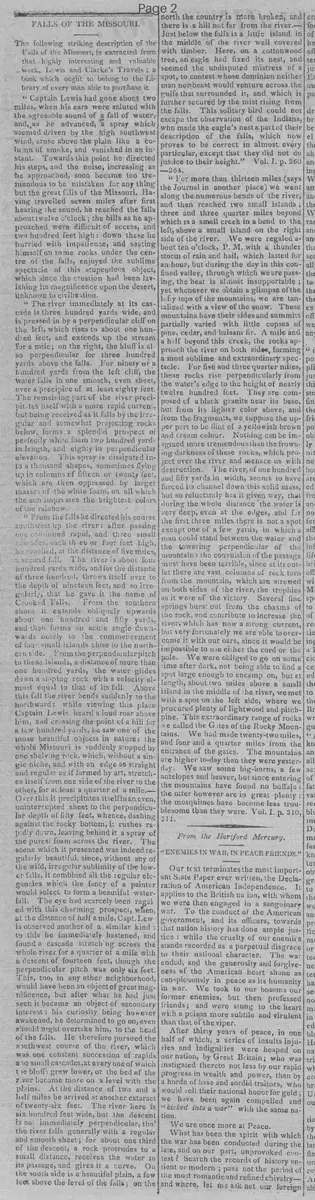
FALLS OF THE MISSOURI.
The following striking description of the Falls of the Missouri, is extracted from that highly interesting and valuable work, Lewis and Clarke's Travels; a book which ought to belong to the Library of every man able to purchase it.
"Captain Lewis had gone about two miles, when his ears were saluted with the agreeable sound of a fall of water, and, as he advanced, a spray which seemed driven by the high southwest wind, arose above the plain like a column of smoke, and vanished in an instant. Towards this point he directed his steps, and the noise, increasing as he approached, soon became too tremendous to be mistaken for any thing but the great falls of the Missouri. Having travelled seven miles after first hearing the sound, he reached the falls about twelve o'clock; the hills as he approached were difficult of access, and two hundred feet high: down these he hurried with impatience, and seating himself on some rocks under the centre of the falls, enjoyed the sublime spectacle of this stupendous object, which since the creation had been lavishing its magnificence upon the desert, unknown to civilization.
"The river immediately at its cascade is three hundred yards wide, and is pressed in by a perpendicular cliff on the left, which rises to about one hundred feet, and extends up the stream for a mile; on the right, the bluffs also perpendicular for three hundred yards above the falls. For ninety or a hundred yards from the left cliff, the water falls in one smooth, even sheet, over a precipice of at least eighty feet. The remaining part of the river precipitates itself with a more rapid current, but being received as it falls by the irregular and somewhat projecting rocks below, forms a splendid prospect of perfectly white foam two hundred yards in length, and eighty in perpendicular elevation. This spray is dissipated into a thousand shapes, sometimes flying up in columns of fifteen or twenty feet, which are then oppressed by larger masses of the white foam, on all which the sun impresses the brightest colors of the rainbow.
"From the falls he directed his course southwest up the river: after passing one continued rapid, and three small cascades, each three or four feet high, he reached, at the distance of five miles, a second fall. The river is about four hundred yards wide, and for the distance of three hundred, throws itself over to the depth of nineteen feet, and so irregularly, that he gave it the name of Crooked Falls. From the southern shore it extends obliquely upwards about one hundred and fifty yards, and then forms an acute angle downwards nearly to the commencement of four small islands close to the northern side. From the perpendicular pitch to these islands, a distance of more than one hundred yards, the water glides down a sloping rock with a velocity almost equal to that of its fall. Above this fall the river bends suddenly to the northward: while viewing this place Captain Lewis heard a loud roar above him, and crossing the point of a hill for a few hundred yards, he saw one of the most beautiful objects in nature: the whole Missouri is suddenly stopped by one shelving rock, which, without a single niche, and with an edge as straight and regular as if formed by art, stretches itself from one side of the river to the other, for at least a quarter of a mile. Over this it precipitates itself in an even, uninterrupted sheet to the perpendicular depth of fifty feet, whence, dashing against the rocky bottom, it rushes rapidly down, leaving behind it a spray of the purest foam across the river. The scene which it presented was indeed regularly beautiful, since, without any of the wild, irregular sublimity of the lower falls, it combined all the regular elegancies which the fancy of a painter would select to form a beautiful waterfall. The eye had scarcely been regaled with this charming prospect, when, at the distance of half a mile, Capt. Lewis observed another of a similar kind: to this he immediately hastened, and found a cascade stretching across the whole river or a quarter of a mile with a descent of fourteen feet, though the perpendicular pitch was only six feet. This, too, in any other neighborhood, would have been an object of great magnificence, but after what he had just seen it became an object of secondary interest: his curiosity being however awakened, he determined to go on, even should night overtake him, to the head of the falls. He therefore pursued the southwest course of the river, which was one constant succession of rapids and small cascades, at every one of which the bluffs grew lower, or the bed of the river became more on a level with the plains. At the distance of two and a half miles he arrived at another cataract of twenty-six feet. The river here is six hundred feet wide, but the descent is not immediately perpendicular, tho' the river falls generally with a regular and smooth sheet; for about one third of the descent, a rock protrudes to a small distance, receives the water in its passage, and gives it a curve. On the south side is a beautiful plain, a few feet above the level of the falls; on the north the country is more broken, and there is a hill not far from the river. Just below the falls is a little island in the middle of the river well covered with timber. Here, on a cottonwood tree, an eagle had fixed its nest, and seemed the undisputed mistress of a spot, to contest whose dominion neither man nor beast would venture across the gulfs that surrounded it, and which is further secured by the mist rising from the falls. This solitary bird could not escape the observation of the Indians, who made the eagle's nest a part of their description of the falls, which now proves to be correct in almost every particular, except that they did not do justice to their height." Vol. I. p. 260-264.
"For more than thirteen miles (says the Journal in another place) we went along the numerous bends of the river, and then reached two small islands; three and three quarter miles beyond which is a small creek in a bend to the left, above a small island on the right side of the river. We were regaled about ten o'clock, P. M. with a thunder storm of rain and hail, which lasted for an hour, but during the day in this confined valley, through which we are passing, the heat is almost insupportable; yet whenever we obtain a glimpse of the lofty tops of the mountains, we are tantalized with a view of the snow. These mountains have their sides and summits partially varied with little copses of pine, cedar, and balsam fir. A mile and a half beyond this creek, the rocks approach the river on both sides, forming a most sublime and extraordinary spectacle: For five and three quarter miles, these rocks rise perpendicularly from the water's edge to the height of nearly twelve hundred feet. They are composed of a black granite near its base, but from its lighter color above, and from the fragments, we suppose the upper part to be flint of a yellowish brown and cream colour. Nothing can be imagined more tremendous than the frowning darkness of these rocks, which project over the river and menace us with destruction. The river, of one hundred and fifty yards in width, seems to have forced its channel down this solid mass, but so reluctantly has it given way, that during the whole distance the water is very deep, even at the edges, and for the first three miles there is not a spot except one of a few yards, in which a man could stand between the water and the towering perpendicular of the mountain: the convulsion of the passage must have been terrible, since at its outlet there are vast columns of rock torn from the mountain, which are strewed on both sides of the river, the trophies as it were of the victory. Several fine springs burst out from the chasms of the rock, and contribute to increase the river, which has now a strong current, but very fortunately we are able to overcome it with our oars, since it would be impossible to use either the cord or the pole. We were obliged to go on some time after dark, not being able to find a spot large enough to encamp on, but at length, about two miles above a small island in the middle of the river, we met with a spot on the left side, where we procured plenty of lightwood and pitch-pine. This extraordinary range of rocks we called the Gates of the Rocky Mountains. We had made twenty-two miles, and four and a quarter miles from the entrance of the gates. The mountains are higher to-day than they were yesterday. We saw some big-horns, a few antelopes and beaver, but since entering the mountains have found no buffalo: the otter however are in great plenty: the mosquitoes have become less troublesome than they were." Vol. I. p. 310, 311.
The following striking description of the Falls of the Missouri, is extracted from that highly interesting and valuable work, Lewis and Clarke's Travels; a book which ought to belong to the Library of every man able to purchase it.
"Captain Lewis had gone about two miles, when his ears were saluted with the agreeable sound of a fall of water, and, as he advanced, a spray which seemed driven by the high southwest wind, arose above the plain like a column of smoke, and vanished in an instant. Towards this point he directed his steps, and the noise, increasing as he approached, soon became too tremendous to be mistaken for any thing but the great falls of the Missouri. Having travelled seven miles after first hearing the sound, he reached the falls about twelve o'clock; the hills as he approached were difficult of access, and two hundred feet high: down these he hurried with impatience, and seating himself on some rocks under the centre of the falls, enjoyed the sublime spectacle of this stupendous object, which since the creation had been lavishing its magnificence upon the desert, unknown to civilization.
"The river immediately at its cascade is three hundred yards wide, and is pressed in by a perpendicular cliff on the left, which rises to about one hundred feet, and extends up the stream for a mile; on the right, the bluffs also perpendicular for three hundred yards above the falls. For ninety or a hundred yards from the left cliff, the water falls in one smooth, even sheet, over a precipice of at least eighty feet. The remaining part of the river precipitates itself with a more rapid current, but being received as it falls by the irregular and somewhat projecting rocks below, forms a splendid prospect of perfectly white foam two hundred yards in length, and eighty in perpendicular elevation. This spray is dissipated into a thousand shapes, sometimes flying up in columns of fifteen or twenty feet, which are then oppressed by larger masses of the white foam, on all which the sun impresses the brightest colors of the rainbow.
"From the falls he directed his course southwest up the river: after passing one continued rapid, and three small cascades, each three or four feet high, he reached, at the distance of five miles, a second fall. The river is about four hundred yards wide, and for the distance of three hundred, throws itself over to the depth of nineteen feet, and so irregularly, that he gave it the name of Crooked Falls. From the southern shore it extends obliquely upwards about one hundred and fifty yards, and then forms an acute angle downwards nearly to the commencement of four small islands close to the northern side. From the perpendicular pitch to these islands, a distance of more than one hundred yards, the water glides down a sloping rock with a velocity almost equal to that of its fall. Above this fall the river bends suddenly to the northward: while viewing this place Captain Lewis heard a loud roar above him, and crossing the point of a hill for a few hundred yards, he saw one of the most beautiful objects in nature: the whole Missouri is suddenly stopped by one shelving rock, which, without a single niche, and with an edge as straight and regular as if formed by art, stretches itself from one side of the river to the other, for at least a quarter of a mile. Over this it precipitates itself in an even, uninterrupted sheet to the perpendicular depth of fifty feet, whence, dashing against the rocky bottom, it rushes rapidly down, leaving behind it a spray of the purest foam across the river. The scene which it presented was indeed regularly beautiful, since, without any of the wild, irregular sublimity of the lower falls, it combined all the regular elegancies which the fancy of a painter would select to form a beautiful waterfall. The eye had scarcely been regaled with this charming prospect, when, at the distance of half a mile, Capt. Lewis observed another of a similar kind: to this he immediately hastened, and found a cascade stretching across the whole river or a quarter of a mile with a descent of fourteen feet, though the perpendicular pitch was only six feet. This, too, in any other neighborhood, would have been an object of great magnificence, but after what he had just seen it became an object of secondary interest: his curiosity being however awakened, he determined to go on, even should night overtake him, to the head of the falls. He therefore pursued the southwest course of the river, which was one constant succession of rapids and small cascades, at every one of which the bluffs grew lower, or the bed of the river became more on a level with the plains. At the distance of two and a half miles he arrived at another cataract of twenty-six feet. The river here is six hundred feet wide, but the descent is not immediately perpendicular, tho' the river falls generally with a regular and smooth sheet; for about one third of the descent, a rock protrudes to a small distance, receives the water in its passage, and gives it a curve. On the south side is a beautiful plain, a few feet above the level of the falls; on the north the country is more broken, and there is a hill not far from the river. Just below the falls is a little island in the middle of the river well covered with timber. Here, on a cottonwood tree, an eagle had fixed its nest, and seemed the undisputed mistress of a spot, to contest whose dominion neither man nor beast would venture across the gulfs that surrounded it, and which is further secured by the mist rising from the falls. This solitary bird could not escape the observation of the Indians, who made the eagle's nest a part of their description of the falls, which now proves to be correct in almost every particular, except that they did not do justice to their height." Vol. I. p. 260-264.
"For more than thirteen miles (says the Journal in another place) we went along the numerous bends of the river, and then reached two small islands; three and three quarter miles beyond which is a small creek in a bend to the left, above a small island on the right side of the river. We were regaled about ten o'clock, P. M. with a thunder storm of rain and hail, which lasted for an hour, but during the day in this confined valley, through which we are passing, the heat is almost insupportable; yet whenever we obtain a glimpse of the lofty tops of the mountains, we are tantalized with a view of the snow. These mountains have their sides and summits partially varied with little copses of pine, cedar, and balsam fir. A mile and a half beyond this creek, the rocks approach the river on both sides, forming a most sublime and extraordinary spectacle: For five and three quarter miles, these rocks rise perpendicularly from the water's edge to the height of nearly twelve hundred feet. They are composed of a black granite near its base, but from its lighter color above, and from the fragments, we suppose the upper part to be flint of a yellowish brown and cream colour. Nothing can be imagined more tremendous than the frowning darkness of these rocks, which project over the river and menace us with destruction. The river, of one hundred and fifty yards in width, seems to have forced its channel down this solid mass, but so reluctantly has it given way, that during the whole distance the water is very deep, even at the edges, and for the first three miles there is not a spot except one of a few yards, in which a man could stand between the water and the towering perpendicular of the mountain: the convulsion of the passage must have been terrible, since at its outlet there are vast columns of rock torn from the mountain, which are strewed on both sides of the river, the trophies as it were of the victory. Several fine springs burst out from the chasms of the rock, and contribute to increase the river, which has now a strong current, but very fortunately we are able to overcome it with our oars, since it would be impossible to use either the cord or the pole. We were obliged to go on some time after dark, not being able to find a spot large enough to encamp on, but at length, about two miles above a small island in the middle of the river, we met with a spot on the left side, where we procured plenty of lightwood and pitch-pine. This extraordinary range of rocks we called the Gates of the Rocky Mountains. We had made twenty-two miles, and four and a quarter miles from the entrance of the gates. The mountains are higher to-day than they were yesterday. We saw some big-horns, a few antelopes and beaver, but since entering the mountains have found no buffalo: the otter however are in great plenty: the mosquitoes have become less troublesome than they were." Vol. I. p. 310, 311.
What sub-type of article is it?
Journey Narrative
Essay
What themes does it cover?
Nature
What keywords are associated?
Missouri Falls
Lewis Clarke Travels
Waterfalls
Rocky Mountains
Exploration
Cascades
Rapids
What entities or persons were involved?
Lewis And Clarke
Literary Details
Title
Falls Of The Missouri.
Author
Lewis And Clarke
Subject
Description Of The Falls Of The Missouri
Form / Style
Descriptive Travel Narrative In Prose
Key Lines
The River Immediately At Its Cascade Is Three Hundred Yards Wide, And Is Pressed In By A Perpendicular Cliff On The Left, Which Rises To About One Hundred Feet, And Extends Up The Stream For A Mile; On The Right, The Bluffs Also Perpendicular For Three Hundred Yards Above The Falls.
Over This It Precipitates Itself In An Even, Uninterrupted Sheet To The Perpendicular Depth Of Fifty Feet, Whence, Dashing Against The Rocky Bottom, It Rushes Rapidly Down, Leaving Behind It A Spray Of The Purest Foam Across The River.
This Extraordinary Range Of Rocks We Called The Gates Of The Rocky Mountains.