Thank you for visiting SNEWPapers!
Sign up free
Alexandria Daily Gazette, Commercial & Political
Alexandria, Virginia
What is this article about?
U.S. Minister William Pinkney in London reports to Secretary Madison on informal diplomatic efforts with British Foreign Secretary Canning to revoke the Orders in Council of 1807 and seek reparations for the Chesapeake attack, leveraging the potential suspension of the U.S. embargo act in June and July 1808.
Clipping
OCR Quality
Full Text
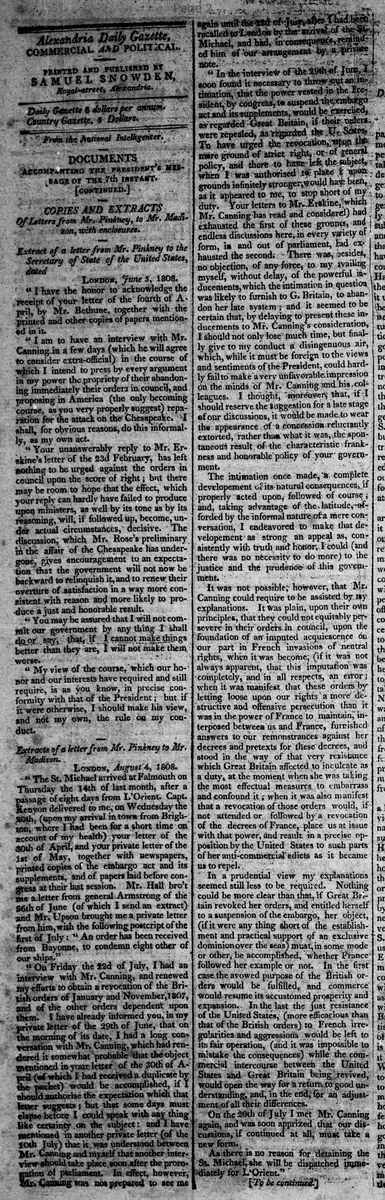
DOCUMENTS
ACCOMPANYING THE PRESIDENT
MESSAGE OF THE 7th INSTANT.
[CONTINUED]
COPIES AND EXTRACTS
Of Letters from Mr. Pinkney, to Mr. Madison, with enclosures.
Extract of a letter from Mr. Pinkney to the Secretary of State of the United States,
dated
London, June 5, 1808.
"I have the honor to acknowledge the receipt of your letter of the fourth of April, by Mr. Bethune, together with the printed and other copies of papers mentioned in it.
"I am to have an interview with Mr. Canning in a few days (which he will agree to consider extra-official) in the course of which I intend to press by every argument in my power the propriety of their abandoning immediately their orders in council, and proposing in America (the only becoming course, as you very properly suggest) reparation for the attack on the Chesapeake. I shall, for obvious reasons, do this informally, as my own act.
"Your unanswerable reply to Mr. Erskine's letter of the 23d February, has left nothing to be urged against the orders in council upon the score of right; but there may be room to hope that the effect, which your reply can hardly have failed to produce upon ministers, as well by its tone as by its reasoning, will, if followed up, become, under actual circumstances, decisive. The discussion, which Mr. Rose's preliminary in the affair of the Chesapeake has undergone, gives encouragement to an expectation that the government will not now be backward to relinquish it, and to renew their overture of satisfaction in a way more consistent with reason and more likely to produce a just and honorable result.
You may be assured that I will not commit our government by any thing I shall do or say, that, if I cannot make things better than they are, I will not make them worse.
"My view of the course which our honor and our interests have required and still require, is as you know, in precise conformity with that of the President; but if it were otherwise, I should make his view, and not my own, the rule of my conduct."
Extracts of a letter from Mr. Pinkney to Mr. Madison.
London, August 4, 1808.
"The St. Michael arrived at Falmouth on Thursday the 14th of last month, after a passage of eight days from L'Orient. Capt. Kenyon delivered to me, on Wednesday the 20th, (upon my arrival in town from Brighton, where I had been for a short time on account of my health) your letter of the 30th of April, and your private letter of the 1st of May, together with newspapers, printed copies of the embargo act and its supplements, and of papers laid before congress at their last session. Mr. Hall brought me a letter from general Armstrong of the 26th of June (of which I send an extract) and Mr. Upson brought me a private letter from him, with the following postscript of the first of July: "An order has been received from Bayonne, to condemn eight other of our ships."
"On Friday the 22d of July, I had an interview with Mr. Canning, and renewed my efforts to obtain a revocation of the British orders of January and November 1807 and of the other orders dependent upon them. I have already informed you, in my private letter of the 29th of June, that on the morning of its date, I had a long conversation with Mr. Canning, which had rendered it somewhat probable that the object mentioned in your letter of the 30th of April (of which I had received a duplicate by the packet) would be accomplished, if I should authorise the expectation which that letter suggests; but that some days must elapse before I could speak with anything like certainty on the subject: and I have mentioned in another private letter (of the 10th July) that it was understood between Mr. Canning and myself that another interview should take place soon after the prorogation of parliament. In effect, however, Mr. Canning was not prepared to see me until the 22d of July, having been recalled to London by the arrival of the St. Michael and I had in consequence reminded him of our arrangement by a private note.
In the interview of the 29th of June I soon found it necessary to throw out an intimation that the power vested in the President by congress, to suspend the embargo act and its supplements, would be exercised as regarded Great Britain, if their orders were repealed, as regarded the U States. To have urged the revocation upon the mere ground of strict right or of general policy, and there to have left the subject when I was authorised to place it upon grounds infinitely stronger, would have been, as it appeared to me, to stop short of my duty. Your letters to Mr Erskine, (which Mr. Canning has read and considered) had exhausted the first of these grounds, and endless discussions here, in every variety of form, in and out of parliament, had exhausted the second: There was, besides, no objection, of any force, to my availing myself, without delay, of the powerful inducements, which the intimation in question was likely to furnish to G. Britain, to abandon her late system; and it seemed to be certain that, by delaying to present these inducements to Mr. Canning's consideration, I should not only lose much time, but finally give to my conduct a disingenuous air, which, while it must be foreign to the views and sentiments of the President, could hardly fail to make a very unfavorable impression on the minds of Mr. Canning and his colleagues. I thought, moreover that, if I should reserve the suggestion for a late stage of our discussions, it would be made to wear the appearance of a concession reluctantly extorted, rather than what it was, the spontaneous result of the characteristic frankness and honorable policy of your government.
The intimation once made, a complete development of its natural consequences, if properly acted upon, followed: of course; and, taking advantage of the latitude afforded by the informal nature of a mere conversation, I endeavored to make that development as strong an appeal as, consistently with truth and honor, I could (and there was no necessity to do more) to the justice and the prudence of this government.
It was not possible; however, that Mr. Canning could require to be assisted by my explanations. It was plain, upon their own principles, that they could not equitably persevere in their orders in council, upon the foundation of an imputed acquiescence on our part in French invasions of neutral rights, when it was become: (if it was not always apparent, that this imputation was completely, and in all respects, an error) when it was manifest that these orders by letting loose upon our rights a more destructive and offensive persecution than it was in the power of France to maintain, interposed between us and France, furnished answers to our remonstrances against: her decrees and pretexts for these decrees, and stood in the way of that very resistance which Great Britain affected to inculcate as a duty, at the moment when she was taking the most effectual measures to embarrass and confound it : when it was also manifest that a revocation of those orders would, if not attended or followed by a revocation of the decrees of France, place us at issue with that power, and result in a precise opposition by the United States to such parts of her anti-commercial edicts as it became us to repel.
In a prudential view my explanations seemed still less to be required. Nothing could be more clear than that, if Great Britain revoked her orders, and entitled herself to a suspension of the embargo, her object (if it were anything short of the establishment and practical support of an exclusive dominion over the seas) must in some mode or other, be accomplished, whether France followed her example or not. In the first case the avowed purpose of the British orders would be fulfilled, and commerce would resume its accustomed prosperity and expansion. In the last, the just resistance of the United States (more efficacious than that of the British orders) to French irregularities and aggressions would be left to it fair operation, (and it was impossible to mistake the consequences) while the commercial intercourse between the United States and Great Britain being revived would open the way for a return to good understanding, and, in the end, for an adjustment of all their differences.
On the 20th of July I met Mr. Canning again, and was soon apprized that our discussions, if continued at all must take a new form.
As there is no reason for detaining the St. Michael, she will be dispatched immediately for L'Orient."
What sub-type of article is it?
What keywords are associated?
What entities or persons were involved?
Where did it happen?
Foreign News Details
Primary Location
London
Event Date
June 5, 1808 And August 4, 1808
Key Persons
Outcome
ongoing negotiations for revocation of british orders in council and reparations for chesapeake; potential suspension of u.s. embargo if orders repealed; no final resolution reported.
Event Details
Mr. Pinkney acknowledges receipt of dispatches and plans informal interview with Mr. Canning to urge abandonment of Orders in Council and Chesapeake reparations. In later extracts, he reports conversations in June and July 1808, intimating U.S. embargo suspension as leverage, developing arguments on rights, policy, and prudence to persuade Britain to revoke orders, highlighting implications for U.S.-French relations and commerce.