Thank you for visiting SNEWPapers!
Sign up free
Poem
March 15, 1803
Kentucky Gazette And General Advertiser
Lexington, Fayette County, Kentucky
What is this article about?
A poem praising the simple, content life of a solitary woodman who labors by cutting wood in a remote forest, free from worldly cares, and finds peace in poverty and moral virtue.
Clipping
OCR Quality
98%
Excellent
Full Text
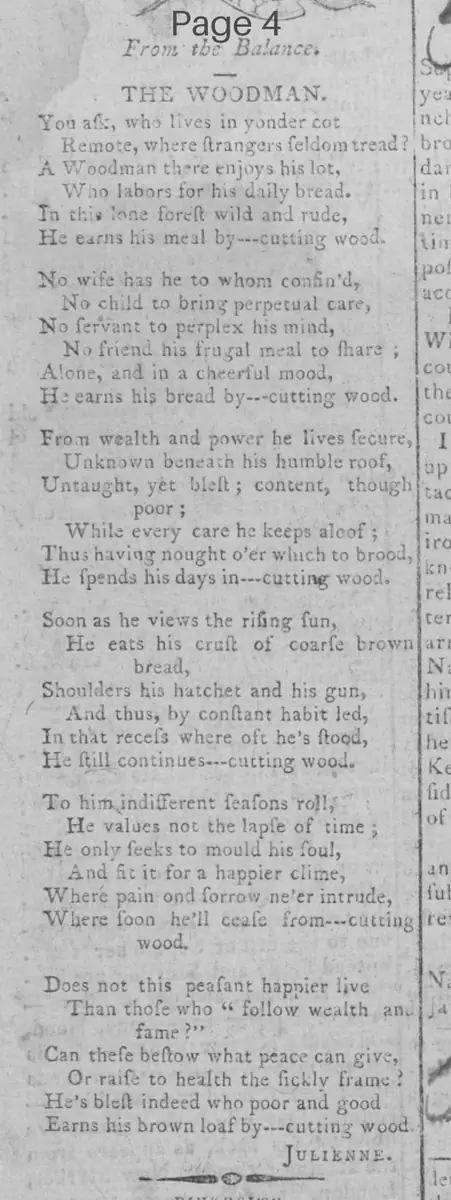
From the Balance.
THE WOODMAN.
You ask, who lives in yonder cot
Remote, where strangers seldom tread?
A Woodman there enjoys his lot,
Who labors for his daily bread.
In this lone forest wild and rude,
He earns his meal by—cutting wood.
No wife has he to whom confin'd,
No child to bring perpetual care,
No servant to perplex his mind,
No friend his frugal meal to share
Alone, and in a cheerful mood.
He earns his bread by—cutting wood.
From wealth and power he lives secure
Unknown beneath his humble roof.
Untaught, yet blest; content, though
poor;
While every care he keeps aloof;
Thus having nought o'er which to brood,
He spends his days in—cutting wood.
Soon as he views the rising sun,
He eats his crust of coarse brown
bread,
Shoulders his hatchet and his gun,
And thus, by constant habit led,
In that recess where oft he's stood,
He still continues—cutting wood.
To him indifferent seasons roll,
He values not the lapse of time;
He only seeks to mould his soul,
And fit it for a happier clime,
Where pain and sorrow ne'er intrude,
Where soon he'll cease from—cutting
wood.
Does not this peasant happier live
Than those who "follow wealth and
fame?"
Can these bestow what peace can give,
Or raise to health the sickly frame?
He's blest indeed who poor and good
Earns his brown loaf by—cutting wood
JULIENNE.
THE WOODMAN.
You ask, who lives in yonder cot
Remote, where strangers seldom tread?
A Woodman there enjoys his lot,
Who labors for his daily bread.
In this lone forest wild and rude,
He earns his meal by—cutting wood.
No wife has he to whom confin'd,
No child to bring perpetual care,
No servant to perplex his mind,
No friend his frugal meal to share
Alone, and in a cheerful mood.
He earns his bread by—cutting wood.
From wealth and power he lives secure
Unknown beneath his humble roof.
Untaught, yet blest; content, though
poor;
While every care he keeps aloof;
Thus having nought o'er which to brood,
He spends his days in—cutting wood.
Soon as he views the rising sun,
He eats his crust of coarse brown
bread,
Shoulders his hatchet and his gun,
And thus, by constant habit led,
In that recess where oft he's stood,
He still continues—cutting wood.
To him indifferent seasons roll,
He values not the lapse of time;
He only seeks to mould his soul,
And fit it for a happier clime,
Where pain and sorrow ne'er intrude,
Where soon he'll cease from—cutting
wood.
Does not this peasant happier live
Than those who "follow wealth and
fame?"
Can these bestow what peace can give,
Or raise to health the sickly frame?
He's blest indeed who poor and good
Earns his brown loaf by—cutting wood
JULIENNE.
What sub-type of article is it?
Ballad
Pastoral
What themes does it cover?
Moral Virtue
What keywords are associated?
Woodman
Simple Life
Contentment
Cutting Wood
Moral Virtue
Rural Solitude
What entities or persons were involved?
Julienne.
Poem Details
Title
The Woodman.
Author
Julienne.
Key Lines
A Woodman There Enjoys His Lot,
Who Labors For His Daily Bread.
From Wealth And Power He Lives Secure
Unknown Beneath His Humble Roof.
Does Not This Peasant Happier Live
Than Those Who "Follow Wealth And Fame?"