Thank you for visiting SNEWPapers!
Sign up free
Story
December 3, 1818
The Rhode Island American, And General Advertiser
Providence, Providence County, Rhode Island
What is this article about?
Proceedings of the Thirteenth Congress (likely 1818) in Senate and House from Nov 25-27: resolutions on Illinois admission, military pay, Bank of US inquiry, salary increases for officials, Washington monument, pensions, and various bills debated and passed.
Clipping
OCR Quality
95%
Excellent
Full Text
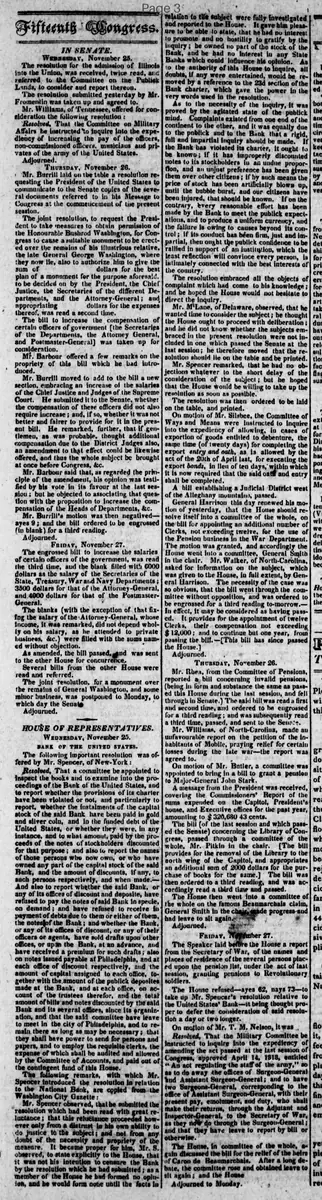
Thirteenth Congress.
IN SENATE.
Wednesday, November 25.
The resolution for the admission of Illinois into the Union, was received, twice read, and referred to the Committee on the Public Lands, to consider and report thereon.
The resolution submitted yesterday by Mr. Fromentin was taken up and agreed to.
Mr. Williams, of Tennessee, offered for consideration the following resolution:
Resolved, That the Committee on Military Affairs be instructed to inquire into the expediency of increasing the pay of the officers, non-commissioned officers, musicians and privates of the army of the United States.
Adjourned.
Thursday, November 26.
Mr. Burrill laid on the table a resolution requesting the President of the United States to communicate to the Senate copies of the several documents referred to in his Message to Congress at the commencement of the present session.
The joint resolution, to request the President to take measures to obtain permission of the Honourable Bushrod Washington, or Congress to cause a suitable monument to be erected over the remains of his illustrious relative, the late General George Washington, where they now lie, also to authorize him to give the sum of dollars for the best plan of a monument for the purpose aforesaid, to be decided on by the President, the Chief Justice, the Secretaries of the different Departments, and the Attorney-General; and appropriating dollars for the expenses thereof, was read a second time.
The bill to increase the compensation of certain officers of government [the Secretaries of the Departments, the Attorney General, and Postmaster-General] was taken up for consideration.
Mr. Barbour offered a few remarks on the propriety of this bill which he had introduced.
Mr. Burrill moved to add to the bill a new section, embracing an increase of the salaries of the Chief Justice and Judges of the Supreme Court. He submitted it to the Senate, whether the compensation of these officers did not also require increase; and, if so, whether it was not better and fairer to provide for it in the present bill. He remarked, further, that if gentlemen, as was probable, thought additional compensation due to the District Judges also, an amendment to that effect could be likewise offered, and thus the whole subject be brought at once before Congress, &c.
Mr. Barbour said that, as regarded the principle of the amendment, his opinion was testified by his vote in its favour at the last session; but he objected to associating that question with the proposition to increase the compensation of the Heads of Departments, &c.
Mr. Burrill's motion was then negatived—ayes 9; and the bill ordered to be engrossed (in blank) for a third reading.
Adjourned.
Friday, November 27.
The engrossed bill to increase the salaries of certain officers of the government, was read the third time, and the blank filled with $6000 dollars as the salary of the Secretaries of the State, Treasury, War and Navy Departments; $3500 dollars for that of the Attorney-General, and $4000 dollars for that of the Postmaster-General.
The blanks (with the exception of that fixing the salary of the Attorney-General, whose income, it was remarked, did not depend wholly on his salary, as he attended to private business, &c.) were filled with the sums named without objection.
As amended, the bill passed, and was sent to the other House for concurrence.
Several bills from the other House were read and referred.
The joint resolution, for a monument over the remains of General Washington, and some minor business, was postponed to Monday, to which day the Senate adjourned.
HOUSE OF REPRESENTATIVES.
Wednesday, November 25.
BANK OF THE UNITED STATES.
The following important resolution was offered by Mr. Spencer, of New-York:
Resolved, That a committee be appointed to inspect the books and to examine into the proceedings of the Bank of the United States, and to report whether the provisions of its charter have been violated or not, and particularly to report, whether the instalments of the capital stock of the said Bank have been paid in gold and silver coin, and in the funded debt of the United States, or whether they were, in any instance, and to what amount, paid by the proceeds of the notes of stockholders discounted for that purpose; and also to report the names of those persons who now own, or who have owned any part of the capital stock of the said Bank, and the amount of discounts, if any, to such persons respectively, and when made.
And also to report whether the said Bank, or any of its offices of discount and deposite, have refused to pay the notes of said Bank in specie, on demand; and have refused to receive in payment of debts due to them or either of them, the notes of the Bank; and whether the Bank, or any of its offices of discount, or any of their officers or agents, have sold drafts upon other offices, or upon the Bank, at an advance, and have received a premium on such drafts; also on notes issued payable at Philadelphia, and at each office of discount respectively, and the amount of capital assigned to each office, together with the amount of the public deposites made at the Bank, and at each office, on account of the trustees therefor, and the total amount of bills and notes discounted by the said Bank and its several offices, since its organization, and that the said committee have leave to meet in the city of Philadelphia, and to remain there as long as may be necessary; that they shall have power to send for persons and papers, and to employ the requisite clerks, the expense of which shall be audited and allowed by the Committee of Accounts, and paid out of the contingent fund of this House.
The following remarks, with which Mr. Spencer introduced the resolution in relation to the National Bank, are copied from the Washington City Gazette:
Mr. Spencer observed, that he submitted the resolution which had been read with great reluctance; that this reluctance proceeded however only from a distrust in his own ability to do justice to the subject; and not from any doubt of the necessity and propriety of the measure. It became proper for him, Mr. S. observed, to state explicitly to the House, that it was not his intention to censure the Bank by the resolution which he had submitted; as a member of the House he had formed no opinion, and he would form none until the facts in relation to the subject were fully investigated and reported to the House. It gave him pleasure to be able to state, that he had no interest to promote and no hostility to gratify by the inquiry; he owned no part of the stock of the Bank, and he had no interest in any State Banks which could influence his opinion. As to the authority of this House to inquire, all doubts, if any were entertained, would be removed by a reference to the 23d section of the Bank charter, which gave the power in the very words used in the resolution.
As to the necessity of the inquiry, it was proved by the agitated state of the public mind. Complaints existed from one end of the continent to the other, and it was equally due to the public and to the Bank that a rigid, full and impartial inquiry should be made. If the Bank has violated its charter, it ought to be known; if it has improperly discounted notes to its stockholders in an undue proportion, and an unjust preference has been given them over other citizens; if by such means the price of stock has been artificially blown up, until the bubble burst, and our citizens have been injured, that should be known. If on the contrary, every reasonable effort has been made by the Bank to meet the public expectations, and to produce a uniform currency, and the failure is owing to causes beyond its control; if its conduct has been firm, just and impartial, then ought the public confidence to be rallied in support of an institution, which the least reflection will convince every person, is intimately connected with the best interests of the country.
The resolution embraced all the objects of complaint which had come to his knowledge; and he hoped the House would not hesitate to direct the inquiry.
Mr. McLane, of Delaware, observed, that he wanted time to consider the subject; he thought the House ought to proceed with deliberation; and he did not know whether the subjects embraced in the present resolution were not included in one which passed the Senate at the last session; he therefore moved that the resolution should lie on the table and be printed.
Mr. Spencer remarked, that he had no objections whatever to the short delay of the consideration of the subject; but he hoped that the House would be willing to take up the resolution as soon as possible.
The resolution was then ordered to be laid on the table, and printed.
On motion of Mr. Silsbee, the Committee of Ways and Means were instructed to inquire into the expediency of allowing, in cases of exportation of goods entitled to debenture, the same time (of twenty days) for completing the export entry and oath, as is allowed by the act of the 20th of April last, for executing the export bonds, in lieu of ten days, within which it is now required that the said oath and entry shall be completed.
A bill establishing a Judicial District west of the Alleghany mountains, passed.
General Harrison this day renewed his motion of yesterday, that the House should resolve itself into a committee of the whole, on the bill for appointing an additional number of Clerks, not exceeding twelve, for the use of the Pension business in the War Department.
The motion was granted, and accordingly the House went into a committee, General Smith in the chair. Mr. Walker, of North-Carolina, asked for information on the subject, which was given to the House, in full extent, by General Harrison. The necessity of the case was so obvious, that the bill went through the committee without opposition, and was ordered to be engrossed for a third reading to-morrow. In effect, it may be considered as having passed. It provides for the appointment of twelve Clerks, their compensation not exceeding $12000; and to continue but one year, from passing the bill. [This bill has since passed the House.]
Adjourned.
Thursday, November 26.
Mr. Rhees, from the Committee of Pensions, reported a bill concerning invalid pensions, (being in form and substance the same as passed this House during the last session, and fell through in Senate.) The said bill was read a first and second time, and ordered to be engrossed for a third reading; and was subsequently read a third time, passed, and sent to the Senate.
Mr. Williams, of North-Carolina, made an unfavourable report on the petition of the inhabitants of Mobile, praying relief for certain losses during the late war—the report was agreed to.
On motion of Mr. Butler, a committee was appointed to bring in a bill to grant a pension to Major-General John Stark.
A message from the President was received, covering the Commissioners' Report of the sums expended on the Capitol, President's house, and Executive offices for the past year, amounting to $320,680 43 cents.
The bill (of the last session and which passed the Senate) concerning the Library of Congress, passed through a committee of the whole. Mr. Pitkin in the chair. The bill provides for the removal of the Library to the north wing of the Capitol, and appropriates an additional sum of 2000 dollars for the purchase of books for the same. The bill was then ordered to a third reading, and was accordingly read a third time and passed.
The House then went into a committee of the whole on the famous Beaumarchais claim. General Smith in the chair made progress and had leave to sit again.
Adjourned.
Friday, November 27.
The Speaker laid before the House a report from the Secretary of War, of the names and places of residence of the several persons placed upon the pension list, under the act of last session, granting pensions to Revolutionary soldiers.
The House refused—ayes 62, nays 73—to take up Mr. Spencer's resolution relative to the United States' Bank—it being thought proper to defer the consideration of said resolution a day or two longer.
On motion of Mr. T. M. Nelson, it was
Resolved, That the Military Committee be instructed to inquire into the expediency of amending the act passed at the last session of Congress, approved April 14, 1818, entitled "An act regulating the staff of the army." so as to do away the offices of Surgeon-General and Assistant Surgeon-General; and to have two Surgeons-General, corresponding to the office of Assistant Surgeon-General, with their present pay, emolument, and duty, who shall make their returns, through the Adjutant and Inspector-General, to the Secretary of War, as they now do through the Surgeon-General; and that they have leave to report by bill or otherwise.
The House, in committee of the whole, again discussed the bill for the relief of the heirs of Caron de Beaumarchais. After a long debate, the committee rose and obtained leave to sit again; and the House adjourned.
IN SENATE.
Wednesday, November 25.
The resolution for the admission of Illinois into the Union, was received, twice read, and referred to the Committee on the Public Lands, to consider and report thereon.
The resolution submitted yesterday by Mr. Fromentin was taken up and agreed to.
Mr. Williams, of Tennessee, offered for consideration the following resolution:
Resolved, That the Committee on Military Affairs be instructed to inquire into the expediency of increasing the pay of the officers, non-commissioned officers, musicians and privates of the army of the United States.
Adjourned.
Thursday, November 26.
Mr. Burrill laid on the table a resolution requesting the President of the United States to communicate to the Senate copies of the several documents referred to in his Message to Congress at the commencement of the present session.
The joint resolution, to request the President to take measures to obtain permission of the Honourable Bushrod Washington, or Congress to cause a suitable monument to be erected over the remains of his illustrious relative, the late General George Washington, where they now lie, also to authorize him to give the sum of dollars for the best plan of a monument for the purpose aforesaid, to be decided on by the President, the Chief Justice, the Secretaries of the different Departments, and the Attorney-General; and appropriating dollars for the expenses thereof, was read a second time.
The bill to increase the compensation of certain officers of government [the Secretaries of the Departments, the Attorney General, and Postmaster-General] was taken up for consideration.
Mr. Barbour offered a few remarks on the propriety of this bill which he had introduced.
Mr. Burrill moved to add to the bill a new section, embracing an increase of the salaries of the Chief Justice and Judges of the Supreme Court. He submitted it to the Senate, whether the compensation of these officers did not also require increase; and, if so, whether it was not better and fairer to provide for it in the present bill. He remarked, further, that if gentlemen, as was probable, thought additional compensation due to the District Judges also, an amendment to that effect could be likewise offered, and thus the whole subject be brought at once before Congress, &c.
Mr. Barbour said that, as regarded the principle of the amendment, his opinion was testified by his vote in its favour at the last session; but he objected to associating that question with the proposition to increase the compensation of the Heads of Departments, &c.
Mr. Burrill's motion was then negatived—ayes 9; and the bill ordered to be engrossed (in blank) for a third reading.
Adjourned.
Friday, November 27.
The engrossed bill to increase the salaries of certain officers of the government, was read the third time, and the blank filled with $6000 dollars as the salary of the Secretaries of the State, Treasury, War and Navy Departments; $3500 dollars for that of the Attorney-General, and $4000 dollars for that of the Postmaster-General.
The blanks (with the exception of that fixing the salary of the Attorney-General, whose income, it was remarked, did not depend wholly on his salary, as he attended to private business, &c.) were filled with the sums named without objection.
As amended, the bill passed, and was sent to the other House for concurrence.
Several bills from the other House were read and referred.
The joint resolution, for a monument over the remains of General Washington, and some minor business, was postponed to Monday, to which day the Senate adjourned.
HOUSE OF REPRESENTATIVES.
Wednesday, November 25.
BANK OF THE UNITED STATES.
The following important resolution was offered by Mr. Spencer, of New-York:
Resolved, That a committee be appointed to inspect the books and to examine into the proceedings of the Bank of the United States, and to report whether the provisions of its charter have been violated or not, and particularly to report, whether the instalments of the capital stock of the said Bank have been paid in gold and silver coin, and in the funded debt of the United States, or whether they were, in any instance, and to what amount, paid by the proceeds of the notes of stockholders discounted for that purpose; and also to report the names of those persons who now own, or who have owned any part of the capital stock of the said Bank, and the amount of discounts, if any, to such persons respectively, and when made.
And also to report whether the said Bank, or any of its offices of discount and deposite, have refused to pay the notes of said Bank in specie, on demand; and have refused to receive in payment of debts due to them or either of them, the notes of the Bank; and whether the Bank, or any of its offices of discount, or any of their officers or agents, have sold drafts upon other offices, or upon the Bank, at an advance, and have received a premium on such drafts; also on notes issued payable at Philadelphia, and at each office of discount respectively, and the amount of capital assigned to each office, together with the amount of the public deposites made at the Bank, and at each office, on account of the trustees therefor, and the total amount of bills and notes discounted by the said Bank and its several offices, since its organization, and that the said committee have leave to meet in the city of Philadelphia, and to remain there as long as may be necessary; that they shall have power to send for persons and papers, and to employ the requisite clerks, the expense of which shall be audited and allowed by the Committee of Accounts, and paid out of the contingent fund of this House.
The following remarks, with which Mr. Spencer introduced the resolution in relation to the National Bank, are copied from the Washington City Gazette:
Mr. Spencer observed, that he submitted the resolution which had been read with great reluctance; that this reluctance proceeded however only from a distrust in his own ability to do justice to the subject; and not from any doubt of the necessity and propriety of the measure. It became proper for him, Mr. S. observed, to state explicitly to the House, that it was not his intention to censure the Bank by the resolution which he had submitted; as a member of the House he had formed no opinion, and he would form none until the facts in relation to the subject were fully investigated and reported to the House. It gave him pleasure to be able to state, that he had no interest to promote and no hostility to gratify by the inquiry; he owned no part of the stock of the Bank, and he had no interest in any State Banks which could influence his opinion. As to the authority of this House to inquire, all doubts, if any were entertained, would be removed by a reference to the 23d section of the Bank charter, which gave the power in the very words used in the resolution.
As to the necessity of the inquiry, it was proved by the agitated state of the public mind. Complaints existed from one end of the continent to the other, and it was equally due to the public and to the Bank that a rigid, full and impartial inquiry should be made. If the Bank has violated its charter, it ought to be known; if it has improperly discounted notes to its stockholders in an undue proportion, and an unjust preference has been given them over other citizens; if by such means the price of stock has been artificially blown up, until the bubble burst, and our citizens have been injured, that should be known. If on the contrary, every reasonable effort has been made by the Bank to meet the public expectations, and to produce a uniform currency, and the failure is owing to causes beyond its control; if its conduct has been firm, just and impartial, then ought the public confidence to be rallied in support of an institution, which the least reflection will convince every person, is intimately connected with the best interests of the country.
The resolution embraced all the objects of complaint which had come to his knowledge; and he hoped the House would not hesitate to direct the inquiry.
Mr. McLane, of Delaware, observed, that he wanted time to consider the subject; he thought the House ought to proceed with deliberation; and he did not know whether the subjects embraced in the present resolution were not included in one which passed the Senate at the last session; he therefore moved that the resolution should lie on the table and be printed.
Mr. Spencer remarked, that he had no objections whatever to the short delay of the consideration of the subject; but he hoped that the House would be willing to take up the resolution as soon as possible.
The resolution was then ordered to be laid on the table, and printed.
On motion of Mr. Silsbee, the Committee of Ways and Means were instructed to inquire into the expediency of allowing, in cases of exportation of goods entitled to debenture, the same time (of twenty days) for completing the export entry and oath, as is allowed by the act of the 20th of April last, for executing the export bonds, in lieu of ten days, within which it is now required that the said oath and entry shall be completed.
A bill establishing a Judicial District west of the Alleghany mountains, passed.
General Harrison this day renewed his motion of yesterday, that the House should resolve itself into a committee of the whole, on the bill for appointing an additional number of Clerks, not exceeding twelve, for the use of the Pension business in the War Department.
The motion was granted, and accordingly the House went into a committee, General Smith in the chair. Mr. Walker, of North-Carolina, asked for information on the subject, which was given to the House, in full extent, by General Harrison. The necessity of the case was so obvious, that the bill went through the committee without opposition, and was ordered to be engrossed for a third reading to-morrow. In effect, it may be considered as having passed. It provides for the appointment of twelve Clerks, their compensation not exceeding $12000; and to continue but one year, from passing the bill. [This bill has since passed the House.]
Adjourned.
Thursday, November 26.
Mr. Rhees, from the Committee of Pensions, reported a bill concerning invalid pensions, (being in form and substance the same as passed this House during the last session, and fell through in Senate.) The said bill was read a first and second time, and ordered to be engrossed for a third reading; and was subsequently read a third time, passed, and sent to the Senate.
Mr. Williams, of North-Carolina, made an unfavourable report on the petition of the inhabitants of Mobile, praying relief for certain losses during the late war—the report was agreed to.
On motion of Mr. Butler, a committee was appointed to bring in a bill to grant a pension to Major-General John Stark.
A message from the President was received, covering the Commissioners' Report of the sums expended on the Capitol, President's house, and Executive offices for the past year, amounting to $320,680 43 cents.
The bill (of the last session and which passed the Senate) concerning the Library of Congress, passed through a committee of the whole. Mr. Pitkin in the chair. The bill provides for the removal of the Library to the north wing of the Capitol, and appropriates an additional sum of 2000 dollars for the purchase of books for the same. The bill was then ordered to a third reading, and was accordingly read a third time and passed.
The House then went into a committee of the whole on the famous Beaumarchais claim. General Smith in the chair made progress and had leave to sit again.
Adjourned.
Friday, November 27.
The Speaker laid before the House a report from the Secretary of War, of the names and places of residence of the several persons placed upon the pension list, under the act of last session, granting pensions to Revolutionary soldiers.
The House refused—ayes 62, nays 73—to take up Mr. Spencer's resolution relative to the United States' Bank—it being thought proper to defer the consideration of said resolution a day or two longer.
On motion of Mr. T. M. Nelson, it was
Resolved, That the Military Committee be instructed to inquire into the expediency of amending the act passed at the last session of Congress, approved April 14, 1818, entitled "An act regulating the staff of the army." so as to do away the offices of Surgeon-General and Assistant Surgeon-General; and to have two Surgeons-General, corresponding to the office of Assistant Surgeon-General, with their present pay, emolument, and duty, who shall make their returns, through the Adjutant and Inspector-General, to the Secretary of War, as they now do through the Surgeon-General; and that they have leave to report by bill or otherwise.
The House, in committee of the whole, again discussed the bill for the relief of the heirs of Caron de Beaumarchais. After a long debate, the committee rose and obtained leave to sit again; and the House adjourned.
What sub-type of article is it?
Historical Event
What keywords are associated?
Congressional Proceedings
Senate Resolutions
House Bills
Bank Investigation
Salary Increases
Washington Monument
Pensions
Beaumarchais Claim
What entities or persons were involved?
Mr. Fromentin
Mr. Williams Of Tennessee
Mr. Burrill
Mr. Barbour
Mr. Spencer Of New York
Mr. Mclane Of Delaware
General Harrison
General Smith
Mr. Rhees
Mr. Williams Of North Carolina
Mr. Butler
Mr. Pitkin
Mr. T. M. Nelson
Where did it happen?
Washington City
Story Details
Key Persons
Mr. Fromentin
Mr. Williams Of Tennessee
Mr. Burrill
Mr. Barbour
Mr. Spencer Of New York
Mr. Mclane Of Delaware
General Harrison
General Smith
Mr. Rhees
Mr. Williams Of North Carolina
Mr. Butler
Mr. Pitkin
Mr. T. M. Nelson
Location
Washington City
Event Date
November 25 27, 1818
Story Details
Report of proceedings in the Thirteenth Congress: Senate debates admission of Illinois, increases in military pay and officer salaries, monument for George Washington; House considers Bank of the United States investigation, pensions, judicial districts, and other bills.