Thank you for visiting SNEWPapers!
Sign up free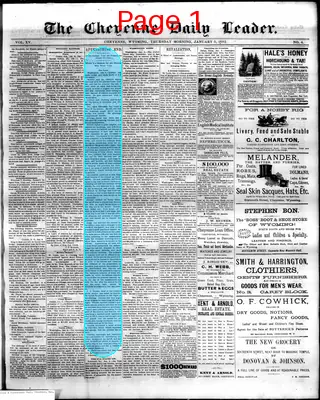
The Cheyenne Daily Leader
Cheyenne, Laramie County, Wyoming
What is this article about?
On January 4 in Washington, the prosecution closes its case in the Charles Guiteau assassination trial, surprising the defense. Counsel Scoville seeks to add insanity witnesses amid preparation hardships; Judge Cox allows limited sur-rebuttal on motive but excludes key expert. Guiteau outbursts noted; testimony includes his claims of political necessity.
Clipping

OCR Quality
Full Text
In the Guiteau Trial the Prosecution Closes Its Case,
Which is a Surprise for the Defense, Who Want Time.
The Trial.
Washington, Jan. 4. Guiteau kept quiet to-day and made merit of it in his speech.
Scoville read an affidavit setting forth that he is the prisoner's sole counsel, and that the prisoner has been in such state of mind that he has been unable to assist or suggest any witness and that the counsel since closing the case, learned of certain material witnesses. He gave names and what he would prove.
Corkhill said Nothing need be said on the motion to introduce this evidence.
Col. Reed addressed the court in favor of the motion. He felt sure that the American people would not begrudge this justice. He glowingly complimented Scoville.
Davidge denied that there was a precedent for reopening the case, and it would be scandalous.
Scoville replied at great length, and detailed the hardships, and difficulties under which the defense had labored in the preparation of their case, was almost impossible to get witnesses to come here. The experts for the defense were compelled to be satisfied with one dollar and twenty-five cents per diem, the regular witness fees, while the experts for the government, came here (it is supposed) leaving great trusts behind them and remained for six weeks; and everyone of them plainly showed by their evidence that they expected full pay for their services, and all know what they meant. And these experts, said Scoville, are still waiting here to see the result of their evidence in hanging this prisoner, but fortunately for cause of justice, your honor, and this jury stands between him and the gallows.
Col. Corkhill could not at this stage allow remarks of the counsel go unanswered. He said, yesterday, and would repeat to-day that he would object to introducing any new fact material to the defense, the only objection to be made by the prosecution had already been mentioned by Davidge that there had never been a trial in this district where so much liberty has been shown by the government.
Guiteau insisted on being heard. The bailiff tried to silence him, but was met with an angry, let me alone or I will slap you in the mouth. Guiteau then called out: Your honor, all I want is to show that I told these men on the way to jail that it was the political situation and pressure of inspiration that caused me to remove the president.
Judge Cox said that the counsel for the defense came here a stranger to the courts of this district, and even to the prisoner himself and found himself environed with difficulties from the outset. The most serious difficulty was that the odium attaching to the assassination made the witnesses unwilling even to allow their names to be known to the defense.
Appreciating all these difficulties which embarrassed the defense. Judge Cox had felt disposed to offset this with equal latitude, and more than ordinary facilities. The evidence of insanity could not be offered in sur-rebuttal. In his opinion the proof of insanity should be limited to the evidence in chief of the defense and rebutting the evidence of the prosecution; he therefore must exclude the evidence of Dr. MacFarland who Scoville said would testify to the prisoner's insanity.
The testimony however of those witnesses by which the defense expected to prove that the prisoner asserted upon the day of the assassination and upon the day after the motive for his act, the court held, should be admitted as evidence in the sur-rebuttal.
J. J. Brooks, chief of the treasury secret service was called by Scoville. He visited the prisoner on the night of the shooting. Guiteau was very angry at the witness for disturbing his rest at night. Witness reproved him as a murderer and the prisoner said that he was no murderer, but a christian gentleman. The act was a political necessity for the good of the country, and that the witness being a stalwart could appreciate why he did it; that he had thought over and prayed over the matter for six weeks, and became convinced that the president must go by his hand.
Scoville introduced a letter written by Scoville's father which expressed the opinion that the prisoner was insane.
Guiteau, sneeringly and insultingly, reproved Scoville for introducing this letter, threatened the bailiff, and said that he could get plenty of experts to testify that he was crazy as a loon, but would not give a cent for a bucketful of expert testimony.
Dr. Beard was called, but was ruled out, and exceptions noted.
Adjourned.
What sub-type of article is it?
What themes does it cover?
What keywords are associated?
What entities or persons were involved?
Where did it happen?
Story Details
Key Persons
Location
Washington
Event Date
Jan. 4
Story Details
In the Guiteau trial, the prosecution closes its case unexpectedly. Defense counsel Scoville moves to introduce new witnesses on insanity, citing difficulties in preparation. The court allows some sur-rebuttal evidence on motive but excludes Dr. MacFarland's testimony. Witnesses like J. J. Brooks testify to Guiteau's statements on the assassination as a political necessity. Guiteau interrupts disruptively.