Thank you for visiting SNEWPapers!
Sign up free
Editorial
March 27, 1807
Alexandria Daily Advertiser
Alexandria, Virginia
What is this article about?
In 'Speculations of Decius,' the author argues that in republics, judges must follow the letter of the law strictly, without discretion, emphasizing the importance of common law, experienced elderly judges, adequate salaries to prevent corruption, and criticizes juries swayed by demagogues.
Clipping
OCR Quality
95%
Excellent
Full Text
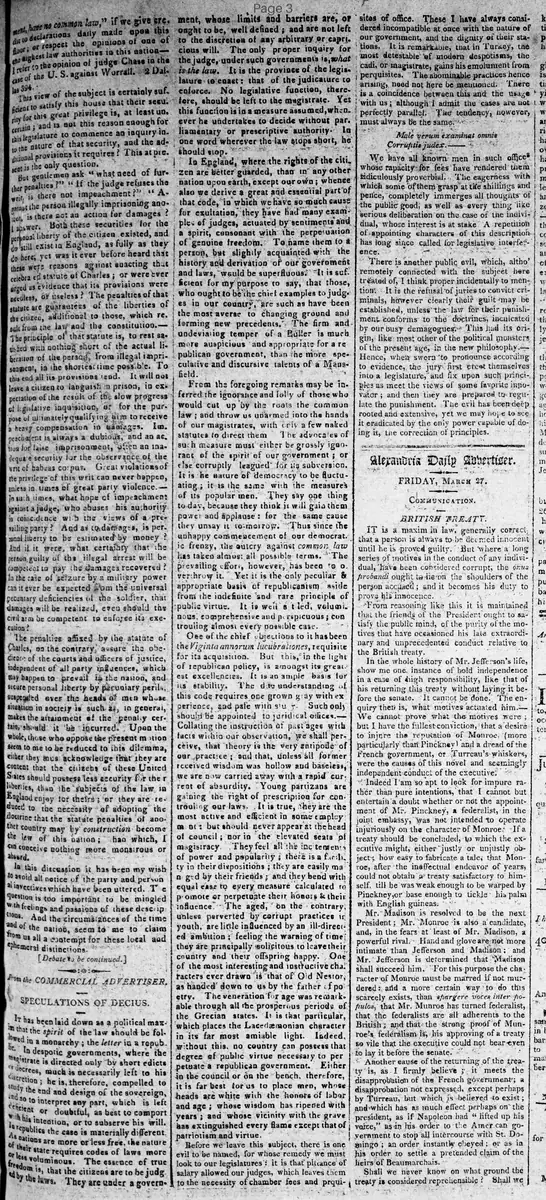
From the COMMERCIAL ADVERTISER.
SPECULATIONS OF DECIUS.
It has been laid down as a political maxim, that the spirit of the law should be followed in a monarchy; the letter in a republic. In despotic governments, where the magistrate is directed only by short edicts or decrees, much is necessarily left to his discretion. He is therefore compelled to study the end and design of the sovereign and so to interpret any part, which is left ambiguous or doubtful as best to comport with his intention, or to subserve his will.
In republics the case is materially different. As nations are more or less free, the nature of their state requires codes of laws more or less voluminous. The essence of true freedom is, that the citizens are to be judged by the laws. They are under a government, whose limits and barriers are, or ought to be, well defined; and are not left to the discretion of any arbitrary or capricious will. The only proper inquiry for the judge, under such governments is, what is the law. It is the province of the legislature to enact: that of the judicature to enforce. No legislative function, therefore, should be left to the magistrate. Yet this function is in a measure assumed, whenever he undertakes to decide without parliamentary or prescriptive authority. In one word wherever the law stops short, he should stop.
In England, where the rights of the citizen are better guarded, than in any other nation upon earth, except our own; whence also we derive a great and essential part of that code, in which we have so much cause for exultation, they have had many examples of judges, actuated by sentiments and a spirit, consonant with the perpetuation of genuine freedom. To name them to a person but slightly acquainted with the history and derivation of our government and laws, would be superfluous. It is sufficient for my purpose to say, that those, who ought to be the chief examples to judges in our country, are such as have been the most averse to changing ground and forming new precedents. The firm and undeviating temper of a Buller is much more auspicious and appropriate for a republican government, than the more speculative and discursive talents of a Mansfield.
From the foregoing remarks may be inferred the ignorance and folly of those who would cut up by the roots the common law; and throw us unarmed into the hands of our magistrates, with only a few naked statutes to direct them. The advocates of such measure must either be grossly ignorant of the spirit of our government; or else corruptly leagued for its subversion.
It is the nature of democracy to be fluctuating: it is the same with the measures of its popular men. They say one thing to-day, because they think it will gain them power and applause: for the same cause they unsay it to-morrow. Thus since the unhappy commencement of our democratic frenzy, the outcry against common law has taken almost all possible terms. The prevailing effort, however, has been to overthrow it. Yet it is the only peculiar and appropriate basis of republicanism aside from the indefinite and rare principle of public virtue. It is well studied, voluminous, comprehensive and perspicuous; controlling almost every possible case.
One of the chief objections to it has been the Viginta annorum lucubrations, requisite for its acquisition. But this, in the light of republican policy, is amongst its greatest excellencies. It is an ample basis for its stability. The due understanding of this code requires one grown gray with experience and pale with study. Such only should be appointed to juridical offices. Collating the instruction of past ages with facts within our observation, we shall perceive, that theory is the very antipode of our practice; and that, unless all former received wisdom was hollow and baseless, we are now carried away with a rapid current of absurdity. Young partisans are gaining the right of prescription for controlling our laws. It is true, they are the most active and efficient in some employments: but should never appear at the head of council; nor in the elevated seats of magistracy. They feel all the incitements of power and popularity; there is a friability in their dispositions; they are easily managed by their friends; and they bend with equal ease to every measure calculated to promote or perpetuate their honors and their influence. The aged, on the contrary, unless perverted by corrupt practices in youth, are little influenced by an ill-directed ambition: feeling the warning of time they are principally solicitous to leave their country and their offspring happy.
One of the most interesting and instructive characters ever drawn is that of Old Nestor, as handed down to us by the father of poetry. The veneration for age was remarkable through all the prosperous periods of the Grecian states. It is that particular, which places the Lacedaemonian character in its fairest most amiable light. Indeed, without this, no country can possess that degree of public virtue necessary to perpetuate a republican government. Either in the council or on the bench, therefore, it is far best for us to place men, whose heads are white with the honors of labor and age; whose wisdom has ripened with years; and whose vicinity with the grave has extinguished every flame except that of patriotism and virtue.
Before we leave this subject, there is one evil to be named, for whose remedy we must look to our legislatures: it is that pittance of salary allowed our judges, which leaves them to the necessity of chamber fees and perquisites of office. These I have always considered incompatible at once with the nature of our government, and the dignity of their stations. It is remarkable, that in Turkey, the most detestable of modern despotisms, the cadi, or magistrate, gains his emolument from perquisites. The abominable practices hence arising, need not here be mentioned. There is a coincidence between this and the usage with us; although I admit the cases are not perfectly parallel. The tendency, however, must always be the same.
Male verum examinat omnis Corruptio judex.
We have all known men in such office whose rapacity for fees have rendered them ridiculously proverbial. The eagerness with which some of them grasp at the shillings and pence, completely immerses all thoughts of the public good, as well as every thing like serious deliberation on the case of the individual, whose interest is at stake. A repetition of appointing characters of this description has long since called for legislative interference.
There is another public evil, which, although remotely connected with the subject here treated of, I think proper incidentally to mention. It is the refusal of juries to convict criminals, however clearly their guilt may be established, unless the law for their punishment conforms to the doctrines, inculcated by our busy demagogues. This had its origin, like most other of the political monsters of the present age; in the new philosophy. Hence, when sworn to pronounce according to evidence, the jury first erect themselves into a legislature, and fix upon such principles as meet the views of some favorite impostor; and then they are prepared to regulate the punishment. The evil has been deep rooted and extensive, yet we may hope to see it eradicated by the only power capable of doing it, the correction of principles.
SPECULATIONS OF DECIUS.
It has been laid down as a political maxim, that the spirit of the law should be followed in a monarchy; the letter in a republic. In despotic governments, where the magistrate is directed only by short edicts or decrees, much is necessarily left to his discretion. He is therefore compelled to study the end and design of the sovereign and so to interpret any part, which is left ambiguous or doubtful as best to comport with his intention, or to subserve his will.
In republics the case is materially different. As nations are more or less free, the nature of their state requires codes of laws more or less voluminous. The essence of true freedom is, that the citizens are to be judged by the laws. They are under a government, whose limits and barriers are, or ought to be, well defined; and are not left to the discretion of any arbitrary or capricious will. The only proper inquiry for the judge, under such governments is, what is the law. It is the province of the legislature to enact: that of the judicature to enforce. No legislative function, therefore, should be left to the magistrate. Yet this function is in a measure assumed, whenever he undertakes to decide without parliamentary or prescriptive authority. In one word wherever the law stops short, he should stop.
In England, where the rights of the citizen are better guarded, than in any other nation upon earth, except our own; whence also we derive a great and essential part of that code, in which we have so much cause for exultation, they have had many examples of judges, actuated by sentiments and a spirit, consonant with the perpetuation of genuine freedom. To name them to a person but slightly acquainted with the history and derivation of our government and laws, would be superfluous. It is sufficient for my purpose to say, that those, who ought to be the chief examples to judges in our country, are such as have been the most averse to changing ground and forming new precedents. The firm and undeviating temper of a Buller is much more auspicious and appropriate for a republican government, than the more speculative and discursive talents of a Mansfield.
From the foregoing remarks may be inferred the ignorance and folly of those who would cut up by the roots the common law; and throw us unarmed into the hands of our magistrates, with only a few naked statutes to direct them. The advocates of such measure must either be grossly ignorant of the spirit of our government; or else corruptly leagued for its subversion.
It is the nature of democracy to be fluctuating: it is the same with the measures of its popular men. They say one thing to-day, because they think it will gain them power and applause: for the same cause they unsay it to-morrow. Thus since the unhappy commencement of our democratic frenzy, the outcry against common law has taken almost all possible terms. The prevailing effort, however, has been to overthrow it. Yet it is the only peculiar and appropriate basis of republicanism aside from the indefinite and rare principle of public virtue. It is well studied, voluminous, comprehensive and perspicuous; controlling almost every possible case.
One of the chief objections to it has been the Viginta annorum lucubrations, requisite for its acquisition. But this, in the light of republican policy, is amongst its greatest excellencies. It is an ample basis for its stability. The due understanding of this code requires one grown gray with experience and pale with study. Such only should be appointed to juridical offices. Collating the instruction of past ages with facts within our observation, we shall perceive, that theory is the very antipode of our practice; and that, unless all former received wisdom was hollow and baseless, we are now carried away with a rapid current of absurdity. Young partisans are gaining the right of prescription for controlling our laws. It is true, they are the most active and efficient in some employments: but should never appear at the head of council; nor in the elevated seats of magistracy. They feel all the incitements of power and popularity; there is a friability in their dispositions; they are easily managed by their friends; and they bend with equal ease to every measure calculated to promote or perpetuate their honors and their influence. The aged, on the contrary, unless perverted by corrupt practices in youth, are little influenced by an ill-directed ambition: feeling the warning of time they are principally solicitous to leave their country and their offspring happy.
One of the most interesting and instructive characters ever drawn is that of Old Nestor, as handed down to us by the father of poetry. The veneration for age was remarkable through all the prosperous periods of the Grecian states. It is that particular, which places the Lacedaemonian character in its fairest most amiable light. Indeed, without this, no country can possess that degree of public virtue necessary to perpetuate a republican government. Either in the council or on the bench, therefore, it is far best for us to place men, whose heads are white with the honors of labor and age; whose wisdom has ripened with years; and whose vicinity with the grave has extinguished every flame except that of patriotism and virtue.
Before we leave this subject, there is one evil to be named, for whose remedy we must look to our legislatures: it is that pittance of salary allowed our judges, which leaves them to the necessity of chamber fees and perquisites of office. These I have always considered incompatible at once with the nature of our government, and the dignity of their stations. It is remarkable, that in Turkey, the most detestable of modern despotisms, the cadi, or magistrate, gains his emolument from perquisites. The abominable practices hence arising, need not here be mentioned. There is a coincidence between this and the usage with us; although I admit the cases are not perfectly parallel. The tendency, however, must always be the same.
Male verum examinat omnis Corruptio judex.
We have all known men in such office whose rapacity for fees have rendered them ridiculously proverbial. The eagerness with which some of them grasp at the shillings and pence, completely immerses all thoughts of the public good, as well as every thing like serious deliberation on the case of the individual, whose interest is at stake. A repetition of appointing characters of this description has long since called for legislative interference.
There is another public evil, which, although remotely connected with the subject here treated of, I think proper incidentally to mention. It is the refusal of juries to convict criminals, however clearly their guilt may be established, unless the law for their punishment conforms to the doctrines, inculcated by our busy demagogues. This had its origin, like most other of the political monsters of the present age; in the new philosophy. Hence, when sworn to pronounce according to evidence, the jury first erect themselves into a legislature, and fix upon such principles as meet the views of some favorite impostor; and then they are prepared to regulate the punishment. The evil has been deep rooted and extensive, yet we may hope to see it eradicated by the only power capable of doing it, the correction of principles.
What sub-type of article is it?
Constitutional
Legal Reform
Moral Or Religious
What keywords are associated?
Common Law
Republican Judiciary
Experienced Judges
Judicial Corruption
Jury Misconduct
Public Virtue
What entities or persons were involved?
Buller
Mansfield
Old Nestor
Judges
Legislature
Juries
Editorial Details
Primary Topic
Defense Of Common Law And Experienced Judiciary In Republics
Stance / Tone
Advocacy For Strict Legal Adherence, Veneration Of Age, And Anti Corruption Measures
Key Figures
Buller
Mansfield
Old Nestor
Judges
Legislature
Juries
Key Arguments
In Republics, Judges Must Follow The Letter Of The Law, Not The Spirit
Common Law Is Essential Basis For Republicanism And Should Not Be Overthrown
Experienced, Elderly Judges Are Preferable To Young Partisans For Stability
Low Judicial Salaries Lead To Corruption Via Fees And Perquisites
Juries Should Not Act As Legislatures Influenced By Demagogues