Thank you for visiting SNEWPapers!
Sign up free
Daily National Intelligencer
Washington, District Of Columbia
What is this article about?
Treasury report by Secretary William H. Crawford detailing the US public debt reduction to $88,885,203.66 by January 1, 1820, treasury balance of $334,996.90, estimated 1820 revenue of $22M against $27M expenditures, recommending revenue increase or spending cuts, possibly via tariffs or internal taxes, and suggesting loans via stock or treasury notes.
Clipping
OCR Quality
Full Text
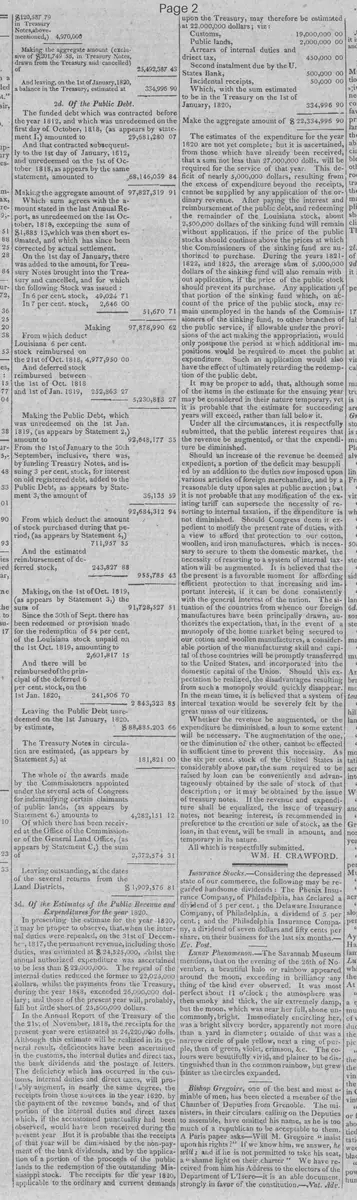
Making the aggregate amount (exclusive of $201,749 58, in Treasury Notes, drawn from the Treasury and cancelled) 25,492,387 43
And leaving, on the 1st of January, 1820, a balance in the Treasury, estimated at 334,996 90
2d. Of the Public Debt.
The funded debt which was contracted before the year 1812, and which was unredeemed on the first day of October, 1818, (as appears by statement I,) amounted to 29,681,280 07
And that contracted subsequently to the 1st day of January, 1812, and unredeemed on the 1st of October, 1818, as appears by the same statement, amounted to 68,146,039 84
Making the aggregate amount of 97,827,319 91
Which sum agrees with the amount stated in the last Annual Report, as unredeemed on the 1st October, 1818, excepting the sum of $1,885 13, which was then short estimated, and which has since been corrected by actual settlement.
On the 1st day of January, there was added to the amount, for Treasury Notes brought into the Treasury and cancelled, and for which the following Stock was issued:
In 6 per cent stock, $49,024 71
In 7 per cent stock, $2,646 00
51,670 71
Making 97,878,990.62
From which deduct Louisiana 6 per cent. stock reimbursed on the 21st of Oct. 1818, $4,977,950 00
And deferred stock reimbursed between the 1st of Oct. 1818 and 1st of Jan. 1819, $252,863 27
5,230,813 27
Making the Public Debt, which was unredeemed on the 1st Jan. 1819, (as appears by Statement 2,) amount to 92,648,177 35
From the 1st of January to the 30th September, inclusive, there was, by funding Treasury Notes, and issuing 3 per cent. stock, for interest on old registered debt, added to the Public Debt, as appears by Statement 3, the amount of: 36,135 59
92,684,312 94
From which deduct the amount of stock purchased during that period, (as appears by Statement 4,) $711,957 55
And the estimated reimbursement of deferred stock, 243,827 88
955,785 43
Making, on the 1st of Oct. 1819, (as appears by Statement 3,) the sum of 91,728,527 51
Since the 30th of Sept. there has been redeemed or provision made for the redemption of 54 per cent. of the Louisiana stock unpaid on the 1st Oct. 1819, amounting to 2,601,817 15
And there will be reimbursed of the principal of the deferred 6 per cent. stock, on the 1st Jan. 1820, 241,506 70
2,843,323 85
Leaving the Public Debt unredeemed on the 1st January, 1820, by estimate, $88,885,203 66
The Treasury Notes in circulation are estimated, (as appears by Statement 5,) at $181,821 00
The whole of the awards made by the Commissioners appointed under the several acts of Congress for indemnifying certain claimants of public lands, (as appears by Statement 6,) amounts to $4,282,151 72
Of which there has been received at the Office of the Commissioner of the General Land Office, (as appears by Statement C,) the sum of $2,372,574 31
Leaving outstanding, at the dates of the several returns from the Land Districts, $1,909,576 81
3d. Of the Estimates of the Public Revenue and Expenditures for the year 1820.
In presenting the estimate for the year 1820, it may be proper to observe, that, when the internal duties were repealed, on the 31st of December, 1817, the permanent revenue, including those duties, was estimated at $24,525,000, whilst the annual authorized expenditure was ascertained to be less than $22,000,000. The repeal of the internal duties reduced the former to 22,025,000 dollars, whilst the payments from the Treasury, during the year 1818, exceeded 26,000,000 dollars; and those of the present year will, probably, fall but little short of 25,500,000 dollars.
In the Annual Report of the Treasury of the 21st of November, 1818, the receipts for the present year were estimated at 24,220,000 dollars. Although this estimate will be realized in its general result, deficiencies have been ascertained in the customs, the internal duties and direct tax, the bank dividends and the postage of letters.
The deficiency which has occurred in the customs, internal duties and direct taxes, will probably augment, in nearly the same degree, the receipts from those sources in the year 1820, by the payment of the revenue bonds, and of that portion of the internal duties and direct taxes which, if the accustomed punctuality had been observed, would have been received during the present year. But it is probable that the receipts of that year will be diminished by the non-payment of the bank dividends, and by the application of a portion of the proceeds of the public lands to the redemption of the outstanding Mississippi stock. The receipts for the year 1820, applicable to the ordinary and current demands upon the Treasury, may therefore be estimated at 22,000,000 dollars; viz:
Customs, 19,000,000 00
Public lands, 2,000,000 00
Arrears of internal duties and direct tax, 450,000 00
Second instalment due by the U. States Bank, 500,000 00
Incidental receipts, 50,000 00
Which, with the sum estimated to be in the Treasury on the 1st of January, 1820, 334,996 90
Make the aggregate amount of $22,334,996 90
The estimates of the expenditure for the year 1820 are not yet complete; but it is ascertained, from those which have already been received, that a sum not less than 27,000,000 dollars will be required for the service of that year. This deficit of nearly 5,000,000 dollars, resulting from the excess of expenditure beyond the receipts, cannot be supplied by any application of the ordinary revenue. After paying the interest and reimbursement of the public debt, and redeeming the remainder of the Louisiana stock, about 2,500,000 dollars of the sinking fund will remain without application, if the price of the public stocks should continue above the prices at which the Commissioners of the sinking fund are authorized to purchase. During the years 1821, 1822, and 1823, the average sum of 5,000,000 dollars of the sinking fund will also remain without application, if the price of the public stock should prevent its purchase. Any application of that portion of the sinking fund which, on account of the price of the public stock, may remain unemployed in the hands of the Commissioners of the sinking fund, to other branches of the public service, if allowable under the provisions of the act making the appropriation, would only postpone the period at which additional impositions would be required to meet the public expenditure. Such an application would also have the effect of ultimately retarding the redemption of the public debt.
It may be proper to add, that, although some of the items in the estimate for the ensuing year may be considered in their nature temporary, yet it is probable that the estimate for succeeding years will exceed, rather than fall below it.
Under all the circumstances, it is respectfully submitted, that the public interest requires that the revenue be augmented, or that the expenditure be diminished.
Should an increase of the revenue be deemed expedient, a portion of the deficit may be supplied by an addition to the duties now imposed upon various articles of foreign merchandize, and by a reasonable duty upon sales at public auction; but it is not probable that any modification of the existing tariff can supersede the necessity of resorting to internal taxation, if the expenditure is not diminished. Should Congress deem it expedient to modify the present rate of duties, with a view to afford that protection to our cotton, woollen, and iron manufactures, which is necessary to secure to them the domestic market, the necessity of resorting to a system of internal taxation will be augmented. It is believed that the present is a favorable moment for affording efficient protection to that increasing and important interest, if it can be done consistently with the general interest of the nation. The situation of the countries from whence our foreign manufactures have been principally drawn, authorizes the expectation, that, in the event of a monopoly of the home market being secured to our cotton and woollen manufactures, a considerable portion of the manufacturing skill and capital of those countries will be promptly transferred to the United States, and incorporated into the domestic capital of the Union. Should this expectation be realized, the disadvantages resulting from such a monopoly would quickly disappear. In the mean time, it is believed that a system of internal taxation would be severely felt by the great mass of our citizens.
Whether the revenue be augmented, or the expenditure be diminished, a loan to some extent will be necessary. The augmentation of the one, or the diminution of the other, cannot be effected in sufficient time to prevent this necessity. As the six per cent. stock of the United States is considerably above par, the sum required to be raised by loan can be conveniently and advantageously obtained by the sale of stock of that description; or it may be obtained by the issue of treasury notes. If the revenue and expenditure shall be equalized, the issue of treasury notes, not bearing interest, is recommended in preference to the creation or sale of stock, as the loan, in that event, will be small in amount, and temporary in its nature.
All which is respectfully submitted.
WM. H. CRAWFORD.
What sub-type of article is it?
What keywords are associated?
What entities or persons were involved?
Where did it happen?
Domestic News Details
Primary Location
United States
Event Date
1st January 1820
Key Persons
Outcome
public debt unredeemed estimated at $88,885,203.66; treasury balance $334,996.90; 1820 revenue estimated at $22,000,000 against expenditures of $27,000,000, creating $5,000,000 deficit; recommendations for revenue augmentation via tariffs or internal taxes, or expenditure reduction, with need for loans.
Event Details
Detailed Treasury report on receipts and expenditures from 1818-1819, public debt status and reductions through reimbursements and purchases, estimates for 1820 revenue sources including customs and public lands, projected expenditures, and policy suggestions for addressing fiscal deficit including protective tariffs and potential internal taxation.