Thank you for visiting SNEWPapers!
Sign up free
Kentucky Gazette
Lexington, Fayette County, Kentucky
What is this article about?
On February 10, 1820, the Governor of the newly established Arkansas Territory addresses the Legislative Council and House of Representatives, explaining his delayed arrival due to logistical issues, congratulating the assembly, and recommending actions on public lands, settler pre-emption rights, Indian treaties, roads, education, and limiting local legislation to revenue and appropriations.
Clipping
OCR Quality
Full Text
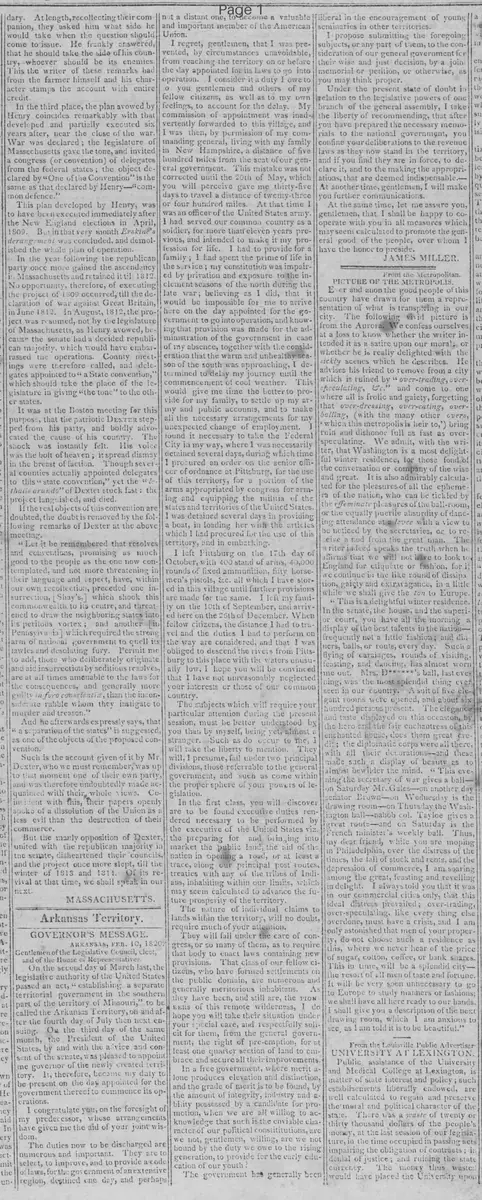
Arkansas Territory.
GOVERNOR'S MESSAGE.
ARKANSAS, FEB. 10, 1820.
Gentlemen of the Legislative Council, elect, and of the House of Representatives.
On the second day of March last, the legislative authority of the United States passed an act, "establishing a separate territorial government in the southern part of the territory of Missouri," to be called the Arkansas Territory, on and after the fourth day of July then next ensuing. On the third day of the same month, the President of the United States, by and with the advice and consent of the senate, was pleased to appoint me governor of the newly created territory. It, therefore, became my duty to be present on the day appointed for the government thereof to commence its operations.
I congratulate you, on the foresight of my predecessor, whose arrangements have given me the aid of your joint wisdom.
The duties now to be discharged are numerous and important. They are to select, to improve, and to provide a code of laws, for the government of an extensive region, destined one day, and perhaps not a distant one, to become a valuable and important member of the American Union.
I regret, gentlemen, that I was prevented, by circumstances unavoidable, from reaching the territory on or before the day appointed for its laws to go into operation. I consider it a duty I owe to you gentlemen and others of my fellow citizens, as well as to my own feelings, to account for the delay. My commission of appointment was inadvertently forwarded to this village, and I was then, by permission of my commanding general, living with my family in New Hampshire, a distance of five hundred miles from the seat of our general government. This mistake was not corrected until the 20th of May, which you will perceive gave me thirty-five days to travel a distance of twenty-three or four hundred miles. At that time I was an officer of the United States army. I had served our common country as a soldier, for more than eleven years previous, and intended to make it my profession for life. I had to provide for a family; I had spent the prime of life in the service; my constitution was impaired by privation and exposure to the inclement seasons of the north during the late war; believing as I did, that it would be impossible for me to arrive here on the day appointed for the government to go into operation, and knowing that provision was made for the administration of the government in case of my absence, together with the consideration that the warm and unhealthy season of the south was approaching, I determined to delay my journey until the commencement of cool weather. This would give me time the better to provide for my family, to settle up my army and public accounts, and to make all the necessary arrangements for my unexpected change of employment. I found it necessary to take the Federal City in my way, where I was necessarily detained several days, during which time I procured an order on the senior officer of ordnance at Pittsburg, for the use of this territory, for a portion of the arms appropriated by congress for arming and equipping the militia of the states and territories of the United States. I was detained several days in providing a boat, in loading her with the articles which I had procured for the use of this territory, and in embarking.
I left Pittsburg on the 17th day of October, with 400 stand of arms, 40,000 rounds of fixed ammunition, fifty horsemen's pistols, &c. all which I have stored in this village until further provisions are made for the same. I left my family on the 10th of September, and arrived here on the 26th of December. When, fellow citizens, the distance I had to travel and the duties I had to perform on the way are considered, and that I was obliged to descend the rivers from Pittsburg to this place with the waters unusually low, I hope you will be convinced that I have not unreasonably neglected your interests or those of our common country.
The subjects which will require your particular attention during the present session, must be better understood by you than by myself, being yet, almost a stranger. Such as do occur to me, I will take the liberty to mention. They will, I presume, fall under two principal divisions, those referrable to the general government, and such as come within the proper sphere of your powers of legislation.
In the first class, you will discover are to be found executive duties rendered necessary to be performed by the executive of the United States viz. the preparing for and bringing into market the public land, the aid of the nation in opening a road, or at least a trace, along our principal post routes, treaties with any of the tribes of Indians, inhabiting within our limits, which may seem calculated to advance the future prosperity of the territory.
The nature of individual claims to lands within the territory, will no doubt, require much of your attention. They will fall under the care of congress, or so many of them, as to require that body to enact laws containing new provisions. That class of our fellow citizens, who have formed settlements on the public domain, are numerous and generally meritorious inhabitants. As they have been, and still are, the Pioneers of this remote wilderness, I do hope you will take their situation under your special care, and respectfully solicit for them, from the general government, the right of pre-emption, for at least one quarter section of land to embrace and secure all their improvements.
In a free government, where merit alone produces elevation and distinction, and the grade of merit is to be found, by the amount of integrity, industry and ability possessed by a candidate for promotion, when we are all willing to acknowledge that such is the enviable character of our political constitutions, are we not, gentlemen, willing, are we not bound by the duty we owe to the rising generation, to provide for the early education of our youth?
The government has generally been liberal in the encouragement of young seminaries in other territories. I propose submitting the foregoing subjects, or any part of them, to the consideration of our general government for their wise and just decision, by a joint memorial or petition, or otherwise, as you may think proper.
Under the present state of doubt in relation to the legislative powers of one branch of the general assembly, I take the liberty of recommending, that after you have prepared the necessary memorials to the national government, you confine your deliberations to the revenue laws as they now stand in the territory, and if you find they are in force, to declare it, and to the making the appropriations, that are deemed indispensable.
At another time, gentlemen, I will make you further communications. At the same time, let me assure you, gentlemen, that I shall be happy to co-operate with you in all measures which may seem calculated to promote the general good of the people, over whom I have the honor to preside.
What sub-type of article is it?
What keywords are associated?
Where did it happen?
Domestic News Details
Primary Location
Arkansas Territory
Event Date
1820 02 10
Event Details
The Governor addresses the legislature, explaining the creation of the territory on July 4, 1819, his appointment on March 3, 1819, and his delayed arrival on December 26, 1819, due to distance from New Hampshire, army duties, and travel logistics including procuring arms in Pittsburgh. He recommends attention to public lands, roads, Indian treaties, settler pre-emption rights, youth education, and limits local legislation to revenue and appropriations amid doubts on powers.