Thank you for visiting SNEWPapers!
Sign up free
Palladium Of Virginia And The Pacific Monitor
Lewisburg, Greenbrier County, West Virginia
What is this article about?
Historical account of the Harpe brothers, notorious outlaws who terrorized early Kentucky with motiveless murders, their pursuit and execution by avengers, and the fate of their companions.
Merged-components note: Continuation of the story about the Harpes across pages, same topic and narrative flow.
Clippings
1 of 2
OCR Quality
Full Text
Extract from Letters from the West.
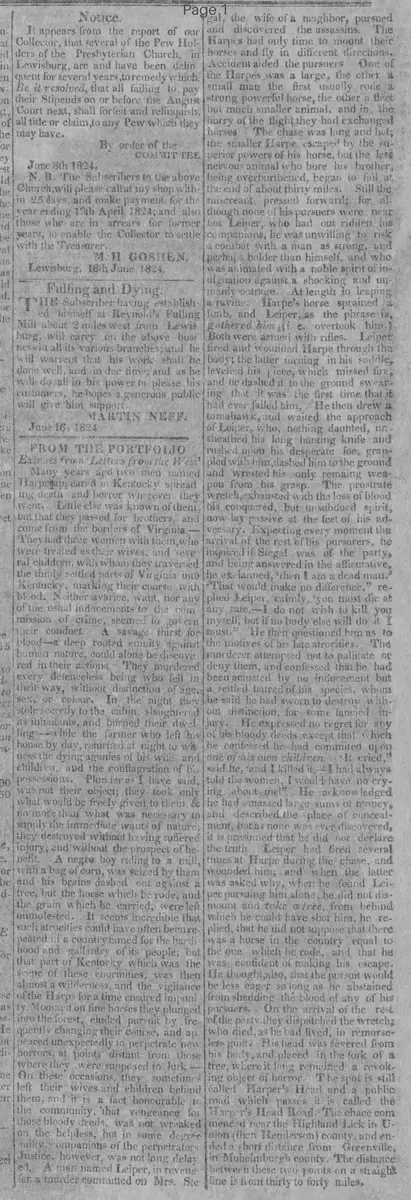
Many years ago two men named Harpes appeared in Kentucky spreading death and horror wherever they went. Little else was known of them, but that they passed for brothers, and came from the borders of Virginia. They had three women with them, who were treated as their wives, and several children, with whom they traversed the thinly settled parts of Virginia into Kentucky, marking their course with blood. Neither avarice, want, nor any of the usual inducements to the commission of crime, seemed to govern their conduct. A savage thirst for blood-a deep rooted enmity against human nature, could alone be discovered in their actions. They murdered every defenseless being who fell in their way, without distinction of age, sex, or colour. In the night they stole secretly to the cabin, slaughtered its inhabitants, and burned their dwellings--while the farmer who left his house by day, returned at night to witness the dying agonies of his wife and children, and the conflagration of his possessions. Plunder as I have said, was not their object; they took only what would be freely given to them, & no more than what was necessary to supply the immediate wants of nature; they destroyed without having suffered injury, and without the prospect of benefit. A negro boy riding to a mill, with a bag of corn, was seized by them and his brains dashed out against a tree, but the horse which he rode, and the grain which he carried, were left unmolested. It seems incredible that such atrocities could have often been repeated in a country famed for the hardihood and gallantry of its people; but that part of Kentucky which was the scene of these enormities, was then almost a wilderness, and the vigilance of the Harps for a time ensured impunity. Mounted on fine horses they plunged into the forest, eluded pursuit by frequently changing their course, and appeared unexpectedly to perpetrate new horrors, at points distant from those where they were supposed to lurk - On these occasions, they sometimes left their wives and children behind them, and it is a fact honourable to the community, that vengeance for those bloody deeds, was not wreaked on the helpless, but in some degree guilty, companions of the perpetrators. Justice, however, was not long delayed. A man named Leiper, in revenge for a murder committed on Mrs. Stegal, the wife of a neighbor, pursued and discovered the assassins. The Harpes had only time to mount their horses and fly in different directions. Accident aided the pursuers. One of the Harpes was a large, the other a small man; the first usually rode a strong powerful horse, the other a fleet but much smaller animal, and in the hurry of the flight they had exchanged horses. The chase was long and hot; the smaller Harpe escaped by the superior powers of his horse, but the less nervous animal who bore his brother, being overburdened, began to fail at the end of about thirty miles. Still the miscreant pressed forward; for although none of his pursuers were near but Leiper, who had out ridden his companions, he was unwilling to risk a combat with a man as strong, and perhaps bolder than himself, and who was animated with a noble spirit of indignation against a shocking and unmanly outrage. At length in leaping a ravine, Harpe's horse sprained his limb, and Leiper, as the phrase is, gathered him, i. e. overtook him. Both were armed with rifles. Leiper fired and wounded Harpe through the body; the latter turning in his saddle, levelled his piece, which missed fire, and he dashed it to the ground swearing that it was the first time that it had ever failed him. He then drew a tomahawk, and waited the approach of Leiper, who, nothing daunted, unsheathed his long hunting knife and rushed upon his desperate foe, grappled with him, dashed him to the ground and wrested his only remaining weapon from his grasp. The prostrate wretch, exhausted with the loss of blood his conqueror, but unsubdued spirit, now lay passive at the feet of his adversary. Expecting every moment the arrival of the rest of his pursuers, he inquired if Stegal was of the party and being answered in the affirmative, he exclaimed, 'then I am a dead man.' 'That would make no difference,' replied Leiper, calmly. 'you must die at any rate,--I do not wish to kill you myself, but if no body else will do it I must.' He then questioned him as to the motives of his late atrocities. The murderer attempted not to palliate or deny them, and confessed that he had been actuated by no inducement but a settled hatred of his species, whom he said he had sworn to destroy without distinction, or some fancied injury. He expressed no regret for any of his bloody deeds except that which he confessed he had committed upon one of his own children. 'It cried,' said he, 'and I killed it.--I had always told the women, I would have no crying about me!' He acknowledged he had amassed large sums of money, and described the place of concealment, but as none was ever discovered, it is presumed that he did not declare the truth. Leiper had fired several times at Harpe during the chase, and wounded him; and when the latter was asked why, when he found Leiper pursuing him alone, he did not dismount and take a tree, from behind which he could have shot him, he replied, that he did not suppose that there was a horse in the country equal to the one which he rode, and that he was confident of making his escape. He thought, also, that the pursuit would be less eager so long as he abstained from shedding the blood of any of his pursuers. On the arrival of the rest of the party they dispatched the wretch who died, as he had lived, in remorseless guilt. His head was severed from his body, and placed in the fork of a tree, where it long remained a revolting object of horror. The spot is still called Harper's Head and a public road which passes it is called the Harper's Head Road. The chase commenced near the Highland Lick in U. nion (then Henderson) county, and ended a short distance from Greenville, in Muhlenburgh county. The distance between these two points on a straight line is from thirty to forty miles.
The other Harpe made his way to the neighbourhood. I think. of Natchez, where he joined a band of robbers, headed by a man named Miller, whose villanies were so notorious that a reward was offered for his head. Harpe took an opportunity, when the rest of his companions were absent, to slay Miller, and putting his head in a bag he carried it forward and the claim was admitted: the head of Miller was recognized,--but so also was the head of Harpe, who was arrested and executed.
In collecting oral testimony with regard to circumstances long past, a considerable variety will be found in the statements of different persons. In this case I have found none except as in the fact of the two Harpes having exchanged horses. A day or two before the fatal denouement they had murdered a gentleman named Love, and had taken his horse, a remarkably fine animal, which "Big Harpe" undoubtedly rode when he was overtaken. It is said that "Little Harpe" escaped on foot, and not on his brother's horse. After Harper's death the women came in, and claimed protection. Two of them were the wives of the larger Harpe, the other one, of his brother. The latter was a decent female, of delicate prepossessing appearance who stated that she had married her husband without any knowledge of his real character, shortly before they set out for the west--that she was so much shocked at the first murder which they committed that she attempted to escape from them but was prevented, and that she had since made similar attempts. She immediately wrote to her father in Virginia, who came for her and took her home. The other women were in no way remarkable. They afterwards married in Muhlenburg county.
What sub-type of article is it?
What themes does it cover?
What keywords are associated?
What entities or persons were involved?
Where did it happen?
Story Details
Key Persons
Location
Kentucky, Near Highland Lick In Union (Then Henderson) County, Greenville In Muhlenburgh County, Borders Of Virginia, Neighbourhood Of Natchez
Event Date
Many Years Ago
Story Details
Two Harpe brothers and their families roamed from Virginia into Kentucky's wilderness, committing brutal, motiveless murders of defenseless people, burning cabins, and killing even their own child. Pursued by Leiper after murdering Mrs. Stegal, Big Harpe is chased, captured after a fight, confesses hatred for humanity, and executed; his head displayed at Harper's Head. Little Harpe escapes, joins robbers near Natchez, kills leader Miller for reward but is recognized by his own head and executed. Their women seek protection; one innocent wife returns to Virginia.