Thank you for visiting SNEWPapers!
Sign up free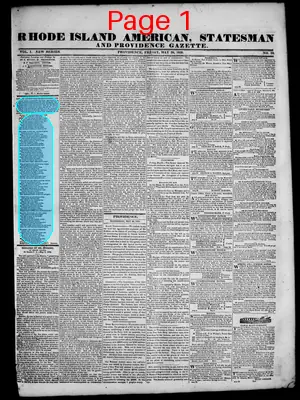
Rhode Island American, Statesman And Providence Gazette
Providence, Providence County, Rhode Island
What is this article about?
Revolutionary hero Colonel Barton, jailed for debt 20 years in Vermont, freed on July 4, 1826, by Lafayette paying his debt, allowing celebration of U.S. independence. Accompanied by a poetic dramatization of the liberation.
Merged-components note: The poem is a poetic rendition illustrating the historical anecdote in the preceding story component; they form a single logical unit on the same subject.
Clipping
OCR Quality
Full Text
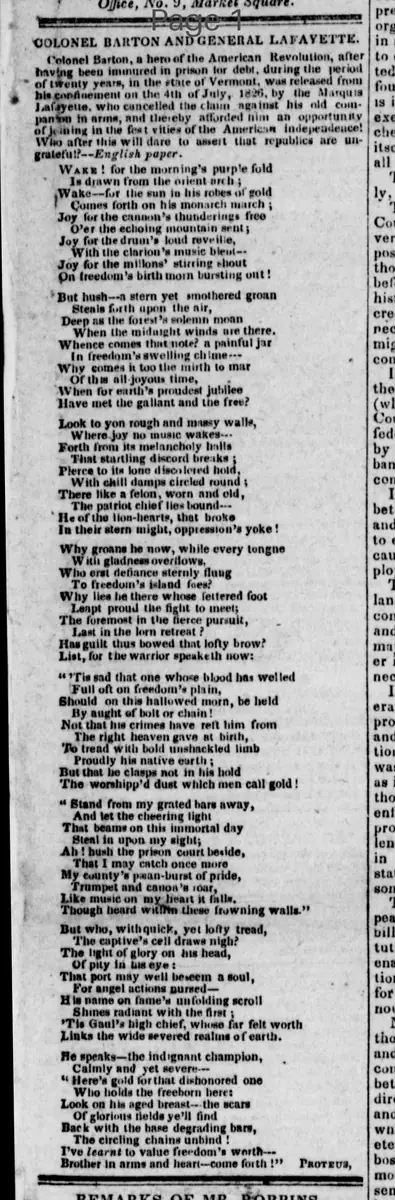
Colonel Barton, a hero of the American Revolution, after having been immured in prison for debt, during the period of twenty years, in the state of Vermont, was released from his confinement on the 4th of July, 1826, by the Marquis Lafayette, who cancelled the claim against his old companion in arms, and thereby afforded him an opportunity of joining in the festivities of the American independence!
Who after this will dare to assert that republics are ungrateful?--English paper.
Wake! for the morning's purple fold
Is drawn from the orient arch;
Wake--for the sun in his robes of gold
Comes forth on his monarch march;
Joy for the cannon's thunderings free
O'er the echoing mountain sent;
Joy for the drum's loud reveille,
With the clarion's music blent-.
Joy for the millions' stirring shout
On freedom's birth morn bursting out!
But hush--a stern yet smothered groan
Steals forth upon the air,
Deep as the forest's solemn moan
When the midnight winds are there.
Whence comes that note? a painful jar
In freedom's swelling chime---
Why comes it too the mirth to mar
Or this all-joyous time,
When for earth's proudest jubilee
Have met the gallant and the free?
Look to yon rough and massy walls,
Where joy no music wakes-..
Forth from its melancholy halls
That startling discord breaks;
Pierce to its lone discolored hold,
With chill damps circled round;
There like a felon, worn and old,
The patriot chief lies bound---
He of the lion-hearts, that broke
In their stern might, oppression's yoke!
Why groans he now, while every tongue
With gladness overflows,
Who erst defiance sternly flung
To freedom's island foes?
Why lies he there whose fettered foot
Leapt proud the fight to meet;
The foremost in the fierce pursuit,
Last in the lorn retreat?
Has guilt thus bowed that lofty brow?
List, for the warrior speaketh now:
"Tis sad that one whose blood has welled
Full oft on freedom's plain,
Should on this hallowed morn, be held
By aught of bolt or chain!
Not that his crimes have reft him from
The right heaven gave at birth,
To tread with bold unshackled limb
Proudly his native earth;
But that he clasps not in his hold
The worshipped dust which men call gold!
"Stand from my grated bars away,
And let the cheering light
That beams on this immortal day
Steal in upon my sight;
Ah! hush the prison court beside,
That I may catch once more
My country's paean-burst of pride,
Trumpet and cannon's roar,
Like music on my heart it falls.
Though heard within these frowning walls."
But who, with quick, yet lofty tread,
The captive's cell draws nigh?
The light of glory on his head,
Of pity in his eye:
That port may well beseem a soul,
For angel actions nursed—
His name on fame's unfolding scroll
Shines radiant with the first;
'Tis Gaul's high chief, whose far felt worth
Links the wide severed realms of earth.
He speaks-the indignant champion,
Calmly and yet severe.-
"Here's gold for that dishonored one
Who holds the freeborn here:
Look on his aged breast---the scars
Of glorious fields ye'll find
Back with the base degrading bars,
The circling chains unbind!
I've learnt to value freedom's worth-
Brother in arms and heart--come forth!"
What sub-type of article is it?
What themes does it cover?
What keywords are associated?
What entities or persons were involved?
Where did it happen?
Story Details
Key Persons
Location
State Of Vermont
Event Date
4th Of July, 1826
Story Details
Colonel Barton, a Revolutionary War hero, imprisoned for debt for 20 years in Vermont, is released on July 4, 1826, by Lafayette, who pays the debt, enabling Barton to join independence celebrations. A poem dramatizes the event, highlighting themes of freedom and heroism.