Thank you for visiting SNEWPapers!
Sign up free
Virginia Argus
Richmond, Virginia
What is this article about?
English papers to March 8 report parliamentary debate negativing motion against Orders in Council; complaints over US embargo; Britain-Turkey treaty; naval movements at Rochefort; rumors of France-Austria war; Wellesley on Portugal. Liverpool markets see price drops in American goods due to embargo breakers.
Clipping
OCR Quality
Full Text
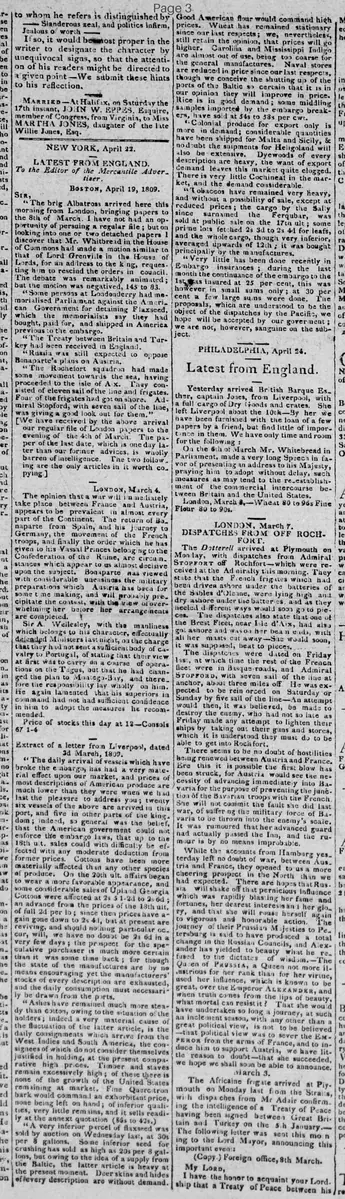
LATEST FROM ENGLAND.
To the Editor of the Mercantile Advertiser.
BOSTON, April 19, 1809.
SIR,
The brig Albatross arrived here this morning from London, bringing papers to the 8th of March. I have not had an opportunity of pursuing a regular file; but on looking into one or two detached papers I discover that Mr. Whitbread in the House of Commons had made a motion similar to that of Lord Grenville in the House of Lords, for an address to the king, requesting him to rescind the orders in council. The debate was remarkably animated; but the motion was negatived, 145 to 83.
Some persons at Londonderry had memorialised Parliament against the American Government for detaining Flaxseed, which the memorialists say they had bought, paid for, and shipped in America previous to the embargo.
The Treaty between Britain and Turkey had been received in England. Russia was still expected to oppose Bonaparte's plans on Austria.
The Rochefort squadron had made some movement towards the sea, having proceeded to the isle of Aix. They consisted of eleven sail of the line and frigates. Four of the frigates had got on shore. Admiral Stopford, with seven sail of the line, was giving a good look out for them.
[We have received by the above arrival our regular file of London papers to the evening of the 4th of March. The paper of the last date, which is one day later than our former advices, is wholly barren of intelligence. The two following are the only articles in it worth copying.]
London, March 4.
The opinion that a war will immediately take place between France and Austria, appears to be prevalent in almost every part of the Continent. The return of Bonaparte from Spain, and his journey to Germany, the movement of the French troops, and finally the order which he has given to his Vassal Princes belonging to the Confederation of the Rhine, are circumstances which appear to us almost decisive upon the subject. Bonaparte has viewed with considerable uneasiness the military preparations which Austria has been for some time making, and will probably precipitate the contest, with the view of overwhelming her before her arrangements are completed.
Sir A. Wellesley, with the manliness which belongs to his character, effectually defended Ministers last night, on the charge that they had not sent a sufficient body of cavalry to Portugal, of stating that their view at first was to carry on a course of operations on the Tagus, but that he had changed the plan to Mondego-Bay, and therefore the responsibility lay wholly on him. He again lamented that his superiors in command had not had sufficient confidence in him to adopt the measures he recommended.
Price of stocks this day at 1/8—Consols 67 1/4
Extract of a letter from Liverpool, dated 3d March, 1809.
The daily arrival of vessels which have broke the embargo, has had a very material effect upon our market, and prices of most descriptions of American produce are much lower than they were when we had last the pleasure to address you; twenty six vessels of the above are arrived in this port, and five in other parts of the kingdom; indeed, so general was the belief, that the American government could not enforce the embargo laws, that up to the 18th ult. sales could with difficulty be effected with any moderate deduction from former prices. Cottons have been more materially affected than any other species of produce. On the 20th ult. affairs began to wear a more favorable appearance, and some considerable sales of Upland Georgia Cottons were effected at 2s 5 1/2d to 2s 6d; an advance from the prices of the 18th ult. of full 2d per lb; since then prices have again gone down to 2s 4d, but at present are reviving, and should nothing particular occur, will, we have no doubt be 2s 6d in a very few days; the prospect for the speculative purchaser is much more certain than it was some time back; for though the state of the manufactures are by no means encouraging yet the manufacturers stocks of every description are exhausted, and the daily consumption must necessarily be drawn from the ports.
Ashes have remained much more steady than cotton, owing to the situation of the holders; indeed a very material cause of the fluctuation of the latter article, is the daily consignments which arrive from the West Indies and South America, the consignees of which do not consider themselves justified in holding, at the present comparative high prices. Timber and staves remain excessively high; of these there is none of the growth of the United States remaining at market, Fine Quercitron bark would command an exhorbitant price, none being left on hand; of inferior qualities, very little remains, and it sells readily at the annexed quotation (86s to 42s.)
A very inferior parcel of flaxseed was sold by auction on Wednesday last, at 30s per 8 gallons. Some inferior seed for crushing has sold as high as 20s per 8 gallons, but owing to the idea of a supply from the Baltic, the latter article is heavy at the present moment. Deer skins and hides of every description are without demand.
Good American flour would command high prices. Wheat has remained stationary since our last respects; we, nevertheless, still retain the opinion, that prices will go higher. Carolina and Mississippi Indigo are almost out of use, being too coarse for the general manufactures. Naval stores are reduced in price since our last respects, though we conceive the shutting up of the ports of the Baltic so certain that it is in our opinion they will improve in price.
Rice is in good demand; some middling samples imported by the embargo breakers, have sold at 54s to 58s per cwt.
Colonial produce for export only is more in demand; considerable quantities have been shipped for Malta and Sicily, & no doubt the shipments for Heligoland will also be extensive. Dyewoods of every description are heavy, the want of export demand leaves this market quite clogged. There is very little Cochineal in the market, and the demand considerable.
Tobaccos have remained very heavy, and without a possibility of sale, except at reduced prices; the cargo by the Sally since surnamed the Ferquhar, was sold at public sale on the 17th ult; some prime lots fetched 2s 3d to 2s 4d for leafs, and the whole cargo, though very inferior, averaged upwards of 1 1/2d; it was bought principally by the manufacturers.
Very little has been done recently in Embargo insurances: during the last month the continuance of the embargo to the 1st was insured at 25 per cent, this was however in small sums only; at 30 per cent a few large sums were done. The proposals, which are understood to be the object of the dispatches by the Pacific, we hope will be accepted by our government; we are not, however, sanguine on the subject.
What sub-type of article is it?
What keywords are associated?
What entities or persons were involved?
Where did it happen?
Foreign News Details
Primary Location
London
Event Date
March 1809
Key Persons
Outcome
motion negatived 145 to 83; consols 67 1/4; various market price fluctuations due to embargo-breaking vessels, e.g., upland georgia cottons at 2s 4d to 2s 6d per lb.
Event Details
Brig Albatross arrived from London with papers to March 8. Whitbread's motion in Commons to rescind Orders in Council debated and negatived. Memorial from Londonderry against US embargo on flaxseed. Britain-Turkey treaty received; Russia expected to oppose Bonaparte's plans on Austria. Rochefort squadron moved to Isle of Aix, four frigates aground; Stopford's seven sail watching. War between France and Austria imminent per continental opinion. Wellesley defended ministers on Portugal cavalry. Liverpool markets affected by embargo breakers: lower prices for American produce like cottons, steady ashes, high timber, fluctuating flaxseed, etc.