Thank you for visiting SNEWPapers!
Sign up free
Editorial
April 8, 1828
Lancaster Gazette
Lancaster, Worcester County, Massachusetts
What is this article about?
Address by the Administration Convention in Raleigh, NC, supporting re-election of President John Quincy Adams against unified opposition to General Jackson. Defends Adams' administration, criticizes personal rivalries over principles, and addresses charges on constitutional powers, foreign policy, and sectionalism.
Clipping
OCR Quality
98%
Excellent
Full Text
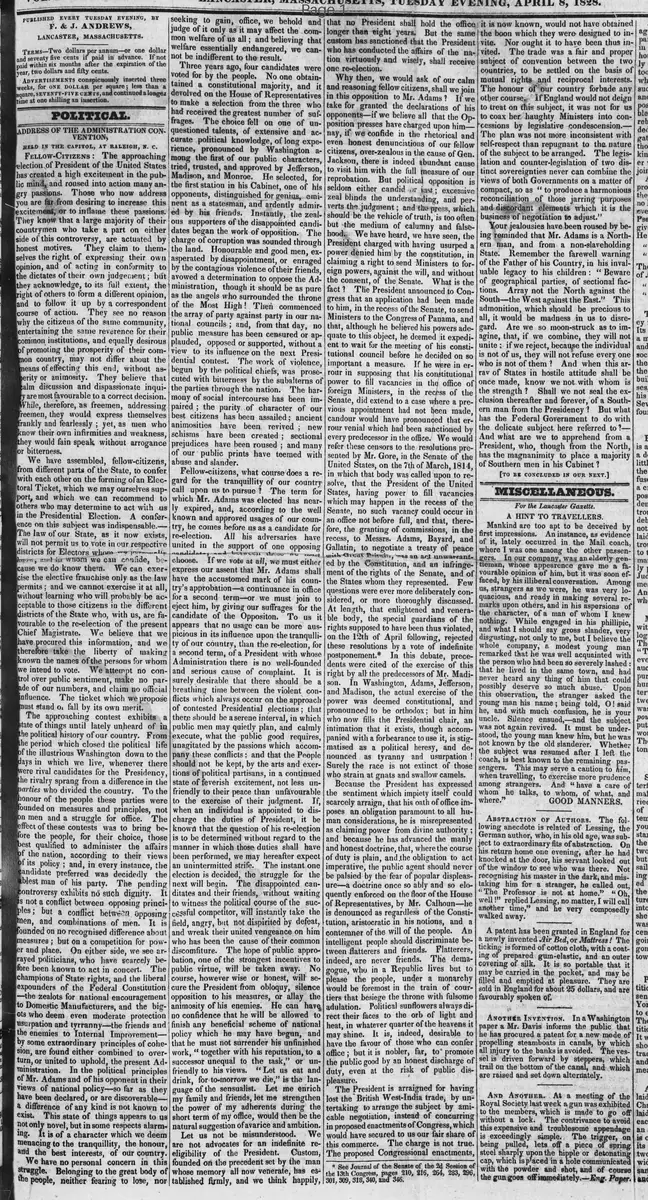
POLITICAL
ADDRESS OF THE ADMINISTRATION CONVENTION,
HELD IN THE CAPITOL, AT RALEIGH, N. C.
Fellow-Citizens: The approaching election of President of the United States has created a high excitement in the public mind, and roused into action many angry passions. Those who now address you are far from desiring to increase this excitement, or to inflame these passions. They know that a large majority of their countrymen who take a part on either side of this controversy, are actuated by honest motives. They claim to themselves the right of expressing their own opinion, and of acting in conformity to the dictates of their own judgement; but they acknowledge, to its full extent, the right of others to form a different opinion, and to follow it up by a correspondent course of action. They see no reason why the citizens of the same community, entertaining the same reverence for their common institutions, and equally desirous of promoting the prosperity of their common country, may not differ about the means of effecting this end, without asperity or animosity. They believe that calm discussion and dispassionate inquiry are most favourable to a correct decision. While, therefore, as freemen, addressing freemen, they would express themselves frankly and fearlessly; yet, as men who know their own infirmities and weakness, they would fain speak without arrogance or bitterness.
We have assembled, fellow-citizens, from different parts of the State, to confer with each other on the forming of an Electoral Ticket, which we may ourselves support, and which we can recommend to others who may determine to act with us in the Presidential Election. A conference on this subject was indispensable. The law of our State, as it now exists, will not permit us to vote in our respective districts for Electors whom we personally know, and in whom we can confide, because we do know them. We can exercise the elective franchise only as the law permits; and we cannot exercise it at all, without learning who will probably be acceptable to those citizens in the different districts of the State who, with us, are favourable to the re-election of the present Chief Magistrate. We believe that we have procured this information, and we therefore take the liberty of making known the names of the persons for whom we intend to vote. We attempt no control over public sentiment, make no parade of our numbers, and claim no official influence. The ticket which we propose must stand or fall by its own merit.
The approaching contest exhibits a state of things until lately unheard of in the political history of our country. From the period which closed the political life of the illustrious Washington down to the days in which we live, whenever there were rival candidates for the Presidency, the rivalry sprang from a difference in the parties who divided the country. To the honour of the people these parties were founded on measures and principles, not on men and a struggle for office. The effect of these contests was to bring before the people, for their choice, those best qualified to administer the affairs of the nation, according to their views of its policy; and, in every instance, the candidate preferred was decidedly the ablest man of his party. The pending controversy exhibits no such dignity. It is not a conflict between opposing principles; but a conflict between opposing men, and combinations of men. It is founded on no recognised difference about measures: but on a competition for power and place. On either side, we see arrayed politicians, who have scarcely before been known to act in concert. The champions of State rights, and the liberal expounders of the Federal Constitution—the zealots for national encouragement to Domestic Manufacturers, and the bigots who deem even moderate protection usurpation and tyranny—the friends and the enemies to Internal Improvement—by some extraordinary principles of cohesion, are found either combined to overthrow, or united to uphold, the present Administration. In the political principles of Mr. Adams and of his opponent in their views of national policy—so far as they have been declared, or are discoverable—a difference of any kind is not known to exist. This state of things appears to us not only novel, but in some respects alarming. It is of a character which we deem menacing to the tranquillity, the honour, and the best interests, of our country.
We have no personal concern in this struggle. Belonging to the great body of the people, neither fearing to lose, nor seeking to gain, office, we behold and judge of it only as it may affect the common welfare of us all; and believing that welfare essentially endangered, we cannot be indifferent to the result.
Three years ago, four candidates were voted for by the people. No one obtained a constitutional majority, and it devolved on the House of Representatives to make a selection from the three who had received the greatest number of suffrages. The choice fell on one of unquestioned talents, of extensive and accurate political knowledge, of long experience, pronounced by Washington among the first of our public characters, tried, trusted, and approved by Jefferson, Madison, and Monroe. He selected, for the first station in his Cabinet, one of his opponents, distinguished for genius, eminent as a statesman, and ardently admired by his friends. Instantly, the zealous supporters of the disappointed candidates began the work of opposition. The charge of corruption was sounded through the land. Honourable and good men, exasperated by disappointment, or enraged by the contagious violence of their friends, avowed a determination to oppose the Administration, though it should be as pure as the angels who surrounded the throne of the Most High! Then commenced the array of party against party in our national councils; and, from that day, no public measure has been censured or applauded, opposed or supported, without a view to its influence on the next Presidential contest. The work of violence, begun by the political chiefs, was prosecuted with bitterness by the subalterns of the parties through the nation. The harmony of social intercourse has been impaired; the purity of character of our best citizens has been assailed; ancient animosities have been revived; new schisms have been created; sectional prejudices have been roused; and many of our public prints have teemed with abuse and slander.
Fellow-citizens, what course does a regard for the tranquillity of our country call upon us to pursue? The term for which Mr. Adams was elected has nearly expired, and, according to the well known and approved usages of our country, he comes before us as a candidate for re-election. All his adversaries have united in the support of one opposing candidate—and we have to choose. If we vote at all, we must either express our assent that Mr. Adams shall have the accustomed mark of his country's approbation—a continuance in office for a second term—or we must join to eject him, by giving our suffrages for the candidate of the Opposition. To us it appears that no usage can be more auspicious in its influence upon the tranquillity of our country, than the re-election, for a second term, of a President with whose Administration there is no well-founded and serious cause of complaint. It is surely desirable that there should be a breathing time between the violent conflicts which always occur on the approach of contested Presidential elections; that there should be a serene interval, in which public men may quietly plan, and calmly execute, what the public good requires, unagitated by the passions which accompany these conflicts; and that the People should not be kept, by the arts and exertions of political partisans, in a continued state of feverish excitement, not less unfriendly to their peace than unfavourable to the exercise of their judgment. If, when an individual is appointed to discharge the duties of President, it be known that the question of his re-election is to be determined without regard to the manner in which those duties shall have been performed, we may hereafter expect an unintermitted strife. The instant one election is decided, the struggle for the next will begin. The disappointed candidates and their friends, without waiting to witness the political course of the successful competitor, will instantly take the field, angry, but not dispirited by defeat, and wreak their united vengeance on him who has been the cause of their common discomfiture. The hope of public approbation, one of the strongest incentives to public virtue, will be taken away. No course, however wise or honest, will secure the President from obloquy, silence opposition to his measures, or allay the animosity of his enemies. He can have no confidence that he will be allowed to finish any beneficial scheme of national policy which he may have begun, and that he must not surrender his unfinished work, "together with his reputation, to a successor unequal to the task," or unfriendly to his views. "Let us eat and drink, for to-morrow we die," is the language of the sensualist. Let me enrich my family and friends, let me strengthen the power of my adherents during the short term of my office, would then be the natural suggestion of avarice and ambition.
Let us not be misunderstood. We are not advocates for an indefinite re-eligibility of the President. Custom, founded on the precedent set by the man whose memory all now venerate, has established firmly, and we think happily, that no President shall hold the office longer than eight years. But the same custom has sanctioned that the President who has conducted the affairs of the nation virtuously and wisely, shall receive one re-election.
Why then, we would ask of our calm and reasoning fellow citizens, shall we join in this opposition to Mr. Adams? If we take for granted the declarations of his opponents—if we believe all that the Opposition presses have charged upon him—nay, if we confide in the rhetorical and even honest denunciations of our fellow citizens, over-zealous in the cause of Gen. Jackson, there is indeed abundant cause to visit him with the full measure of our reprobation. But political opposition is seldom either candid or just; excessive zeal blinds the understanding, and perverts the judgment; and the press, which should be the vehicle of truth, is too often but the medium of calumny and falsehood. We have heard, we have seen, the President charged with having usurped a power denied him by the constitution, in claiming a right to send Ministers to foreign powers, against the will, and without the consent, of the Senate. What is the fact? The President announced to Congress that an application had been made to him, in the recess of the Senate, to send Ministers to the Congress of Panama, and that, although he believed his powers adequate to this object, he deemed it expedient to wait for the meeting of his constitutional council before he decided on so important a measure. If he were in error in supposing that his constitutional power to fill vacancies in the office of foreign Ministers, in the recess of the Senate, did extend to a case where a previous appointment had not been made, candour would have pronounced that error venial which had been sanctioned by every predecessor in the office. We would refer these censors to the resolutions presented by Mr. Gore, in the Senate of the United States, on the 7th of March, 1814, in which that body was called upon to resolve, that the President of the United States, having power to fill vacancies which may happen in the recess of the Senate, no such vacancy could occur in an office not before full, and that, therefore, the granting of commissions, in the recess, to Messrs. Adams, Bayard, and Gallatin, to negotiate a treaty of peace with Great Britain, was an act unwarranted by the Constitution, and an infringement of the rights of the Senate, and of the States whom they represented. Few questions were ever more deliberately considered, or more thoroughly discussed. At length, that enlightened and venerable body, the special guardians of the rights supposed to have been thus violated, on the 12th of April following, rejected these resolutions by a vote of indefinite postponement. In this debate, precedents were cited of the exercise of this right by all the predecessors of Mr. Madison. In Washington, Adams, Jefferson, and Madison, the actual exercise of the power was deemed constitutional, and pronounced to be orthodox; but in him who now fills the Presidential chair, an intimation that it exists, though accompanied with a forbearance to use it, is stigmatised as a political heresy, and denounced as tyranny and usurpation! Surely the race is not extinct of those who strain at gnats and swallow camels.
Because the President has expressed the sentiment which impiety itself could scarcely arraign, that his oath of office imposes an obligation paramount to all human considerations, he is misrepresented as claiming power from divine authority; and because he has advanced the manly and honest doctrine, that, where the course of duty is plain, and the obligation to act imperative, the public agent should never be palsied by the fear of popular displeasure—a doctrine once so ably and so eloquently enforced on the floor of the House of Representatives, by Mr. Calhoun—he is denounced as regardless of the Constitution, aristocratic in his notions, and a contemner of the will of the people. An intelligent people should discriminate between flatterers and friends. Flatterers, indeed, are never friends. The demagogue, who in a Republic lives but to please the people, under a monarchy would be foremost in the train of courtiers that besiege the throne with fulsome adulation. Political sunflowers always direct their faces to the orb of light and heat, in whatever quarter of the heavens it may shine. It is, indeed, desirable to have the favour of those who can confer office; but it is nobler, far, to promote the public good by an honest discharge of duty, even at the risk of public displeasure.
The President is arraigned for having lost the British West-India trade, by undertaking to arrange the subject by amicable negotiation, instead of concurring in proposed enactments of Congress, which would have secured to us our fair share of this commerce. The charge is not true. The proposed Congressional enactments, it is now known, would not have obtained the boon which they were designed to invite. Nor ought it to have been thus invited. The trade was a fair and proper subject of convention between the two countries, to be settled on the basis of mutual rights and reciprocal interests. The honour of our country forbade any other course. If England would not deign to treat on this subject, it was not for us to coax her haughty Ministers into concessions by legislative condescension. The plan was not more inconsistent with self-respect than repugnant to the nature of the subject to be arranged. The legislation and counter-legislation of two distinct sovereignties never can combine the views of both Governments on a matter of compact, so as "to produce a harmonious reconciliation of those jarring purposes and discordant elements which it is the business of negotiation to adjust."
Your jealousies have been roused by being reminded that Mr. Adams is a Northern man, and from a non-slaveholding State. Remember the farewell warning of the Father of his Country, in his invaluable legacy to his children: "Beware of geographical parties, of sectional factions. Array not the North against the South—the West against the East." This admonition, which should be precious to all, it would be madness in us to disregard. Are we so moon-struck as to imagine, that, if we combine, they will not unite; if we reject, because the individual is not of us, they will not refuse every one who is not of them? And when this array of States in hostile attitude shall be once made, know we not with whom is the strength? Shall we not seal the exclusion thereafter and forever, of a Southern man from the Presidency? But what has the Federal Government to do with the delicate subject here referred to?—And what are we to apprehend from a President, who, though from the North, has the magnanimity to place a majority of Southern men in his Cabinet?
[TO BE CONCLUDED IN OUR NEXT.]
ADDRESS OF THE ADMINISTRATION CONVENTION,
HELD IN THE CAPITOL, AT RALEIGH, N. C.
Fellow-Citizens: The approaching election of President of the United States has created a high excitement in the public mind, and roused into action many angry passions. Those who now address you are far from desiring to increase this excitement, or to inflame these passions. They know that a large majority of their countrymen who take a part on either side of this controversy, are actuated by honest motives. They claim to themselves the right of expressing their own opinion, and of acting in conformity to the dictates of their own judgement; but they acknowledge, to its full extent, the right of others to form a different opinion, and to follow it up by a correspondent course of action. They see no reason why the citizens of the same community, entertaining the same reverence for their common institutions, and equally desirous of promoting the prosperity of their common country, may not differ about the means of effecting this end, without asperity or animosity. They believe that calm discussion and dispassionate inquiry are most favourable to a correct decision. While, therefore, as freemen, addressing freemen, they would express themselves frankly and fearlessly; yet, as men who know their own infirmities and weakness, they would fain speak without arrogance or bitterness.
We have assembled, fellow-citizens, from different parts of the State, to confer with each other on the forming of an Electoral Ticket, which we may ourselves support, and which we can recommend to others who may determine to act with us in the Presidential Election. A conference on this subject was indispensable. The law of our State, as it now exists, will not permit us to vote in our respective districts for Electors whom we personally know, and in whom we can confide, because we do know them. We can exercise the elective franchise only as the law permits; and we cannot exercise it at all, without learning who will probably be acceptable to those citizens in the different districts of the State who, with us, are favourable to the re-election of the present Chief Magistrate. We believe that we have procured this information, and we therefore take the liberty of making known the names of the persons for whom we intend to vote. We attempt no control over public sentiment, make no parade of our numbers, and claim no official influence. The ticket which we propose must stand or fall by its own merit.
The approaching contest exhibits a state of things until lately unheard of in the political history of our country. From the period which closed the political life of the illustrious Washington down to the days in which we live, whenever there were rival candidates for the Presidency, the rivalry sprang from a difference in the parties who divided the country. To the honour of the people these parties were founded on measures and principles, not on men and a struggle for office. The effect of these contests was to bring before the people, for their choice, those best qualified to administer the affairs of the nation, according to their views of its policy; and, in every instance, the candidate preferred was decidedly the ablest man of his party. The pending controversy exhibits no such dignity. It is not a conflict between opposing principles; but a conflict between opposing men, and combinations of men. It is founded on no recognised difference about measures: but on a competition for power and place. On either side, we see arrayed politicians, who have scarcely before been known to act in concert. The champions of State rights, and the liberal expounders of the Federal Constitution—the zealots for national encouragement to Domestic Manufacturers, and the bigots who deem even moderate protection usurpation and tyranny—the friends and the enemies to Internal Improvement—by some extraordinary principles of cohesion, are found either combined to overthrow, or united to uphold, the present Administration. In the political principles of Mr. Adams and of his opponent in their views of national policy—so far as they have been declared, or are discoverable—a difference of any kind is not known to exist. This state of things appears to us not only novel, but in some respects alarming. It is of a character which we deem menacing to the tranquillity, the honour, and the best interests, of our country.
We have no personal concern in this struggle. Belonging to the great body of the people, neither fearing to lose, nor seeking to gain, office, we behold and judge of it only as it may affect the common welfare of us all; and believing that welfare essentially endangered, we cannot be indifferent to the result.
Three years ago, four candidates were voted for by the people. No one obtained a constitutional majority, and it devolved on the House of Representatives to make a selection from the three who had received the greatest number of suffrages. The choice fell on one of unquestioned talents, of extensive and accurate political knowledge, of long experience, pronounced by Washington among the first of our public characters, tried, trusted, and approved by Jefferson, Madison, and Monroe. He selected, for the first station in his Cabinet, one of his opponents, distinguished for genius, eminent as a statesman, and ardently admired by his friends. Instantly, the zealous supporters of the disappointed candidates began the work of opposition. The charge of corruption was sounded through the land. Honourable and good men, exasperated by disappointment, or enraged by the contagious violence of their friends, avowed a determination to oppose the Administration, though it should be as pure as the angels who surrounded the throne of the Most High! Then commenced the array of party against party in our national councils; and, from that day, no public measure has been censured or applauded, opposed or supported, without a view to its influence on the next Presidential contest. The work of violence, begun by the political chiefs, was prosecuted with bitterness by the subalterns of the parties through the nation. The harmony of social intercourse has been impaired; the purity of character of our best citizens has been assailed; ancient animosities have been revived; new schisms have been created; sectional prejudices have been roused; and many of our public prints have teemed with abuse and slander.
Fellow-citizens, what course does a regard for the tranquillity of our country call upon us to pursue? The term for which Mr. Adams was elected has nearly expired, and, according to the well known and approved usages of our country, he comes before us as a candidate for re-election. All his adversaries have united in the support of one opposing candidate—and we have to choose. If we vote at all, we must either express our assent that Mr. Adams shall have the accustomed mark of his country's approbation—a continuance in office for a second term—or we must join to eject him, by giving our suffrages for the candidate of the Opposition. To us it appears that no usage can be more auspicious in its influence upon the tranquillity of our country, than the re-election, for a second term, of a President with whose Administration there is no well-founded and serious cause of complaint. It is surely desirable that there should be a breathing time between the violent conflicts which always occur on the approach of contested Presidential elections; that there should be a serene interval, in which public men may quietly plan, and calmly execute, what the public good requires, unagitated by the passions which accompany these conflicts; and that the People should not be kept, by the arts and exertions of political partisans, in a continued state of feverish excitement, not less unfriendly to their peace than unfavourable to the exercise of their judgment. If, when an individual is appointed to discharge the duties of President, it be known that the question of his re-election is to be determined without regard to the manner in which those duties shall have been performed, we may hereafter expect an unintermitted strife. The instant one election is decided, the struggle for the next will begin. The disappointed candidates and their friends, without waiting to witness the political course of the successful competitor, will instantly take the field, angry, but not dispirited by defeat, and wreak their united vengeance on him who has been the cause of their common discomfiture. The hope of public approbation, one of the strongest incentives to public virtue, will be taken away. No course, however wise or honest, will secure the President from obloquy, silence opposition to his measures, or allay the animosity of his enemies. He can have no confidence that he will be allowed to finish any beneficial scheme of national policy which he may have begun, and that he must not surrender his unfinished work, "together with his reputation, to a successor unequal to the task," or unfriendly to his views. "Let us eat and drink, for to-morrow we die," is the language of the sensualist. Let me enrich my family and friends, let me strengthen the power of my adherents during the short term of my office, would then be the natural suggestion of avarice and ambition.
Let us not be misunderstood. We are not advocates for an indefinite re-eligibility of the President. Custom, founded on the precedent set by the man whose memory all now venerate, has established firmly, and we think happily, that no President shall hold the office longer than eight years. But the same custom has sanctioned that the President who has conducted the affairs of the nation virtuously and wisely, shall receive one re-election.
Why then, we would ask of our calm and reasoning fellow citizens, shall we join in this opposition to Mr. Adams? If we take for granted the declarations of his opponents—if we believe all that the Opposition presses have charged upon him—nay, if we confide in the rhetorical and even honest denunciations of our fellow citizens, over-zealous in the cause of Gen. Jackson, there is indeed abundant cause to visit him with the full measure of our reprobation. But political opposition is seldom either candid or just; excessive zeal blinds the understanding, and perverts the judgment; and the press, which should be the vehicle of truth, is too often but the medium of calumny and falsehood. We have heard, we have seen, the President charged with having usurped a power denied him by the constitution, in claiming a right to send Ministers to foreign powers, against the will, and without the consent, of the Senate. What is the fact? The President announced to Congress that an application had been made to him, in the recess of the Senate, to send Ministers to the Congress of Panama, and that, although he believed his powers adequate to this object, he deemed it expedient to wait for the meeting of his constitutional council before he decided on so important a measure. If he were in error in supposing that his constitutional power to fill vacancies in the office of foreign Ministers, in the recess of the Senate, did extend to a case where a previous appointment had not been made, candour would have pronounced that error venial which had been sanctioned by every predecessor in the office. We would refer these censors to the resolutions presented by Mr. Gore, in the Senate of the United States, on the 7th of March, 1814, in which that body was called upon to resolve, that the President of the United States, having power to fill vacancies which may happen in the recess of the Senate, no such vacancy could occur in an office not before full, and that, therefore, the granting of commissions, in the recess, to Messrs. Adams, Bayard, and Gallatin, to negotiate a treaty of peace with Great Britain, was an act unwarranted by the Constitution, and an infringement of the rights of the Senate, and of the States whom they represented. Few questions were ever more deliberately considered, or more thoroughly discussed. At length, that enlightened and venerable body, the special guardians of the rights supposed to have been thus violated, on the 12th of April following, rejected these resolutions by a vote of indefinite postponement. In this debate, precedents were cited of the exercise of this right by all the predecessors of Mr. Madison. In Washington, Adams, Jefferson, and Madison, the actual exercise of the power was deemed constitutional, and pronounced to be orthodox; but in him who now fills the Presidential chair, an intimation that it exists, though accompanied with a forbearance to use it, is stigmatised as a political heresy, and denounced as tyranny and usurpation! Surely the race is not extinct of those who strain at gnats and swallow camels.
Because the President has expressed the sentiment which impiety itself could scarcely arraign, that his oath of office imposes an obligation paramount to all human considerations, he is misrepresented as claiming power from divine authority; and because he has advanced the manly and honest doctrine, that, where the course of duty is plain, and the obligation to act imperative, the public agent should never be palsied by the fear of popular displeasure—a doctrine once so ably and so eloquently enforced on the floor of the House of Representatives, by Mr. Calhoun—he is denounced as regardless of the Constitution, aristocratic in his notions, and a contemner of the will of the people. An intelligent people should discriminate between flatterers and friends. Flatterers, indeed, are never friends. The demagogue, who in a Republic lives but to please the people, under a monarchy would be foremost in the train of courtiers that besiege the throne with fulsome adulation. Political sunflowers always direct their faces to the orb of light and heat, in whatever quarter of the heavens it may shine. It is, indeed, desirable to have the favour of those who can confer office; but it is nobler, far, to promote the public good by an honest discharge of duty, even at the risk of public displeasure.
The President is arraigned for having lost the British West-India trade, by undertaking to arrange the subject by amicable negotiation, instead of concurring in proposed enactments of Congress, which would have secured to us our fair share of this commerce. The charge is not true. The proposed Congressional enactments, it is now known, would not have obtained the boon which they were designed to invite. Nor ought it to have been thus invited. The trade was a fair and proper subject of convention between the two countries, to be settled on the basis of mutual rights and reciprocal interests. The honour of our country forbade any other course. If England would not deign to treat on this subject, it was not for us to coax her haughty Ministers into concessions by legislative condescension. The plan was not more inconsistent with self-respect than repugnant to the nature of the subject to be arranged. The legislation and counter-legislation of two distinct sovereignties never can combine the views of both Governments on a matter of compact, so as "to produce a harmonious reconciliation of those jarring purposes and discordant elements which it is the business of negotiation to adjust."
Your jealousies have been roused by being reminded that Mr. Adams is a Northern man, and from a non-slaveholding State. Remember the farewell warning of the Father of his Country, in his invaluable legacy to his children: "Beware of geographical parties, of sectional factions. Array not the North against the South—the West against the East." This admonition, which should be precious to all, it would be madness in us to disregard. Are we so moon-struck as to imagine, that, if we combine, they will not unite; if we reject, because the individual is not of us, they will not refuse every one who is not of them? And when this array of States in hostile attitude shall be once made, know we not with whom is the strength? Shall we not seal the exclusion thereafter and forever, of a Southern man from the Presidency? But what has the Federal Government to do with the delicate subject here referred to?—And what are we to apprehend from a President, who, though from the North, has the magnanimity to place a majority of Southern men in his Cabinet?
[TO BE CONCLUDED IN OUR NEXT.]
What sub-type of article is it?
Partisan Politics
Constitutional
Foreign Affairs
What keywords are associated?
Adams Re Election
Presidential Contest
Partisan Opposition
Constitutional Powers
Panama Congress
West India Trade
Sectional Prejudices
What entities or persons were involved?
John Quincy Adams
Gen. Jackson
Washington
Jefferson
Madison
Monroe
Calhoun
Administration Convention
Senate
Editorial Details
Primary Topic
Support For John Quincy Adams' Re Election
Stance / Tone
Strongly Supportive Of Adams, Critical Of Jackson Opposition
Key Figures
John Quincy Adams
Gen. Jackson
Washington
Jefferson
Madison
Monroe
Calhoun
Administration Convention
Senate
Key Arguments
Election Should Be Based On Principles, Not Personal Rivalries
Re Election Of Adams Promotes National Tranquility
Opposition Charges Of Usurpation On Panama Ministers Are Unfounded, Supported By Precedents
Adams' Oath And Duty Doctrine Misrepresented
Negotiation Preferable To Legislation For British West India Trade
Warn Against Sectional Divisions Based On Adams' Northern Origin