Thank you for visiting SNEWPapers!
Sign up free
Letter to Editor
October 13, 1806
Norfolk Gazette And Publick Ledger
Norfolk, Virginia
What is this article about?
In this 1806 letter, 'Hampden' defends Rep. John Randolph against claims he sought a diplomatic post to England due to disappointment, clarifying that brief discussions among congressmen about his suitability for a mission addressing British maritime aggressions were twisted by factional malice without his involvement.
Clipping
OCR Quality
98%
Excellent
Full Text
From the Enquirer.
COMMUNICATION.
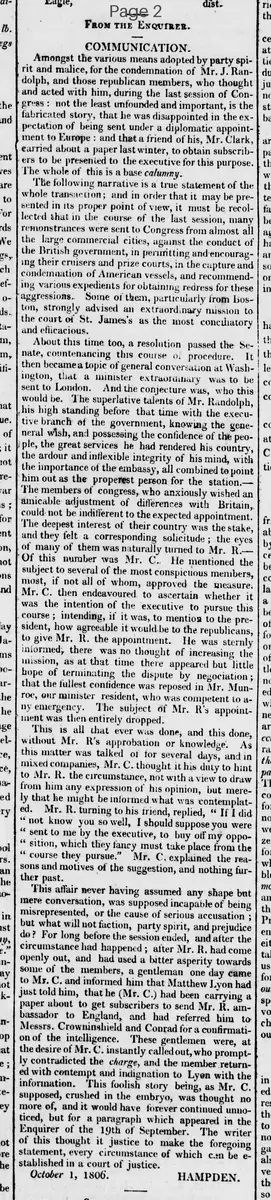
Amongst the various means adopted by party spirit and malice, for the condemnation of Mr. J. Randolph, and those republican members, who thought and acted with him, during the last session of Congress: not the least unfounded and important, is the fabricated story, that he was disappointed in the expectation of being sent under a diplomatic appointment to Europe: and that a friend of his, Mr. Clark, carried about a paper last winter, to obtain subscribers to be presented to the executive for this purpose.
The whole of this is a base calumny.
The following narrative is a true statement of the whole transaction; and in order that it may be presented in its proper point of view, it must be recollected that in the course of the last session, many remonstrances were sent to Congress from almost all the large commercial cities, against the conduct of the British government, in permitting and encouraging their cruisers and prize courts, in the capture and condemnation of American vessels, and recommending various expedients for obtaining redress for these aggressions. Some of them, particularly from Boston, strongly advised an extraordinary mission to the court of St. James's as the most conciliatory and efficacious.
About this time too, a resolution passed the Senate, countenancing this course of procedure. It then became a topic of general conversation at Washington, that a minister extraordinary was to be sent to London. And the conjecture was, who this would be. The superlative talents of Mr. Randolph, his high standing before that time with the executive branch of the government, knowing the general wish, and possessing the confidence of the people, the great services he had rendered his country, the ardour and inflexible integrity of his mind, with the importance of the embassy, all combined to point him out as the properest person for the station.
The members of congress, who anxiously wished an amicable adjustment of differences with Britain, could not be indifferent to the expected appointment. The deepest interest of their country was the stake and they felt a corresponding solicitude; the eyes of many of them was naturally turned to Mr. R. Of this number was Mr. C. He mentioned the subject to several of the most conspicuous members, most, if not all of whom, approved the measure: Mr. C. then endeavoured to ascertain whether it was the intention of the executive to pursue this course; intending, if it was, to mention to the president, how agreeable it would be to the republicans, to give Mr. R. the appointment. He was sternly informed; there was no thought of increasing the mission, as at that time there appeared but little hope of terminating the dispute by negociation; that the fullest confidence was reposed in Mr. Monroe, our minister resident, who was competent to any emergency. The subject of Mr. R's appointment was then entirely dropped.
This is all that ever was done, and this done, without Mr. R's approbation or knowledge. As this matter was talked of for several days, and in mixed companies, Mr. C. thought it his duty to hint to Mr. R. the circumstance, not with a view to draw from him any expression of his opinion, but merely that he might be informed what was contemplated. Mr. R. turning to his friend, replied, "If I did not know you so well, I should suppose you were sent to me by the executive, to buy off my opposition, which they fancy must take place from the course they pursue." Mr. C. explained the reasons and motives of the suggestion, and nothing further past.
This affair never having assumed any shape but mere conversation, was supposed incapable of being misrepresented, or the cause of serious accusation; but what will not faction, party spirit, and prejudice do? For long before the session ended, and after the circumstance had happened; after Mr. R. had come openly out, and had used a bitter asperity towards some of the members, a gentleman one day came to Mr. C. and informed him that Matthew Lyon had just told him, that he (Mr. C.) had been carrying a paper about to get subscribers to send Mr. R. ambassador to England, and had referred him to Messrs. Crowninshield and Conrad for a confirmation of the intelligence. These gentlemen were, at the desire of Mr. C. instantly called out, who promptly contradicted the charge, and the member returned with contempt and indignation to Lyon with the information. This foolish story being, as Mr. C. supposed, crushed in the embryo, was thought no more of, and it would have forever continued unnoticed, but for a paragraph which appeared in the Enquirer of the 19th of September. The writer of this thought it justice to make the foregoing statement, every circumstance of which can be established in a court of justice.
October 1, 1806.
HAMPDEN.
COMMUNICATION.
Amongst the various means adopted by party spirit and malice, for the condemnation of Mr. J. Randolph, and those republican members, who thought and acted with him, during the last session of Congress: not the least unfounded and important, is the fabricated story, that he was disappointed in the expectation of being sent under a diplomatic appointment to Europe: and that a friend of his, Mr. Clark, carried about a paper last winter, to obtain subscribers to be presented to the executive for this purpose.
The whole of this is a base calumny.
The following narrative is a true statement of the whole transaction; and in order that it may be presented in its proper point of view, it must be recollected that in the course of the last session, many remonstrances were sent to Congress from almost all the large commercial cities, against the conduct of the British government, in permitting and encouraging their cruisers and prize courts, in the capture and condemnation of American vessels, and recommending various expedients for obtaining redress for these aggressions. Some of them, particularly from Boston, strongly advised an extraordinary mission to the court of St. James's as the most conciliatory and efficacious.
About this time too, a resolution passed the Senate, countenancing this course of procedure. It then became a topic of general conversation at Washington, that a minister extraordinary was to be sent to London. And the conjecture was, who this would be. The superlative talents of Mr. Randolph, his high standing before that time with the executive branch of the government, knowing the general wish, and possessing the confidence of the people, the great services he had rendered his country, the ardour and inflexible integrity of his mind, with the importance of the embassy, all combined to point him out as the properest person for the station.
The members of congress, who anxiously wished an amicable adjustment of differences with Britain, could not be indifferent to the expected appointment. The deepest interest of their country was the stake and they felt a corresponding solicitude; the eyes of many of them was naturally turned to Mr. R. Of this number was Mr. C. He mentioned the subject to several of the most conspicuous members, most, if not all of whom, approved the measure: Mr. C. then endeavoured to ascertain whether it was the intention of the executive to pursue this course; intending, if it was, to mention to the president, how agreeable it would be to the republicans, to give Mr. R. the appointment. He was sternly informed; there was no thought of increasing the mission, as at that time there appeared but little hope of terminating the dispute by negociation; that the fullest confidence was reposed in Mr. Monroe, our minister resident, who was competent to any emergency. The subject of Mr. R's appointment was then entirely dropped.
This is all that ever was done, and this done, without Mr. R's approbation or knowledge. As this matter was talked of for several days, and in mixed companies, Mr. C. thought it his duty to hint to Mr. R. the circumstance, not with a view to draw from him any expression of his opinion, but merely that he might be informed what was contemplated. Mr. R. turning to his friend, replied, "If I did not know you so well, I should suppose you were sent to me by the executive, to buy off my opposition, which they fancy must take place from the course they pursue." Mr. C. explained the reasons and motives of the suggestion, and nothing further past.
This affair never having assumed any shape but mere conversation, was supposed incapable of being misrepresented, or the cause of serious accusation; but what will not faction, party spirit, and prejudice do? For long before the session ended, and after the circumstance had happened; after Mr. R. had come openly out, and had used a bitter asperity towards some of the members, a gentleman one day came to Mr. C. and informed him that Matthew Lyon had just told him, that he (Mr. C.) had been carrying a paper about to get subscribers to send Mr. R. ambassador to England, and had referred him to Messrs. Crowninshield and Conrad for a confirmation of the intelligence. These gentlemen were, at the desire of Mr. C. instantly called out, who promptly contradicted the charge, and the member returned with contempt and indignation to Lyon with the information. This foolish story being, as Mr. C. supposed, crushed in the embryo, was thought no more of, and it would have forever continued unnoticed, but for a paragraph which appeared in the Enquirer of the 19th of September. The writer of this thought it justice to make the foregoing statement, every circumstance of which can be established in a court of justice.
October 1, 1806.
HAMPDEN.
What sub-type of article is it?
Persuasive
Political
Informative
What themes does it cover?
Politics
Commerce Trade
Military War
What keywords are associated?
John Randolph
Diplomatic Mission
British Aggressions
Party Calumny
Congress Session
Political Intrigue
American Vessels
Senate Resolution
What entities or persons were involved?
Hampden
Letter to Editor Details
Author
Hampden
Main Argument
the letter refutes the false accusation that mr. j. randolph sought a diplomatic appointment to europe out of disappointment, explaining that an informal conversation among congressmen about his suitability for a mission to britain was misconstrued by political opponents without his knowledge or involvement.
Notable Details
Mentions Remonstrances From Commercial Cities Like Boston Against British Captures Of American Vessels
Senate Resolution Supporting An Extraordinary Mission To London
Involves Mr. Clark (Mr. C.) Discussing With Members Including Crowninshield And Conrad
Matthew Lyon Spread The False Story
References Confidence In Mr. Monroe As Resident Minister