Thank you for visiting SNEWPapers!
Sign up free
The Marion Daily Mirror
Marion, Marion County, Ohio
What is this article about?
Arthur Newton, solicitor who defended Dr. Harvey Hawley Crippen in his murder trial, was suspended from practicing law for one year by England's chief justice for selling a false confession to a newspaper and misconducting the defense for publicity. The case highlights criticisms of English criminal courts.
Merged-components note: Continuation of the Arthur Newton suspension story within page 1, based on sequential reading order and flowing text content.
Clipping
OCR Quality
Full Text
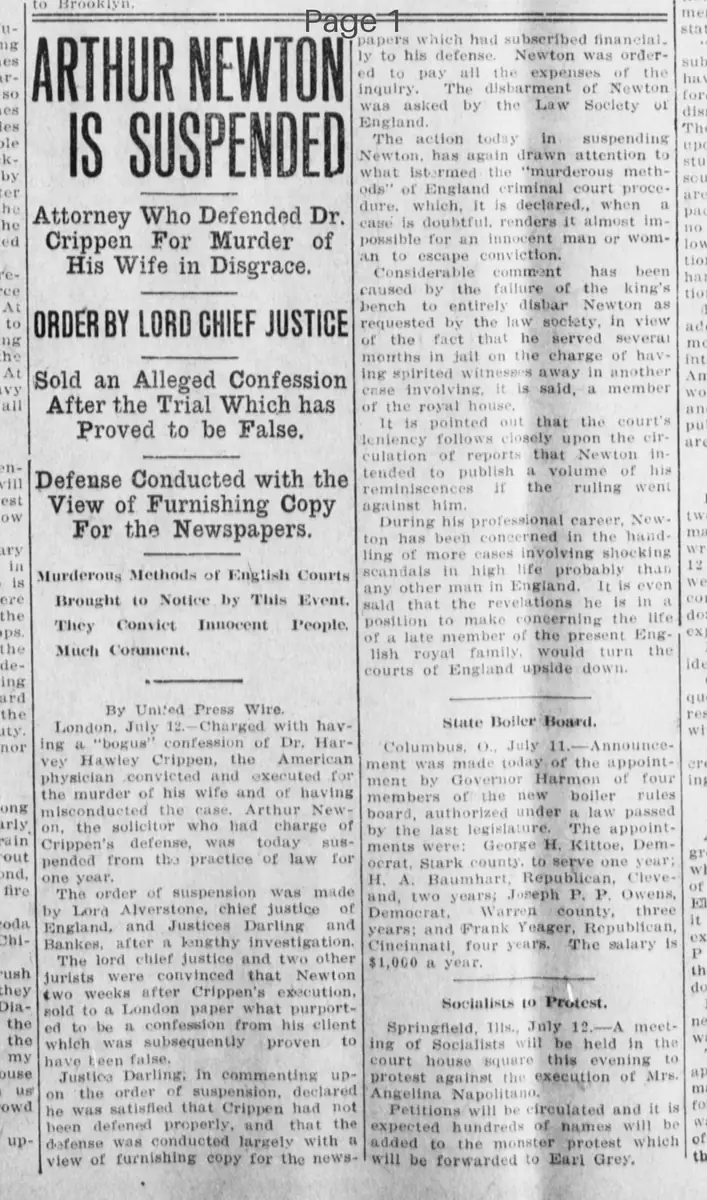
IS SUSPENDED
Attorney Who Defended Dr.
Crippen
For Murder
of
His Wife in Disgrace.
ORDER BY LORD CHIEF JUSTICE
Sold an Alleged Confession
After the Trial Which has
Proved to be False.
Defense Conducted with the
View of Furnishing Copy
For the Newspapers.
Murderous Methods of English Courts
Brought to Notice by This Event.
They
Convict
Innocent
People,
Much Comment.
By United Press Wire.
London, July 12.-Charged with having a "bogus" confession of Dr. Harvey Hawley Crippen, the American physician convicted and executed for the murder of his wife and of having misconducted the case, Arthur Newton, the solicitor who had charge of Crippen's defense, was today suspended from the practice of law for one year.
The order of suspension was made by Lord Alverstone, chief justice of England, and Justices Darling and Bankes, after a lengthy investigation.
The lord chief justice and two other jurists were convinced that Newton two weeks after Crippen's execution, sold to a London paper what purported to be a confession from his client which was subsequently proven to have been false.
Justice Darling, in commenting upon the order of suspension, declared he was satisfied that Crippen had not been defended properly, and that the defense was conducted largely with a view of furnishing copy for the newspapers which had subscribed financially to his defense.
Newton was ordered to pay all the expenses of the inquiry.
The disbarment of Newton was asked by the Law Society of England.
The action today in suspending Newton, has again drawn attention to what is termed the "murderous methods" of England criminal court procedure, which, it is declared, when a case is doubtful, renders it almost impossible for an innocent man or woman to escape conviction.
Considerable comment has been caused by the failure of the king's bench to entirely disbar Newton as requested by the Law society, in view of the fact that he served several months in jail on the charge of having spirited witnesses away in another case involving, it is said, a member of the royal house.
It is pointed out that the court's leniency follows closely upon the circulation of reports that Newton intended to publish a volume of his reminiscences if the ruling went against him.
During his professional career, Newton has been concerned in the handling of more cases involving shocking scandals in high life probably than any other man in England. It is even said that the revelations he is in a position to make concerning the life of a late member of the present English royal family, would turn the courts of England upside down.
What sub-type of article is it?
What themes does it cover?
What keywords are associated?
What entities or persons were involved?
Where did it happen?
Story Details
Key Persons
Location
London
Event Date
July 12
Story Details
Arthur Newton, who defended Dr. Crippen in his murder trial, sold a false confession to a newspaper after the execution and conducted the defense for publicity purposes, leading to his one-year suspension from law practice by the chief justice and colleagues. The case renews criticism of English courts' conviction practices and notes leniency possibly due to Newton's potential revelations about scandals.