Thank you for visiting SNEWPapers!
Sign up free
The Jersey City News
Jersey City, Hudson County, New Jersey
What is this article about?
Enthusiastic amnesty meeting in Hoboken's St. Mary's School Hall for Irish and Irish-American political prisoners. Speakers including James F. Eagan detailed harsh prison conditions, Mayor Simon Kelly and John H. Parnell urged support and liberation. Donations collected, entertainment provided, ended with 'God Save Ireland.'
Clipping
OCR Quality
Full Text
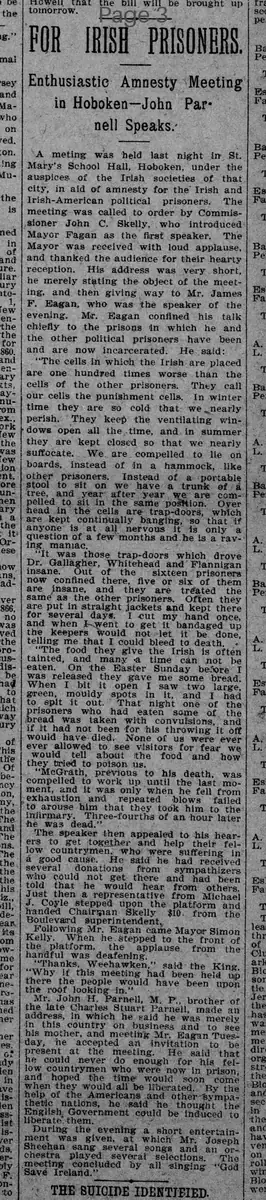
Enthusiastic Amnesty Meeting in Hoboken—John Parnell Speaks.
A meeting was held last night in St. Mary's School Hall, Hoboken, under the auspices of the Irish societies of that city, in aid of amnesty for the Irish and Irish-American political prisoners. The meeting was called to order by Commissioner John C. Skelly, who introduced Mayor Fagan as the first speaker. The Mayor was received with loud applause, and thanked the audience for their hearty reception. His address was very short, he merely stating the object of the meeting, and then giving way to Mr. James F. Eagan, who was the speaker of the evening. Mr. Eagan confined his talk chiefly to the prisons in which he and the other political prisoners have been and are now incarcerated. He said:
"The cells in which the Irish are placed are one hundred times worse than the cells of the other prisoners. They call our cells the punishment cells. In winter time they are so cold that we nearly perish. They keep the ventilating windows open all the time, and in summer they are kept closed so that we nearly suffocate. We are compelled to lie on boards, instead of in a hammock, like other prisoners. Instead of a portable stool to sit on we have a trunk of a tree, and year after year we are compelled to sit in the same position. Over head in the cells are trap-doors, which are kept continually banging, so that if anyone is at all nervous it is only a question of a few months and he is a raving maniac.
"It was those trap-doors which drove Dr. Gallagher, Whitehead and Flannigan insane. Out of the sixteen prisoners now confined there, five or six of them are insane, and they are treated the same as the other prisoners. Often they are put in straight jackets and kept there for several days. I cut my hand once, and when I went to get it bandaged up the keepers would not let it be done, telling me that I could bleed to death.
"The food they give the Irish is often tainted, and many a time can not be eaten. On the Easter Sunday before I was released they gave me some bread. When I bit it open I saw two large, green, mouldy spots in it, and I had to spit it out. That night one of the prisoners who had eaten some of the bread was taken with convulsions, and if it had not been for his throwing it off would have died. None of us were ever allowed to see visitors for fear we would tell about the food and how they tried to poison us.
McGrath, previous to his death, was compelled to work up until the last moment, and it was only when he fell from exhaustion and repeated blows failed to arouse him that they took him to the Infirmary. Three-fourths of an hour later he was dead."
The speaker then appealed to his hearers to get together and help their fellow countrymen, who were suffering in a good cause. He said he had received several donations from sympathizers who could not get there and had been told that he would hear from others. Just then a representative from Michael J. Coyle stepped upon the platform and handed Chairman Skelly $10 from the Boulevard superintendent.
Following Mr. Eagan came Mayor Simon Kelly. When he stepped to the front of the platform, the applause from the handful was deafening.
"Thanks, Weehawken," said the King. "Why if this meeting had been held up there the people would have been upon the roof looking in."
Mr. John H. Parnell, M. P., brother of the late Charles Stuart Parnell, made an address, in which he said he was merely in this country on business and to see his mother, and meeting Mr. Eagan Tuesday, he accepted an invitation to be present at the meeting. He said that he could never do enough for his fellow countrymen who were now in prison, and hoped the time would soon come when they would all be liberated. By the help of the Americans and other sympathetic nations, he said he thought the English Government could be induced to liberate them.
During the evening a short entertainment was given, at which Mr. Joseph Sheehan sang several songs and an orchestra played several selections. The meeting concluded by all singing "God Save Ireland."
What sub-type of article is it?
What themes does it cover?
What keywords are associated?
What entities or persons were involved?
Where did it happen?
Story Details
Key Persons
Location
St. Mary's School Hall, Hoboken
Story Details
Amnesty meeting for Irish political prisoners features speeches on harsh prison conditions by ex-prisoner James F. Eagan, including insanity from noise, tainted food, and death of McGrath; appeals for support by Parnell and others; donations received and entertainment provided.