Thank you for visiting SNEWPapers!
Sign up free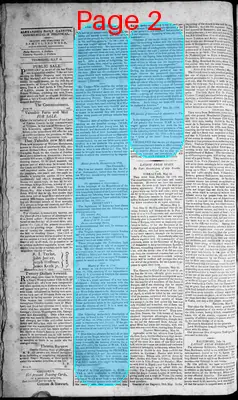
Editorial
July 16, 1812
Alexandria Daily Gazette, Commercial & Political
Alexandria, Virginia
What is this article about?
Editorial in Boston Repertory critiques Democratic-Republicans' inconsistency, contrasting their 1798 anti-war stance against France (quoted from Independent Chronicle) with 1812 support for war against England, warning of war's miseries and highlighting past calls for negotiation over conflict.
Clipping
OCR Quality
95%
Excellent
Full Text
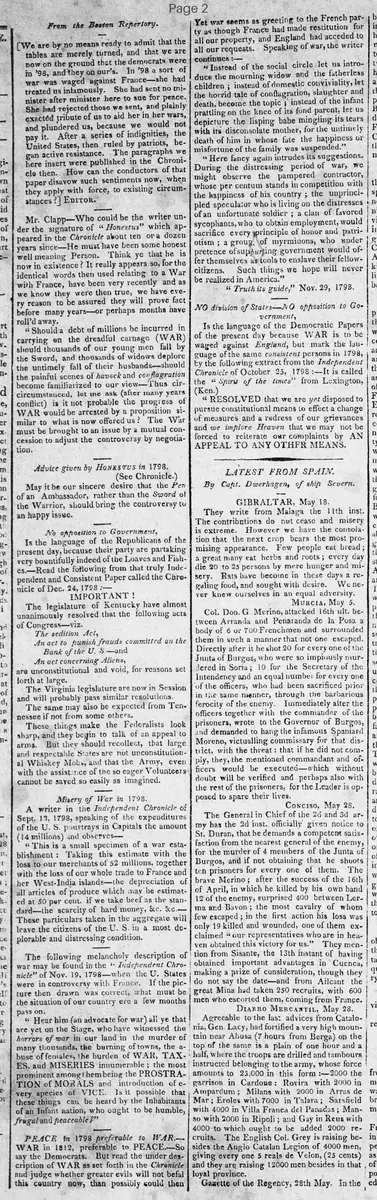
From the Boston Repertory.
[We are by no means ready to admit that the tables are merely turned, and that we are now on the ground that the democrats were in '98, and they on our's. In '98 France treated us infamously. She had sent no minister after minister here to sue for peace. She had rejected those we sent, and plainly exacted tribute of us to aid her in her wars, and plundered us, because we would not pay it. After a series of indignities, the United States, then ruled by patriots, began active resistance. The paragraphs we here insert were published in the Chronicle then. How can the conductors of that paper disavow such sentiments now, when they apply with force, to existing circumstances?] Editor.
Mr. Clapp—Who could be the writer under the signature of "Honestus" which appeared in the Chronicle about ten or a dozen years since—He must have been some honest well meaning Person. Think ye that he is now in existence? It really appears so, for the identical words then used relating to a War with France, have been very recently and as we know they were then true, we have every reason to be assured they will prove fact before many years—or perhaps months have roll'd away.
"Should a debt of millions be incurred in carrying on the dreadful carnage (WAR) should thousands of our young men fall by the Sword, and thousands of widows deplore the untimely fall of their husbands—should the painful scenes of havock and conflagration become familiarized to our view—Thus circumstanced, let me ask (after many years conflict) is it not probable the progress of WAR would be arrested by a proposition similar to what is now offered us? The War must be brought to an issue by a mutual concession to adjust the controversy by negotiation."
Advice given by Honestus in 1798.
(See Chronicle.)
May it be our sincere desire that the Pen of an Ambassador, rather than the Sword of the Warrior, should bring the controversy to an happy issue.
No opposition to Government,
Is the language of the Republicans of the present day, because their party are partaking very bountifully indeed of the Loaves and Fishes.—Read the following from that truly Independent and Consistent Paper called the Chronicle of Dec. 24, 1798 :—
IMPORTANT!
The legislature of Kentucky have almost unanimously resolved that the following acts of Congress—viz.
The sedition Act,
An act to punish frauds committed on the Bank of the U. S.—and
An act concerning Aliens,
are unconstitutional and void, for reasons set forth at large.
The Virginia legislature are now in Session and will probably pass similar resolutions. The same may also be expected from Tennessee if not from some others.
These things make the Federalists look sharp, and they begin to talk of an appeal to arms. But they should recollect, that large and respectable States are not unconstitutional Whiskey Mobs, and that the Army, even with the assistance of the so eager Volunteers cannot be saved so easily as imagined.
Misery of War in 1798.
A writer in the Independent Chronicle of Sept. 13, 1798, speaking of the expenditures of the U. S. pourtrays in Capitals the amount (14 millions) and observes—
"This is a small specimen of a war establishment: Taking this estimate with the loss to our merchants of 52 millions, together with the loss of our whole trade to France and her West-India islands—the depreciation of all articles of produce which may be estimated at 50 per cent. if we take beef as the standard—the scarcity of hard money, &c. &c.— These particulars taken in the aggregate will leave the citizens of the U. S. in a most deplorable and distressing condition."
The following melancholy description of war may be found in the "Independent Chronicle" of Nov. 19, 1798—when the U. States were in controversy with France. If the picture then drawn was correct, what must be the situation of our country ere a few months pass on.
"Hear him (an advocate for war) all ye that are yet on the Stage, who have witnessed the horrors of war in our land in the murder of many thousands, the burning of towns, the abuse of females, the burden of WAR, TAXES. and MISERIES innumerable; the most prominent amongst them being the PROSTRATION of MORALS and introduction of every species of VICE. Is it possible that these things can be heard by the Inhabitants of an Infant nation, who ought to be humble, frugal and peaceable ?"
PEACE In 1798 preferable to WAR.— WAR in 1812, preferable to PEACE.—So say the Democrats. But read the under description of WAR as set forth in the Chronicle and judge whether greater evils will not befall this country now, than possibly could then
Yet war seems as greeting to the French party as though France had made restitution for all our property, and England had acceded to all our requests. Speaking of war, the writer continues
"Instead of the social circle let us introduce the mourning widow and the fatherless children : instead of domestic conviviality, let the horrid tale of conflagration, slaughter and death, become the topic instead of the infant prattling on the knee of its fond parent, let us depicture the lisping babe mingling its tears with its disconsolate mother, for the untimely death of him in whose fate the happiness or misfortune of the family was suspended."
"Here fancy again intrudes its suggestions. During the distressing period of war, we might observe the pampered contractor, whose per centum stands in competition with the happiness of his country ; the unprincipled speculator who is living on the distresses of an unfortunate soldier : a clan of favored sycophants, who to obtain employment, would sacrifice every principle of honor and patriotism ; a group of myrmidons, who under pretence of supporting government would offer themselves as tools to enslave their fellow-citizens. Such things we hope will never be realized in America."
"Truth its guide," Nov. 29, 1798.
NO division of States—NO opposition to Government,
Is the language of the Democratic Papers of the present day because WAR is to be waged against England, but mark the language of the same consistent persons in 1798, by the following extract from the Independent Chronicle of October 25, 1798 :—It is called the "Spirit of the times" from Lexington, (Ken.)
"RESOLVED that we are yet disposed to pursue constitutional means to effect a change of measures and a redress of our grievances and we implore Heaven that we may not be forced to reiterate our complaints by AN APPEAL TO ANY OTHER MEANS."
[We are by no means ready to admit that the tables are merely turned, and that we are now on the ground that the democrats were in '98, and they on our's. In '98 France treated us infamously. She had sent no minister after minister here to sue for peace. She had rejected those we sent, and plainly exacted tribute of us to aid her in her wars, and plundered us, because we would not pay it. After a series of indignities, the United States, then ruled by patriots, began active resistance. The paragraphs we here insert were published in the Chronicle then. How can the conductors of that paper disavow such sentiments now, when they apply with force, to existing circumstances?] Editor.
Mr. Clapp—Who could be the writer under the signature of "Honestus" which appeared in the Chronicle about ten or a dozen years since—He must have been some honest well meaning Person. Think ye that he is now in existence? It really appears so, for the identical words then used relating to a War with France, have been very recently and as we know they were then true, we have every reason to be assured they will prove fact before many years—or perhaps months have roll'd away.
"Should a debt of millions be incurred in carrying on the dreadful carnage (WAR) should thousands of our young men fall by the Sword, and thousands of widows deplore the untimely fall of their husbands—should the painful scenes of havock and conflagration become familiarized to our view—Thus circumstanced, let me ask (after many years conflict) is it not probable the progress of WAR would be arrested by a proposition similar to what is now offered us? The War must be brought to an issue by a mutual concession to adjust the controversy by negotiation."
Advice given by Honestus in 1798.
(See Chronicle.)
May it be our sincere desire that the Pen of an Ambassador, rather than the Sword of the Warrior, should bring the controversy to an happy issue.
No opposition to Government,
Is the language of the Republicans of the present day, because their party are partaking very bountifully indeed of the Loaves and Fishes.—Read the following from that truly Independent and Consistent Paper called the Chronicle of Dec. 24, 1798 :—
IMPORTANT!
The legislature of Kentucky have almost unanimously resolved that the following acts of Congress—viz.
The sedition Act,
An act to punish frauds committed on the Bank of the U. S.—and
An act concerning Aliens,
are unconstitutional and void, for reasons set forth at large.
The Virginia legislature are now in Session and will probably pass similar resolutions. The same may also be expected from Tennessee if not from some others.
These things make the Federalists look sharp, and they begin to talk of an appeal to arms. But they should recollect, that large and respectable States are not unconstitutional Whiskey Mobs, and that the Army, even with the assistance of the so eager Volunteers cannot be saved so easily as imagined.
Misery of War in 1798.
A writer in the Independent Chronicle of Sept. 13, 1798, speaking of the expenditures of the U. S. pourtrays in Capitals the amount (14 millions) and observes—
"This is a small specimen of a war establishment: Taking this estimate with the loss to our merchants of 52 millions, together with the loss of our whole trade to France and her West-India islands—the depreciation of all articles of produce which may be estimated at 50 per cent. if we take beef as the standard—the scarcity of hard money, &c. &c.— These particulars taken in the aggregate will leave the citizens of the U. S. in a most deplorable and distressing condition."
The following melancholy description of war may be found in the "Independent Chronicle" of Nov. 19, 1798—when the U. States were in controversy with France. If the picture then drawn was correct, what must be the situation of our country ere a few months pass on.
"Hear him (an advocate for war) all ye that are yet on the Stage, who have witnessed the horrors of war in our land in the murder of many thousands, the burning of towns, the abuse of females, the burden of WAR, TAXES. and MISERIES innumerable; the most prominent amongst them being the PROSTRATION of MORALS and introduction of every species of VICE. Is it possible that these things can be heard by the Inhabitants of an Infant nation, who ought to be humble, frugal and peaceable ?"
PEACE In 1798 preferable to WAR.— WAR in 1812, preferable to PEACE.—So say the Democrats. But read the under description of WAR as set forth in the Chronicle and judge whether greater evils will not befall this country now, than possibly could then
Yet war seems as greeting to the French party as though France had made restitution for all our property, and England had acceded to all our requests. Speaking of war, the writer continues
"Instead of the social circle let us introduce the mourning widow and the fatherless children : instead of domestic conviviality, let the horrid tale of conflagration, slaughter and death, become the topic instead of the infant prattling on the knee of its fond parent, let us depicture the lisping babe mingling its tears with its disconsolate mother, for the untimely death of him in whose fate the happiness or misfortune of the family was suspended."
"Here fancy again intrudes its suggestions. During the distressing period of war, we might observe the pampered contractor, whose per centum stands in competition with the happiness of his country ; the unprincipled speculator who is living on the distresses of an unfortunate soldier : a clan of favored sycophants, who to obtain employment, would sacrifice every principle of honor and patriotism ; a group of myrmidons, who under pretence of supporting government would offer themselves as tools to enslave their fellow-citizens. Such things we hope will never be realized in America."
"Truth its guide," Nov. 29, 1798.
NO division of States—NO opposition to Government,
Is the language of the Democratic Papers of the present day because WAR is to be waged against England, but mark the language of the same consistent persons in 1798, by the following extract from the Independent Chronicle of October 25, 1798 :—It is called the "Spirit of the times" from Lexington, (Ken.)
"RESOLVED that we are yet disposed to pursue constitutional means to effect a change of measures and a redress of our grievances and we implore Heaven that we may not be forced to reiterate our complaints by AN APPEAL TO ANY OTHER MEANS."
What sub-type of article is it?
Partisan Politics
War Or Peace
Foreign Affairs
What keywords are associated?
Partisan Inconsistency
War Horrors
1798 Sentiments
Democratic Hypocrisy
Peace Negotiation
France England Conflict
Independent Chronicle Quotes
What entities or persons were involved?
Democrats
Republicans
Federalists
Independent Chronicle
Honestus
France
England
Kentucky Legislature
Virginia Legislature
Editorial Details
Primary Topic
Democratic Inconsistency On War Policy From 1798 Anti France War To 1812 Pro England War
Stance / Tone
Anti Democratic Critique Favoring Peace And Negotiation
Key Figures
Democrats
Republicans
Federalists
Independent Chronicle
Honestus
France
England
Kentucky Legislature
Virginia Legislature
Key Arguments
Democrats Opposed War With France In 1798 But Support War With England In 1812
War Brings Debt, Deaths, Widows, Destruction, And Moral Decay
Negotiation Preferable To War, As Advised By Honestus In 1798
Past Democratic Calls For Constitutional Resistance And Opposition To Federal Acts Like Sedition And Alien Acts
War Profiteers And Sycophants Exploit Conflicts
Consistency Demanded In Opposition To Government When Out Of Power