Thank you for visiting SNEWPapers!
Sign up free
The Ypsilanti Daily Press
Ypsilanti, Washtenaw County, Michigan
What is this article about?
Congressional push expected after Jan. 3 for pay-as-you-go income tax legislation to avert taxpayer default, with Sen. Clark advocating Ruml plan forgiving one year's taxes despite Treasury opposition. Washington, D.C., Dec. 2.
Merged-components note: Continuation of tax payment story from page 1 to page 5; merged based on 'See TAXES Page 5'.
Clippings
1 of 2
OCR Quality
Full Text
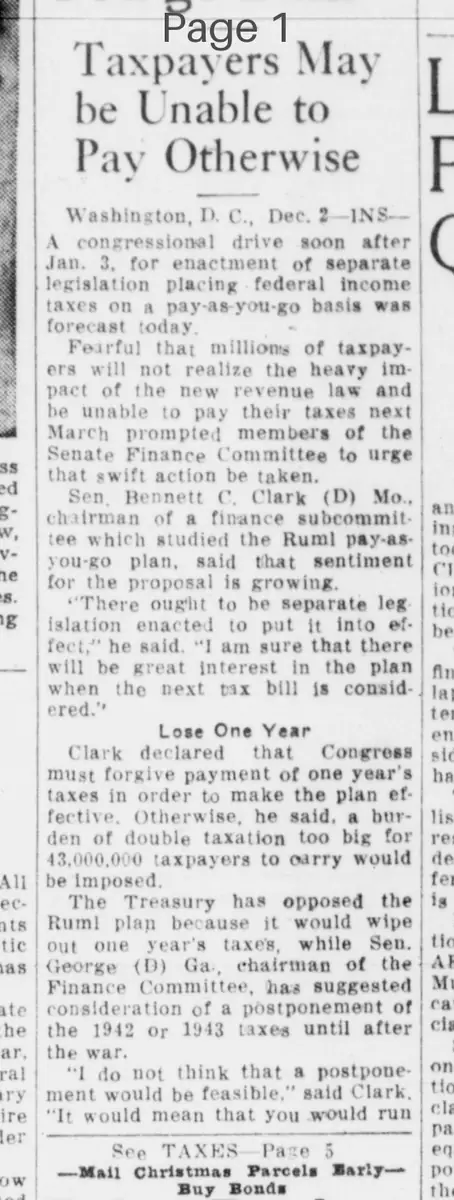
Washington, D. C., Dec. 2—INS—A congressional drive soon after Jan. 3, for enactment of separate legislation placing federal income taxes on a pay-as-you-go basis was forecast today.
Fearful that millions of taxpayers will not realize the heavy impact of the new revenue law and be unable to pay their taxes next March prompted members of the Senate Finance Committee to urge that swift action be taken.
Sen. Bennett C. Clark (D) Mo., chairman of a finance subcommittee which studied the Ruml pay-as-you-go plan, said that sentiment for the proposal is growing.
"There ought to be separate legislation enacted to put it into effect," he said. "I am sure that there will be great interest in the plan when the next tax bill is considered."
Lose One Year
Clark declared that Congress must forgive payment of one year's taxes in order to make the plan effective. Otherwise, he said, a burden of double taxation too big for 43,000,000 taxpayers to carry would be imposed.
The Treasury has opposed the Ruml plan because it would wipe out one year's taxes, while Sen. George (D) Ga., chairman of the Finance Committee, has suggested consideration of a postponement of the 1942 or 1943 taxes until after the war.
"I do not think that a postponement would be feasible," said Clark. "It would mean that you would run
See TAXES Page 5
Taxes
(Continued from Page One)
into the question of double taxation perhaps at a time when taxpayers are less able to pay than now
He might be able to work out a spread of death duties over two or three years
Would Get Most
Clark maintained that in the long run. the government would get most of the taxes even if the one year was forgiven.
One possibility of failure of congress to adopt the pay as you go plan. according to congressional experts. Is that huge amounts of war bonds will be cashed next year in order to enable persons to pay taxes
While the Treasury will begin collecting the 5 per cent victory tax on Jan. 1 from pay rolls. tax experts say that in most cases it will be far less than the tax liability of the individual. and thus is not a true pay-as-you go plan
Treasury experts are considering a new tax bill. estimated to range from six billions to 16 billions. but congressional leaders were informed that recommendations will not be ready before congress convenes early in January.
What sub-type of article is it?
What keywords are associated?
What entities or persons were involved?
Where did it happen?
Domestic News Details
Primary Location
Washington, D. C.
Event Date
Dec. 2
Key Persons
Outcome
congress must forgive payment of one year's taxes to avoid double taxation burden on 43,000,000 taxpayers; treasury opposes ruml plan; potential cashing of war bonds to pay taxes; victory tax collection starts jan. 1 but insufficient.
Event Details
A congressional drive is forecast soon after Jan. 3 for legislation to place federal income taxes on a pay-as-you-go basis, urged by Senate Finance Committee members fearing taxpayers' inability to pay under new revenue law. Sen. Bennett C. Clark supports the Ruml plan, stating separate legislation needed and one year's taxes must be forgiven. Sen. George suggests postponement of 1942 or 1943 taxes. Clark argues government would collect most taxes long-term and postponement infeasible. Treasury considers new tax bill of 6-16 billions.