Thank you for visiting SNEWPapers!
Sign up free
Daily Richmond Whig
Richmond, Virginia
What is this article about?
Sir George Murray, Secretary of State for the Colonies, delivers a speech in the British House of Commons on March 5 advocating for the relief measure for Roman Catholics in Ireland, arguing it will strengthen the constitution, promote unity, and advance Ireland's prosperity without destroying civil society.
Clipping
OCR Quality
Full Text
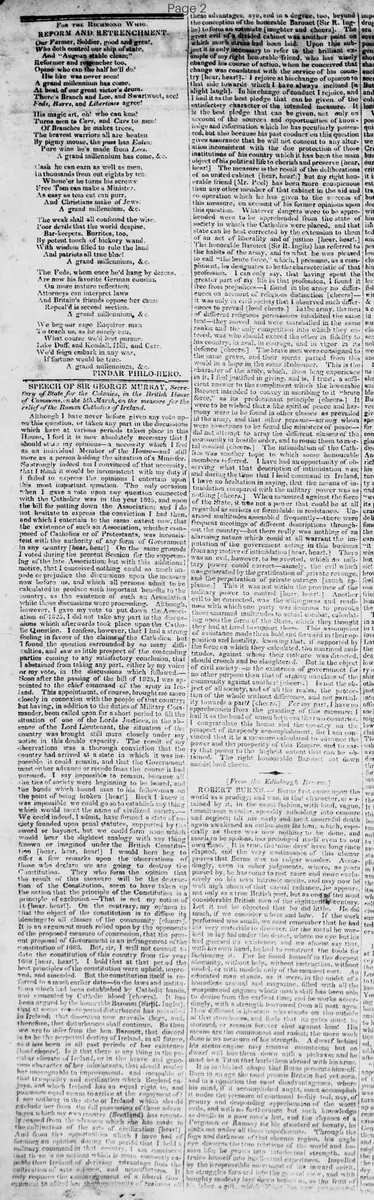
Although I have never before given any vote upon this question, or taken any part in the discussions which have at various periods taken place in this House, I feel it is now absolutely necessary that I should state my opinions--a necessity which I feel as an individual Member of the House--and still more as a person holding the situation of a Minister. So strongly indeed am I convinced of that necessity, that I think it would be inconsistent with my duty if I failed to express the opinions I entertain upon this most important question. The only occasion when I gave a vote upon any question connected with the Catholics was in the year 1825, and upon the bill for putting down the Association; and I do not hesitate to express the conviction I had then, and which I entertain to the same extent now, that the existence of such an Association, whether composed of Catholics or of Protestants, was inconsistent with the authority of any form of Government in any country [hear, hear!]. On the same grounds I voted during the present Session for the suppressing of the late Association; but with this additional motive, that I conceived nothing could so much impede or prejudice the discussions upon the measure now before us, and which all persons admit to be calculated to produce such important benefits to the country, as the existence of such an Association while those discussions were proceeding. Although, however, I gave my vote to put down the Association of 1825, I did not take any part in the discussions which afterwards took place upon the Catholic Question. I confess, however, that I had a strong feeling in favour of the claims of the Catholics; but I found the question surrounded by so many difficulties, and saw so little prospect of the contending parties coming to any satisfactory conclusion, that I abstained from taking any part, either by my voice or my vote, in the discussions which followed.--Soon after the passing of the bill of 1825, I was appointed to the chief command of the army in Ireland. This appointment, of course, brought me more closely in connexion with the people of that country; but having, in addition to the duties of Military Commander, been called upon for a short period to fill the situation of one of the Lords Justices, in the absence of the Lord Lieutenant, the situation of the country was brought still more closely under my notice in this double capacity. The result of my observations was a thorough conviction that the country had arrived at a state in which it was impossible it could remain, and that the Government must either advance or recede from the course it had pursued. I say impossible to remain, because all the ties of society were beginning to be loosed, and the bonds which bound man to his fellow-man on the point of being broken [hear!]. Back I knew it was impossible we could go so to establish any thing which would merit the name of civilized society.--We could indeed, I admit, have formed a state of society founded upon penal statutes, supported by the sword or bayonet, but we could form none which would bear the slightest analogy with any thing known or imagined under the British Constitution [hear, hear, hear!]. I would here beg to offer a few remarks upon the observations of those who declare we are going to destroy the Constitution. They who form the opinion that the result of this measure will be the destruction of the Constitution, seem to have taken up the notion that the principle of the Constitution is a principle of exclusion.--That is not my notion of it [hear, hear!]. On the contrary, my opinion is that the object of the constitution is to diffuse its blessings to all classes of the community [cheers]. It is an argument much relied upon by the opponents of the proposed measure of concession, that the present proposal of Government is an infringement of the constitution of 1688. But, sir, I will not consent to date the constitution of this country from the year 1688 [hear, hear!]. I hold that at that period the best principles of the constitution were upheld, improved, and amended. But the constitution itself is referred to a much earlier date--to the laws and institutions which had been established by Catholic hands, and cemented by Catholic blood [cheers!]. It has been argued by the honorable Baronet (Sir R. Inglis), that at some recent period disturbance has prevailed in Ireland: that dissention now prevails there, and, therefore, that disturbances shall continue. So then we are to infer from the hon. Baronet, that discord is to be the perpetual destiny of Ireland, in all future, as it has been in all past periods of her existence [loud cheers]. Is it that there is any thing in the peculiar climate of Ireland, or in the brave and generous character of her inhabitants, that should render her impregnable to improvement, and incapable of that tranquility and civilization which England enjoys, and which Ireland has an equal right to, and possesses equal means to arrive at the enjoyment of? I see nothing in the state of Ireland which should exclude her from the full possession of those advantages which my own country (Scotland) has recently reaped from the way in which she has made use of the cultivation of the arts of civilization [hear!]. And from the opportunities which I have had of forming an opinion during the period that I held a military command in that country, I am convinced that there is no nation which is more eminently capable than Ireland of the cultivation of arts, science, and manufactures. It only requires the encouragement of a liberal government to afford her the opportunity of realizing all these advantages; aye, and in a degree, too, beyond the conception of the honorable Baronet (Sir R. Inglis) to form an estimate [laughter and cheers]. The great evil of a divided cabinet was another point on which much stress had been laid. Upon this subject it is only necessary to refer to the brilliant example of my right honorable friend, who has wisely changed his course of action, when he conceived that change was consistent with the service of his country [hear, hear!]. I rejoice at his change of opinion to that side towards which I have always inclined [a slight laugh]. In his change of conduct I rejoice, and I hail it as the best pledge that can be given of the satisfactory character of the intended measure. It is the best pledge that can be given, not only on account of the sources and opportunities of knowledge and information which he has peculiarly possessed, but also because his past conduct on this question gives assurance that he will not consent to any alteration inconsistent with the due protection of those institutions of his country which it has been the main object of his political life to cherish and preserve [hear, hear!]. The measure is the result of the deliberations of an united cabinet [hear, hear!]; but my right honorable friend (Mr. Peel) has been more conspicuous than any other member of that cabinet in the aid and co-operation which he has given to the success of this measure, on account of his former opinions upon this question. Whatever dangers were to be apprehended were to be apprehended from the state of society in which the Catholics were placed, and that state can be best corrected by the extension to them of an act of liberality and of justice [hear, hear!]. The honorable Baronet (Sir R. Inglis) has referred to the habits of the army, and to what he was pleased to call "the brute force," which, I presume, as a compliment, he designates to be the characteristic of that profession. I can only say, that having spent the greater part of my life in that profession, I found it free from prejudices--I found in the army no differences on account of religious distinction [cheers]--it was only in civil society that I observed such differences to prevail [loud cheers]. In the army, the men of different religious persuasions inhabited the same tent--they moved and were marshalled in the same ranks; and the only competition into which they entered, was who should exceed the other in fidelity to his country, in zeal, in courage, and in vigor in its defence [cheers]. The brave men were consigned to the same grave, and their spirits parted from this world in a hope in the same Redeemer. This is the character of the army, which, from long experience in it, I feel justified in giving, and is, I trust, a sufficient answer to the compliment which the honorable Baronet intended to convey in ascribing to it "brute force," as its predominant principle [cheers]. It were to be wished that a like spirit of peace and harmony were to be found in other classes as prevailed in the army, and that other persons--among whom were sometimes to be found the ministers of peace--did not attempt to array the different classes of the community in hostile order, and to rouse them to mortal combat [cheers]. The intimidation of the Catholics was another topic to which some honorable members referred. I have had an opportunity of observing what that description of intimidation was; and during the time that I held command in Ireland, I have no hesitation in saying, that the means of intimidation compared with the military power was as nothing [cheers]. When measured against the force of the State, it was not a power that could be at all regarded as serious or formidable in resistance. Unarmed multitudes assembled frequently--there were frequent meetings of different descriptions throughout the country--but there really was nothing of an alarming nature which could at all warrant the imputation of the government acting in this business from any motive of intimidation [hear, hear!]. There was an evil, however, to be averted, which no military power could correct--namely, the evil which was generated by the gratification of private revenge, and the perpetration of private outrage [much applause]. This it was not within the province of the military power to control [hear, hear!]. Another evil to be corrected, was the willingness and readiness with which one party was desirous to provoke those unarmed multitudes to actual combat, calculating upon the force of the State, which they thought they had at hand to support them. This assumption of assistance made them bold and forward in their opposition and hostility, knowing that, if supported by the force on which they calculated, the unarmed multitudes, against whom their violence was directed, should crouch and be slaughtered. But is the object of civil society--is the existence of government for no other purpose than that of arming one class of the community against another: [cheers]. Is not the object of all society, and of all the realm, the protection of the whole without difference, and not partiality towards a part? [cheers.] For my part, I have no apprehension from the granting of this measure; I hail it as the bond of union between the two countries. I congratulate this house and the country on the prospect of its speedy accomplishment, for I am convinced that it is a measure calculated to advance the power and the prosperity of this Empire, and to carry that power to the highest extent that can be obtained. The right honourable Baronet sat down amidst loud cheers.
What sub-type of article is it?
What keywords are associated?
What entities or persons were involved?
Where did it happen?
Foreign News Details
Primary Location
Ireland
Event Date
5th March
Key Persons
Outcome
advocacy for measure granting relief to roman catholics in ireland, expected to promote union, prosperity, and constitutional blessings without destruction of society.
Event Details
Sir George Murray expresses support for the government's measure to relieve Roman Catholics in Ireland, drawing from his experiences in Ireland and arguing that the current state is unsustainable, that the constitution promotes inclusion rather than exclusion, and that the measure will foster harmony and advancement in Ireland similar to other parts of the Empire.