Thank you for visiting SNEWPapers!
Sign up free
Editorial
December 5, 1807
Alexandria Daily Advertiser
Alexandria, Virginia
What is this article about?
Editorial from Boston Centinel critiques Napoleon's blockading decree against Britain as invalid under law of nations and violative of 1800 US-France treaty, allowing seizure of British goods even under US flag. Anticipates British retaliation due to US submission, aimed at dividing US from Britain.
Clipping
OCR Quality
95%
Excellent
Full Text
[Boston Centinel]
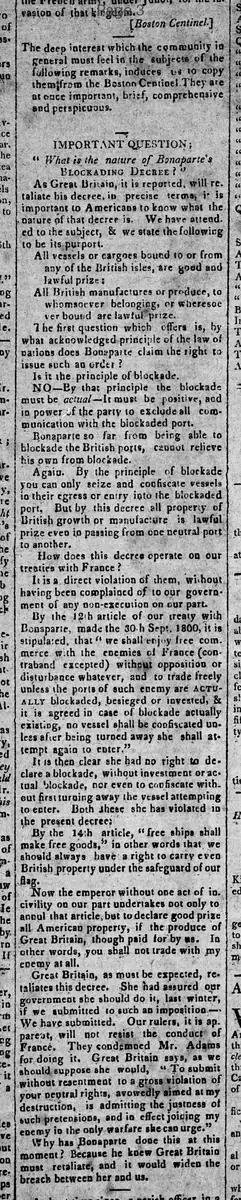
The deep interest which the community in general must feel in the subjects of the following remarks, induces us to copy them from the Boston Centinel. They are at once important, brief, comprehensive and perspicuous.
IMPORTANT QUESTION;
"What is the nature of Bonaparte's BLOCKADING DECREE?"
As Great Britain, it is reported, will retaliate his decree, in precise terms, it is important to Americans to know what the nature of that decree is. - We have attended to the subject, & we state the following to be its purport.
All vessels or cargoes bound to or from any of the British isles, are good and lawful prize:
All British manufactures or produce, to whomsoever belonging, or wheresoever bound are lawful prize.
The first question which offers is, by what acknowledged principle of the law of nations does Bonaparte claim the right to issue such an order?
Is it the principle of blockade.
NO—By that principle the blockade must be actual—It must be positive, and in power of the party to exclude all communication with the blockaded port. Bonaparte so far from being able to blockade the British ports, cannot relieve his own from blockade.
Again. By the principle of blockade you can only seize and confiscate vessels in their egress or entry into the blockaded port, But by this decree all property of British growth or manufacture is lawful prize even in passing from one neutral port to another.
How does this decree operate on our treaties with France?
It is a direct violation of them, without having been complained of to our government of any non-execution on our part.
By the 12th article of our treaty with Bonaparte, made the 30th Sept. 1800, it is stipulated, that "we shall enjoy free commerce with the enemies of France (contraband excepted) without opposition or disturbance whatever, and to trade freely unless the ports of such enemy are ACTUALLY blockaded, besieged or invested, & it is agreed in case of blockade actually existing, no vessel shall be confiscated unless after being turned away she shall attempt again to enter."
It is then clear she had no right to declare a blockade, without investment or actual blockade, nor even to confiscate without first turning away the vessel attempting to enter. Both these she has violated in the present decree:
By the 14th article, "free ships shall make free goods," in other words that we should always have a right to carry even British property under the safeguard of our flag.
Now the emperor without one act of incivility on our part undertakes not only to annul that article, but to declare good prize all American property, if the produce of Great Britain, though paid for by us. In other words, you shall not trade with my enemy at all.
Great Britain, as must be expected, retaliates this decree. She had assured our government she should do it, last winter, if we submitted to such an imposition.— We have submitted. Our rulers, it is apparent, will not resist the conduct of France. They condemned Mr. Adams for doing it. Great Britain says, as we should suppose she would, "To submit without resentment to a gross violation of your neutral rights, avowedly aimed at my destruction, is admitting the justness of such pretensions, and in effect joining my enemy in the only warfare she can urge."
Why has Bonaparte done this at this moment? Because he knew Great Britain must retaliate, and it would widen the breach between her and us.
The deep interest which the community in general must feel in the subjects of the following remarks, induces us to copy them from the Boston Centinel. They are at once important, brief, comprehensive and perspicuous.
IMPORTANT QUESTION;
"What is the nature of Bonaparte's BLOCKADING DECREE?"
As Great Britain, it is reported, will retaliate his decree, in precise terms, it is important to Americans to know what the nature of that decree is. - We have attended to the subject, & we state the following to be its purport.
All vessels or cargoes bound to or from any of the British isles, are good and lawful prize:
All British manufactures or produce, to whomsoever belonging, or wheresoever bound are lawful prize.
The first question which offers is, by what acknowledged principle of the law of nations does Bonaparte claim the right to issue such an order?
Is it the principle of blockade.
NO—By that principle the blockade must be actual—It must be positive, and in power of the party to exclude all communication with the blockaded port. Bonaparte so far from being able to blockade the British ports, cannot relieve his own from blockade.
Again. By the principle of blockade you can only seize and confiscate vessels in their egress or entry into the blockaded port, But by this decree all property of British growth or manufacture is lawful prize even in passing from one neutral port to another.
How does this decree operate on our treaties with France?
It is a direct violation of them, without having been complained of to our government of any non-execution on our part.
By the 12th article of our treaty with Bonaparte, made the 30th Sept. 1800, it is stipulated, that "we shall enjoy free commerce with the enemies of France (contraband excepted) without opposition or disturbance whatever, and to trade freely unless the ports of such enemy are ACTUALLY blockaded, besieged or invested, & it is agreed in case of blockade actually existing, no vessel shall be confiscated unless after being turned away she shall attempt again to enter."
It is then clear she had no right to declare a blockade, without investment or actual blockade, nor even to confiscate without first turning away the vessel attempting to enter. Both these she has violated in the present decree:
By the 14th article, "free ships shall make free goods," in other words that we should always have a right to carry even British property under the safeguard of our flag.
Now the emperor without one act of incivility on our part undertakes not only to annul that article, but to declare good prize all American property, if the produce of Great Britain, though paid for by us. In other words, you shall not trade with my enemy at all.
Great Britain, as must be expected, retaliates this decree. She had assured our government she should do it, last winter, if we submitted to such an imposition.— We have submitted. Our rulers, it is apparent, will not resist the conduct of France. They condemned Mr. Adams for doing it. Great Britain says, as we should suppose she would, "To submit without resentment to a gross violation of your neutral rights, avowedly aimed at my destruction, is admitting the justness of such pretensions, and in effect joining my enemy in the only warfare she can urge."
Why has Bonaparte done this at this moment? Because he knew Great Britain must retaliate, and it would widen the breach between her and us.
What sub-type of article is it?
Foreign Affairs
War Or Peace
Trade Or Commerce
What keywords are associated?
Bonaparte Decree
Blockade Violation
Neutral Rights
Us Treaties
British Retaliation
French Aggression
What entities or persons were involved?
Bonaparte
Great Britain
France
United States
Mr. Adams
Editorial Details
Primary Topic
Critique Of Bonaparte's Blockading Decree
Stance / Tone
Strongly Critical Of French Violation Of Neutral Rights
Key Figures
Bonaparte
Great Britain
France
United States
Mr. Adams
Key Arguments
Bonaparte's Decree Declares All Vessels Or Cargoes To Or From British Isles As Lawful Prize
All British Manufactures Or Produce Are Lawful Prize Regardless Of Ownership Or Destination
Decree Violates Principle Of Actual Blockade As France Cannot Blockade British Ports
Decree Allows Seizure Of British Goods Even Between Neutral Ports
Directly Violates 12th Article Of 1800 Us France Treaty On Free Commerce With Enemies Unless Actually Blockaded
Violates 14th Article Making Free Ships Free Goods
France Annuls Treaty Rights Without Us Provocation
Us Submission Invites British Retaliation
Bonaparte Aims To Widen Breach Between Us And Britain