Thank you for visiting SNEWPapers!
Sign up free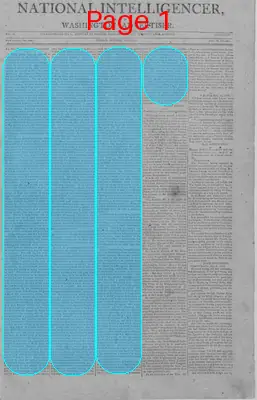
Editorial
October 29, 1802
The National Intelligencer And Washington Advertiser
Washington, District Of Columbia
What is this article about?
An editorial advocating the study of human nature to recognize societal equality, critique the idolization of leaders and heroes, and prevent tyranny, emphasizing that all individuals contribute equally to progress and governance under a just administration.
Clipping
OCR Quality
98%
Excellent
Full Text
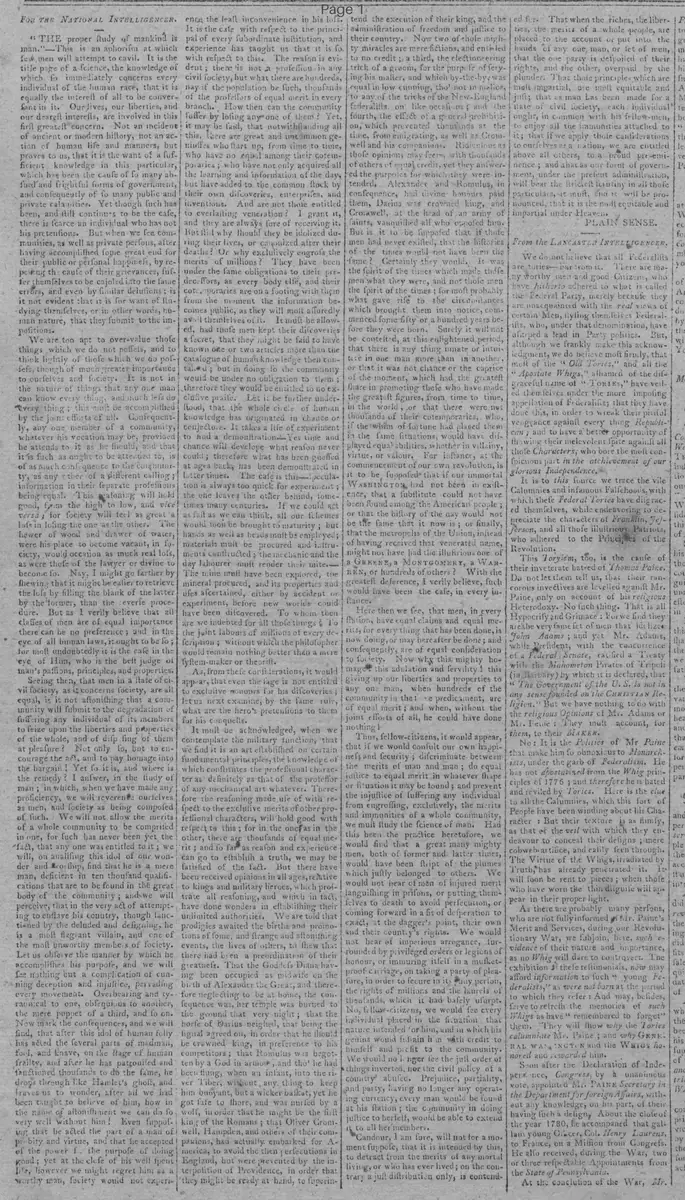
FOR THE NATIONAL INTELLIGENCER
"THE proper study of mankind is man."
This is an aphorism at which few men will attempt to cavil. It is the title page of a science, the knowledge of which so immediately concerns every individual of the human race, that it is equally the interest of all to be conversant in it. Our lives, our liberties, and our dearest interests, are involved in this first greatest concern. Not an incident of ancient or modern history, not an action of human life and manners, but proves to us, that it is the want of a sufficient knowledge in this particular, which has been the cause of so many absurd and frightful forms of government, and consequently of so many public and private calamities. Yet though such has been, and still continues to be the case, there is scarce an individual who has not his pretensions. But when we see communities, as well as private persons, after having accomplished some great end for their public or personal happiness, by removing the cause of their grievances, suffer themselves to be cajoled into the same errors, and even by similar delusions; is it not evident that it is for want of studying themselves, or in other words, human nature, that they submit to the impositions.
We are too apt to over-value those things which we do not possess, and to think lightly of those which we do possess, though of much greater importance to ourselves and society. It is not in the nature of things that any one man can know every thing, and much less do every thing; this must be accomplished by the joint efforts of all. Consequently, any one member of a community, whatever his vocation may be, provided he attends to it as he should, and that it is such as ought to be attended to, is of as much consequence to the community, as any other of a different calling; information in their separate professions being equal. This reasoning will hold good, from the high to low, and vice versa; for society will feel as great a loss in losing the one as the other. The hewer of wood and drawer of water, were his place to become vacant, in society, would occasion as much real loss, as were those of the lawyer or divine to become so. Nay, I might go farther by showing, that it might be easier to retrieve the loss by filling the blank of the latter by the former, than the reverse procedure. But as I verily believe that all classes of men are of equal importance there can be no preference; and in the eye of all human laws, it ought to be so; for most undoubtedly it is the case in the eye of Him, who is the best judge of man's passions, principles, and properties.
Seeing then, that men in a state of civil society, as it concerns society, are all equal, is it not astonishing that a community will submit to the degradation of suffering any individual of its members to seize upon the liberties and properties of the whole, and of disposing of them at pleasure? Not only so, but to encourage the act, and to pay homage into the bargain! Yet so it is, and where is the remedy? I answer, in the study of man; in which, when we have made any proficiency, we will reverence ourselves as men, and society as being composed of such. We will not allow the merits of a whole community to be comprised in one, for such has never been yet the fact, that any one was entitled to it; we will, on qualifying this idol of our wonder and worship, find that he is a mere man, deficient in ten thousand qualifications that are to be found in the great body of the community; and we will perceive, that in the very act of attempting to enslave his country, though sanctioned by the deluded and designing, he is a most flagrant villain, and one of the most unworthy members of society.
Let us observe the manner by which he accomplishes his purpose, and we will see nothing but a complication of cunning deception and injustice, pervading every movement. Overbearing and tyrannical to one, obsequious to another, the mere puppet of a third, and so on. Now mark the consequences, and we will find, that after this idol of human folly has acted the several parts of madman, tool, and knave, on the stage of human frailty, and after he has patronised and sanctioned thousands to do the same, he drops through like Hamlet's ghost, and leaves us to wonder, after all we had been taught to believe of him, how in the name of astonishment we can do so very well without him! Even supposing that he acted the part of a man of probity and virtue, and that he accepted of the power for the purpose of doing good; yet at the close of his well spent life, however we might regret him as a worthy man, society would not experience the least inconvenience in his loss.
It is the case with respect to the principal of every subordinate institution, and experience has taught us that it is so with respect to this. The reason is evident; there is not a profession in any civil society, but what there are hundreds, nay if the population be such, thousands of the professors of equal merit in every branch. How then can the community suffer by losing any one of them? Yet, it may be said, that notwithstanding all this, there are great and uncommon geniuses who start up, from time to time, who have no equal among their contemporaries; who have not only acquired all the learning and information of the day, but have added to the common stock by their own discoveries, enterprises, and inventions. And are not those entitled to everlasting veneration? I grant it, and they are always sure of receiving it. But still why should they be idolized during their lives, or canonized after their deaths? Or why exclusively engross the merits of millions? They have been under the same obligations to their predecessors, as every body else, and their cotemporaries are on a footing with them from the moment the information becomes public, as they will most assuredly avail themselves of it. It must be allowed, had those men kept their discoveries a secret, that they might be said to have known one or two articles more than the catalogue of human knowledge then stood; but in doing so the community would be under no obligation to them; therefore they would be entitled to no exclusive praise. Let it be further understood, that the whole circle of human knowledge has originated in chance or conjecture. It takes a life of experiment to find a demonstration Yet time and chance will develope what reason never could; therefore what has been guessed at ages back, has been demonstrated in latter times. The case is this: speculation is always too quick for experiment; the one leaves the other behind, sometimes many centuries. If we could act as fast as we can think, all our schemes would soon be brought to maturity; but hands as well as heads must be employed; materials must be procured and instruments constructed; the mechanic and the day labourer must render their mite. The mine must have been explored, the mineral procured, and its properties and uses ascertained, either by accident or experiment, before new worlds could have been discovered. To whom then are we indebted for all those things? To the joint labours of millions of every description; without which the philosopher would remain nothing better than a mere system-maker or theorist.
As, from these considerations, it would appear, that even the sage is not entitled to exclusive honours for his discoveries: let us next examine, by the same rule, what are the hero's pretensions to them for his conquests.
It must be acknowledged, when we contemplate the military function, that we find it is an art established on certain fundamental principles, the knowledge of which constitutes the professional character as definitely as that of the professor of any mechanical art whatever. Therefore the reasoning made use of with respect to the exclusive merits of other professional characters, will hold good with respect to this; for in the one as in the other, there are thousands of equal merit; and so far as reason and experience can go to establish a truth, we may be satisfied of the fact. But there have been received opinions in all ages, relative to kings and military heroes, which prostrate all reasoning, and which in fact, have done wonders in establishing their unlimited authorities. We are told that prodigies awaited the births and promotions of some, and strange and astonishing events, the lives of others, to shew that there had been a preordination of their greatness. That the Goddess Diana having been occupied as midwife on the birth of Alexander the Great, and therefore neglecting to be at home, the consequence was, her temple was burned to the ground that very night; that the horse of Darius neighed, that being the signal agreed on, in order that he should be crowned king, in preference to his competitors; that Romulus was begotten by a God in armour, and tho' he had been flung, when an infant, into the river Tiber, without any thing to keep him buoyant, but a wicker basket, yet he got safe to shore, and was nursed by a wolf, in order that he might be the first king of the Romans; that Oliver Cromwell, Hampden, and others of their companions, had actually embarked for America, to avoid the then persecutions in England, but were prevented by the interposition of Providence, in order that they might be ready at hand, to operate, attend the execution of their king, and the administration of freedom and justice to their country. Now two of those mighty miracles are mere fictions, and entitled to no credit; a third, the electioneering trick of a groom, for the purpose of carrying his master, and which by-the-by, was equal in low cunning, tho' not malice, to any of the tricks of the New-England federalists, on like occasions; and the fourth, the effect of a general prohibition, which prevented thousands at the time, from emigrating, as well as Cromwell and his companions. Ridiculous as those opinions may seem, with thousands of others of equal credit, yet they answered the purposes for which they were intended. Alexander and Romulus, in consequence, had divine honours paid them, Darius was crowned king, and Cromwell, at the head of an army of saints, vanquished all who opposed him.
But is it to be supposed that if those men had never existed, that the histories of the times would not have been the same? Certainly they would. It was the spirit of the times which made those men what they were, and not those men the spirit of the times; for most probably what gave rise to the circumstances which brought them into notice, commenced some fifty or a hundred years before they were born. Surely it will not be contested, at this enlightened period, that there is any thing innate or intuitive in one man more than in another. or that it was not chance or the caprice of the moment, which had the greatest share in promoting those who have made the greatest figures, from time to time, in the world or that there were not thousands of their cotemporaries, who, if the whim of fortune had placed them in the same situations, would have displayed equal abilities, whether in villainy, virtue, or valour. For instance, at the commencement of our own revolution, is it to be supposed that if our immortal Washington had not been in existence, that a substitute could not have been found among the American people; or that the history of the day would not be the same that it now is; or finally, that the metropolis of the Union, instead of having received that venerated name, might not have had the illustrious one of a Greene, a Montgomery, a Warren, or hundreds of others? With the greatest deference, I verily believe, such would have been the case, in every instance.
Here then we see, that men, in every station, have equal claims and equal merits, for every thing that has been done, is now doing, or may hereafter be done; and consequently, are of equal consideration to society. Now why this, mighty homage: this adulation and servility this giving up our liberties and properties to any one man, when hundreds of the community in their several predicament, are of equal merit; and when, without the joint efforts of all, he could have done nothing!
Thus, fellow-citizens, it would appear, that if we would consult our own happiness and security; discriminate between the merits of man and man; do equal justice to equal merit in whatever shape or situation it may be found; and prevent the injustice of suffering any individual from engrossing, exclusively, the merits and immunities of a whole community. we must study the science of man. Had this been the practice heretofore, we would find that a great many mighty men, both of former and latter times, would have been stript of the plumes which justly belonged to others. We would not hear of men of injured merit languishing in prisons, or putting themselves to death to avoid persecution, or coming forward in a fit of desperation to exact, at the dagger's point, their own and their country's rights. We would not hear of imperious arrogance, surrounded by privileged orders or legions of honour, or immuring itself in a musket-proof carriage, on taking a party of pleasure, in order to secure in its way person, the rights of millions and the laurels of thousands, which it had basely usurped. No, fellow-citizens, we would see every individual placed in the situation that nature intended for him, and in which his genius would shine forth in with credit to himself and profit to the community. We would no longer see the just order of things inverted, nor the civil policy of a country abused. Prejudice, partiality, and party, having no longer any operating currency, every man would be found at his station; the Community in doing justice to herself, would be able to extend it to all her members.
Candour, I am sure, will not for a moment suppose, that it is intended by this, to detract from the merits of any mortal living, or who has ever lived; on the contrary a just distribution only, is contended for. That when the riches, the liberties, the merits of a whole people, are placed to the account or put into the hands of any one man, or set of men, that the one party is despoiled of their rights. and the other, overpaid by the plunder. That those principles which are most impartial, are most equitable and just; that as man has been made for a state of civil society, each individual ought, in common with his fellow-men, to enjoy all the immunities attached to it; that if we apply those considerations to ourselves as a nation, we are entitled above all others, to a proud pre-eminence; and that as our form of government, under the present administration, will bear the strictest scrutiny in all those particulars, it must, and it will be pronounced, that it is the most equitable and impartial under Heaven.
"THE proper study of mankind is man."
This is an aphorism at which few men will attempt to cavil. It is the title page of a science, the knowledge of which so immediately concerns every individual of the human race, that it is equally the interest of all to be conversant in it. Our lives, our liberties, and our dearest interests, are involved in this first greatest concern. Not an incident of ancient or modern history, not an action of human life and manners, but proves to us, that it is the want of a sufficient knowledge in this particular, which has been the cause of so many absurd and frightful forms of government, and consequently of so many public and private calamities. Yet though such has been, and still continues to be the case, there is scarce an individual who has not his pretensions. But when we see communities, as well as private persons, after having accomplished some great end for their public or personal happiness, by removing the cause of their grievances, suffer themselves to be cajoled into the same errors, and even by similar delusions; is it not evident that it is for want of studying themselves, or in other words, human nature, that they submit to the impositions.
We are too apt to over-value those things which we do not possess, and to think lightly of those which we do possess, though of much greater importance to ourselves and society. It is not in the nature of things that any one man can know every thing, and much less do every thing; this must be accomplished by the joint efforts of all. Consequently, any one member of a community, whatever his vocation may be, provided he attends to it as he should, and that it is such as ought to be attended to, is of as much consequence to the community, as any other of a different calling; information in their separate professions being equal. This reasoning will hold good, from the high to low, and vice versa; for society will feel as great a loss in losing the one as the other. The hewer of wood and drawer of water, were his place to become vacant, in society, would occasion as much real loss, as were those of the lawyer or divine to become so. Nay, I might go farther by showing, that it might be easier to retrieve the loss by filling the blank of the latter by the former, than the reverse procedure. But as I verily believe that all classes of men are of equal importance there can be no preference; and in the eye of all human laws, it ought to be so; for most undoubtedly it is the case in the eye of Him, who is the best judge of man's passions, principles, and properties.
Seeing then, that men in a state of civil society, as it concerns society, are all equal, is it not astonishing that a community will submit to the degradation of suffering any individual of its members to seize upon the liberties and properties of the whole, and of disposing of them at pleasure? Not only so, but to encourage the act, and to pay homage into the bargain! Yet so it is, and where is the remedy? I answer, in the study of man; in which, when we have made any proficiency, we will reverence ourselves as men, and society as being composed of such. We will not allow the merits of a whole community to be comprised in one, for such has never been yet the fact, that any one was entitled to it; we will, on qualifying this idol of our wonder and worship, find that he is a mere man, deficient in ten thousand qualifications that are to be found in the great body of the community; and we will perceive, that in the very act of attempting to enslave his country, though sanctioned by the deluded and designing, he is a most flagrant villain, and one of the most unworthy members of society.
Let us observe the manner by which he accomplishes his purpose, and we will see nothing but a complication of cunning deception and injustice, pervading every movement. Overbearing and tyrannical to one, obsequious to another, the mere puppet of a third, and so on. Now mark the consequences, and we will find, that after this idol of human folly has acted the several parts of madman, tool, and knave, on the stage of human frailty, and after he has patronised and sanctioned thousands to do the same, he drops through like Hamlet's ghost, and leaves us to wonder, after all we had been taught to believe of him, how in the name of astonishment we can do so very well without him! Even supposing that he acted the part of a man of probity and virtue, and that he accepted of the power for the purpose of doing good; yet at the close of his well spent life, however we might regret him as a worthy man, society would not experience the least inconvenience in his loss.
It is the case with respect to the principal of every subordinate institution, and experience has taught us that it is so with respect to this. The reason is evident; there is not a profession in any civil society, but what there are hundreds, nay if the population be such, thousands of the professors of equal merit in every branch. How then can the community suffer by losing any one of them? Yet, it may be said, that notwithstanding all this, there are great and uncommon geniuses who start up, from time to time, who have no equal among their contemporaries; who have not only acquired all the learning and information of the day, but have added to the common stock by their own discoveries, enterprises, and inventions. And are not those entitled to everlasting veneration? I grant it, and they are always sure of receiving it. But still why should they be idolized during their lives, or canonized after their deaths? Or why exclusively engross the merits of millions? They have been under the same obligations to their predecessors, as every body else, and their cotemporaries are on a footing with them from the moment the information becomes public, as they will most assuredly avail themselves of it. It must be allowed, had those men kept their discoveries a secret, that they might be said to have known one or two articles more than the catalogue of human knowledge then stood; but in doing so the community would be under no obligation to them; therefore they would be entitled to no exclusive praise. Let it be further understood, that the whole circle of human knowledge has originated in chance or conjecture. It takes a life of experiment to find a demonstration Yet time and chance will develope what reason never could; therefore what has been guessed at ages back, has been demonstrated in latter times. The case is this: speculation is always too quick for experiment; the one leaves the other behind, sometimes many centuries. If we could act as fast as we can think, all our schemes would soon be brought to maturity; but hands as well as heads must be employed; materials must be procured and instruments constructed; the mechanic and the day labourer must render their mite. The mine must have been explored, the mineral procured, and its properties and uses ascertained, either by accident or experiment, before new worlds could have been discovered. To whom then are we indebted for all those things? To the joint labours of millions of every description; without which the philosopher would remain nothing better than a mere system-maker or theorist.
As, from these considerations, it would appear, that even the sage is not entitled to exclusive honours for his discoveries: let us next examine, by the same rule, what are the hero's pretensions to them for his conquests.
It must be acknowledged, when we contemplate the military function, that we find it is an art established on certain fundamental principles, the knowledge of which constitutes the professional character as definitely as that of the professor of any mechanical art whatever. Therefore the reasoning made use of with respect to the exclusive merits of other professional characters, will hold good with respect to this; for in the one as in the other, there are thousands of equal merit; and so far as reason and experience can go to establish a truth, we may be satisfied of the fact. But there have been received opinions in all ages, relative to kings and military heroes, which prostrate all reasoning, and which in fact, have done wonders in establishing their unlimited authorities. We are told that prodigies awaited the births and promotions of some, and strange and astonishing events, the lives of others, to shew that there had been a preordination of their greatness. That the Goddess Diana having been occupied as midwife on the birth of Alexander the Great, and therefore neglecting to be at home, the consequence was, her temple was burned to the ground that very night; that the horse of Darius neighed, that being the signal agreed on, in order that he should be crowned king, in preference to his competitors; that Romulus was begotten by a God in armour, and tho' he had been flung, when an infant, into the river Tiber, without any thing to keep him buoyant, but a wicker basket, yet he got safe to shore, and was nursed by a wolf, in order that he might be the first king of the Romans; that Oliver Cromwell, Hampden, and others of their companions, had actually embarked for America, to avoid the then persecutions in England, but were prevented by the interposition of Providence, in order that they might be ready at hand, to operate, attend the execution of their king, and the administration of freedom and justice to their country. Now two of those mighty miracles are mere fictions, and entitled to no credit; a third, the electioneering trick of a groom, for the purpose of carrying his master, and which by-the-by, was equal in low cunning, tho' not malice, to any of the tricks of the New-England federalists, on like occasions; and the fourth, the effect of a general prohibition, which prevented thousands at the time, from emigrating, as well as Cromwell and his companions. Ridiculous as those opinions may seem, with thousands of others of equal credit, yet they answered the purposes for which they were intended. Alexander and Romulus, in consequence, had divine honours paid them, Darius was crowned king, and Cromwell, at the head of an army of saints, vanquished all who opposed him.
But is it to be supposed that if those men had never existed, that the histories of the times would not have been the same? Certainly they would. It was the spirit of the times which made those men what they were, and not those men the spirit of the times; for most probably what gave rise to the circumstances which brought them into notice, commenced some fifty or a hundred years before they were born. Surely it will not be contested, at this enlightened period, that there is any thing innate or intuitive in one man more than in another. or that it was not chance or the caprice of the moment, which had the greatest share in promoting those who have made the greatest figures, from time to time, in the world or that there were not thousands of their cotemporaries, who, if the whim of fortune had placed them in the same situations, would have displayed equal abilities, whether in villainy, virtue, or valour. For instance, at the commencement of our own revolution, is it to be supposed that if our immortal Washington had not been in existence, that a substitute could not have been found among the American people; or that the history of the day would not be the same that it now is; or finally, that the metropolis of the Union, instead of having received that venerated name, might not have had the illustrious one of a Greene, a Montgomery, a Warren, or hundreds of others? With the greatest deference, I verily believe, such would have been the case, in every instance.
Here then we see, that men, in every station, have equal claims and equal merits, for every thing that has been done, is now doing, or may hereafter be done; and consequently, are of equal consideration to society. Now why this, mighty homage: this adulation and servility this giving up our liberties and properties to any one man, when hundreds of the community in their several predicament, are of equal merit; and when, without the joint efforts of all, he could have done nothing!
Thus, fellow-citizens, it would appear, that if we would consult our own happiness and security; discriminate between the merits of man and man; do equal justice to equal merit in whatever shape or situation it may be found; and prevent the injustice of suffering any individual from engrossing, exclusively, the merits and immunities of a whole community. we must study the science of man. Had this been the practice heretofore, we would find that a great many mighty men, both of former and latter times, would have been stript of the plumes which justly belonged to others. We would not hear of men of injured merit languishing in prisons, or putting themselves to death to avoid persecution, or coming forward in a fit of desperation to exact, at the dagger's point, their own and their country's rights. We would not hear of imperious arrogance, surrounded by privileged orders or legions of honour, or immuring itself in a musket-proof carriage, on taking a party of pleasure, in order to secure in its way person, the rights of millions and the laurels of thousands, which it had basely usurped. No, fellow-citizens, we would see every individual placed in the situation that nature intended for him, and in which his genius would shine forth in with credit to himself and profit to the community. We would no longer see the just order of things inverted, nor the civil policy of a country abused. Prejudice, partiality, and party, having no longer any operating currency, every man would be found at his station; the Community in doing justice to herself, would be able to extend it to all her members.
Candour, I am sure, will not for a moment suppose, that it is intended by this, to detract from the merits of any mortal living, or who has ever lived; on the contrary a just distribution only, is contended for. That when the riches, the liberties, the merits of a whole people, are placed to the account or put into the hands of any one man, or set of men, that the one party is despoiled of their rights. and the other, overpaid by the plunder. That those principles which are most impartial, are most equitable and just; that as man has been made for a state of civil society, each individual ought, in common with his fellow-men, to enjoy all the immunities attached to it; that if we apply those considerations to ourselves as a nation, we are entitled above all others, to a proud pre-eminence; and that as our form of government, under the present administration, will bear the strictest scrutiny in all those particulars, it must, and it will be pronounced, that it is the most equitable and impartial under Heaven.
What sub-type of article is it?
Social Reform
Constitutional
Moral Or Religious
What keywords are associated?
Human Nature
Societal Equality
Leader Idolization
Collective Merit
Just Governance
Moral Study
What entities or persons were involved?
Washington
Alexander The Great
Romulus
Oliver Cromwell
Darius
Editorial Details
Primary Topic
Study Of Human Nature For Equality And Just Governance
Stance / Tone
Advocacy For Societal Equality And Critique Of Leader Idolization
Key Figures
Washington
Alexander The Great
Romulus
Oliver Cromwell
Darius
Key Arguments
Study Of Human Nature Prevents Submission To Tyranny
All Members Of Society Are Equally Important Regardless Of Vocation
Idolization Of Leaders Leads To Loss Of Liberties
Great Discoveries And Conquests Result From Collective Efforts
Historical Heroes Are Products Of Their Times, Not Innate Superiority
Equitable Distribution Of Merits Promotes Justice