Thank you for visiting SNEWPapers!
Sign up free
Editorial
August 15, 1836
Lynchburg Virginian
Lynchburg, Virginia
What is this article about?
Editorial defends the charter for the Lynchburg & Tennessee Rail Road against objections from the Abingdon Statesman, arguing that Lynchburg will handle increased trade, the James River Canal will complement rail transport, and rails are preferable for passengers and light goods while canals suit bulky items.
Clipping
OCR Quality
95%
Excellent
Full Text
RAILROAD
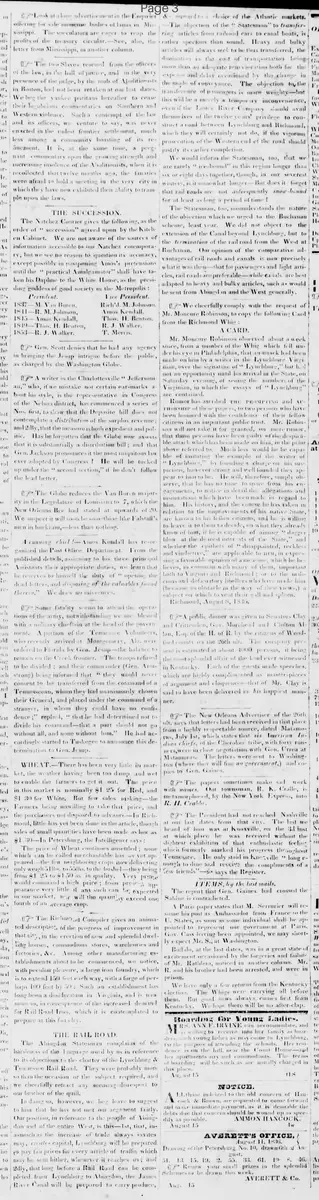
The Abingdon Statesman complains of the harshness of the language used by us in reference to its objections to the charter of the Lynchburg & Tennessee Rail Road. They were probably more so than the occasion or the subject required, and we cheerfully retract any seeming disrespect to our brother of the quill.
In doing so, however, we beg leave to suggest to him that he has not met our argument fairly. Our position, in reference to the people of Abingdon and of the entire West, is this—1st, that, inasmuch as the increase of trade always invites, if it creates capital, Lynchburg will be prepared to pay fair prices for every article of traffic which may be sent hither, whenever it reaches us; and 2dly, that long before a Rail Road can be completed from Lynchburg to Abingdon, the James River Canal will be prepared to carry produce, & onward to a choice of the Atlantic markets.
The objection of the "Statesman" to transferring articles from railroad cars to canal boats, is rather specious than sound. Heavy and bulky articles will always seek to be thus transferred, the diminution in the cost of transportation being more than an adequate remuneration both for the expense and delay occasioned by the change in the mode of conveyance. The objection to the transference of passengers is more weighty—but this will be merely a temporary inconvenience, even if the James River Company should avail themselves of the twelve years' privilege to construct a road between Lynchburg and Richmond, which they will certainly not do, if the vigorous prosecution of the Western end of the road should justify its earlier completion.
We would inform the Statesman, too, that we are rarely "ice-bound" in this region longer than six or eight days together, though, in our severest winters, it is somewhat longer—But does it forget that rail roads are not unfrequently snow-bound for at least as long a period of time?
The Statesman, too, misunderstands the nature of the objection which we urged to the Buchanan scheme, last year. We did not object to the extension of the Canal beyond Lynchburg, but to the termination of the rail road from the West at Buchanan. Our opinion of the comparative advantages of rail roads and canals is now precisely what it was then—that for passengers and light articles, rail roads are preferable—while canals are best adapted to heavy and bulky articles, such as would be sent from Abingdon and the West generally.
The Abingdon Statesman complains of the harshness of the language used by us in reference to its objections to the charter of the Lynchburg & Tennessee Rail Road. They were probably more so than the occasion or the subject required, and we cheerfully retract any seeming disrespect to our brother of the quill.
In doing so, however, we beg leave to suggest to him that he has not met our argument fairly. Our position, in reference to the people of Abingdon and of the entire West, is this—1st, that, inasmuch as the increase of trade always invites, if it creates capital, Lynchburg will be prepared to pay fair prices for every article of traffic which may be sent hither, whenever it reaches us; and 2dly, that long before a Rail Road can be completed from Lynchburg to Abingdon, the James River Canal will be prepared to carry produce, & onward to a choice of the Atlantic markets.
The objection of the "Statesman" to transferring articles from railroad cars to canal boats, is rather specious than sound. Heavy and bulky articles will always seek to be thus transferred, the diminution in the cost of transportation being more than an adequate remuneration both for the expense and delay occasioned by the change in the mode of conveyance. The objection to the transference of passengers is more weighty—but this will be merely a temporary inconvenience, even if the James River Company should avail themselves of the twelve years' privilege to construct a road between Lynchburg and Richmond, which they will certainly not do, if the vigorous prosecution of the Western end of the road should justify its earlier completion.
We would inform the Statesman, too, that we are rarely "ice-bound" in this region longer than six or eight days together, though, in our severest winters, it is somewhat longer—But does it forget that rail roads are not unfrequently snow-bound for at least as long a period of time?
The Statesman, too, misunderstands the nature of the objection which we urged to the Buchanan scheme, last year. We did not object to the extension of the Canal beyond Lynchburg, but to the termination of the rail road from the West at Buchanan. Our opinion of the comparative advantages of rail roads and canals is now precisely what it was then—that for passengers and light articles, rail roads are preferable—while canals are best adapted to heavy and bulky articles, such as would be sent from Abingdon and the West generally.
What sub-type of article is it?
Infrastructure
Trade Or Commerce
What keywords are associated?
Railroad Charter
Lynchburg Tennessee Rail Road
James River Canal
Abingdon Statesman
Western Trade
Transportation Advantages
Canal Rail Integration
What entities or persons were involved?
Abingdon Statesman
Lynchburg & Tennessee Rail Road
James River Canal
Buchanan Scheme
Editorial Details
Primary Topic
Defense Of Lynchburg & Tennessee Rail Road Charter Against Abingdon Statesman Objections
Stance / Tone
Conciliatory Yet Firm Defense Of Rail And Canal Integration For Western Trade
Key Figures
Abingdon Statesman
Lynchburg & Tennessee Rail Road
James River Canal
Buchanan Scheme
Key Arguments
Lynchburg Will Pay Fair Prices For Increased Western Trade
James River Canal Will Be Ready Before Full Rail Completion To Abingdon
Transfer From Rail To Canal Is Economical For Heavy Goods Despite Delay
Passenger Transfer Inconvenience Is Temporary
Local Ice Binding Is Shorter Than Rail Snow Binding
Previous Objection Was To Rail Termination At Buchanan, Not Canal Extension
Rails Better For Passengers And Light Articles; Canals For Bulky Goods