Thank you for visiting SNEWPapers!
Sign up free
Randolph County Journal
Winchester, Randolph County, Indiana
What is this article about?
Pierre Lacour, a retired Bordeaux winemaker and chemist, spent nearly 30 years creating chemical imitations of fine liquors that fooled experts. He published a book on the method, leading to widespread adulterated liquors in Europe and the US using poisons like strychnine. Jno. Hawkins obtained a copy to expose the fraud.
Merged-components note: Continuation of the same story on adulterated liquors, split across sequential reading orders.
Clipping
OCR Quality
Full Text
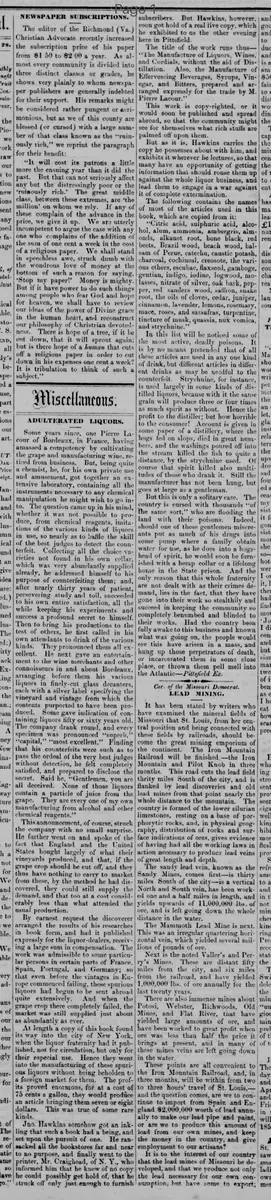
ADULTERATED
LIQUORS.
Some years since, one Pierre Lacour of Bordeaux, in France, having amassed a competency by cultivating the grape and manufacturing wine, retired from business. But, being quite a chemist, he, for his own private use and amusement, got together an extensive laboratory, containing all the instruments necessary to any chemical manipulation he might wish to go into. The question came up in his mind, whether it was not possible to produce from chemical reagents, imitations of the various kinds of liquors in use, so nearly as to baffle the skill of the best judges to detect the counterfeit. Collecting all the choice varieties not found in his own cellar which was very abundantly supplied already, he addressed himself to his purpose of counterfeiting them; and, after nearly thirty years of patient, persevering study and toil, succeeded to his own entire satisfaction, all the while keeping his experiments and success a profound secret to himself.
Then to bring his productions to the test of others, he first called in his own attendants to drink of the various kinds. They pronounced them all excellent. He next gave an entertainment to the wine merchants and other connoisseurs in and about Bordeaux, arranging before them his various liquors in finely-cut glass decanters, each with a silver label specifying the vineyard and vintage from which the contents purported to have been produced. Some gave indication of containing liquors fifty or sixty years old. The company drank round, and every specimen was pronounced "superb," "capital," "most excellent." Finding that his counterfeits were such as to pass the ordeal of the very best judges without detection, he felt completely satisfied, and prepared to disclose the secret. Said he, "Gentlemen, you are all deceived. None of those liquors contain a particle of juice from the grape. They are every one of my own manufacturing from alcohol and other chemical reagents."
This announcement, of course, struck the company with no small surprise. He further went on and spoke of the fact that England and the United States bought largely of what their vineyards produced, and that, if the grape crop should be cut off, and they thus have nothing to carry to market from these, by the method he had discovered, they could still supply the demand, and that too at a cost considerably less than what attended the usual production.
By earnest request the discoverer arranged the results of his researches in book form, and had it published expressly for the liquor-dealers, receiving a large sum in compensation. The work was admissible to some particular persons in certain parts of France, Spain, Portugal, and Germany; so that even before the vintages in Europe commenced failing, these spurious liquors had begun to be sent abroad quite extensively. And when the grape crop there completely failed, the market was still supplied just about as abundantly as ever.
At length a copy of this book found its way into the city of New York, when the liquor fraternity had it published, not for circulation, but only for their especial use. Hence they went into the manufacturing of these spurious liquors without being beholden to a foreign market for them. The profits proved enormous, for at a cost of 75 cents a gallon, they would produce an article bringing them seven or eight dollars. This was true of some rare kinds.
Jno. Hawkins somehow got an inkling that such a book had a being, and set upon the pursuit of one. He ransacked all the bookstores far and near to no purpose, and finally went to the printer, Mr. Craighead, of N. Y., who informed him that he knew of no copy he could possibly get hold of, that he struck off only just enough to furnish subscribers.
But Hawkins, however soon got hold of a real live copy, which he exhibited to us the other evening here in Pittsfield.
The title of the work runs thus—
"The Manufacture of Liquors, Wines, and Cordials, without the aid of Distillation. Also, the Manufacture of Effervescing Beverages, Syrups, Vinegar, and Bitters, prepared and arranged expressly for the trade by M. Pierre Lacour."
This work is copy-righted, or it would soon be published and spread abroad, so that the community might see for themselves what rich stuffs are palmed off upon them.
But as it is, Hawkins carries the copy he possesses about with him, and exhibits it wherever he lectures, so that many have an opportunity of getting information that should rouse them up against the whole liquor business, and lead them to engage in a war against it of complete extermination.
The following contains the names of most of the articles used in this book, which are copied from it:
"Citric acid, sulphuric acid, alcohol, alum, ammonia, ambergris, almonds, alkanet root, bone black, red beets, Brazil wood, peach wood, balsam of Peru, catechu, caustic potash, charcoal, cochineal, creosote, the various ethers, escubac, flaxseed, gamboge, gentian, indigo, iodine, logwood, molasses, nitrate of silver, oak bark, pepper, red sanders wood, saffron, snake root, the oils of cloves, cedar, juniper, cinnamon, lavender, lemons, rosemary, mace, roses, and sassafras, turpentine, tincture of musk, quassia, nux vomica and strychnine."
In this list will be noticed some of the most active, deadly poisons. It is by no means pretended that of all these articles are used in any one kind of drink, but different articles in different drinks as may be needful to the counterfeit. Strychnine, for instance, is used largely in some kinds of distilled liquors, because with it the same grain will produce three or four times as much spirit as without. Hence the profit to the distiller; but how horrible to the consumer! Account is given in some paper of a distillery, where the hogs fed on slops, died in great numbers, and the washings poured off into the stream killed the fish to quite a distance, by the strychnine used. Of course that spirit killed also multitudes of those who drank it. Still the manufacturer has not been hung, but goes at large as a gentleman.
But this is only a solitary case. The country is cursed with thousands "of the same sort," who are flooding the land with their poisons. Indeed, should one of these gentlemen miscreants put as much of his drugs into some pump where a family obtain water for use, as he does into a hogshead of spirit, he would soon be furnished with a hemp collar or a lifelong home in the State prison. And the only reason that this whole fraternity are not dealt with as their crimes demand, lies in the fact, that they have gone into their work so stealthily and succeed in keeping the community so completely benumbed and blinded to their works. Had the country been fully awake to this business and known what was going on, the people would ere this have arisen in a mass, and hung up those perpetrators of death, or incarcerated them in some close place, or thrown them pell mell into the Atlantic—Pittsfield Ex.
What sub-type of article is it?
What themes does it cover?
What keywords are associated?
What entities or persons were involved?
Where did it happen?
Story Details
Key Persons
Location
Bordeaux, France; New York; Pittsfield
Event Date
Some Years Since
Story Details
Pierre Lacour develops chemical methods to imitate fine liquors, deceiving experts and publishing a book for dealers, leading to poisonous adulterated drinks flooding markets in Europe and the US; Jno. Hawkins acquires and exhibits the book to expose the fraud and advocate against the liquor trade.