Thank you for visiting SNEWPapers!
Sign up free
Virginia Argus
Richmond, Virginia
What is this article about?
Editorial celebrates approaching anniversary of U.S. political independence and advocates for economic self-sufficiency, citing William Cobbett's preface to Robert Livingston's 'Essay on Sheep.' It promotes domestic wool production and manufacturing to reduce dependency on England, crediting Napoleon's invasion of Spain for dispersing Merino sheep stocks to America.
Merged-components note: These sequential components form an opinionated piece on national independence, manufacturing, and foreign dependence, with a partisan tone favoring self-reliance; better classified as editorial rather than story.
Clipping
OCR Quality
Full Text
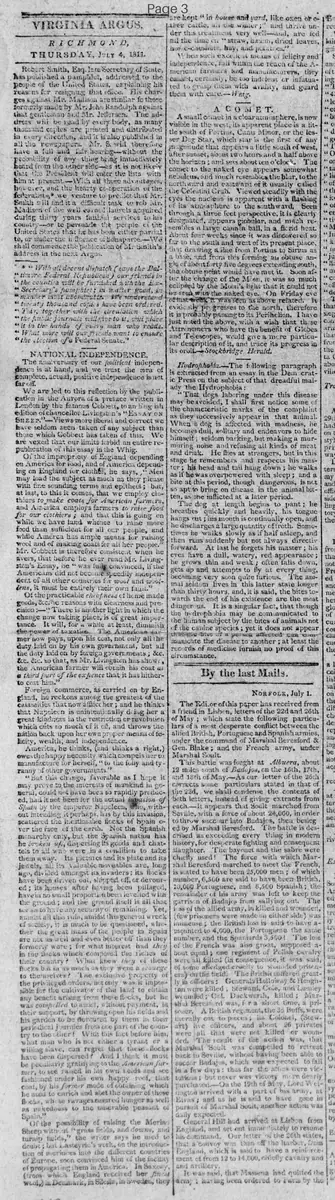
The anniversary of our political independence is at hand, and we trust the aura of complete, actual, positive independence is not far off.
We are led to this reflection by the publication in the Aurora of a preface written in London by the famous Cobbett, to an English edition of Chancellor Livingston's "Essay on Sheep." Views more liberal and correct we have seldom seen taken of any subject than those which Cobbett has taken of this. We are vexed that our limits forbid an entire re-publication of this essay in the Whig.
Of the impropriety of England depending on America for food, and of America depending on England for clothes, he says, "Men may load the subject as much as they please with fine sounding terms and epithets; but, at last, to this it comes, that we employ clothiers to make coats for American farmers, and America employs farmers to raise food for our clothiers; and that this is going on while we have land whence to raise more food than sufficient for all our people, and while America has ample means for raising wool and of making coats for all her people."
Mr. Cobbett is therefore consistent when he avers, that before he ever read Mr. Livingston's Essay, he "was fully convinced, if the Americans did not become speedily independent of all other countries for wool and woollens, it must be entirely their own fault."
Of the practicable cheapness of home made goods, &c. he reasons with clearness and precision :—"There is another light in which the change now taking place, is of great importance. It will, for a while at least, diminish the power of taxation. The American farmer now pays, upon his coat, not only all the duty laid on by his own government, but all the duty laid on by foreign governments; &c. &c. so that, as Mr. Livingston has shown, the American farmer will obtain his coat at a third part of the expense that it has hitherto cost him."
Foreign commerce, as carried on by England, he reckons among the greatest of the calamities that now afflict her; and he thinks that Napoleon is unintentionally doing her a great kindness in the restriction or revocation which cuts so much of it off, and throws the nation back upon her own proper means of felicity, wealth, and independence.
America, he thinks, (and thinks aright,) owes the happy necessity which compels her to manufacture for herself, "to the folly and tyranny of other governments."
"But this change, favorable as I hope it may prove to the interests of mankind in general, could not have been so rapidly produced, had it not been for the actual invasion of Spain by the emperor Napoleon, who, without intending it perhaps, has by this invasion, scattered the inestimable stocks of Spain over the face of the earth. Not the Spanish monarchy only, but the Spanish nation has been broken up, dispersing its goods and chattels to all who were in a condition to take them away. Its pictures and its plate and its jewels, all its valuable moveables are, long ago, divided amongst its invaders; its flocks have been driven out, shipped off, or devoured; its houses after having been pillaged, have in no small proportion been levelled with the ground; and the ground itself is all that seems to have any security of remaining. Yet, amidst all this ruin, amidst this general wreck of society, it is much to be questioned, whether the great mass of the people in Spain are not as well and even better off than they formerly were; for what interest had they in the flocks which composed the riches of their country? What knew they of these flocks but as much as they were a scourge to themselves? The exclusive property of the privileged orders, not only was it impossible for the cultivator of the land to obtain any benefit arising from these flocks, but he was compelled to assist, without payment, in their support, by throwing open his fields and his garden to be devoured by them in their periodical journies from one part of the country to the other! With this fact before him, what man who is not either a tyrant or a willing slave, can regret that these flocks have been dispersed? And I think it must be peculiarly gratifying to the American farmer, to see raised in his own fields and see fashioned under his own happy roof, that coat, by his former mode of obtaining which he used to enrich and abet the owner of those flocks, whose ravages ensured hunger as well as nakedness to the miserable peasant of Spain."
Of the possibility of raising the Merino Sheep with at grass fields, and downs, and turnip fields, the writer says he used to doubt; but Lasteyrie’s work, on the introduction of merinos into the different Countries of Europe, soon convinced him of the facility of propagating them in America. In Saxony, (from which England received her finest wool, and Denmark, in Silesia, in Sweden, they are kept "in house and yard, like oxen or other cattle, in the winter;" and thrive under this treatment very well—and, are fed all the time on "straw, haulm, dried leaves, horse-chestnuts, hay, and potatoes."
When such excellent means of felicity and independence, follow within the reach of the American farmers and manufacturers, they cannot, certainly, be too indolent or infatuated to grasp them with avidity, and guard them with Care.—Whig.
What sub-type of article is it?
What keywords are associated?
What entities or persons were involved?
Editorial Details
Primary Topic
American Economic Independence Through Domestic Wool Production And Manufacturing
Stance / Tone
Strongly Supportive Of Self Sufficiency And Critical Of Foreign Dependency
Key Figures
Key Arguments