Thank you for visiting SNEWPapers!
Sign up free
The Caledonian
Saint Johnsbury, Caledonia County, Vermont
What is this article about?
President John Tyler's 1842 annual message to Congress highlights national prosperity, resolved foreign disputes with Britain, slave trade efforts, relations with Mexico and others, end of Florida Indian War, economic challenges from banking excesses, tariff revisions, military/naval updates, and proposes an Exchequer system for stable currency.
Merged-components note: This is a continuation of the President's annual message split across pages 2 and 3; relabeled from 'story' to 'domestic_news' as it is national government reporting.
Clippings
1 of 2
OCR Quality
Full Text
Here shall the Press the People's rights maintain,
Unawed by influence and unbribed by gain.
Here patriot Truth her glorious precepts draw,
Pledged to Religion, Liberty, and Law.
ST. JOHNSBURY.
TUESDAY, DECEMBER 13, 1842.
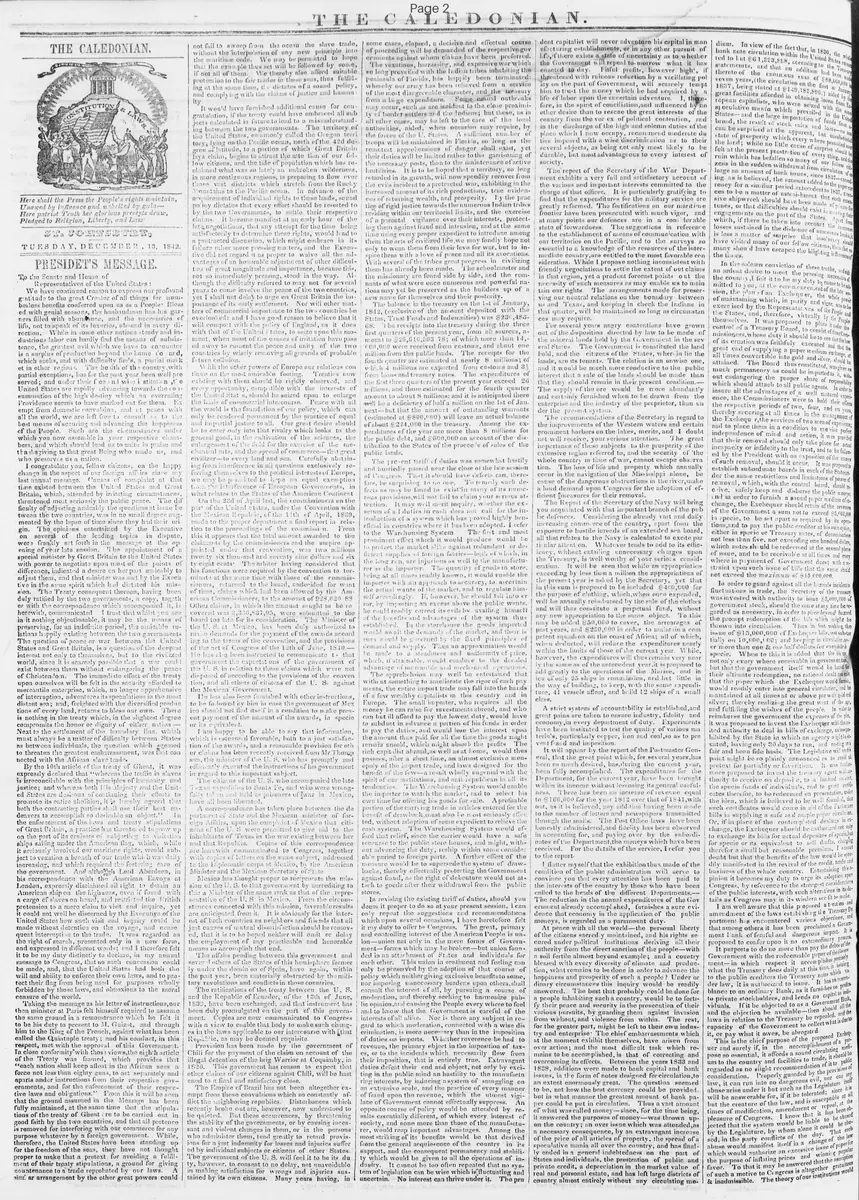
PRESIDENT'S MESSAGE.
To the Senate and House of Representatives of the United States:
We have continued reason to express our profound gratitude to the great Creator of all things for numberless benefits conferred upon us as a People. Blessed with genial seasons, the husbandman has his garners filled with abundance, and the necessaries of life, not to speak of its luxuries, abound in every direction. While in some other nations steady and industrious labor can hardly find the means of subsistence, the greatest evil which we have to encounter is a surplus of production beyond the home demand, which seeks, and with difficulty finds, a partial market in other regions. The health of the country, with partial exceptions, has for the past year been well preserved; and under their free constitutional institutions, the United States are rapidly advancing towards the consummation of the high destiny which an overruling Providence seems to have marked out for them. Exempt from domestic convulsion, and at peace with all the world, we are left free to consult as to the best means of securing and advancing the happiness of the People. Such are the circumstances under which you now assemble in your respective chambers, and which should lead us to unite in praise and thanksgiving to that great Being who made us, and who preserves us a nation.
I congratulate you, fellow citizens, on the happy change in the aspect of our foreign affairs since my last annual message. Causes of complaint at that time existed between the United States and Great Britain, which, attended by irritating circumstances, threatened most seriously the public peace. The difficulty of adjusting amicably the questions at issue between the two countries, was in no small degree augmented by the lapse of time since they had their origin. The opinions entertained by the Executive on several of the leading topics in dispute, were frankly set forth in the message at the opening of your late session. The appointment of a special minister by Great Britain to the United States with power to negotiate upon most of the points of difference, indicated a desire on her part amicably to adjust them, and that minister was met by the Executive in the same spirit which had dictated his mission. The Treaty consequent thereon, having been duly ratified by the two governments, a copy, together with the correspondence which accompanied it, is herewith communicated. I trust that whilst you see in it nothing objectionable, it may be the means of preserving, for an indefinite period, the amicable relations happily existing between the two governments.
The question of peace or war between the United States and Great Britain, is a question of the deepest interest not only to themselves, but to the civilized world, since it is scarcely possible that a war could exist between them without endangering the peace of Christendom. The immediate effect of the treaty upon ourselves will be felt in the security afforded to mercantile enterprise, which, no longer apprehensive of interruption, adventures its speculations in the most distant sea; and, freighted with the diversified productions of every land, returns to bless our own. There is nothing in the treaty which, in the slightest degree, compromises the honor or dignity of either nation.
Next to the settlement of the boundary line, which must always be a matter of difficulty between States as between individuals, the question which seemed to threaten the greatest embarrassment, was that connected with the African slave trade. By the 10th article of the treaty of Ghent, it was expressly declared that "whereas the traffic in slaves is irreconcilable with the principles of humanity and justice; and whereas both His Majesty and the United States are desirous of continuing their efforts to promote its entire abolition, it is hereby agreed that both the contracting parties shall use their best endeavors to accomplish so desirable an object."
In the enforcement of the laws and treaty stipulations of Great Britain, a practice has therefore grown up on the part of its cruisers of subjecting to visitation ships sailing under the American flag, which, while it seriously involved our maritime rights, would subject to vexation a branch of our trade which was daily increasing, and which required the fostering care of the government. And although Lord Aberdeen, in his correspondence with the American Envoys at London, expressly disclaimed all right to detain an American ship on the high seas, even if found with a cargo of slaves on board, and restricted the British pretension to a mere claim to visit and inquire, yet it could not well be discerned by the Executive of the United States how such visit and inquiry could be made without detention on the voyage, and consequent interruption to the trade. It was regarded as the right of search, presented only in a new form, and expressed in different words; and I therefore felt it to be my duty distinctly to declare, in my annual message to Congress, that no such concession could be made, and, that the United States had both the will and ability to enforce their own laws, and to protect their flag from being used for purposes wholly forbidden by those laws, and obnoxious to the moral censure of the world.
Taking the message as his letter of instructions, our then minister at Paris felt himself required to assume the same ground in a remonstrance which he felt it to be his duty to present to M. Guizot, and through him to the King of the French, against what has been called the Quintuple treaty; and his conduct, in this respect, met with the approval of this Government.
In close conformity with those views, the eighth article of the Treaty was framed, which provides that "each nation shall keep afloat in the African seas a force not less than eighty guns, to act separately and apart under instructions from their respective governments, and for the enforcement of their respective laws and obligations." From this it will be seen that the ground assumed in the Message has been fully maintained, at the same time that the stipulations of the treaty of Ghent are to be carried out in good faith by the two countries, and that all pretence is removed for interfering with our commerce for any purpose whatever by a foreign government. While, therefore, the United States have been standing up for the freedom of the seas, they have not thought proper to make that a pretext for avoiding a fulfilment of their treaty stipulations, a ground for giving countenance to a trade reprobated by our laws. A similar arrangement by the other great powers could not fail to sweep from the ocean the slave trade, without the interpolation of any new principle into the maritime code. We may be permitted to hope that the example thus set will be followed by some, if not all of them. We thereby also afford suitable protection to the fair trader in those seas, thus fulfilling at the same time, the dictates of a sound policy, and complying with the claims of justice and humanity.
It would have furnished additional cause for congratulation, if the treaty could have embraced all subjects calculated in future to lead to a misunderstanding between the two governments. The territory of the United States, commonly called the Oregon territory, lying on the Pacific ocean, north of the 42d degree of latitude, to a portion of which Great Britain lays claim, begins to attract the attention of our fellow citizens, and the tide of population which has reclaimed what was so lately an unbroken wilderness, in more contiguous regions, is preparing to flow over those vast districts which stretch from the Rocky Mountains to the Pacific ocean. In advance of the acquisition of individual rights to these lands, sound policy dictates that every effort should be resorted to by the two governments, to settle their respective claims. It became manifest at an early hour of the late negotiations, that any attempt for the time being satisfactorily to determine those rights, would lead to a protracted discussion, which might embrace in its failure other more pressing matters, and the Executive did not regard it as proper to waive all the advantages of an honorable adjustment of other difficulties of great magnitude and importance, because this, not so immediately pressing, stood in the way. Although the difficulty referred to may not for several years to come involve the peace of the two countries, yet I shall not delay to urge on Great Britain the importance of its early settlement. Nor will other matters of commercial importance to the two countries be overlooked; and I have good reason to believe that it will comport with the policy of England, as it does with that of the United States, to seize upon this moment, when most of the causes of irritation have passed away to cement the peace and unity of the two countries by wisely removing all grounds of probable future collision.
With the other powers of Europe our relations continue on the most amicable footing. Treaties now existing with them should be rigidly observed, and every opportunity, compatible with the interests of the United States, should be seized upon to enlarge the basis of commercial intercourse. Peace with all the world is the foundation of our policy, which can only be rendered permanent by the practice of equal and impartial justice to all. Our great desire should be to enter only into that rivalry which looks to the general good, in the cultivation of the sciences, the enlargement of the field for the exercise of the mechanical arts, and the spread of commerce-that great civilizer-to every land and sea. Carefully abstaining from interference in all questions exclusively referring themselves to the political interests of Europe, we may be permitted to hope an equal exemption from their interference of European Governments, in what relates to the States of the American Continent.
On the 23d of April last, the commissioners on the part of the United States, under the Convention with the Mexican Republic, of the 11th of April, 1839, made to the proper department a final report in relation to the proceedings of the commission. From this it appears that the total amount awarded to the claimants by the commissioners and the umpire appointed under that convention, was two millions twenty six thousand and seventy nine dollars and sixty eight cents. The arbiter having considered that his functions were required by the convention to terminate at the same time with those of the commissioners, returned to the board, undecided for want of time, claims which had been allowed by the American Commissioners, to the amount of $928,620 83. Other claims, in which the amount sought to be recovered was $3,336,887.05, were submitted to the board too late for its consideration. The Minister of the U. S. at Mexico, has been duly authorized to make demands for the payment of the awards according to the terms of the convention, and the provisions of the act of Congress of the 11th of June, 1840. He has also been instructed to communicate to that government the expectations of the government of the U. S. in relation to those claims which were not disposed of according to the provisions of the convention, and all others of citizens of the U. S. against the Mexican Government.
He has also been furnished with other instructions, to be followed by him in case the government of Mexico should not find itself in a condition to make present payment of the amount of the awards, in specie or its equivalent.
I am happy to be able to say that information, which is esteemed favorable, both to a just satisfaction of the awards, and a reasonable provision for other claims has been recently received from Mr. Thompson, the minister of the U. S. who has promptly and efficiently executed the instructions of his government in regard to this important subject.
The citizens of the U. S. who accompanied the late Texan expedition to Santa Fe, and who were wrongfully seized and hold as prisoners of war in Mexico, have all been liberated.
A correspondence has taken place between the department of state and the Mexican minister of foreign Affairs, upon the complaint of Mexico that citizens of the U. S were permitted to give aid to the inhabitants of Texas in the war existing between her and that Republic. Copies of this correspondence are herewith communicated to Congress, together with copies of letters on the same subject, addressed to the Diplomatic corps at Mexico, by the American Minister and the Mexican Secretary of State.
Mexico has thought proper to reciprocate the mission of the U. S. to that government by accrediting to this a Minister of the same rank as that of the representative of the U. S in Mexico. From the circumstances connected with this mission, favorable results are anticipated from it. It is obviously for the interest of both countries as neighbors and friends that all just causes of mutual dissatisfaction should be removed, that it is to be hoped neither will omit or delay the employment of any practicable and honorable means to accomplish that end.
The affairs pending between this government and several others of the States of this hemisphere formerly under the dominion of Spain, have again, within the past year, been materially obstructed by their military revolutions and conflicts. The ratifications of the treaty between the U. S. and the Republic of Ecuador, of the 13th of June, 1839, have been exchanged, and that instrument has been duly promulgated on the part of this government. Copies are now communicated to Congress with a view to enable that body to make such changes in the laws applicable to our intercourse with that Republic, as may be deemed requisite.
Provision has been made by the government of Chili for the payment of the claim on account of the illegal detention of the brig Warrior at Coquimbo, in 1820. This government has reason to expect that other claims of our citizens against Chili, will be hastened to a final and satisfactory close.
The Empire of Brazil has not been altogether exempt from those convulsions which so constantly afflict the neighboring republics. Disturbances which recently broke out are, however, now understood to be quieted. But these occurrences, by threatening the stability of the governments, or by causing incessant and violent changes in them, or in the persons who administer them, tend greatly to retard provisions or a just indemnity for losses and injuries suffered by individual subjects or citizens of other States. The government of the U. S. will feel it to be its duty, however, to consent to no delay, not unavoidable in making satisfaction for wrongs and injuries sustained by its own citizens. Many years having, in some cases, elapsed, a decisive and effectual course of proceeding will be demanded of the respective governments against whom claims have been preferred.
The vexatious, harassing, and expensive war which so long prevailed with the Indian tribes inhabiting the peninsula of Florida, has happily been terminated: whereby our army has been relieved from a service of the most disagreeable character, and the treasury from a large expenditure. Some casual outbreaks may occur, such as are incident to the close proximity of border settlers and the Indians; but these, as in all other cases, may be left to the care of the local authorities, aided, when occasion may require, by the forces of the U. States. A sufficient number of troops will be maintained in Florida, so long as the remotest apprehensions of danger shall exist, yet their duties will be limited rather to the garrisoning of the necessary posts, than to the maintenance of active hostilities. It is to be hoped that a territory, so long retarded in its growth, will now speedily recover from the evils incident to a protracted war, exhibiting in the increased amount of its rich productions, true evidences of returning wealth, and prosperity. By the practice of rigid justice towards the numerous Indian tribes residing within our territorial limits, and the exercise of a parental vigilance over their interests, protecting them against fraud and intrusion, and at the same time using every proper expedient to introduce among them the arts of civilized life, we may fondly hope not only to wean them from their love for war, but to inspire them with a love of peace and all its avocations. With several of the tribes great progress in civilizing them has already been made. The schoolmaster and the missionary are found side by side, and the remnants of what were once numerous and powerful nations may yet be preserved as the builders up of a new name for themselves and their posterity.
The balance in the treasury on the 1st of January, 1842, (exclusive of the amount deposited with the States, Trust Funds and Indemnities) was $23,1483.68. The receipts into the treasury during the three first quarters of the present year, from all sources, amount to $26,610,593 78; of which more than 14,000,000 were received from customs, and about one million from the public lands. The receipts for the fourth quarter are estimated at nearly 8 millions; of which 4 millions are expected from customs and 3 from loans and treasury notes. The expenditures of the first three quarters of the present year exceed 26 millions, and those estimated for the fourth quarter amount to about 8 millions: and it is anticipated there will be a deficiency of half a million on the 1st of Jan. next-but that the amount of outstanding warrants (estimated at $800,000) will leave an actual balance of about $224,000 in the treasury. Among the expenditures of the year are more than 8 millions for the public debt, and $360,000 on account of the distribution to the States of the proceeds of sales of the public lands.
The present tariff of duties was somewhat hastily and hurriedly passed near the close of the late session of Congress. That it should have defects can, therefore, be surprising to no one. To remedy such defects as may be found to exist in many of its numerous provisions, will not fail to claim your serious attention. It may well merit inquiry, whether the exaction of all duties in cash does not call for the introduction of a system which has proved highly beneficial in countries where it has been adopted. I refer to the Warehousing System.
The first and most prominent effect which it would produce would be to protect the market alike against redundant or deficient supplies of foreign fabrics-both of which, in the long run, are injurious as well to the manufacturer as the importer. The quantity of goods in store, being at all times readily known, it would enable the importer with an approach to accuracy, to ascertain the actual wants of the market, and to regulate himself accordingly. If, however, he should fall into error, by importing an excess above the public wants, he could readily correct its evils by availing himself of the benefits and advantages of the system thus established. In the storehouse the goods imported would await the demands of the market, and their issues would be governed by the fixed principles of demand and supply. Thus an approximation would be made to a steadiness and uniformity of price, which, if attainable, would conduce to the decided advantage of mercantile and mechanical operations.
The apprehension may well be entertained that without something to ameliorate the rigor of cash payments, the entire import trade may fall into the hands of a few wealthy capitalists in this country and in Europe. The small importer, who requires all the money he can raise for investments abroad, and who can but ill afford to pay the lowest duty, would have to subduct in advance a portion of his funds in order to pay the duties, and would lose the interest upon the amount thus paid for all the time the goods might remain unsold, which might absorb the profits. The rich capitalist abroad, as well as at home, would thus possess, after a short time, an almost exclusive monopoly of the import trade, and laws designed for the benefit of the few-a result wholly ungenial with the spirit of our institutions, and anti-republican in all its tendencies. The Warehousing System would enable the importer to watch the market, and to select his own time for offering his goods for sale. A profitable portion of the carrying trade in articles entered for the benefit of drawback, must also be most seriously affected, without adoption of some expedient to relieve the cash system. The Warehousing System would afford that relief, since the carrier would have a safe recourse to the public store houses, and might, without advancing the duty, reship within some considerable period to foreign parts. A further effect of the measure would be to supersede the system of drawbacks, thereby effectually protecting the Government against fraud, as the right of debenture would not attach to goods after their withdrawal from the public stores.
In revising the existing tariff of duties, should you deem it proper to do so at your present session, I can only repeat the suggestions and recommendations which upon several occasions, I have heretofore felt it my duty to offer to Congress. The great, primary and controlling interest of the American People is union-union not only in the mere forms of Government-forms which may be broken-but union founded in an attachment of States and individuals for each other. This union in sentiment and feeling can only be preserved by the adoption of that course of policy which neither giving exclusive benefits to some, nor imposing unnecessary burdens upon others, shall consult the interest of all, by pursuing a course of moderation, and thereby seeking to harmonize public opinion, and causing the People everywhere to feel and to know that the Government is careful of the interests of all alike. Nor is there any subject in regard to which moderation, connected with a wise discrimination, is more necessary than in the imposition of duties on imports. Whether reverence be had to revenue, the primary object in the imposition of taxes, or to the incidents which necessarily flow from their imposition, that is entirely true. Extravagant duties defeat their end and object, not only by exciting in the public mind an hostility to the manufacturing interests, by inducing a system of smuggling on an extensive scale, and the practice of every manner of fraud upon the revenue, which the utmost vigilance of Government cannot effectually suppress. An opposite course of policy would be attended by results essentially different, of which every interest of society, and none more than those of the manufacturer, would reap important advantages. Among the most striking of its benefits would be that derived from the general acquiescence of the country in its support, and the consequent permanency and stability which would be given to all the operations of industry. It cannot be too often repeated that no system of legislation can be wise which is fluctuating and uncertain. No interest can thrive under it. The prudent capitalist will never adventure his capital in manufacturing establishments, or in any other pursuit of life, if there exists a state of uncertainty as to whether the Government will repeal to-morrow what it has enacted to-day. Fitful profits, however high, if threatened with ruinous reduction by a vacillating policy on the part of Government, will scarcely tempt him to trust the money which he had acquired by a life of labor upon the uncertain adventure. I, therefore, in the spirit of conciliation, and influenced by no other desire than to rescue the great interests of the country from the vortex of political contention, and in the discharge of the high and solemn duties of the place which I now occupy, recommend moderate duties imposed with a wise discrimination as to their several objects, as being not only most likely to be durable, but most advantageous to every interest of society.
The report of the Secretary of the War Department exhibits a very full and satisfactory account of the various and important interests committed to the charge of that officer. It is particularly gratifying to find that the expenditures for the military service are greatly reformed. The fortifications on our maritime frontier have been prosecuted with much vigor, and at many points our defences are in a considerable state of forwardness. The suggestions in reference to the establishment of means of communication with our territories on the Pacific, and to the surveys so essential to a knowledge of the resources of the intermediate country, are entitled to the most favorable consideration. While I propose nothing inconsistent with friendly negotiations to settle the extent of our claims in that region, yet a prudent forecast points out the necessity of such measures as may enable us to maintain our rights. The arrangements made for preserving our neutral relations on the boundary between us and Texas, and keeping in check the Indians in that quarter, will be maintained so long as circumstances may require.
For several years angry contentions have grown out of the disposition directed by law to be made of the mineral lands held by the Government in the several States. The Government is constituted the land lord, and the citizens of the States, wherein lie the lands, are its tenants. The relation is an unwise one, and it would be much more conducive to the public interest that a sale of the lands should be made than that they should remain in their present condition. The supply of the ore would be more abundantly and certainly furnished when to be drawn from the enterprise and the industry of the proprietor, than under the present system.
The recommendations of the Secretary in regard to the improvements of the Western waters and certain prominent harbors on the lakes, merits, and I doubt not will receive, your serious attention. The great importance of these subjects to the prosperity of the extensive region referred to, and the security of the whole country in time of war, cannot escape observation. The loss of life and property which annually occur in the navigation of the Mississippi alone, because of the dangerous obstructions in the river, make a loud demand upon Congress for the adoption of efficient measures for their removal.
The Report of the Secretary of the Navy will bring you acquainted with that important branch of the public defences. Considering the already vast and daily increasing commerce of the country, apart from the exposure to hostile inroads of an extended sea board, all that relates to the Navy is calculated to excite particular attention. Whatever tends to add to its efficiency, without entailing unnecessary charges upon the Treasury, is well worthy of your serious consideration. It will be seen that while an appropriation exceeding by less than a million the appropriations of the present year is asked by the Secretary, yet that in this sum is proposed to be included $100,000 for the purpose of clothing, which, when once expended, will be annually reimbursed by the sale of the clothes and will thus constitute a perpetual fund, without any new appropriation to the same object. To this may be added $50,000 to cover the arrearages of past years, and $250,000 in order to maintain a competent squadron on the coast of Africa; all of which, when deducted, will reduce the expenditures nearly within the limits of those of the current year. While, however, the expenditures will thus remain very nearly the same as of the antecedent year, it is proposed to add greatly to the operations of the Marine, and in lieu of only 25 ships in commission, and but little in the way of building, to keep, with the same expenditure, 41 vessels afloat, and build 12 ships of a small class.
A strict system of accountability is established, and great pains are taken to ensure industry, fidelity and economy, in every department of duty. Experiments have been instituted to test the quality of various materials, particularly copper, iron and coal, so as to prevent fraud and imposition.
It will appear by the report of the Postmaster General, that the great point which, for several years, has been so much desired, has, during the current year, been fully accomplished. The expenditures for the Department, for the current year, have been brought within its income without lessening its general usefulness. There has been an increase of revenue equal to $166,000 for the year 1842 over that of 1841, without, as it is believed, any addition having been made to the number of letters and newspapers transmitted through the mails. The Post Office laws have been honestly administered, and fidelity has been observed in accounting for, and paying over by the subordinates of the Department, the moneys which have been received. For the details of the service, I refer you to the report.
I flatter myself that the exhibition thus made of the condition of the public administration will serve to convince you that every attention has been paid to the interests of the country by those who have been called to the heads of the different Departments. The reduction in the annual expenditures of the Government already accomplished, furnishes a sure evidence that economy in the application of the public moneys, is regarded as a paramount duty.
At peace with all the world-the personal liberty of the citizens sacredly maintained, and his rights secured under political institutions deriving all their authority from the direct sanction of the People-with a soil fertile almost beyond example; and a country blessed with every diversity of climate and production, what remains to be done in order to advance the happiness and prosperity of such a people? Under ordinary circumstances this inquiry would be readily answered. The best that probably could be done for a people inhabiting such a country, would be to fortify their peace and security in the prosecution of their various pursuits, by guarding them against invasion from without, and violence from within. The rest, for the greater part, might be left to their own industry and enterprise. The chief embarrassments which at the moment exhibit themselves, have arisen from over action; and the most difficult task which remains to be accomplished, is that of correcting and overcoming its effects. Between the years 1833 and 1838, additions were made to bank capital and bank issues, in the form of notes designed for circulation, to an extent enormously great. The question seemed to be, not how the best currency could be provided, but in what manner the greatest amount of bank paper could be put in circulation. Thus a vast amount of what was called money-since, for the time being, it answered the purposes of money-was thrown upon the country; an over issue which was attended, as a necessary consequence, by an extravagant increase of the price of all articles of property, the spread of a speculative mania all over the country, and has finally ended in a general indebtedness on the part of States and individuals, the prostration of public and private credit, a depreciation in the market value of real and personal estate, and has left large districts of country almost entirely without any circulating medium.
In addition to the evils of an excessive issue of bank paper, the facilities afforded by the legislation of 1837 thereto, stated as enormous creation at the rate of $149 in obtaining on 185 ue 890 trst lons aided ol from bym.
Speculative mania large which importation prevailed of funds in from a broad be surprised the resuit at of the stock apparent but unsubstamt little cause of surprise Dreval should be befallen prostration withdrawal many of liom every of our cirenlation thing fellow and ehi h.
Zarg an mount of bak issu, since 17ex ry engagements sive ces to shipwreck be that there a matter on diliculties be should in the of taken the sarprise part have dishonor into of shonld fellow the that account citizens insolvency the than immense should that for so many shou d have escaped the blighting uensof the tines.
the an In ardent count the solemn dusire y i felt to conviction it meet to be the my of pressing these truths necessitiesdf andwit sion mitted muiutaining the you plan ef at which an the comnencenentof Exchequ in parity er and the vigor the whole wastobe late powe ses and the therefore Representat virtually ves of by the the the People People and a whose Treasury It was duty proposed Board it should to to consist be place to see ofthreeCom- itunder thatthelaw the and the of its croation was faithfuly executed and that the great end of supplying a paper mnedium exchange, at all times convertible into gold and silver. should be attained. The Board thus constituted, wasgiven as much permanency us could be imparted to ii, with. out endangering the proper share of responsibility which should attach to all public agents. Inorder io insure all the advantages of a well matured experi ence, the Commissioncrs were to hold their office the respective periods of two, four, and sx years thereby sccuring at all tines in the manogemont df the Exchequ r,the services of two menof experience aad to place thern in a condition to execise perfect independence of mind and action, it was provide that their removal should only take place for actual incapacity or infidelity to the irust, and to be follow- ed by the P'resident with an exposition ofthe camse of such removal, should it occur. It was proposedto establish subordinate boards in each of the States,m- dor the san.e restrictions and limnitations of powerd removal, which, with the central board, should re c ive, safely keep and disburse the public noneys ind in order to furnish a sound p: per medium ofer- change, the Exchcquer should retain of the revennes of the Government a sun not to exceed $5,c00,00 in specic, to be set apart as lequired by its opera- tions,and to pay the public creditor at his own option, eithcr in specie or Treasury netes, of denominations not less than five, not exceeding one hundred dollars, which notes should be redecned at the several places of issue, and to be reccivab'le at all times and erery where in payment of (Giovernn.ent dues; with are- straint upon such issue of bills that the same should not exceed the maximum of s15 eco,oco. In order to guard against all the hazards incidentu fluctuntions in trade, the Secretary of the treasury was invested with authority to issue s5,00o,c00 of governnent stock, should ihe sane at any time bere- garded as necessary, in order to plvce bevond hazard the prompt redemption of th:e Uills which might be thrown into circuiation. I hus in fart makivg tho issue of l5,Ooo,Ooo of Exchequer Lills, restsubstan tially on l0,ooe,i o0: and keeping in circulatien rer er more than one & one half dollars for evendoliri specie. When to this it is added that the Wis ae not on'y every where receivable in governnentd but that the government itself would be lornd fr their ultimnte redemption, no rational doult cament that the poper which the Excheguer would farnish, would readiiy enter into general circulation, and be maintained at all times at or above par wah gold ard silver; thereby realizing the great want of the me and fulfi ling the wishes of the peon'e. In oider ts reiniburse the governnent the expenses of the pan, it was proposed to invest the Exchequer withthelm- ited authority to deal in bills of exchange, unlesspo- hibited by the State in which an agency iightlesit- cated, having only 30 days to ran, ard resting c fair and bona fide basis. The Legislative will onthis poitt n.ight be so plainly announced es to avoid all pretext for partiality or fhvoritisin. It was father more proposed to invest the tronsary ngent wihan thority to receive on deposi c, to a Imited anenrt, the specie funds of individuals, and to grant cetif- eates therefor, to be redeemed on presentation, uder the ilea, which is believed to be tell found d, thst such certificates wou'd come in ajd ofthe Ixeleqret bills in supplying a sufe an.d ample papor circulaion Or, if in place of the contenp' ted dealngs in ex- to exchange its bills for actual deposites of specie,but change, the Exchequer should be authorized not only for specie or its equivalent to seli drafts, charging therefor a small but reasonable preminm, I canrot doubt but that the benefits of the law wou'd be spee- dily manifested in the revival of the credit, trade and business of the whole country. Entertaining thso- pinion becomes my duty urge its adoption upor Congress, by reference to the strongest corsiderations of the public interests with such alterations its tails as Congress may in its wisdom see it to make. amendment of the laws establishig tl e Treasury De I am well aware that this p'oposed a'teration and ment lank of fearful and dangerous import. It is that among others it has been proclained a Goven- partiment has encountered various objections It purports to do no more than pay the debs of he confer upon extrnordinary ment-in which respect it accomplishes precisely Government with the redeemable to the oh s does daily e law b the Lae y it cul icrter sh,ns .t. 1.. ahrecd such abuse woul mniest iteliange oe a nucn would authorize an excessive isave ol pape favor. To that it may & inadminsible. T'ho theory ofour institutions wcold such motive Cyngress be answered that the ascription prices and altogether gratuitous the purpose inflating
It is the chief que o the d Exce- poessential, forso clag u to thyf law, it can run into no dangerous evil, por consideration. Properly guarded by tho provisions of recommendation can any itsell w po answorable or, if it be tolernted; sinco Legislature but the crentury of tho kaw, and is susceptibl pleasure of Congress. I know that it has been ob- amendment times modification b the Lae y it cul such conflicts
T isthe chiepue o the d Exce- poessential, forso clag u to thyf cayoth ent o letht d it, or pay what it awes, be abrogated
lead as to a different conclusion. But a perfect security
against a proceeding so reckless would be found to
exist in the very nature of things. The political par-
ties of the country as to resort to such an expedient, would
that the moment the paper ceased to be convertible.
Generally meet with a signal overthrow in the fact
becoming worthless, and in the end, dishonor the Govern-
into specie, or otherwise promptly redeemed, it would
ment, involve the people in ruin, and such political
view involves the utter impossibility of furnishing any
party in byplus disgrace. At the same time, such a
currency other than that of the precious metals; for,
if the government itself cannot forgo the temptation
of excessive paper issues, what reliance can be plac-
ed in corporations upon whom the temptations of indi-
viduil aggrandizement would most strongly operate?
The People would have to blame none but them-
wives for any injury that might arise from a course
in reckless, since their agents would be the wrong-
door, and they the passive spectators,
'There can be but three kinds of public currency.
1st Gold and silver; 2d. The paper of state institu-
tions, or, 3d. A representative of the precious met-
als, provided by the General Government, or under
its authority. The Sub-Treasury system rejected
the last in any form; and, as it was believed that no
reliance could be placed on the issues of local insti-
tutions, for the purposes of general circulation, it ne-
cessarily and unavoidably adopted specie as the ex-
clusive currency for its own use. And this must ever
be the case unless one of the other kinds be used.
The choice, in the present state of public sentiment
lies between an exclusive specie currency on the one
hand, and Government issues of some kind on the
other.—That these issues cannot be made by a char-
tered institution, is supposed to be conclusively set-
led. They must be made, then, directly by Govern-
ment agents. For several years past they have been
thus made in the form of Treasury notes, and have
answered a valuable purpose. Their usefulness has
been limited by their being transient and temporary;
their ceasing to bear interest at given periods, neces-
sarily cause their speedy return, and thus restricts
their range of circulation, and, being used only in the
disbursements of the Government, they cannot reach
those points where they are most required. By ren-
dering their use permanent, to the moderate extent
already mentioned, by offering no inducement for their
return, and by exchanging them for coin and other
values, they will constitute, to a certain extent, the
general currency so much needed to maintain the
internal trade of the country. And this is the Ex-
chequer plan, so far as it may operate in furnishing a
currency.
I cannot forgo the occasion to urge its importance to
the credit of the Government in a financial point of
view. The great necessity of resorting to every prop-
er and becoming expedient in order to place the Trea-
sury on a footing of the highest respectability, is en-
tirely obvious: The credit of the Government may
be regarded as the very soul of the Government it-
self—a principle of vitality without which all its move-
ments are languid and all its operations embarrassed:
In this spirit the Executive felt itself bound by the
most imperative sense of duty to submit to Congress,
at its last session, the propriety of making a specific
pledge of the land fund, as the basis for the negotia-
tion of the loans authorized to be contracted. I then
thought that such an application of the public domain
would, without doubt, have placed at the command
of the Government ample funds to relieve the Trea-
sury from the temporary embarrassment under which
it labored. American credit has suffered a consider-
able shock in Europe, from the large indebtedness of
the States and the temporary inability of some of
them to meet the interest on their debts. The utter
and disastrous prostration of the United States Bank
of Pennsylvania, had contributed largely to increase
the sentiment of distrust by reason of the loss and ru-
ins sustained by the holders of its stock, a large por-
tion of whom were foreigners, and many of whom
were alike ignorant of our political organization, and
of her actual responsibilities It was the anxious de-
sire of the Executive that in the effort to negotiate
the broad, the American negotiator might be
able to point the money lender to the fund mortgaged
for the redemption of the principal and interest of any
loan he might contract, and thereby vindicate the
government from all suspicion of bad faith or inabil-
ity to meet its engagements. Congress differed from
the executive in this view of the subject: It became,
nevertheless, the duty of the Executive to resort to
every expedient in its power to negotiate the author-
ized loan.
After a failure to do so in the American
market, a citizen of high character and talent was
sent to Europe with no better success; and thus the
portifying spectacle has been presented of the inabil-
ity of this Government to obtain a loan so small as
not in the whole to amount to more than one-fourth
of its ordinary annual income; at a time when the Gov
ernments of Europe, although involved in debt, and
with their subjects heavily burdened with taxation,
publily obtain loans of any amount at a greatly re-
duced rate of interest It would be unprofitable to
be: further into this anomalous state of things, but I
cannot conclude without adding that, for a Govern-
ment which has paid off its debts of two wars with
the largest maritime power of Europe, and now owing
no debt which is next to nothing when compared with
its boundless resources, a Government the strongest
in the world, because emanating from the popular
will, and firmly rooted in the affections of a great and
free people, and whose fidelity to its engagements
has never been questioned; for such a government
to have tendered to the capitalists of other countries
opportunity for a small investment of its stock, and
get to have failed, implies either the most unfounded
distrust in its good faith, or a purpose, to obtain
which the course pursued is the most fatal which
could have been adopted. It has become obvious to
men that the Government must look to its own
means for supplying its wants, and it is consoling to
know that these means are altogether adequate for
the object.
It is believed that in a short time it will reach the maximum
of $15,000,000
it is obvious
that $10,000,000
hereby
be
added
to
the
available
means
of
the
Treasury
without
cost
or
charge
Nor
can
fail
to
urge
great
and
beneficial
effects
which
would
be
pro-
beed in aid of all the active pursuits of life. Its effects upon the solvent
State
banks while it would
rce into
rugh its weekly settlements, would be highly ben-
felal
and
with
the
advantages
of
sound
perstoration of confidence and credit would follow.
The
numerous
train
of
blessings
My
convictions
emost
strong
that
those
benefits
would
follow
from
eadoption
of
this
measure
but
if
the
result
should
adverse
there
is
this
security
in
connection
with
that the law creating
it may be repealed at the
measure of the Legislature,
jation of its good faith.
I recommend to Congress to take into consideration
without the slightest im-
epropriety
of
re-imbursing
fine
imposed
on
Gen
ekson
at
New-Orleans
at
the time of the attack
Idefence
of
the
city
and
paid by him. Without
ing any reflection on the judicial tribunal which
posed
the
fine
the
remission
at
this
gr ded
as
not
unjust
or
inexpedient
The voice of
eivil
authority
was
heard
amidst
the
glittering
of
s
and
obeyed
by
those
who
held
the
sword
there
giving additional
movement.
If the laws were offended, their maj-
Iusture to a memorable military
was
fuly
vindicated
and
although
the
penalty
ared
and
paid
is
worthy
of
little
regard
in
a
pecu-
it
can
hardly
be
doubted
that
it
to
the
war-worn
veteran
now
in
remen and in his days the re-
m Ihe circumstances in which
placed him. There are cases in which public func-
iionaries may be called on to weigh the public inter-
est against their own hazards, and if the civil law be
violated from praiseworthy motives, or any overruling
sense of public danger and public necessity, punish-
mout may well be restrained within that limit which
asserts and maintains the authority of the law, and
the subjection of the military to the civil power.
The defence of New-Orleans, while it saved a city
from the hands of the enemy, placed the name of
Gen. Jackson among those of the greatest Captains of
the age, and illustrated one of the brightest pages of
our history. Now that the causes of excitement, cx-
isting at the time, have ceased to operate, it is be-
lieved that remission of this fine, and whatever of
gratification that remains might cause the eminent
man who incurred and paid it, would be in accor-
dance with the general feeling and wishes of the
American People.
I have thus, fellow-citizens, acquitted myself of
my duty under the Constitution, by laying before
you, as succinctly as I have been able, the state of
the Union, and by inviting your attention to meas-
ures of much importance to the country. The Ex.
ecutive will most zealously unite its efforts with
those of the Legislative Department in the accomplish-
ment of all that is required to relieve the wants of a
common constituency, or elevate the destinies of a be-
loved country.
JOHN TYLER.
Washington, December, 1842.
What sub-type of article is it?
What keywords are associated?
What entities or persons were involved?
Where did it happen?
Domestic News Details
Primary Location
Washington
Event Date
December 1842
Key Persons
Event Details
President John Tyler's annual message to Congress discusses gratitude for national blessings, improvements in foreign relations with Great Britain including a treaty, the African slave trade, relations with other nations like Mexico and Brazil, end of the Florida Indian war, financial conditions, tariff and warehousing system recommendations, military and naval reports, post office improvements, and proposals for an Exchequer plan to manage currency and credit.