Thank you for visiting SNEWPapers!
Sign up free
Story
March 2, 1950
The Potters Herald
East Liverpool, Columbiana County, Ohio
What is this article about?
LPA columnist Bradford V. Carter argues in Washington that lifting federal rent controls could trigger economic recession by hiking rents and cutting consumer spending on essentials, urging support for extension amid housing shortages and opposition from real estate interests. (214 characters)
Clipping
OCR Quality
98%
Excellent
Full Text
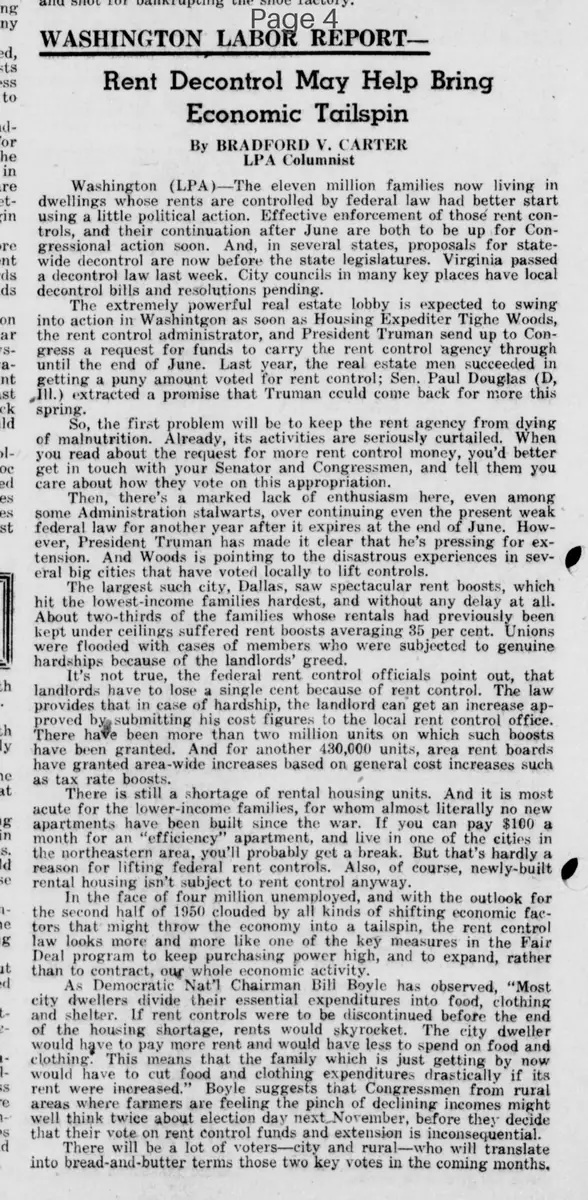
WASHINGTON LABOR REPORT
Rent Decontrol May Help Bring
Economic Tailspin
By BRADFORD V. CARTER
LPA Columnist
Washington (LPA)—The eleven million families now living in dwellings whose rents are controlled by federal law had better start using a little political action. Effective enforcement of those rent controls, and their continuation after June are both to be up for Congressional action soon. And, in several states, proposals for state-wide decontrol are now before the state legislatures. Virginia passed a decontrol law last week. City councils in many key places have local decontrol bills and resolutions pending.
The extremely powerful real estate lobby is expected to swing into action in Washington as soon as Housing Expediter Tighe Woods, the rent control administrator, and President Truman send up to Congress a request for funds to carry the rent control agency through until the end of June. Last year, the real estate men succeeded in getting a puny amount voted for rent control; Sen. Paul Douglas (D, Ill.) extracted a promise that Truman could come back for more this spring.
So, the first problem will be to keep the rent agency from dying of malnutrition. Already, its activities are seriously curtailed. When you read about the request for more rent control money, you'd better get in touch with your Senator and Congressmen, and tell them you care about how they vote on this appropriation.
Then, there's a marked lack of enthusiasm here, even among some Administration stalwarts, over continuing even the present weak federal law for another year after it expires at the end of June. However, President Truman has made it clear that he's pressing for extension. And Woods is pointing to the disastrous experiences in several big cities that have voted locally to lift controls.
The largest such city, Dallas, saw spectacular rent boosts, which hit the lowest-income families hardest, and without any delay at all. About two-thirds of the families whose rentals had previously been kept under ceilings suffered rent boosts averaging 35 per cent. Unions were flooded with cases of members who were subjected to genuine hardships because of the landlords' greed.
It's not true, the federal rent control officials point out, that landlords have to lose a single cent because of rent control. The law provides that in case of hardship, the landlord can get an increase approved by submitting his cost figures to the local rent control office.
There have been more than two million units on which such boosts have been granted. And for another 430,000 units, area rent boards have granted area-wide increases based on general cost increases such as tax rate boosts.
There is still a shortage of rental housing units. And it is most acute for the lower-income families, for whom almost literally no new apartments have been built since the war. If you can pay $100 a month for an "efficiency" apartment, and live in one of the cities in the northeastern area, you'll probably get a break. But that's hardly a reason for lifting federal rent controls. Also, of course, newly-built rental housing isn't subject to rent control anyway.
In the face of four million unemployed, and with the outlook for the second half of 1950 clouded by all kinds of shifting economic factors that might throw the economy into a tailspin, the rent control law looks more and more like one of the key measures in the Fair Deal program to keep purchasing power high, and to expand, rather than to contract, our whole economic activity.
As Democratic Nat'l Chairman Bill Boyle has observed, "Most city dwellers divide their essential expenditures into food, clothing and shelter. If rent controls were to be discontinued before the end of the housing shortage, rents would skyrocket. The city dweller would have to pay more rent and would have less to spend on food and clothing. This means that the family which is just getting by now would have to cut food and clothing expenditures drastically if its rent were increased."
Boyle suggests that Congressmen from rural areas where farmers are feeling the pinch of declining incomes might well think twice about election day next November, before they decide that their vote on rent control funds and extension is inconsequential.
There will be a lot of voters—city and rural—who will translate into bread-and-butter terms those two key votes in the coming months.
Rent Decontrol May Help Bring
Economic Tailspin
By BRADFORD V. CARTER
LPA Columnist
Washington (LPA)—The eleven million families now living in dwellings whose rents are controlled by federal law had better start using a little political action. Effective enforcement of those rent controls, and their continuation after June are both to be up for Congressional action soon. And, in several states, proposals for state-wide decontrol are now before the state legislatures. Virginia passed a decontrol law last week. City councils in many key places have local decontrol bills and resolutions pending.
The extremely powerful real estate lobby is expected to swing into action in Washington as soon as Housing Expediter Tighe Woods, the rent control administrator, and President Truman send up to Congress a request for funds to carry the rent control agency through until the end of June. Last year, the real estate men succeeded in getting a puny amount voted for rent control; Sen. Paul Douglas (D, Ill.) extracted a promise that Truman could come back for more this spring.
So, the first problem will be to keep the rent agency from dying of malnutrition. Already, its activities are seriously curtailed. When you read about the request for more rent control money, you'd better get in touch with your Senator and Congressmen, and tell them you care about how they vote on this appropriation.
Then, there's a marked lack of enthusiasm here, even among some Administration stalwarts, over continuing even the present weak federal law for another year after it expires at the end of June. However, President Truman has made it clear that he's pressing for extension. And Woods is pointing to the disastrous experiences in several big cities that have voted locally to lift controls.
The largest such city, Dallas, saw spectacular rent boosts, which hit the lowest-income families hardest, and without any delay at all. About two-thirds of the families whose rentals had previously been kept under ceilings suffered rent boosts averaging 35 per cent. Unions were flooded with cases of members who were subjected to genuine hardships because of the landlords' greed.
It's not true, the federal rent control officials point out, that landlords have to lose a single cent because of rent control. The law provides that in case of hardship, the landlord can get an increase approved by submitting his cost figures to the local rent control office.
There have been more than two million units on which such boosts have been granted. And for another 430,000 units, area rent boards have granted area-wide increases based on general cost increases such as tax rate boosts.
There is still a shortage of rental housing units. And it is most acute for the lower-income families, for whom almost literally no new apartments have been built since the war. If you can pay $100 a month for an "efficiency" apartment, and live in one of the cities in the northeastern area, you'll probably get a break. But that's hardly a reason for lifting federal rent controls. Also, of course, newly-built rental housing isn't subject to rent control anyway.
In the face of four million unemployed, and with the outlook for the second half of 1950 clouded by all kinds of shifting economic factors that might throw the economy into a tailspin, the rent control law looks more and more like one of the key measures in the Fair Deal program to keep purchasing power high, and to expand, rather than to contract, our whole economic activity.
As Democratic Nat'l Chairman Bill Boyle has observed, "Most city dwellers divide their essential expenditures into food, clothing and shelter. If rent controls were to be discontinued before the end of the housing shortage, rents would skyrocket. The city dweller would have to pay more rent and would have less to spend on food and clothing. This means that the family which is just getting by now would have to cut food and clothing expenditures drastically if its rent were increased."
Boyle suggests that Congressmen from rural areas where farmers are feeling the pinch of declining incomes might well think twice about election day next November, before they decide that their vote on rent control funds and extension is inconsequential.
There will be a lot of voters—city and rural—who will translate into bread-and-butter terms those two key votes in the coming months.
What sub-type of article is it?
Historical Event
What themes does it cover?
Justice
Misfortune
Survival
What keywords are associated?
Rent Control
Decontrol
Economic Tailspin
Housing Shortage
Real Estate Lobby
Truman Administration
What entities or persons were involved?
Bradford V. Carter
Tighe Woods
President Truman
Sen. Paul Douglas
Bill Boyle
Where did it happen?
Washington
Story Details
Key Persons
Bradford V. Carter
Tighe Woods
President Truman
Sen. Paul Douglas
Bill Boyle
Location
Washington
Event Date
Spring 1950
Story Details
Column warns that decontrolling rents could lead to economic downturn by reducing purchasing power amid housing shortage and unemployment; urges political action to maintain federal rent controls against real estate lobby opposition, citing examples like Dallas rent hikes.