Thank you for visiting SNEWPapers!
Sign up free
Editorial
January 7, 1915
The Bossier Banner
Benton, Bellevue, Bossier County, Louisiana
What is this article about?
This editorial extols the triumphs and democratic spirit of modern science, its global influence, and humble service to humanity. However, it argues that rationalism alone cannot sustain the human soul, emphasizing the essential role of sentiment, love, and imagination for true progress and meaning.
Clipping
OCR Quality
98%
Excellent
Full Text
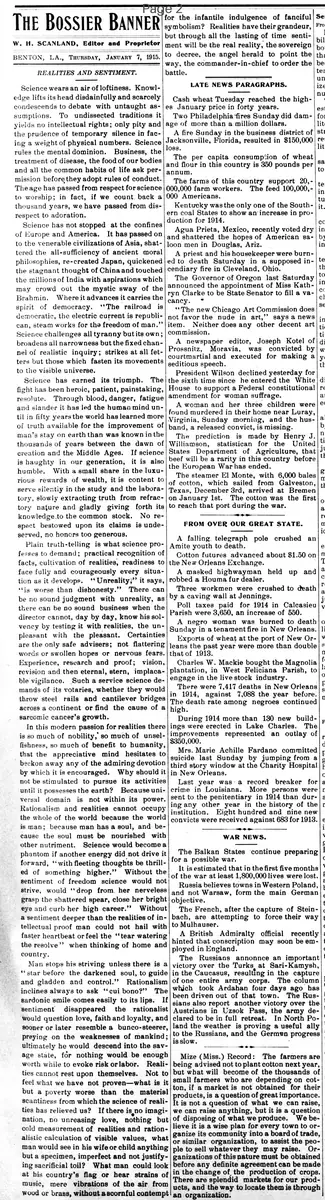
REALITIES AND SENTIMENT.
Science wears an air of loftiness. Knowledge lifts its head disdainfully and scarcely condescends to debate with untaught assumptions. To undissected traditions it yields no intellectual rights; only pity and the prudence of temporary silence in facing a weight of physical numbers. Science rules the mental dominion. Business, the treatment of disease, the food of our bodies and all the common habits of life ask permission before they adopt rules of conduct. The age has passed from respect for science to worship; in fact, if we count back a thousand years, we have passed from disrespect to adoration.
Science has not stopped at the confines of Europe and America. It has passed on to the venerable civilizations of Asia, shattered the all-sufficiency of ancient moral philosophies, re-created Japan, quickened the stagnant thought of China and touched the millions of India with aspirations which may crowd out the mystic sway of the Brahmin. Where it advances it carries the spirit of democracy.
'The railroad is democratic, the electric current is republican, steam works for the freedom of man.'
Science challenges all tyranny but its own; broadens all narrowness but the fixed channel of realistic inquiry; strikes at all fetters but those which fasten its movements to the visible universe.
Science has earned its triumph. The fight has been heroic, patient, painstaking, resolute. Through blood, danger, fatigue and slander it has led the human mind until in fifty years the world has learned more of truth available for the improvement of man's stay on earth than was known in the thousands of years between the dawn of creation and the Middle Ages. If science is haughty in our generation, it is also humble. With a small share in the luxurious rewards of wealth, it is content to serve silently in the study and the laboratory, slowly extracting truth from refractory nature and gladly giving forth its knowledge to the common stock. No respect bestowed upon its claims is undeserved, no honors too generous.
Plain truth-telling is what science professes to demand; practical recognition of facts, cultivation of realities, readiness to face fully and courageously every situation as it develops. 'Unreality,' it says, 'is worse than dishonesty.' There can be no sound judgment with unreality, as there can be no sound business when the director cannot, day by day, know his solvency by testing it with realities, the unpleasant with the pleasant. Certainties are the only safe advisers; not flattering words or swollen hopes or nervous fears. Experience, research and proof; vision, revision and then eternal, stern, implacable vigilance. Such a service science demands of its votaries, whether they would throw steel rails and cantilever bridges across a continent or find the cause of a sarcomic cancer's growth.
In this modern passion for realities there is so much of nobility, so much of unselfishness, so much of benefit to humanity, that the appreciative mind hesitates to beckon away any of the admiring devotion by which it is encouraged. Why should it not be stimulated to pursue its activities until it possesses the earth? Because universal domain is not within its power.
Rationalism and realities cannot occupy the whole of the world because the world is man; because man has a soul, and because the soul must be nourished with other nutriment. Science would become a phantom if another energy did not drive it forward, 'with fleeting thoughts be thrilled of something higher.' Without the sentiment of freedom science would not strive, would 'drop from her nerveless grasp the shattered spear, close her bright eye and curb her high career.' Without a sentiment deeper than the realities of intellectual proof man could not hail with faster heartbeat or feel the 'tear watering the resolve' when thinking of home and country.
Man stops his striving unless there is a 'star before the darkened soul, to guide and gladden and control.' Rationalism inclines always to ask 'cui bono?' The sardonic smile comes easily to its lips. If sentiment disappeared the rationalist would question love, faith and loyalty, and sooner or later resemble a bunco-steerer, preying on the weaknesses of mankind; ultimately he would descend into the savage state, for nothing would be enough worth while to evoke risk or labor. Realities cannot rest upon themselves. Not to feel what we have not proven—what is it but a poverty worse than the material scantiness from which the science of realities has relieved us? If there is no imagination, no unreasing love, nothing but cold measurement of realities and realistic calculation of visible values, what man would see in his wife or child anything but a specimen, imperfect and not justifying sacrificial toil? What man could look at his country's flag or hear strains of music, mere vibrations of the air from wood or brass, without scornful contempt for the infantile indulgence of fanciful symbolism? Realities have their grandeur, but through all the lasting of time sentiment will be the real reality, the sovereign to decree, the angel herald to point the way, the commander-in-chief to order the battle.
Science wears an air of loftiness. Knowledge lifts its head disdainfully and scarcely condescends to debate with untaught assumptions. To undissected traditions it yields no intellectual rights; only pity and the prudence of temporary silence in facing a weight of physical numbers. Science rules the mental dominion. Business, the treatment of disease, the food of our bodies and all the common habits of life ask permission before they adopt rules of conduct. The age has passed from respect for science to worship; in fact, if we count back a thousand years, we have passed from disrespect to adoration.
Science has not stopped at the confines of Europe and America. It has passed on to the venerable civilizations of Asia, shattered the all-sufficiency of ancient moral philosophies, re-created Japan, quickened the stagnant thought of China and touched the millions of India with aspirations which may crowd out the mystic sway of the Brahmin. Where it advances it carries the spirit of democracy.
'The railroad is democratic, the electric current is republican, steam works for the freedom of man.'
Science challenges all tyranny but its own; broadens all narrowness but the fixed channel of realistic inquiry; strikes at all fetters but those which fasten its movements to the visible universe.
Science has earned its triumph. The fight has been heroic, patient, painstaking, resolute. Through blood, danger, fatigue and slander it has led the human mind until in fifty years the world has learned more of truth available for the improvement of man's stay on earth than was known in the thousands of years between the dawn of creation and the Middle Ages. If science is haughty in our generation, it is also humble. With a small share in the luxurious rewards of wealth, it is content to serve silently in the study and the laboratory, slowly extracting truth from refractory nature and gladly giving forth its knowledge to the common stock. No respect bestowed upon its claims is undeserved, no honors too generous.
Plain truth-telling is what science professes to demand; practical recognition of facts, cultivation of realities, readiness to face fully and courageously every situation as it develops. 'Unreality,' it says, 'is worse than dishonesty.' There can be no sound judgment with unreality, as there can be no sound business when the director cannot, day by day, know his solvency by testing it with realities, the unpleasant with the pleasant. Certainties are the only safe advisers; not flattering words or swollen hopes or nervous fears. Experience, research and proof; vision, revision and then eternal, stern, implacable vigilance. Such a service science demands of its votaries, whether they would throw steel rails and cantilever bridges across a continent or find the cause of a sarcomic cancer's growth.
In this modern passion for realities there is so much of nobility, so much of unselfishness, so much of benefit to humanity, that the appreciative mind hesitates to beckon away any of the admiring devotion by which it is encouraged. Why should it not be stimulated to pursue its activities until it possesses the earth? Because universal domain is not within its power.
Rationalism and realities cannot occupy the whole of the world because the world is man; because man has a soul, and because the soul must be nourished with other nutriment. Science would become a phantom if another energy did not drive it forward, 'with fleeting thoughts be thrilled of something higher.' Without the sentiment of freedom science would not strive, would 'drop from her nerveless grasp the shattered spear, close her bright eye and curb her high career.' Without a sentiment deeper than the realities of intellectual proof man could not hail with faster heartbeat or feel the 'tear watering the resolve' when thinking of home and country.
Man stops his striving unless there is a 'star before the darkened soul, to guide and gladden and control.' Rationalism inclines always to ask 'cui bono?' The sardonic smile comes easily to its lips. If sentiment disappeared the rationalist would question love, faith and loyalty, and sooner or later resemble a bunco-steerer, preying on the weaknesses of mankind; ultimately he would descend into the savage state, for nothing would be enough worth while to evoke risk or labor. Realities cannot rest upon themselves. Not to feel what we have not proven—what is it but a poverty worse than the material scantiness from which the science of realities has relieved us? If there is no imagination, no unreasing love, nothing but cold measurement of realities and realistic calculation of visible values, what man would see in his wife or child anything but a specimen, imperfect and not justifying sacrificial toil? What man could look at his country's flag or hear strains of music, mere vibrations of the air from wood or brass, without scornful contempt for the infantile indulgence of fanciful symbolism? Realities have their grandeur, but through all the lasting of time sentiment will be the real reality, the sovereign to decree, the angel herald to point the way, the commander-in-chief to order the battle.
What sub-type of article is it?
Science Or Medicine
Moral Or Religious
What keywords are associated?
Science
Realities
Sentiment
Democracy
Human Soul
Rationalism
Progress
Editorial Details
Primary Topic
Balance Between Scientific Realities And Human Sentiment
Stance / Tone
Appreciative Of Science But Insistent On The Necessity Of Sentiment
Key Arguments
Science Has Triumphed Through Heroic Effort And Deserves Respect And Worship
Science Advances Democracy And Challenges Tyranny Globally
Rationalism Demands Truth Telling And Facing Realities For Progress
Man's Soul Requires Sentiment, Love, And Imagination Beyond Mere Facts
Without Sentiment, Rationalism Leads To Savagery And Loss Of Motivation
Sentiment Is The True Reality That Guides And Ennobles Human Striving