Thank you for visiting SNEWPapers!
Sign up free
Gazette Of The United States
Philadelphia, Philadelphia County, Pennsylvania
What is this article about?
In the U.S. House of Representatives on March 14, Mr. Bourne concludes his speech defending the exclusive treaty-making power of the President and Senate, arguing against House ratification. He references debates from the North Carolina ratification convention supporting this view, emphasizing constitutional intent and public support for the Jay Treaty.
Clipping
OCR Quality
Full Text
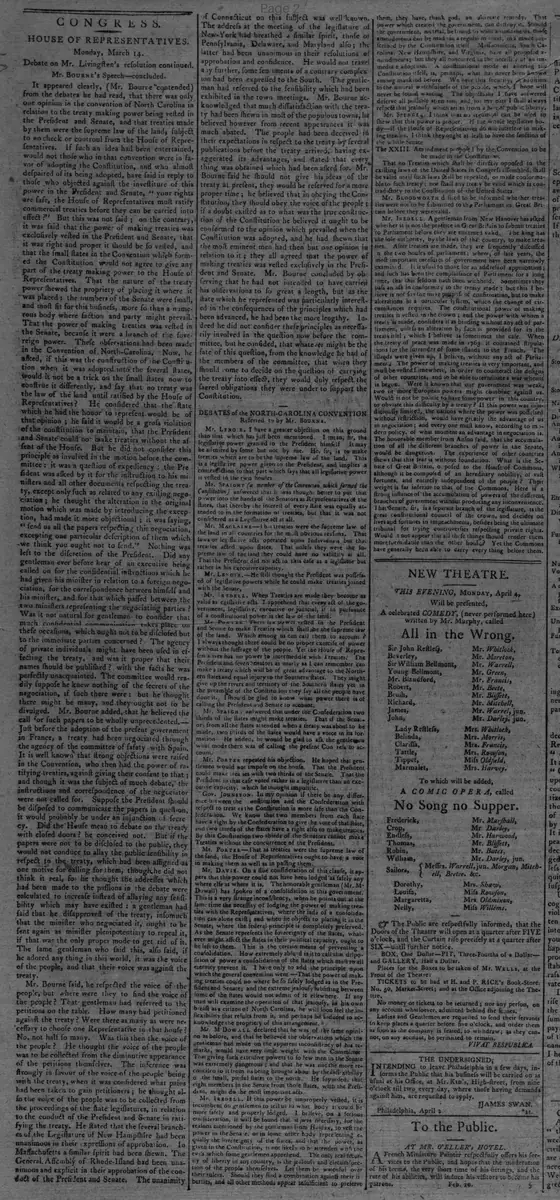
HOUSE OF REPRESENTATIVES.
Monday, March 14.
Debate on Mr. Livingston's resolution continued.
Mr. Bourne's Speech—concluded.
It appeared clearly, (Mr. Bourne contended) from the debates he had read, that there was only one opinion in the convention of North Carolina in relation to the treaty making power being vested in the President and Senate, and that treaties made by them were the supreme law of the land, subject to no check or controul from the House of Representatives. If such an idea had been entertained, would not those who in that convention were in favour of adopting the Constitution, and who almost despaired of its being adopted, have said in reply to those who objected against the investiture of this power in the President and Senate, "your rights are safe, the House of Representatives must ratify commercial treaties before they can be carried into effect?" But this was not said; on the contrary, it was said that the power of making treaties was exclusively vested in the President and Senate, that it was right and proper it should be so vested, and that the small states in the Convention which formed the Constitution would not agree to give any part of the treaty making power to the House of Representatives. That the nature of the treaty power shewed the propriety of placing it where it was placed: the numbers of the Senate were small and most fit for this business, more so than a numerous body where faction and party might prevail. That the power of making treaties was vested in the Senate, because it was a branch of the sovereign power. These observations had been made in the Convention of North-Carolina. Now, he asked, if this was the construction of the Constitution when it was adopted into the several states, would it not be a trick on the small states now to construe it differently, and say that no treaty was the law of the land until ratified by the House of Representatives? He considered that the state which he had the honour to represent, would be of that opinion; he said it would be a gross violation of the constitution to maintain, that the President and Senate could not make treaties without the assent of the House. But he did not consider this principle as involved in the motion before the committee: it was a question of expediency: the President was asked by it for the instructions to his ministers and all other documents respecting the treaty, except only such as related to any existing negotiation; he thought the alteration in the original motion which was made by introducing the exception, had made it more objectionable; it was saying, "send us all the papers respecting this negotiation, excepting one particular description of them which we think you ought not to send." Nothing was left to the discretion of the President. Did any gentleman ever before hear of an executive being called on for the confidential instructions which he had given his minister in relation to a foreign negotiation, for the correspondence between himself and his minister, and for that which passed between the two ministers representing the negotiating parties? Was it not natural for gentlemen to consider that much confidential communication takes place, on these occasions, which ought not to be disclosed but to the immediate parties concerned? The agency of private individuals might have been used in effecting the treaty, and was it proper that their names should be published? with the facts he was perfectly unacquainted. The committee would readily suppose he knew nothing of the secrets of the negotiation, if such there were: but he thought there might be many, and they ought not to be divulged. Mr. Bourne added, that he believed the call for such papers to be wholly unprecedented.—Just before the adoption of the present government in France, a treaty, had been negotiated through the agency of the committee of safety with Spain. It is well known that strong objections were raised in the Convention, who then had the power of ratifying-treaties, against giving their consent to that; and though it was the subject of much debate, the instructions and correspondence of the negotiator were not called for. Suppose the President should be disposed to communicate the papers in question, it would probably be under an injunction of secrecy. Did the House mean to debate on the treaty with closed doors? he conceived not. But if the papers were not to be disclosed to the public, they would not conduce to allay the public sensibility in respect to the treaty, which had been assigned as one motive for calling for them, though he did not think it real, so he thought the address which had been made to the passions in the debate were calculated to increase instead of allaying any sensibility which may have existed: a gentleman had said that he disapproved of the treaty, insomuch that the minister who negotiated it, ought to be sent again as minister plenipotentiary to repeal it, if that was the only proper mode to get rid of it. The same gentleman who said this, also said, if he adored any thing in this world, it was the voice of the people, and that their voice was against the treaty.
Mr. Bourne said, he respected the voice of the people, but where were they to find the voice of the people? That gentleman had referred to the petitions on the table. How many had petitioned against the treaty? Were there as many as were necessary to choose one Representative in that house? No, not half so many. Was this then the voice of the people? He thought the voice of the people was to be collected from the diminutive appearance of the petitions themselves. The inference was strongly in favour of the voice of the people being with the treaty, when it was considered what pains had been taken to gain petitioners; he thought also the voice of the people was to be collected from the proceedings of the state legislatures, in relation to the conduct of the President and Senate in ratifying the treaty. He stated that the several branches of the Legislature of New-Hampshire had been unanimous in their expressions of approbation. In Massachusetts a similar spirit had been shewn. The General Assembly of Rhode-Island had been unanimous and explicit in their approbation of the conduct of the President and Senate. The unanimity of Connecticut on this subject was well known. The address at the meeting of the legislature of New-York had breathed a similar spirit, those of Pennsylvania, Delaware, and Maryland also; the latter had been unanimous in their resolutions of approbation and confidence. He would not travel any further, some sentiments of a contrary complexion had been expressed to the South. The gentleman had referred to the sensibility which had been exhibited in the town meetings. Mr. Bourne acknowledged that much dissatisfaction with the treaty had been shewn in most of the populous towns, he believed however from recent appearances it was much abated. The people had been deceived in their expectations in respect to the treaty by several publications before the treaty arrived, having exaggerated its advantages, and stated that every thing was obtained which had been asked for. Mr. Bourne said he should not give his ideas of the treaty at present, they would be reserved for a more proper time; he believed that in obeying the Constitution, they should obey the voice of the people; if a doubt existed as to what was the true construction of the Constitution he believed it ought to be conformed to the opinion which prevailed when the Constitution was adopted, and he had shewn that the most eminent men had then but one opinion in relation to it; they all agreed that the power of making treaties was vested exclusively in the President and Senate. Mr. Bourne concluded by observing that he had not intended to have carried his observations to so great a length, but as the state which he represented was particularly interested in the consequences of the principles which had been advanced, he had been the more lengthy. Indeed he did not consider these principles as necessarily involved in the question now before the committee, but he confided, that whatever might be the fate of this question, from the knowledge he had of the members of the committee, that when they should come to decide on the question of carrying the treaty into effect, they would duly respect, the sacred obligations they were under to support the Constitution.
DEBATES of the NORTH-CAROLINA CONVENTION
Referred to by Mr. Bourne.
Mr. Lenoir. I have a greater objection on this ground than that which has just been mentioned, I mean, sir, the legislative power granted to the President himself. It may be admired by some but not by me. He, sir, is to make treaties which are to be the supreme law of the land. This is a legislative power given to the President, and implies a contradiction to that part which says that all legislative power is vested in the two houses.
Mr. Sevier (a member of the Convention which formed the Constitution) answered that it was thought better to put that power into the hands of the Senators as Representatives of the states, that thereby the interest of every state was equally attended to in the formation of treaties, but that it was not considered as a Legislative Act at all.
Mr. Maclaine—I but treaties were the supreme law of the land in all countries for the most obvious reasons. That laws or legislative acts operated upon Individuals but that treaties acted upon states. That unless they were the supreme law of the land they could have no validity at all. That the President did not act in this case as a legislator but rather in his executive capacity.
Mr. Lenoir. Me still thought the President was possessed of legislative powers while he could make treaties joined with the Senate.
Mr. Iredell. When Treaties are made they become as valid as legislative acts. I apprehend that every act of the government, legislative, executive or judicial, if in pursuance of a constitutional power is the law of the land.
Mr. Porter. There is a power vested in the President and Senate to make Treaties which shall be the supreme law of the land. Which among us can call them to account.? I always thought there could be no proper exercise of power without the suffrage of the people. Yet the House of Representatives has no power to intermeddle with treaties. The President and even Senators as nearly as I can remember can make a treaty which will be of great advantage to the Northern states and equal injury to the Southern states. They might give up the rivers and territory of the Southern states yet in the preamble of the Constitution they say all the people have done it. I should be glad to know what power there is of calling the President and Senate to account.
Mr. Spaight answered that under the Confederation two thirds of the states might make treaties. That if the Senators from all the states attended when a treaty was about to be made, two thirds of the states would have a voice in its formation. He added, he would be glad to ask the gentleman what mode there was of calling the present Congress to account.
Mr. Porter repeated his objection. He hoped that gentlemen would not impose on the house. That the President could make treaties with two thirds of the Senate. That the President in that case voted rather in a legislative than an executive capacity, which he thought impolitic.
Gov. Johnston. In my opinion if there be any difference between the constitution and the Confederation with respect to treaties the Constitution is more safe than the Confederation. We know that two members from each state have a right by the Confederation to give the vote of that state, and two thirds of the states have a right also to make treaties. By this Constitution two thirds of the Senators cannot make Treaties without the concurrence of the President.
Mr. Porter—That as treaties were the supreme law of the land, the House of Representatives ought to have a vote in making them as well as in passing them.
Mr. Davie. On a due consideration of this clause, it appears that this power could not have been lodged as safely any where else as where it is. The honorable gentleman (Mr. Macdowall) has spoken of a consolidation in this government. This is a very strange inconsistency, when he points out at the same time the necessity of lodging the power of making treaties with the Representatives, where the idea of a consolidation can alone exist; and when he objects to placing it in the Senate, where the federal principle is completely preserved. As the Senate represents the sovereignty of the states, whatever might affect the states in their political capacity, ought to be left to them. This is the certain means of preventing a consolidation. How extremely absurd is it to call that disposition of power a consolidation of the states which must really prevent it. I have only to add the principle upon which the general convention went.—That the power of making treaties could no where be so safely lodged as in the President and Senate; and the extreme jealousy subsisting between some of the states would not admit of it elsewhere. If any man will examine the operation of that jealousy, in his own breast as a citizen of North Carolina, he will soon feel the inflexibility that results from it, and perhaps be induced to acknowledge the propriety of this arrangement.
Mr. Macdowall declared that he was of the same opinion as before, and that he believed the observations which the gentleman had made on the apparent inconsistency of his remarks, would have very little weight with the Committee. That giving such extensive powers to so few men in the Senate was extremely dangerous; and that he was not the more reconciled to it from its being brought about by the inflexibility of the small, pitiful states to the north. He supposed, that eight members in the Senate from those states, with the President, might do the most important acts.
Mr. Iredell. If this power be improperly vested, it is incumbent on gentlemen to tell us in what body it could be more safely and properly lodged. I believe, on a serious consideration, it will be found that it was necessary, for the reasons mentioned by the gentleman from Halifax, to vest the power in the Senate, or in some other body representing equally the sovereignty of the states, and that the power, as given in the Constitution, is not likely to be attended with the evils which some gentlemen apprehend. The only real security of liberty in any country, is the jealousy and circumspection of the people themselves. Let them be watchful over their rulers. Should they find a combination against their liberties, and all other methods appear insufficient to preserve them, they have, thank god, an ultimate remedy. That power which created the government, Can destroy it. Should the government, on trial, be found to want amendments, those amendments can be made in a regular method, in a mode prescribed by the Constitution itself. Massachusetts, South Carolina, New Hampshire, and Virginia, have all proposed amendments; but they all concurred in the necessity of an immediate adoption. A constitutional mode of altering the Constitution itself, is, perhaps, what has never been known among mankind before. We have this Security, in addition to the natural watchfulness of the people, which I hope will never be found wanting. The objections I have answered deserve all possible attention, and, for my part I shall always respect that jealousy which arises from a love of public liberty.
Mr. Spencer. I think that no argument can be used to shew that this power is proper. If the whole legislative body—if the House of Representatives do not interfere in making treaties, I think they ought at least to have the sanction of the whole Senate.
The XXIII. Amendment proposed by the Convention to be made in the Constitution.
That no Treaties which Shall be directly opposed to the existing laws of the United States in Congress assembled, shall be valid until such laws shall be repealed, or made conformable to such treaty; nor shall any treaty be valid which is contradictory to the Constitution of the United States.
Mr. Bloodworth wished to be informed whether treaties were not to be submitted to the Parliament in Great Britain before they were valid.
Mr. Iredell. A gentleman from New Hanover has asked whether it is not the practice in Great Britain to submit treaties to Parliament before they are esteemed valid. The king has the sole authority, by the laws of that country, to make treaties. After treaties are made, they are frequently discussed in the two houses of parliament: where, of late years, the most important measures of government have been narrowly examined. It is usual to move for an address of approbation; and such has been the complaisance of Parliament for a long time, that this seldom hath been withheld. Sometimes they pass an act in conformity to the treaty made: but this I believe is not for the mere purpose of confirmation, but to make alterations in a particular system, which the change of circumstances requires. The constitutional power of making treaties is vested in the crown; and the power with whom a treaty is made, considers it as binding without any act of parliament, unless an alteration by such is provided for in the treaty itself; which I believe is sometimes the case. When the treaty of peace was made in 1783, it contained stipulations for the surrender of some islands to the French. The islands were given up, I believe, without any act of Parliament. The power of making treaties is very important, and must be vested somewhere, in order to counteract the designs of other countries, and to be able to terminate a war when it is begun. Were it known that our government was weak, two or more European powers might combine against us. Would it not be politic to have some power in this country, to obviate this difficulty by a treaty? If this power was injudiciously limited, the nations where the power was possessed without restriction, would have greatly the advantage of us in negotiation; and every one must know, according to modern policy, of what moment an advantage in negotiation is. The honorable member from Anson said, that the accumulation of all the different branches of power in the Senate, would be dangerous. The experience of other countries shews that this fear is without foundation. What is the Senate of Great Britain, opposed to the House of Commons, although it be composed of an hereditary nobility, of vast fortunes, and entirely independent of the people? Their weight is far inferior to that of the Commons. Here is a strong instance of the accumulation of powers of the different branches of government without producing any inconvenience. That Senate, sir, is a separate branch of the legislature, is the great constitutional council of the crown, and decides on lives and fortunes in impeachments, besides being the ultimate tribunal for trying controversies respecting private rights. Would it not appear that all these things should render them more formidable than the other house? Yet the Commons have generally been able to carry every thing before them.
What sub-type of article is it?
What themes does it cover?
What keywords are associated?
What entities or persons were involved?
Where did it happen?
Story Details
Key Persons
Location
House Of Representatives
Event Date
Monday, March 14
Story Details
Mr. Bourne argues in the House that the treaty-making power is exclusively with the President and Senate, referencing North Carolina convention debates where speakers like Iredell and Davie defended this arrangement against objections from Lenoir and Porter, emphasizing constitutional supremacy and state interests.