Thank you for visiting SNEWPapers!
Sign up free
Norfolk Gazette And Publick Ledger
Norfolk, Virginia
What is this article about?
In a letter from Paris dated September 23, 1815, the Duke of Wellington informs Lord Castlereagh about diplomatic efforts and minimal military involvement to retrieve artworks belonging to the King of the Netherlands from the Louvre Museum, defending the action against accusations of breaching the Treaty of Paris.
Merged-components note: Continuation of the Duke of Wellington's letter across pages; relabel from 'letter_to_editor' to 'foreign_news' as it is diplomatic correspondence, not a reader letter; merge into single coherent foreign news component
Clippings
1 of 2
OCR Quality
Full Text
Paris, September 23.
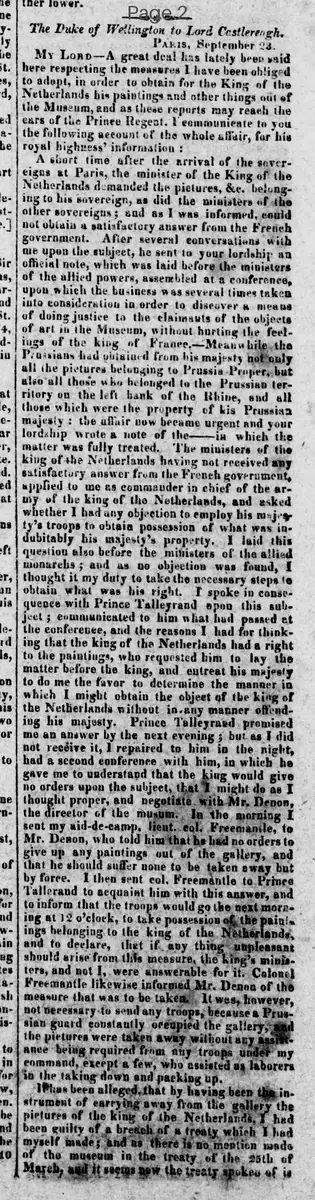
My Lord—A great deal has lately been said here respecting the measures I have been obliged to adopt, in order to obtain for the King of the Netherlands his paintings and other things out of the Museum, and as these reports may reach the ears of the Prince Regent, I communicate to you the following account of the whole affair, for his royal highness' information:
A short time after the arrival of the sovereigns at Paris, the minister of the King of the Netherlands demanded the pictures, &c. belonging to his sovereign, as did the ministers of the other sovereigns; and as I was informed, could not obtain a satisfactory answer from the French government. After several conversations with me upon the subject, he sent to your lordship an official note, which was laid before the ministers of the allied powers, assembled at a conference, upon which the business was several times taken into consideration in order to discover a means of doing justice to the claimants of the objects of art in the Museum, without hurting the feelings of the king of France.—Meanwhile the Prussians had obtained from his majesty not only all the pictures belonging to Prussia Proper, but also all those who belonged to the Prussian territory on the left bank of the Rhine, and all those which were the property of his Prussian majesty: the affair now became urgent and your lordship wrote a note of the—in which the matter was fully treated. The ministers of the king of the Netherlands having not received any satisfactory answer from the French government, applied to me as commander in chief of the army of the king of the Netherlands, and asked whether I had any objection to employ his majesty's troops to obtain possession of what was indubitably his majesty's property. I laid this question also before the ministers of the allied monarchs; and as no objection was found, I thought it my duty to take the necessary steps to obtain what was his right. I spoke in consequence with Prince Talleyrand upon this subject; communicated to him what had passed at the conference, and the reasons I had for thinking that the king of the Netherlands had a right to the paintings, who requested him to lay the matter before the king, and entreat his majesty to do me the favor to determine the manner in which I might obtain the object of the king of the Netherlands without in any manner offending his majesty. Prince Talleyrand promised me an answer by the next evening; but as I did not receive it, I repaired to him in the night, had a second conference with him, in which he gave me to understand that the king would give no orders upon the subject, that I might do as I thought proper, and negotiate with Mr. Denon, the director of the museum. In the morning I sent my aid-de-camp, lieut. col. Freemantle, to Mr. Denon, who told him that he had no orders to give up any paintings out of the gallery, and that he should suffer none to be taken away but by force. I then sent col. Freemantle to Prince Talleyrand to acquaint him with this answer, and to inform that the troops would go the next morning at 12 o'clock, to take possession of the paintings belonging to the king of the Netherlands, and to declare, that if anything unpleasant should arise from this measure, the king's ministers, and not I, were answerable for it. Colonel Freemantle likewise informed Mr. Denon of the measure that was to be taken. It was, however, not necessary to send any troops, because a Prussian guard constantly occupied the gallery, and the pictures were taken away without any assistance being required from any troops under my command, except a few, who assisted as laborers in the taking down and packing up.
It has been alleged, that by having been the instrument of carrying away from the gallery the pictures of the king of the Netherlands, I had been guilty of a breach of a treaty which I had myself made and as there is no mention made of the museum in the treaty, of the 25th of March, and it seems now the treaty spoken of is
The military convention of Paris. It is necessary to show how this convention is connected with the museum.
I do not want to prove that the allies were at war with France; there is no doubt that their armies entered Paris under a military convention concluded with an officer of the government, the prefect of the department of the Seine, and an officer of the army who represented both authorities at that moment present at Paris, and empowered by those authorities to negotiate and conclude for them.
The article of the convention which is alleged to have been broken, is the fifth, which relates to the public property. I positively deny that this article has any reference whatever to the gallery of paintings.
The French commissioners introduced in the original project an article to provide for the security of this species of property; but Prince Blucher would not consent, saying there were in the gallery paintings which had been taken from Prussia, and which Louis XVIII had promised to restore, which however, had never been done. I repeated this circumstance to the French commissioners, and they prepared to accept the article with the exception of the Prussian pictures, and to this proposal I answered that I was there as the representative of the other nations in Europe, and that I must claim for other nations all that was conceded to the Prussians. I added, that I had no instructions concerning the museum, nor any grounds how the sovereigns would act; that they would certainly urge that the king should fulfil his obligations, and that I advised the omission of the article entirely, and the reserving this affair to the decision of the sovereigns when they should arrive.
Thus stands the affair of the museum in reference to the treaty. The convention of Paris is silent upon it, and a negotiation took place, which left the business to the decision of the sovereigns.
Taking it for granted that the silence of the treaty of Paris, of May 1814, respecting the museum, had given the French government an indisputable claim to the pieces contained in it, it cannot be denied that this claim was annihilated by this negotiation.
Those who negotiated for the French government judged that the victorious armies had a right to take the works of art from the museum, and they therefore endeavoured to save them by introducing an article into the military convention. This article was rejected and the claim of the allies greatly advanced by the negotiation on their side, and this was the reason that the article was rejected. Not only then was the possession of them not guaranteed by the military convention, but the above mentioned negotiation tended the more to weaken the right of the French government to the possession, which was founded on the silence of the treaty of Paris of May 1814.
The allies having now legal possession of the pieces in the museum, could do no otherwise than restore them to those from whom they had been taken away, contrary to the usages of civilized warfare, during the dreadful period of the French revolution, and the tyranny of Bonaparte.
The conduct of the allies with respect to the museum at the time of the treaty of Paris, must be ascribed to their desire to gratify the French army, and to confirm the reconciliation with Europe to which the army seemed at that time to be disposed.
But the circumstances are now entirely different; the army has disappointed the just expectations of the world, and embraced the first opportunity to rise against its sovereign, and to serve the general enemy of humanity with a view to the renewal of the rightful times that were passed, and of the scenes of pillage against which the world has made so many gigantic efforts.
This army having been defeated by the armies of Europe, it is dissolved by the united council of the sovereigns, and there can be no reason why the powers of Europe should do wrong to their own subjects, in order to again satisfy the army; indeed, it never appeared to me to be necessary that the allied sovereigns should neglect this opportunity to do justice and favor their own subjects, in order to please the French nation.
The feeling of the French people upon this subject can be no other than national arrogance. They would desire to retain these works of art, not because Paris is the properest place for them to be preserved in, (for all artists and connoisseurs, who have written on the subject, agree that they ought to be sent back to the places where they originally were) but because they have been acquired by conquests of which they are the trophies.
The same feeling that makes the people of France wish to keep the pictures and statues of other nations, must naturally make other nations wish, now that victory is on their side, to restore those articles to the lawful owners; and the allied sovereigns must feel a desire to prohibit this object.
It is besides to be wished, as well for the happiness of France, as of the world, that if the French people are not convinced that Europe is too strong for them they may be made to feel, that however extensive for a time their temporary and partial advantages over one or more of the powers of Europe may be, the day of retribution must at length come.
According to my feelings, then, it would not only be unjust in sovereigns to gratify the French people; but the sacrifices they would make would be impolitic, as it would deprive them of the opportunity of giving the French a great moral lesson.
I am, my dear lord, &c.
WELLINGTON
What sub-type of article is it?
What keywords are associated?
What entities or persons were involved?
Where did it happen?
Foreign News Details
Primary Location
Paris
Event Date
September 23
Key Persons
Outcome
paintings and artworks belonging to the king of the netherlands were successfully retrieved from the louvre museum without significant force, using prussian guards and minimal assistance from allied troops for packing.
Event Details
The Duke of Wellington details diplomatic negotiations with French officials, including Prince Talleyrand and museum director Denon, to reclaim Dutch-owned artworks from the Louvre following allied conferences. Despite initial resistance, the items were removed peacefully, justified as restitution from Napoleonic looting, not breaching the Paris military convention which omitted museum provisions.