Thank you for visiting SNEWPapers!
Sign up free
Editorial
May 11, 1939
The Coolidge Examiner
Coolidge, Pinal County, Arizona
What is this article about?
In a 1939 article, C. Houston Goudiss offers dietary advice for families with finicky appetites in warmer weather, stressing the inclusion of vitamin B1, iron-rich foods, greens, fruits, and milk to promote health and digestion.
Clipping
OCR Quality
100%
Excellent
Full Text
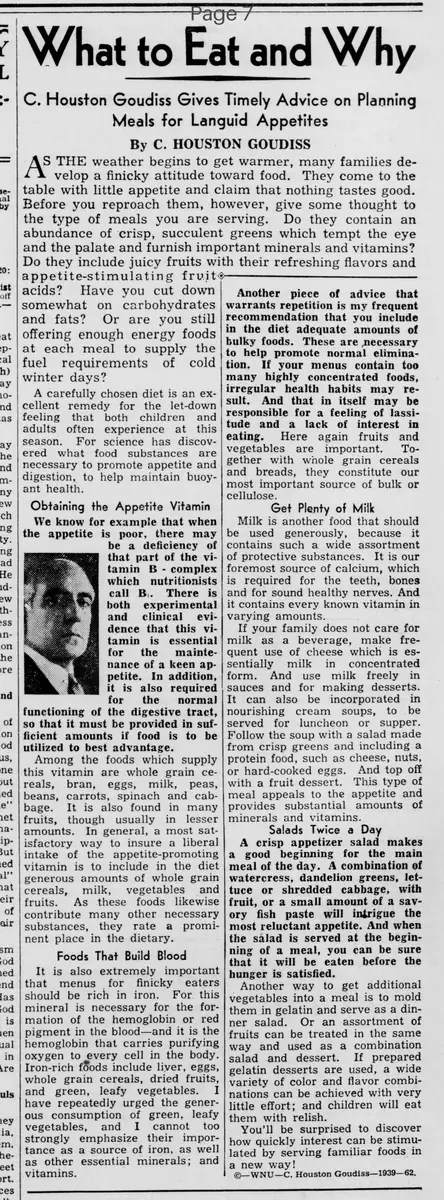
What to Eat and Why
C. Houston Goudiss Gives Timely Advice on Planning Meals for Languid Appetites
By C. HOUSTON GOUDISS
AS THE weather begins to get warmer, many families develop a finicky attitude toward food. They come to the table with little appetite and claim that nothing tastes good.
Before you reproach them, however, give some thought to the type of meals you are serving.
Do they contain an abundance of crisp, succulent greens which tempt the eye and the palate and furnish important minerals and vitamins?
Do they include juicy fruits with their refreshing flavors and appetite-stimulating fruit acids? Have you cut down somewhat on carbohydrates and fats? Or are you still offering enough energy foods at each meal to supply the fuel requirements of cold winter days?
A carefully chosen diet is an excellent remedy for the let-down feeling that both children and adults often experience at this season. For science has discovered what food substances are necessary to promote appetite and digestion, to help maintain buoyant health.
Obtaining the Appetite Vitamin
We know for example that when the appetite is poor, there may be a deficiency of that part of the vitamin B-complex which nutritionists call B1. There is both experimental and clinical evidence that this vitamin is essential for the maintenance of a keen appetite. In addition, it is also required for the normal functioning of the digestive tract, so that it must be provided in sufficient amounts if food is to be utilized to best advantage.
Among the foods which supply this vitamin are whole grain cereals, bran, eggs, milk, peas, beans, carrots, spinach and cabbage. It is also found in many fruits, though usually in lesser amounts. In general, a most satisfactory way to insure a liberal intake of the appetite-promoting vitamin is to include in the diet generous amounts of whole grain cereals, milk, vegetables and fruits.
As these foods likewise contribute many other necessary substances, they rate a prominent place in the dietary.
Foods That Build Blood
It is also extremely important that menus for finicky eaters should be rich in iron. For this mineral is necessary for the formation of the hemoglobin or red pigment in the blood-and it is the hemoglobin that carries purifying oxygen to every cell in the body.
Iron-rich foods include liver, eggs, whole grain cereals, dried fruits, and green, leafy vegetables.
I have repeatedly urged the generous consumption of green, leafy vegetables, and I cannot too strongly emphasize their importance as a source of iron, as well as other essential minerals and vitamins.
Another piece of advice that warrants repetition is my frequent recommendation that you include in the diet adequate amounts of bulky foods. These are necessary to help promote normal elimination. If your menus contain too many highly concentrated foods, irregular health habits may result. And that in itself may be responsible for a feeling of lassitude and a lack of interest in eating.
Here again fruits and vegetables are important. Together with whole grain cereals and breads, they constitute our most important source of bulk or cellulose.
Get Plenty of Milk
Milk is another food that should be used generously, because it contains such a wide assortment of protective substances. It is our foremost source of calcium, which is required for the teeth, bones and for sound healthy nerves. And it contains every known vitamin in varying amounts.
If your family does not care for milk as a beverage, make frequent use of cheese which is essentially milk in concentrated form. And use milk freely in sauces and for making desserts. It can also be incorporated in nourishing cream soups, to be served for luncheon or supper.
Follow the soup with a salad made from crisp greens and including a protein food, such as cheese, nuts, or hard-cooked eggs. And top off with a fruit dessert. This type of meal appeals to the appetite and provides substantial amounts of minerals and vitamins.
Salads Twice a Day
A crisp appetizer salad makes a good beginning for the main meal of the day. A combination of watercress, dandelion greens, lettuce or shredded cabbage, with fruit, or a small amount of a savory fish paste will intrigue the most reluctant appetite. And when the salad is served at the beginning of a meal, you can be sure that it will be eaten before the hunger is satisfied.
Another way to get additional vegetables into a meal is to mold them in gelatin and serve as a dinner salad. Or an assortment of fruits can be treated in the same way and used as a combination salad and dessert. If prepared gelatin desserts are used, a wide variety of color and flavor combinations can be achieved with very little effort; and children will eat them with relish.
You'll be surprised to discover how quickly interest can be stimulated by serving familiar foods in a new way!
©-WNU-C. Houston Goudiss-1939-62.
C. Houston Goudiss Gives Timely Advice on Planning Meals for Languid Appetites
By C. HOUSTON GOUDISS
AS THE weather begins to get warmer, many families develop a finicky attitude toward food. They come to the table with little appetite and claim that nothing tastes good.
Before you reproach them, however, give some thought to the type of meals you are serving.
Do they contain an abundance of crisp, succulent greens which tempt the eye and the palate and furnish important minerals and vitamins?
Do they include juicy fruits with their refreshing flavors and appetite-stimulating fruit acids? Have you cut down somewhat on carbohydrates and fats? Or are you still offering enough energy foods at each meal to supply the fuel requirements of cold winter days?
A carefully chosen diet is an excellent remedy for the let-down feeling that both children and adults often experience at this season. For science has discovered what food substances are necessary to promote appetite and digestion, to help maintain buoyant health.
Obtaining the Appetite Vitamin
We know for example that when the appetite is poor, there may be a deficiency of that part of the vitamin B-complex which nutritionists call B1. There is both experimental and clinical evidence that this vitamin is essential for the maintenance of a keen appetite. In addition, it is also required for the normal functioning of the digestive tract, so that it must be provided in sufficient amounts if food is to be utilized to best advantage.
Among the foods which supply this vitamin are whole grain cereals, bran, eggs, milk, peas, beans, carrots, spinach and cabbage. It is also found in many fruits, though usually in lesser amounts. In general, a most satisfactory way to insure a liberal intake of the appetite-promoting vitamin is to include in the diet generous amounts of whole grain cereals, milk, vegetables and fruits.
As these foods likewise contribute many other necessary substances, they rate a prominent place in the dietary.
Foods That Build Blood
It is also extremely important that menus for finicky eaters should be rich in iron. For this mineral is necessary for the formation of the hemoglobin or red pigment in the blood-and it is the hemoglobin that carries purifying oxygen to every cell in the body.
Iron-rich foods include liver, eggs, whole grain cereals, dried fruits, and green, leafy vegetables.
I have repeatedly urged the generous consumption of green, leafy vegetables, and I cannot too strongly emphasize their importance as a source of iron, as well as other essential minerals and vitamins.
Another piece of advice that warrants repetition is my frequent recommendation that you include in the diet adequate amounts of bulky foods. These are necessary to help promote normal elimination. If your menus contain too many highly concentrated foods, irregular health habits may result. And that in itself may be responsible for a feeling of lassitude and a lack of interest in eating.
Here again fruits and vegetables are important. Together with whole grain cereals and breads, they constitute our most important source of bulk or cellulose.
Get Plenty of Milk
Milk is another food that should be used generously, because it contains such a wide assortment of protective substances. It is our foremost source of calcium, which is required for the teeth, bones and for sound healthy nerves. And it contains every known vitamin in varying amounts.
If your family does not care for milk as a beverage, make frequent use of cheese which is essentially milk in concentrated form. And use milk freely in sauces and for making desserts. It can also be incorporated in nourishing cream soups, to be served for luncheon or supper.
Follow the soup with a salad made from crisp greens and including a protein food, such as cheese, nuts, or hard-cooked eggs. And top off with a fruit dessert. This type of meal appeals to the appetite and provides substantial amounts of minerals and vitamins.
Salads Twice a Day
A crisp appetizer salad makes a good beginning for the main meal of the day. A combination of watercress, dandelion greens, lettuce or shredded cabbage, with fruit, or a small amount of a savory fish paste will intrigue the most reluctant appetite. And when the salad is served at the beginning of a meal, you can be sure that it will be eaten before the hunger is satisfied.
Another way to get additional vegetables into a meal is to mold them in gelatin and serve as a dinner salad. Or an assortment of fruits can be treated in the same way and used as a combination salad and dessert. If prepared gelatin desserts are used, a wide variety of color and flavor combinations can be achieved with very little effort; and children will eat them with relish.
You'll be surprised to discover how quickly interest can be stimulated by serving familiar foods in a new way!
©-WNU-C. Houston Goudiss-1939-62.
What sub-type of article is it?
Science Or Medicine
What keywords are associated?
Nutrition
Appetite
Vitamins
Diet
Warm Weather
Leafy Greens
Milk
Iron Rich Foods
What entities or persons were involved?
C. Houston Goudiss
Editorial Details
Primary Topic
Dietary Advice For Improving Appetites In Warm Weather
Stance / Tone
Informative And Advisory
Key Figures
C. Houston Goudiss
Key Arguments
Include Crisp Greens And Juicy Fruits To Tempt Appetite And Provide Minerals And Vitamins
Reduce Carbohydrates And Fats In Warmer Weather
Vitamin B1 Is Essential For Appetite And Digestion, Found In Whole Grains, Milk, Vegetables, Fruits
Iron From Liver, Eggs, Cereals, Dried Fruits, Leafy Greens Is Crucial For Blood Health
Use Bulky Foods Like Fruits, Vegetables, Whole Grains For Normal Elimination
Incorporate Milk Generously For Calcium And Vitamins, Or Use Cheese And Milk In Dishes
Serve Salads At Meals To Ensure Vegetable Intake And Stimulate Appetite