Thank you for visiting SNEWPapers!
Sign up free
Alexandria Advertiser And Commercial Intelligencer
Alexandria, Virginia
What is this article about?
Transcript of a U.S. Senate debate on January 14, 1802, featuring Mr. Baldwin of Georgia arguing for repealing the previous session's Judiciary Act reorganizing federal courts, emphasizing the superiority of the old system, concerns over expanding federal power, and procedural irregularities in the act's passage.
Clipping
OCR Quality
Full Text
OF THE UNITED STATES
THURSDAY, Jan. 14, 1802
DEBATE
On motion of Mr. Breckenridge to repeal the act passed last session, for new organizing the courts of the United States.
JUDICIARY ESTABLISHMENT
[Continued.]
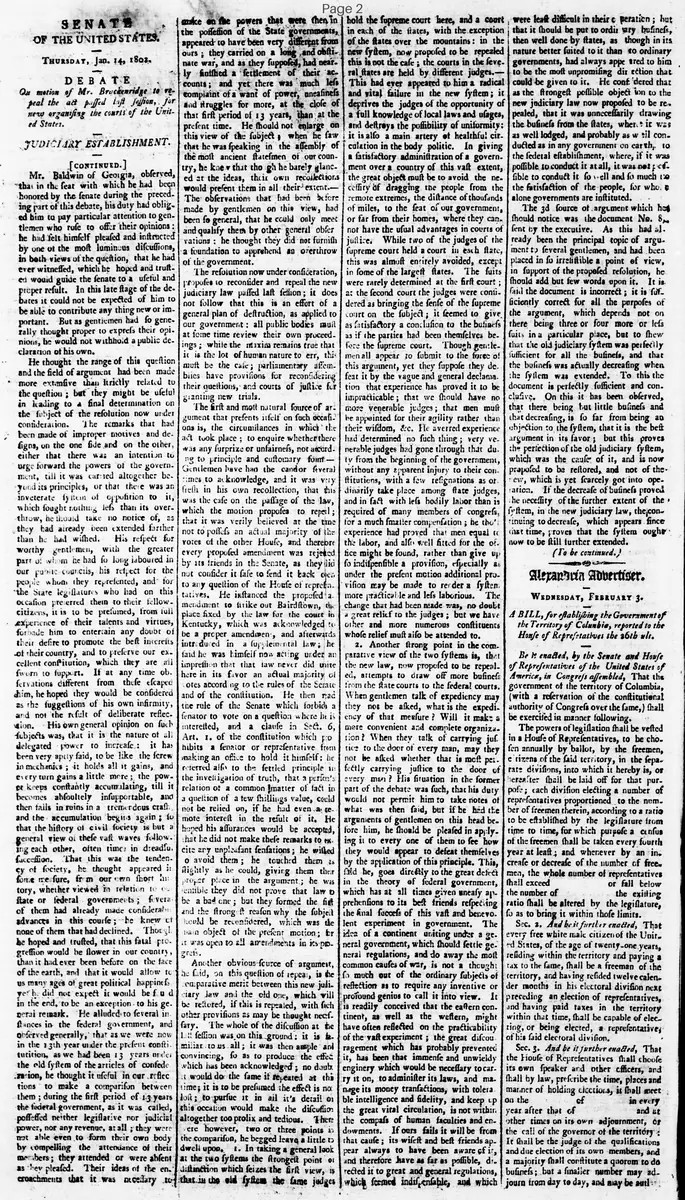
Mr. Baldwin of Georgia, observed, "that in the seat with which he had been honored by the Senate during the preceding part of this debate, his duty had obliged him to pay particular attention to gentlemen who rose to offer their opinions: he had felt himself pleased and instructed by one of the most luminous discussions, in both views of the question, that he had ever witnessed, which he hoped and trusted would guide the Senate to a useful and proper result. In this late stage of the debates it could not be expected of him to be able to contribute any thing new or important. But as gentlemen had so generally thought proper to express their opinions, he would not withhold a public declaration of his own.
He thought the range of this question and the field of argument had been made more extensive than strictly related to the question; but they might be useful in leading to a final determination on the subject of the resolution now under consideration. The remarks that had been made of improper motives and designs, on the one side and on the other, either that there was an intention to urge forward the powers of the government, till it was carried altogether beyond its principles, or that there was an inveterate system of opposition to it, which ought nothing less than its overthrow, he should take no notice of, as they had already been extended farther than he had wished. His respect for worthy gentlemen, with the greater part of whom he had so long laboured in our public councils, his respect for the people whom they represented, and for the State legislatures who had on this occasion preferred them to their fellow citizens, it is to be presumed, from full experience of their talents and virtues, forbade him to entertain any doubt of their desire to promote the best interests of their country, and to preserve our excellent constitution, which they are all sworn to support. If at any time observations different from these escaped him, he hoped they would be considered as the suggestions of his own infirmity, and not the result of deliberate reflection. His own general opinion on such subjects was, that it is the nature of all delegated power to increase: it has been very aptly said, to be like the screw in mechanics; it holds all it gains, and every turn gains a little more; the power keeps constantly accumulating, till it becomes absolutely insupportable, and then falls in ruins in a tremendous crash, and the accumulation begins again; so that the history of civil society is but a general view of these vast waves following each other, often times in dreadful succession. That this was the tendency of society, he thought appeared in some measure, from our own short history, whether viewed in relation to our state or federal governments; several of them had already made considerable advances in this course: --he knew of none of them that had declined. Though he hoped and trusted, that this fatal progression would be slower in our country, than it had ever been before on the face of the earth, and that it would allow to us many ages of great political happiness yet he did not expect it would be found in the end, to be an exception to his general remark. He alluded to several instances in the federal government, and observed generally, 'that as we were now in the 13th year under the present constitution, as we had been 13 years under the old system of the articles of confederation, he thought it useful in our reflections to make a comparison between them; during the first period of 13 years the federal government, as it was called, possessed neither legislative nor judicial power, nor any revenue, at all; they were not able even to form their own body by compelling the attendance of their members; they attended or were absent as they pleased. Their ideas of the encroachments that it was necessary to make on the powers that were then in possession of the State governments, appeared to have been very different from ours; they carried on a long and obstinate war, and as they supposed, had nearly finished a settlement of their accounts; and yet there was much less complaint of a want of power, uneasiness and struggles for more, at the close of that first period of 13 years, than at the present time. He should not enlarge on this view of the subject, when he saw that he was speaking in the assembly of the most ancient statesmen of our country, he knew that though he barely glanced at the ideas, their own recollections would present them in all their extent. The observations that had been before made by gentlemen on this view, had been so general, that he could only meet and qualify these by other general observations: he thought they did not furnish a foundation to apprehend so overthrow of the government.
The resolution now under consideration, proposes to reconsider and repeal the new judiciary law passed last session; it does not follow that this is an effort of a general plan of destruction, as applied to our government: all public bodies must at some time review their own proceedings; while the maxim remains true that it is the lot of human nature to err, this must be the case; parliamentary assemblies have provisions for reconsidering their questions, and courts of justice for granting new trials.
The first and most natural source of argument that presents itself on such occasions is, the circumstances in which the act took place: to enquire whether there was any surprise or unfairness, not according to principle and customary form. Gentlemen have had the candor several times to acknowledge, and it was very fresh in his own recollection, that his was the case on the passage of the law, which the motion proposes to repeal; that it was verily believed at the time not to possess an actual majority of the votes of the other House, and therefore every proposed amendment was rejected by its friends in the Senate, as they did not consider it safe to send it back on any question of the House of Representatives. He instanced the proposed amendment to strike out Bardstown, the place fixed by the law for the court in Kentucky, which was acknowledged to be a proper amendment, and afterwards introduced in a supplemental law: he said he was himself now acting under an impression that that law never did while here in its favor an actual majority of votes according to the rules of the Senate and of the constitution. He then read the rule of the Senate which forbid a senator to vote on a question where he is interested, and a clause in Sect. 6. Art. I. of the constitution which prohibits a senator or representative from making an office to hold it himself: he referred also to the settled principle in the investigation of truth, that a person's relation of a common matter of fact in a question of a few shillings value, could not be relied on, if he had even a remote interest in the result of it. He hoped his assurances would be accepted, that he did not make these remarks to excite any unpleasant sensations; he wished to avoid them: he touched them as lightly as he could, giving them their proper place in the argument; he was sensible they did not prove that law to be a bad one; but they formed the first and the strong est reason why the subject should be reconsidered, which was the main object of the present motion; but it was open to all amendments in its progress.
Another obvious source of argument, he said, on this question of repeal, is the comparative merit between this new judiciary law and the old one, which will be restored, if this is repealed, with such other provisions as may be thought necessary. The whole of the discussion at the last session was on this ground: it is known to us all; it was then ample and convincing, so as to produce the effect which has been acknowledged: no doubt it would do the same if repeated at this time; it is to be presumed the effect is not lost; to pursue it in all it's detail on this occasion would make the discussion altogether too prolix and tedious. There were however, two or three points in the comparison, he begged leave a little to dwell upon. 1. In taking a general look at the two systems the strongest point or distinction which seizes the first view, is that in the old system the same judges hold the supreme court here, and a court in each of the states, with the exception of the states over the mountains: in the new system, now proposed to be repealed this is not the case; the courts in the several states are held by different judges. This had ever appeared to him a radical and vital failure in the new system; it deprives the judges of the opportunity of a full knowledge of local laws and usages, and destroys the possibility of uniformity: it is also a main artery of healthful circulation in the body politic. In giving a satisfactory administration of a government over a country of this vast extent, the great object must be to avoid the necessity of dragging the people from the remote extremes, the distance of thousands of miles, to the seat of our government, or far from their homes, where they cannot have the usual advantages in courts of justice. While two of the judges of the supreme court held a court in each state, this was almost entirely avoided, except in some of the largest states. The suits were rarely determined at the first court: at the second court the judges were considered as bringing the sense of the supreme court on the subject; it seemed to give as satisfactory a conclusion to the business as if the parties had been themselves before the supreme court. Though gentlemen all appear to submit to the force of this argument, yet they suppose they defeat it by the vague and general declamation that experience has proved it to be impracticable; that we should have no more venerable judges: that men must be appointed for their agility rather than their wisdom, &c. He averred experience had determined no such thing; very venerable judges had gone through that duty from the beginning of the government, without any apparent injury to their constitutions, with a few resignations as ordinarily take place among state judges, and in fact with less bodily labor than is required of many members of congress, for a much smaller compensation; he thought experience had proved that men equal to the labor, and also well fitted for the office might be found, rather than give up so indispensable a provision, especially as under the present motion additional provision may be made to render a system more practicable and less laborious. The change that had been made was, no doubt a great relief to the judges; but we have other and more numerous constituents whose relief must also be attended to.
2. Another strong point in the comparative view of the two systems in, that the new law, now proposed to be repealed, attempts to draw off more business from the State courts to the federal courts. When gentlemen talk of expediency may they not be asked, what is the expediency of that measure? Will it make a more convenient and complete organization? When they talk of carrying justice to the door of every man, may they not be asked whether that is most perfectly carrying justice to the door of every man? His situation in the former part of the debate was such, that his duty would not permit him to take notes of what was then said, but if he had the arguments of gentlemen on this head before him, he should be pleased in applying it to every one of them to see how they would appear to defeat themselves by the application of this principle. This, said he, goes directly to the great defect in the theory of federal government, which has at all times given uneasy apprehensions to its best friends respecting the final success of this vast and benevolent experiment in government. The idea of a continent uniting under a general government, which should settle general regulations, and do away the most common causes of war, is not a thought so much out of the ordinary subjects of reflection as to require any inventive or profound genius to call it into view. It is readily conceived that the eastern continent, as well as the western, might have often reflected on the practicability of the vast experiment; the great discouragement which has probably prevented it, has been that immense and unwieldy enginery which would be necessary to carry it on, to administer its laws, and manage its money transactions, with tolerable intelligence and fidelity, and keep up the great vital circulation, is not within the compass of human faculties and endowments. If ours fails it will be from that cause; its wisest and best friends appear always to have been aware of it: and therefore have as far as possible, directed it to great and general regulations, which seemed indispensable, and which were least difficult in their operation: but that it should be put to ordinary business, then well done by states, as though in its nature better suited to it than to ordinary governments, had always appeared to him to be the most unpromising direction that could be given to it. He considered that as the strongest possible objection to the new judiciary law now proposed to be repealed, that it was unnecessarily drawing the business from the states, where it was as well lodged, and probably as well conducted as in any government on earth, to the federal establishment, where, if it was possible to conduct it at all, it was not possible to conduct it so well and so much to the satisfaction of the people, for whose benefit alone governments are instituted.
The 3d source of argument which he should notice was the document No. 6 sent by the executive. As this had already been the principal topic of argument to several gentlemen, and had been placed in so irresistible a point of view, in support of the proposed resolution, he should add but few words upon it. It is said the document is incorrect; it is sufficiently correct for all the purposes of the argument, which depends not on there being three or four more or less suits in a particular place, but to show that the old judiciary system was perfectly sufficient for all the business, and that the business was actually decreasing when the system was extended. To this the document is perfectly sufficient and conclusive. On this it has been observed, that there being but little business and that decreasing, is so far from being an objection to the system, that it is the best argument in its favor: but this proves the perfection of the old judiciary system, which was the cause of it, and is now proposed to be restored, and not of the new, which is yet scarcely got into operation. If the decrease of business proved the necessity of the further extent of the system, in the new judiciary law, the continuing to decrease, which appears since that time, proves that the system ought now to be still further extended.
(To be continued.)
What sub-type of article is it?
What themes does it cover?
What keywords are associated?
What entities or persons were involved?
Where did it happen?
Story Details
Key Persons
Location
Senate Of The United States
Event Date
Thursday, Jan. 14, 1802
Story Details
Mr. Baldwin argues for repealing the new Judiciary Act, citing procedural irregularities in its passage, superiority of the old system for local knowledge and uniformity, risks of expanding federal power over state courts, and evidence from executive document showing the old system's sufficiency.