Thank you for visiting SNEWPapers!
Sign up free
Story
June 4, 1900
Freeland Tribune
Freeland, Luzerne County, Pennsylvania
What is this article about?
Article on the scarce spruce gum harvest in Maine this season, due to unskilled gatherers producing low-quality product. Details the winter hardships of gum hunters who traverse forests on snowshoes, using special rods to collect small amounts from spruce trees, earning up to $1 per pound for clean gum.
Clipping
OCR Quality
98%
Excellent
Full Text
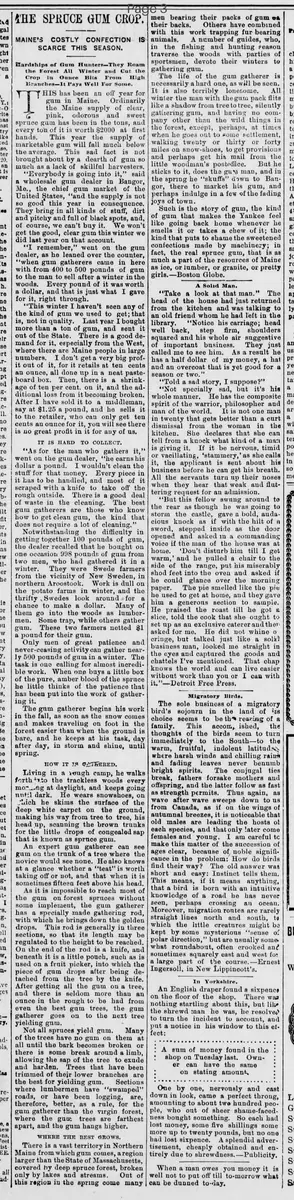
THE SPRUCE GUM CROP.
MAINE'S COSTLY CONFECTION IS SCARCE THIS SEASON.
Hardships of Gum Hunters—They Roam the Forest All Winter and Cut the Crop in Ounce Bits From High Branches—It Pays Well For Some.
This has been an off year for gum in Maine. Ordinarily the Maine supply of clear, pink, odorous and sweet spruce gum has been in the tons, and every ton of it is worth $2000 at first hands. This year the supply of marketable gum will fall much below the average. This sad fact is not brought about by a dearth of gum so much as a lack of skillful harvesters.
"Everybody is going into it," said a wholesale gum dealer in Bangor, Me., the chief gum market of the United States, "and the supply is not so good this year in consequence. They bring in all kinds of stuff, dirt and pitchy and full of black spots, and, of course, we can't buy it. We won't get the good, clear gum this winter we did last year on that account.
"I remember," went on the gum dealer, as he leaned over the counter, "when gum gatherers came in here with from 400 to 500 pounds of gum to the man to sell after a winter in the woods. Every pound of it was worth a dollar, and that is just what I gave for it, right through.
"This winter I haven't seen any of the kind of gum we used to get; that is, not in quality. Last year I bought more than a ton of gum, and sent it out of the State. There is a good demand for it, especially from the West, where there are Maine people in large numbers. I don't get a very big profit out of it, for it retails at ten cents an ounce, all done up in a neat pasteboard box. Then, there is a shrinkage of ten per cent. on it, and the additional loss from it becoming broken. After I have sold it to a middleman, say at $1.25 a pound, and he sells it to the retailer, who can only get ten cents an ounce for it, you will see there is no great profit in it for any of us.
IT IS HARD TO COLLECT.
"As for the man who gathers it," went on the gum dealer, "he earns his dollar a pound. I wouldn't clean the stuff for that money. Every piece in it has to be handled, and most of it scraped with a knife to take off the rough outside. There is a good deal of waste in the cleaning. The best gum gatherers are those who know how to get clean gum, the kind that does not require a lot of cleaning."
Notwithstanding the difficulty in getting together 100 pounds of gum, the dealer recalled that he bought on one occasion 998 pounds of gum from two men, who had gathered it in a winter. They were Swede farmers from the vicinity of New Sweden, in northern Aroostook. Work is dull on the potato farms in winter, and the thrifty Swedes look around for a chance to make a dollar. Many of them go into the woods as lumber men. Some trap, while others gather gum. These two farmers netted $1 a pound for their gum.
Only men of great patience and never-ceasing activity can gather nearly 500 pounds of gum in a winter. The task is one calling for almost incredible work. When one buys a little box of the pure, amber blood of the spruce he little thinks of the patience that has been put into the work of gathering it.
The gum gatherer begins his work in the fall, as soon as the snow comes and makes traveling on foot in the forest easier than when the ground is bare, and he keeps at his task, day after day, in storm and shine, until spring.
HOW IT IS GATHERED.
Living in a log camp, he walks forth into the trackless woods every morning at daylight, and keeps going until dark. He wears snowshoes, on which he skims the surface of the deep white carpet on the ground, making his way from tree to tree, his head up, scanning the brown trunks for the little drops of congealed sap that is known as spruce gum.
An expert gum gatherer can see gum on the trunk of a tree where the novice would see none. He also knows at a glance whether a "teat" is worth taking off or not, and that when it is sometimes fifteen feet above his head.
As it is impossible to reach most of the gum on forest spruces without some implement, the gum gatherer has a specially made gathering rod, with which he brings down the golden drops. This rod is generally in three sections, so that its length may be regulated to the height to be reached. On the end of the rod is a knife, and beneath it is a little pouch, such as is used on a fruit picker, into which the piece of gum drops after being detached from the tree by the knife.
After getting all the gum on a tree, and there is seldom more than an ounce in the rough to be had from even the best gum trees, the gum gatherer goes on to the next tree yielding gum.
Not all spruces yield gum. Many of the trees have no gum on them at all until the bark becomes broken or there is some break around a limb, allowing the sap of the tree to exude and harden. Trees that have been trimmed of their lower branches are the best for yielding gum. Sections where lumbermen have "swamped" roads, or have been logging, are, therefore, better, as a rule, for the gum gatherer than the virgin forest, where the gum trees are farthest apart, and the gum hangs higher.
WHERE THE BEST GROWS.
There is a vast territory in Northern Maine from which gum comes, a region larger than the State of Massachusetts, covered by deep spruce forest, broken only by lakes and streams. Out of this region in the spring come many men bearing their packs of gum on their backs. Others have combined this work trapping fur bearing animals. A number of guides, who, in the fishing and hunting season traverse the woods with parties of sportsmen, devote their winters to gathering gum.
The life of the gum gatherer is necessarily a hard one, as will be seen. It is also terribly lonesome. All winter the man with the gum pack flits like a shadow from tree to tree, silently gathering gum, and having no company other than the wild things in the forest, except, perhaps, at times when he goes out to some settlement, walking twenty or thirty or forty miles on snow-shoes, to get provisions and perhaps get his mail from the little woodman's post office. But he sticks to it, does the gum man, and in the spring he "skuffs" down to Bangor, there to market his gum, and perhaps indulge in a few of the fading joys of town.
Such is the story of gum, the kind of gum that makes the Yankee feel like going back home whenever he smells it or takes a chew of it; the kind that puts to shame the sweetened confections made by machinery; in fact, the real spruce gum, that is as much a part of the resources of Maine as ice, or lumber, or granite, or pretty girls.—Boston Globe.
MAINE'S COSTLY CONFECTION IS SCARCE THIS SEASON.
Hardships of Gum Hunters—They Roam the Forest All Winter and Cut the Crop in Ounce Bits From High Branches—It Pays Well For Some.
This has been an off year for gum in Maine. Ordinarily the Maine supply of clear, pink, odorous and sweet spruce gum has been in the tons, and every ton of it is worth $2000 at first hands. This year the supply of marketable gum will fall much below the average. This sad fact is not brought about by a dearth of gum so much as a lack of skillful harvesters.
"Everybody is going into it," said a wholesale gum dealer in Bangor, Me., the chief gum market of the United States, "and the supply is not so good this year in consequence. They bring in all kinds of stuff, dirt and pitchy and full of black spots, and, of course, we can't buy it. We won't get the good, clear gum this winter we did last year on that account.
"I remember," went on the gum dealer, as he leaned over the counter, "when gum gatherers came in here with from 400 to 500 pounds of gum to the man to sell after a winter in the woods. Every pound of it was worth a dollar, and that is just what I gave for it, right through.
"This winter I haven't seen any of the kind of gum we used to get; that is, not in quality. Last year I bought more than a ton of gum, and sent it out of the State. There is a good demand for it, especially from the West, where there are Maine people in large numbers. I don't get a very big profit out of it, for it retails at ten cents an ounce, all done up in a neat pasteboard box. Then, there is a shrinkage of ten per cent. on it, and the additional loss from it becoming broken. After I have sold it to a middleman, say at $1.25 a pound, and he sells it to the retailer, who can only get ten cents an ounce for it, you will see there is no great profit in it for any of us.
IT IS HARD TO COLLECT.
"As for the man who gathers it," went on the gum dealer, "he earns his dollar a pound. I wouldn't clean the stuff for that money. Every piece in it has to be handled, and most of it scraped with a knife to take off the rough outside. There is a good deal of waste in the cleaning. The best gum gatherers are those who know how to get clean gum, the kind that does not require a lot of cleaning."
Notwithstanding the difficulty in getting together 100 pounds of gum, the dealer recalled that he bought on one occasion 998 pounds of gum from two men, who had gathered it in a winter. They were Swede farmers from the vicinity of New Sweden, in northern Aroostook. Work is dull on the potato farms in winter, and the thrifty Swedes look around for a chance to make a dollar. Many of them go into the woods as lumber men. Some trap, while others gather gum. These two farmers netted $1 a pound for their gum.
Only men of great patience and never-ceasing activity can gather nearly 500 pounds of gum in a winter. The task is one calling for almost incredible work. When one buys a little box of the pure, amber blood of the spruce he little thinks of the patience that has been put into the work of gathering it.
The gum gatherer begins his work in the fall, as soon as the snow comes and makes traveling on foot in the forest easier than when the ground is bare, and he keeps at his task, day after day, in storm and shine, until spring.
HOW IT IS GATHERED.
Living in a log camp, he walks forth into the trackless woods every morning at daylight, and keeps going until dark. He wears snowshoes, on which he skims the surface of the deep white carpet on the ground, making his way from tree to tree, his head up, scanning the brown trunks for the little drops of congealed sap that is known as spruce gum.
An expert gum gatherer can see gum on the trunk of a tree where the novice would see none. He also knows at a glance whether a "teat" is worth taking off or not, and that when it is sometimes fifteen feet above his head.
As it is impossible to reach most of the gum on forest spruces without some implement, the gum gatherer has a specially made gathering rod, with which he brings down the golden drops. This rod is generally in three sections, so that its length may be regulated to the height to be reached. On the end of the rod is a knife, and beneath it is a little pouch, such as is used on a fruit picker, into which the piece of gum drops after being detached from the tree by the knife.
After getting all the gum on a tree, and there is seldom more than an ounce in the rough to be had from even the best gum trees, the gum gatherer goes on to the next tree yielding gum.
Not all spruces yield gum. Many of the trees have no gum on them at all until the bark becomes broken or there is some break around a limb, allowing the sap of the tree to exude and harden. Trees that have been trimmed of their lower branches are the best for yielding gum. Sections where lumbermen have "swamped" roads, or have been logging, are, therefore, better, as a rule, for the gum gatherer than the virgin forest, where the gum trees are farthest apart, and the gum hangs higher.
WHERE THE BEST GROWS.
There is a vast territory in Northern Maine from which gum comes, a region larger than the State of Massachusetts, covered by deep spruce forest, broken only by lakes and streams. Out of this region in the spring come many men bearing their packs of gum on their backs. Others have combined this work trapping fur bearing animals. A number of guides, who, in the fishing and hunting season traverse the woods with parties of sportsmen, devote their winters to gathering gum.
The life of the gum gatherer is necessarily a hard one, as will be seen. It is also terribly lonesome. All winter the man with the gum pack flits like a shadow from tree to tree, silently gathering gum, and having no company other than the wild things in the forest, except, perhaps, at times when he goes out to some settlement, walking twenty or thirty or forty miles on snow-shoes, to get provisions and perhaps get his mail from the little woodman's post office. But he sticks to it, does the gum man, and in the spring he "skuffs" down to Bangor, there to market his gum, and perhaps indulge in a few of the fading joys of town.
Such is the story of gum, the kind of gum that makes the Yankee feel like going back home whenever he smells it or takes a chew of it; the kind that puts to shame the sweetened confections made by machinery; in fact, the real spruce gum, that is as much a part of the resources of Maine as ice, or lumber, or granite, or pretty girls.—Boston Globe.
What sub-type of article is it?
Curiosity
What themes does it cover?
Nature
Misfortune
Triumph
What keywords are associated?
Spruce Gum
Maine Harvest
Gum Gatherers
Winter Collection
Forest Hardships
Swede Farmers
Bangor Market
Where did it happen?
Northern Maine Forests, Bangor
Story Details
Location
Northern Maine Forests, Bangor
Event Date
This Winter
Story Details
Scarce marketable spruce gum in Maine due to unskilled harvesters producing dirty product. Skilled gum gatherers endure winter forest hardships on snowshoes, using rods to collect small bits from high spruce branches, earning $1 per pound after cleaning.