Thank you for visiting SNEWPapers!
Sign up free
Arkansas State Gazette And Democrat
Little Rock, Pulaski County, Arkansas
What is this article about?
Biennial report of Arkansas Auditor R.H. Johnson to the General Assembly, detailing state treasury receipts, expenditures, taxable property values, and fund balances for fiscal years ending September 30, 1852. Includes tables A-O on appropriations, revenues, and recommendations for tax reforms favoring residents over non-resident speculators, improved revenue collection, and Penitentiary management changes.
Merged-components note: The Auditor's Biennial Report is continued from page 1 to page 4; merging these components as they form a single logical government report on state finances.
Clippings
1 of 2
OCR Quality
Full Text
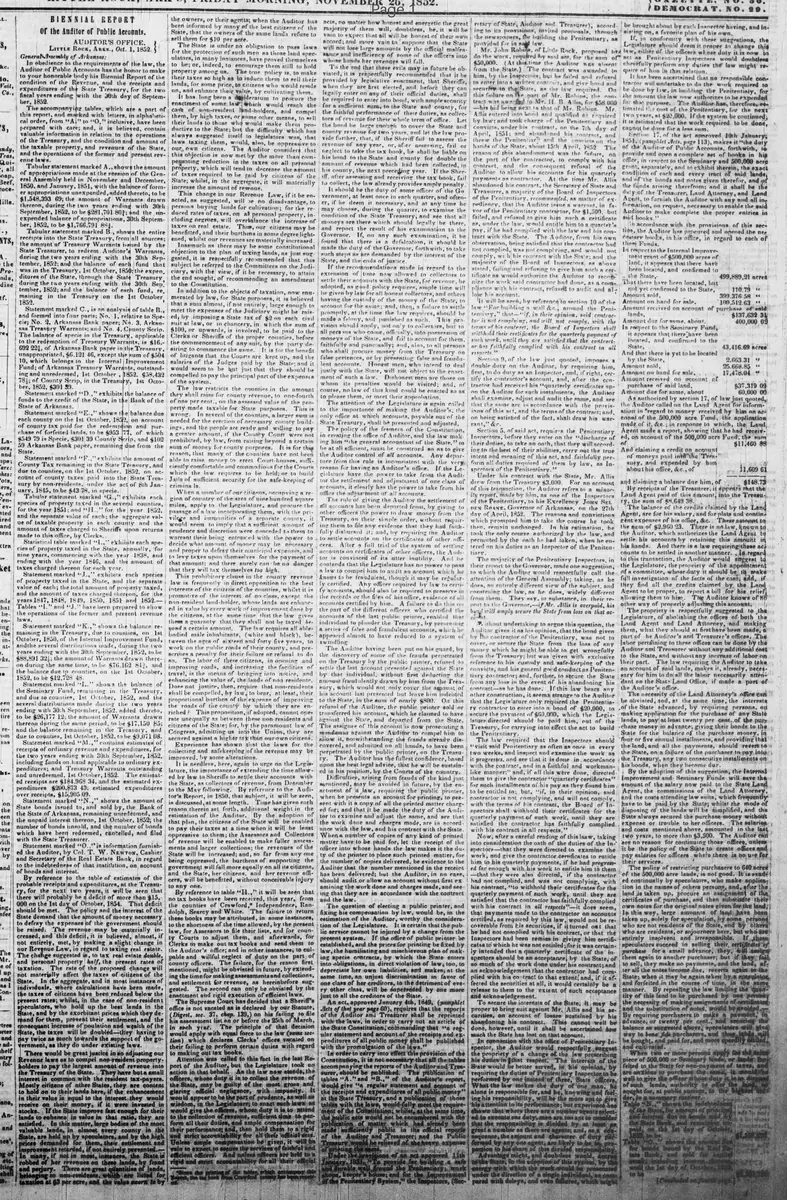
Of the Auditor of Public Accounts.
AUDITOR'S OFFICE.
Little Rock, Arks., Oct. 1, 1852.
To the General Assembly of Arkansas:
In obedience to the requirements of the law, the Auditor of Public Accounts has the honor to make to your honorable body his Biennial Report of the condition of the Revenue, and the receipts and expenditures of the State Treasury, for the two fiscal years ending with the 30th day of September, 1852.
The accompanying tables, which are a part of this report, and marked with letters, in alphabetical order, from "A" to "O," inclusive, have been prepared with care; and, it is believed, contain valuable information in relation to the operations of the Treasury, and the condition and amount of the taxable property, and revenues of the State, and the operations of the former and present revenue laws.
Tabular statement marked A., shows the amount of appropriations made at the session of the General Assembly held in November and December, 1850, and January, 1851, with the balance of former appropriations unexpended, added thereto, to be $1,548,393 69; the amount of Warrants drawn thereon, during the two years ending with 30th September, 1852, to be $281,701 80; and the unexpended balance of appropriations, 30th September, 1852, to be $1,266,691 89.
Tabular statement marked B, shows the entire receipts into the State Treasury, from all sources; the amount of Treasury Warrants issued by the State Treasurer, to redeem Auditor's Warrants, during the two years ending with the 30th September, 1852; and the balance of each fund that was in the Treasury, 1st October, 1850; the expenditures of the State, through the State Treasury, during the two years ending with the 30th September, 1852; and the balance of each fund, remaining in the Treasury on the 1st October 1852.
Statement marked C., is an analysis of table B., and formed into four parts; No. 1, relative to Specie; No. 2, Arkansas Bank paper; No. 3, Arkansas Treasury Warrants; and No. 4, County Scrip.
The balance of specie in the Treasury, applicable to the redemption of Treasury Warrants, is $16,692 25; of Arkansas Bank paper in the Treasury, unappropriated, $6,121 46, except the sum of $504 10, which belongs to the Internal Improvement Fund: of Arkansas Treasury Warrants, outstanding and unredeemed, 1st October, 1852, $58,432 78; of County Scrip, in the Treasury, 1st October, 1852, $301 39.
Statement marked "D," exhibits the balance of funds to the credit of the State, in the Bank of the State of Arkansas.
Statement marked "E.," shows the balance due each county on the 1st October, 1852, on account of county tax paid for the redemption and purchase of forfeited lands, to be $953 77, of which $549 79 is Specie, $301 39 County Scrip, and $102 59 Arkansas Bank paper, remaining due from the State.
Statement marked "F.," exhibits the amount of County Tax remaining in the State Treasury, and due to counties, on the 1st October, 1852, on account of county taxes paid into the State Treasury by non-residents, under the act of 5th January, 1845, to be $43 78, in specie.
Tabular statement marked "G.," exhibits each species of property taxed in the several counties, for the year 1851; and "H" for the year 1852, and the separate value of each; the aggregate value of taxable property in each county and the amount of taxes charged to Sheriffs upon returns made to this office, by Clerks.
Statistical table marked "I.," exhibits each species of property taxed in the State, annually, for nine years, commencing with the year 1838, and ending with the year 1846, and the amount of taxes charged thereon for each year.
Statement marked "J.," exhibits each species of property taxed in the State, and the separate value of each; the total amount of property taxed, and the amount of taxes charged thereon, for the years 1847, 1848, 1849, 1850, 1851 and 1852.
Tables "H." and "I." have been prepared to show the operations of the former and present revenue laws.
Statement marked "K.," shows the balance remaining in the Treasury, due to counties, on 1st October, 1850, of the Internal Improvement Fund, and the several distributions made, during the two years ending with the 30th September, 1852, to be $88,891 32; the amount of Warrants drawn thereon during the same time, to be $76,162 84, and the balance due to counties, on the 1st October, 1852, to be $12,728 48
Statement marked "L." shows the balance of the Seminary Fund, remaining in the Treasury, and due to counties, 1st October, 1852, and the several distributions made during the two years ending with 30th September, 1852, added thereto, to be $26,177 12; the amount of Warrants drawn thereon during the same period, to be $17,150 85; and the balance remaining in the Treasury, and due to counties, 1st October, 1852, to be $9,026 27.
Statement marked "M.," contains estimates of receipts of ordinary revenue and expenditures, for the two years ending with 30th September, 1854, including funds on hand applicable to ordinary expenditures; and Treasury Warrants outstanding and unredeemed, 1st October, 1852. The estimated receipts are $184,968 34, and the estimated expenditures $200,873 43; estimated expenditures over receipts, $15,905 09.
Statement marked "N." shows the amount of State bonds issued to, and sold by, the Bank of the State of Arkansas, remaining unredeemed, and the unpaid interest thereon, 1st October, 1852; the number of bonds unsold, and the number of bonds which have been redeemed, cancelled, and filed with the State Treasurer.
Statement marked "O." is information furnished the Auditor, by Col. T. W. Newton, Cashier and Secretary of the Real Estate Bank, in regard to the indebtedness of that institution, on account of bonds and interest.
By reference to the table of estimates of the probable receipts and expenditures, at the Treasury, for the next two years, it will be seen that there will probably be a deficit of more than $15,000 on the 1st day of October, 1854. That deficit should be met. The policy and the interest of the State demand that the amount of money necessary to defray the expenses of the government should be raised. The revenue may be materially increased, and this deficit, it is believed, almost, if not entirely, met, by making a slight change in our Revenue Law, in regard to taxing real estate.
The change suggested is, to tax real estate double, and personal property half, the present rates of taxation. The rate of the proposed change will not materially affect the taxes of citizens of the State. In the aggregate, and in most instances of individual, where calculations have been made, the taxes of citizens have been reduced below the present rates; whilst, in the case of non-resident speculators, who hold up the best lands in the State, and by the exorbitant prices which they demand for them, prevent their settlement, and the consequent increase of population and wealth of the State, the taxes will be doubled—they having to pay twice as much towards the support of the government, as they do under existing laws.
There would be great justice in so adjusting our Revenue laws as to compel non-resident property-holders to pay the largest amount of revenue into the Treasury of the State. They have but a small interest in common with the resident tax-payers. Mostly citizens of other States, they are content to hold on to their lands here, if the enhancement in their value is equal to the interest they would receive on their money, if it were invested in stocks. If the State improves not enough for their lands to enhance in value in that ratio, they are satisfied. In this matter, large bodies of the most valuable lands, in almost every county, in the State, are held up by speculators and by the high prices demanded for them, their settlement and improvement retarded, if not entirely prevented. In many, if not in most instances, the State is robbed of her revenues on these lands by fraud and perjury. There are great quantities of lands belonging to non-residents which are listed for taxation at 50 cents per acre, and the value sworn to by the owners, or their agents; when the Auditor has been informed by many of the best citizens of the State, that the owners of the same lands refuse to sell them for $10 per acre.
The State is under no obligation to pass laws for the protection of such men as those land speculators, in many instances, have proved themselves to be; or, indeed, to encourage them still to hold property among us. The true policy is, to make their taxes so high as to induce them to sell their lands, for some price, to citizens who would reside on, and enhance their value, by cultivating them.
It has long been a desideratum to procure the enactment of some law which would reach the case of non-resident land-holders, and compel them, by high taxes, or some other means, to sell their lands to those who would make them productive to the State; but the difficulty which has always suggested itself to legislators was, that laws taxing them, would, also, be oppressive to our own citizens. The Auditor considers that this objection is now met by the more than compensating reduction in the taxes on all personal property, which will tend to decrease the amount of taxes required to be paid by citizens of the State; whilst, in the aggregate, it will materially increase the amount of revenue.
This change in our Revenue Law, if it be enacted, as suggested, will be no disadvantage, to persons buying lands for cultivation; for the reduced rates of taxes, on all personal property, including negroes, will overbalance the increase of taxes on real estate. Thus, our citizens may be benefitted, and their burthens in some degree lightened, whilst our revenues are materially increased.
Inasmuch as there may be some constitutional objection to the plan of taxing lands, as just suggested, it is respectfully recommended that this subject be referred to the Committees on the Judiciary, with the view, if it be necessary, to attain the end sought, of recommending an amendment to the Constitution.
In addition to the objects of taxation, now enumerated by law, for State purposes, it is believed that a sum almost, if not entirely, large enough to meet the expenses of the Judiciary might be raised, by imposing a State tax of $2 on each civil suit at law, or in chancery, in which the sum of $100, or upwards, is involved, to be paid to the Clerks or Sheriffs of the proper counties, before the commencement of any suit, by the party desiring to commence the same. It is for the benefit of litigants that the Courts are kept up, and the salaries of the Judges paid by the State; and it would seem to be but just that they should be compelled to pay the principal part of the expenses of the system.
The law restricts the counties in the amount they shall raise for county revenue, to one-fourth of one per cent., on the assessed value of the property made taxable for State purposes. This is wrong. In several of the counties, a larger sum is needed for the erection of necessary county buildings, and the people are ready and willing to pay a greater amount, if the County Court were not prohibited, by law, from raising beyond a certain sum of money for county purposes. It is for this reason, that many of the counties have not been able to raise money to erect Court-houses, sufficiently comfortable and commodious for the Courts which the law requires to be held; or to build Jails of sufficient security for the safe-keeping of criminals.
When a number of our citizens, occupying a region of country of the area of nine hundred square miles, apply to the Legislature, and procure the passage of a law incorporating them, with the privileges and immunities of a separate county, it would seem to imply that a sufficient amount of prudence and discretion were conceded to them to warrant their being entrusted with the power to decide what amount of money may be necessary and proper to defray their municipal expenses, and to levy taxes upon themselves for the payment of that amount; and there surely can be no danger that they will tax themselves too high.
This prohibitory clause in the county revenue law is frequently in direct opposition to the best interests of the citizens of the counties, whilst it is promotive of the interest of no class, except the non-resident land-holder, whose lands are enhanced in value by every work of improvement done by the citizens, at the same time that the law gives them a guaranty that they shall not be taxed beyond a certain amount. The Law requires all able-bodied male inhabitants, (white and black), between the ages of sixteen and forty five years, to work on the public roads of their county, and prescribes a penalty for their failure or refusal to do so. The labor of these citizens, in opening and improving roads, and increasing the facilities of travel, is the means of bringing into notice, and enhancing the value of, the lands of non residents.
Does not justice, then, require that non-residents shall be compelled, by law, to bear, at least, their proportional burthen of the expense of improving the roads of the county by which they are enriched? This proposition, if adopted, cannot operate unequally as between these non-residents and citizens of the State; for, by the paramount law of Congress, admitting us into the Union, they are secured against a higher tax than our own citizens.
Experience has shown that the laws for the collecting and safe-keeping of the revenue may be improved, by some alterations.
It is needless, here, again to urge on the Legislature, the importance of extending the time allowed by law to Sheriffs to settle their accounts with the State, as collectors of revenue, from December to the May following. By reference to the Auditor's Report, in 1850, that subject, it will be seen, is discussed, at some length. Time has given each reason therein set forth, additional weight in the estimation of the Auditor. By the adoption of that plan, the citizens of the State will be enabled to pay their taxes at a time when it will be least oppressive to them; the Assessors and Collectors of revenue will be enabled to make fuller assessments and larger collections; the revenues of the State will be increased; and, so far from any one being oppressed, the burthens of supporting the government will fall more equally on all its citizens, and the State, her citizens, and her revenue officers, will be benefited, without conceivable injury to any one.
By reference to table "H.," it will be seen that no tax books have been received, this year, from the counties of Crawford, Independence, Randolph, Searcy and White. The failure to return these books may be attributed, in some instances, to the shortness of the time allowed, by the present law, for Assessors to file their lists, and for county Courts to adjust them, and afterwards, for Clerks to make out tax books and send them to the Auditor's office; and in other instances, to culpable and willful neglect of duty on the part of county officers. The failure, for the reason first mentioned, might be obviated in future, by extending the time for making assessments and collections, and settlement of revenue, as hereinbefore suggested. The second can only be obviated by the enactment and rigid execution of efficient laws.
The Supreme Court has decided that a Sheriff's office is not vacated as is declared by our Statute, (Digest, sec. 37, chap. 139,) on his failing to file his assessment list on or before the 25th of March, in each year.
The principle of that decision would apply with equal force to the law (same section) which declares Clerks' offices vacated on their failing to perform certain duties with regard to making out tax books.
Attention was called to this fact in the last Report of the Auditor, but the Legislature took no action in that behalf.
As the law now stands, the officers, whose duty it is to collect the revenue of the State, may be guilty of the most gross and glaring official negligence, with impunity. It would appear to be the part of prudence, as well as wisdom, in the Legislature, to enact such laws as would give the officers, whose duty it is to attend to the collection of revenue, sufficient time to perform all their duties and ample compensation for their performance; and, then hold them to a rigid and strict accountability for all their official acts Unless ample compensation be given, it will be vain to expect to secure the services of faithful and efficient officers. And if efficient officers are held to a rigid and strict accountability for all their official acts, no matter how honest and energetic the great majority of them will, doubtless, be, it will be vain to expect that all will be honest of their own accord; and more vain to suppose that the State will not lose large amounts by the official malfeasance and inefficiency of some of the officers into whose hands her revenues will fall.
To the end that these evils may in future be obviated, it is respectfully recommended that it be provided by legislative enactment, that Sheriffs, when they are first elected, and before they can legally enter on any of their official duties, shall be required to enter into bond, with ample security for a sufficient sum, to the State and county, for the faithful performance of their duties, as collectors of revenue for their whole term of office. Let the bond be large enough to cover the State and county revenue for two years, and let the law provide further, that, if the Sheriff fail to assess the revenue of any year, or, after assessing, fail or neglect to take the tax book, he shall be liable on his bond to the State and county for double the amount of revenue which had been collected, in his county, the next preceding year. If the Sheriff, after assessing and receiving the tax book, fail to collect, the law already provides ample penalty.
It should be the duty of some officer of the Government, at least once in each quarter, and oftener, if he deem it necessary, and at any time he may choose, during the quarter, to examine the condition of the State Treasury, and see that all moneys are there which should legally be there, and report the result of his examination to the Governor. If, on any such examination, it be found that there is a defalcation, it should be made the duty of the Governor, forthwith, to take such steps as are demanded by the interest of the State, and the ends of justice.
If the recommendations made in regard to the extension of time now allowed to collectors to settle their accounts with the State, for revenue, be adopted, as good policy requires, ample time will be given by law for all honest collectors, and others having the custody of the money of the State, to account for the same; and, then, a failure to settle promptly, at the time the law requires, should be made a felony, and punished as such. This provision should apply, not only to collectors, but to all persons who come, officially, into possession of moneys of the State, and fail to account for them faithfully and punctually; and, also, to all persons who shall procure money from the Treasury on false pretences, or by presenting false and fraudulent accounts. Honest men, who intend to deal justly with the State, will not object to the enactment of such a law. Dishonest men are those on whom its penalties would be visited: and, of course, no law of this kind could be enacted so as to please them, or meet their approbation.
The attention of the Legislature is again called to the importance of making the Auditor's, the only office at which accounts, payable out of the State Treasury, shall be presented and adjusted.
The policy of the framers of the Constitution, in creating the office of Auditor, and the law making him "the general accountant of the State," to be at all efficient, must be construed so as to give the Auditor control of all accounts. Any departure from this rule is inconsistent with the very reason for having an Auditor's office. If the Legislature have the power to take from the Auditor the settlement and adjustment of one class of accounts, it clearly has the power to take from his office the adjustment of all accounts.
The rule of giving the Auditor the settlement of all accounts has been departed from, by giving to other officers the power to draw money from the Treasury, on their simple order, without requiring them to file any evidence that they had faithfully disbursed it; and, by requiring the Auditor to settle accounts on the certificates of other officers. After a full trial of the system of settling accounts on certificates of other officers, the Auditor is convinced of its utter inutility. And he contends that the Legislature has no power to pass a law to compel him to audit an account which he knows to be fraudulent, though it may be regularly certified. Any officer required by law to certify accounts, should also be required to preserve in the records or the files of his office, evidence of all accounts certified by him. A failure to do thus on the part of the different officers who certified the accounts of the last public printer, enabled that individual to plunder the Treasury, by presenting a series of false and fraudulent accounts, which he appeared almost to have reduced to a system of swindling
The Auditor having been put on his guard, by the discovery of some of the frauds perpetrated on the Treasury by the public printer, refused to settle the last account presented against the State by that individual, without first deducting the amount fraudulently drawn by him from the Treasury, which would not only cover the amount of his account last presented but leave him indebted to the State, in the sum of nearly $800. On this refusal of the Auditor, the public printer sold or transferred his account, which he claimed to have against the State, and departed from the State.
The assignee of this account is now prosecuting a mandamus against the Auditor to compel him to allow it, notwithstanding the frauds already discovered, and admitted on all hands, to have been perpetrated by the public printer, on the Treasury. The Auditor has the fullest confidence, based upon the best legal advice, that he will be sustained in his position, by the Courts of the country.
Difficulties, arising from frauds of the kind just mentioned, may be avoided in future, by the enactment of a law, requiring the public printer, when he presents an account for printing, to present with it a copy of all the printed matter charged for; and that it be made the duty of the Auditor to examine and adjust the same, and see that the work done and charges made, are in accordance with the law, and his contract with the State. When a number of copies of any kind of printed matter have to be paid for, let the receipt of the officer into whose hands the law makes it the duty of the printer to place such printed matter, for the number of copies delivered, be evidence to the Auditor that the number mentioned in the receipt has been delivered; but the Auditor, in no case, should audit or allow an account without first examining the work done and charges made, and seeing that they are in accordance with the contract and the law.
The question of electing a public printer, and fixing his compensation by law, would be, in the estimation of the Auditor, worthy the consideration of the Legislature. It is certain that the public service cannot be injured by a change from the present system. If the office of public printer be established, and the prices for printing be fixed by law, the humiliating and mischievous plan of making specie contracts, by which the State enters into obligations, in direct violation of law, too, to depreciate her own liabilities, and makes, at the same time, an unjust discrimination in favor of one class of her creditors, to the detriment of every other class, will be superseded by one more just to all the creditors of the State.
An act, approved January 4th, 1849, (pamphlet Acts of that year page 60), requires that the reports of the Auditor and Treasurer shall be reprinted with the laws, in order to carry out an article of the State Constitution, commanding that "a regular statement and account of the receipts and expenditures of all public money shall be published with the promulgation of the laws."
In order to carry into effect this provision of the Constitution, it is not necessary that all the tables accompanying the reports of the Auditor and Treasurer, should be published. The publication of tables "A." and "B.," of the Auditor's report, would give "a regular statement and account of the receipts and expenditures of all public money' at the State Treasury, and a publication of those tables with the laws, would fully meet the requirement of the Constitution; whilst at the same time the public acts would not be encumbered with the publication of matter which had already been made sufficiently public in the official reports of the Auditor and Treasurer; and the Treasury would be relieved of the heavy expense of printing the reports under the provisions of an act approved January 1st, 1851, "To provide for building a wall around the Penitentiary."
The Secretary of State, Auditor and Treasurer, according to its provisions, invited proposals, through the newspapers, for building the Penitentiary, as provided for in said law.
Mr. John Robins, of Little Rock, proposed to do the work, required by said act, for the sum of $50,000. (At this time the Auditor was absent from the State.) The contract was awarded to him, by the Inspectors; but he failed and refused to enter into a written contract, and give bond and security to the State, as the law required. On this failure on the part of Mr. Robins, the contract was awarded to Mr. I. B. Allis, for $58,000—his bid being next to that of Mr. Robins. Mr. Allis entered into bond and qualified as required by law: and took charge of the Penitentiary and convicts, under his contract, on the 7th day of April, 1851: and abandoned his contract, and threw the Penitentiary and the convicts on the hands of the State, about 15th April, 1852 The reason of this abandonment was the failure, on the part of the contractor, to comply with his contract, and the consequent refusal of the Auditor to allow his accounts for his quarterly payments as contractor. At the time Mr. Allis abandoned his contract, the Secretary of State and Treasurer, a majority of the Board of Inspectors of the Penitentiary, recommended, as matter of expediency, that the Auditor issue a warrant, in favor of the Penitentiary contractor, for $1,500. but failed, and refused to give him such a certificate as, under the law, would entitle him to a quarter's pay, if he had complied with the law and his contract with the State. The Auditor, from his own observation, being satisfied that the contractor had not complied, was not complying, and would not comply, with his contract with the State: and the majority of the Board of Inspectors, as above stated, failing and refusing to give him such a certificate as would authorize the Auditor to recognize the work said contractor had done, as a compliance with his contract, refused to audit and allow his account.
It will be seen, by reference to section 10 of the law "For building a wall &c. around the Penitentiary," that—"if, in their opinion, said contractor is not complying, and will not comply, with the terms of his contract, the Board of Inspectors shall withhold their certificates for the quarterly payment of such work, until they are satisfied that the contractor has faithfully complied with his contract in all respects."
Section 9, of the law just quoted, imposes a double duty on the Auditor, by requiring him, first, to do duty as an Inspector, and, if right, certify the contractor's account, and, after the contractor had received his "quarterly certificates upon the Auditor for such instalments, the Auditor shall examine, adjust and audit the same, and see that the same are in accordance with the provisions of this act, and the terms of the contract; and, on being satisfied of the fact, shall draw his warrant." &c.
Section 5, of said act, requires the Penitentiary Inspectors, before they enter on the "discharge of their duties, to take an oath, that they will, according to the best of their abilities, carry out the true intent and meaning of this act, and faithfully perform all duties required of them by law, as Inspectors of the Penitentiary."
Under his contract with the State, Mr. Allis drew from the Treasury $3,000. For an account of this transaction, the Auditor refers to a minority report, made by him, as one of the Inspectors of the Penitentiary, to his Excellency John Selden Roane, Governor of Arkansas, on the 27th day of April, 1852. The reasons and convictions which prompted him to take the course he took then, remain unchanged. In his estimation, he took the only course authorized by the law, and permitted by the oath he had taken, when he entered on his duties as an Inspector of the Penitentiary.
The majority of the Penitentiary Inspectors, in their report to the Governor, made one suggestion, to which the Auditor would respectfully call the attention of the General Assembly; taking, as he does, an entirely different view of the subject, and construing the law, as he does, widely different from them. They say, in substance, in their report to the Governor—if Mr. Allis is overpaid, his bond will amply secure the State from loss on that account.
Without undertaking to argue this question, the Auditor gives it as his opinion, that the bond given by the contractor of the Penitentiary, was not to cover, or secure the State from the loss of any money which he might be able to get wrongfully from the Treasury; but was given with exclusive reference to his custody and safe-keeping of the convicts, and his general good conduct as Penitentiary contractor; and, further, to secure the State from any loss in the event of his abandoning his contract—as he has done. If this law bears any other construction, it seems strange to the Auditor that the Legislature only required the Penitentiary contractor to enter into a bond of $20,000, to secure the payment of $60,000, which the Legislature directed should be paid him, out of the Treasury, for carrying into effect the act to build the Penitentiary.
The law required that the Inspectors should "visit said Penitentiary as often as once in every two weeks, and inspect and examine the work, as it progresses, and see that it is done in accordance with the contract, and in a faithful and workmanlike manner:" and, if all this were done, directed them to give the contractor "quarterly certificates" for such installments of his pay as they found him to be entitled to: but, "if, in their opinion, said contractor is not complying, and will not comply, with the terms of his contract, the Board of Inspectors shall withhold their certificates for the quarterly payment of such work, until they are satisfied the contractor has faithfully complied with his contract in all respects."
Now, after a careful reading of this law, taking into consideration the oath of the duties of the Inspectors—that they were directed to examine the work, and give the contractor certificates to entitle him to his quarterly payments, if he had progressed far enough with his work to entitle him to them—that they were also directed, if the contractor had not complied, and was not complying, with his contract, "to withhold their certificates for the quarterly payment of such work, until they are satisfied that the contractor has faithfully complied with his contract in all respects"—it does seem, that payments made to the contractor on accounts certified, as required by this law, would not be recoverable from his securities, if it turned out that he had not complied with his contract, or that the Inspectors had been remiss in giving him certificates to which he was not entitled; for it was certainly intended that a quarterly certificate of the inspectors should be an acceptance, by the State, of so much of the work done under his contract; and an acknowledgement that the contractor had complied with his contract to that extent; and, if it affected the securities at all, it would certainly be a release to them to the extent of such acceptance and acknowledgement.
To secure the interests of the State; it may be proper to bring suit against Mr. Allis and his securities, on account of losses sustained by his abandoning his contract. This cannot well be done, however, until it shall be ascertained how much the State has lost on that account.
In connection with the office of Penitentiary Inspector, the Auditor would respectfully suggest the propriety of a change of the law prescribing his duties in that respect. The interests of the State would be better served, in his opinion, by requiring the duties of Penitentiary Inspector to be performed by one instead of three, State officers. What the law makes the duty of one man, he alone is responsible for, and he, knowing and feeling his responsibility, will be the more apt to give his attention to its performance; but experience has shown that where there are a number of agents selected to execute one duty, men are too apt to consider that the responsibility is divided by at least as great a number as there are agents; and, as a consequence, the amount and character of duty performed by any one agent, are likely to be, in proportion to his share of this divided responsibility
Advantage might, and doubtless would, accrue to the State, in the adoption of this system, by the energy with which the work would be prosecuted under the direction of a single individual, as compared with delays, and even failures, which arise from the clashing of opinions, or from each Inspector having, and insisting on, a favorite plan of his own.
If, in conformity with these suggestions, the Legislature should deem it proper to change this law, either of the officers whose duty it is now to act as Penitentiary Inspectors would doubtless cheerfully perform any duties the law might require of him in that relation.
It has been ascertained that no responsible contractor will undertake to do the work required to be done by law, in building the Penitentiary, for the amount the law now authorizes to be expended for that purpose. The Auditor has, therefore, estimated the cost of the Penitentiary, for the next two years, at $20,000. If the system be continued it is estimated that the work required to be done, cannot be done for a less sum.
Section 17, of the act approved 10th January, 1851, (pamphlet Acts, page 113), makes it "the duty of the Auditor of Public Accounts, forthwith, to provide and open a complete set of books in his office, in respect to the Seminary and 500,000 acre grant, separately, and to exhibit therein, the exact condition of each and every tract of said lands and of the bonds and notes given therefor, and of the funds arising therefrom; and it shall be the duty of the Treasurer, Land Attorney, and Land Agent, to furnish the Auditor with any and all information, on request, necessary to enable the said Auditor to make complete the proper entries in said books."
In accordance with the provisions of this section, the Auditor has procured and opened the necessary books, in his office, in regard to each of these Funds.
In respect to the Internal Improvement grant of 500,000 acres of land, it appears that there have been located, and confirmed to the State, 499,889.21 acres That there have been located, but not yet confirmed to the State, 110.79 Amount sold, 399,376.58 Amount on hand for sale, 100,512.63 Amount received on account of purchase of said lands, $137,632 31 Amount due for same, about 400,000 00
In respect to the Seminary Fund, it appears that there have been located, and confirmed to the State, 43,416.69 acres And that there is yet to be located by the State, 2,663.31 Amount sold, 25,668.85 Amount on hand for sale, 17,748.04 Amount received on account of purchase of said land, $37,319 09 Amount due for same, about 60,000 00
As authorized by section 17, of law just quoted, the Auditor called on the Land Agent for information in regard to money received by him on account of the 500,000 acre Fund, the application made of it, &c.; in response to which, the Land Agent made a report, showing that he had received, on account of the 500,000 acre Fund; the sum of $11,460 88 And claiming a credit on account of moneys paid into the Treasury, and expended by him about his office, &c., of $11,609 61 and claiming a balance due him, of $148 73 By receipts of the Treasurer, it appears that the Land Agent paid of this amount, into the Treasury, the sum of $3,649 38.
The balance of the credits claimed by the Land Agent, are for his salary, and for plats and contingent expenses of his office, &c. These amount to the sum of $2,960 23. There is no law, known to the Auditor, which authorizes the Land Agent to settle his accounts by retaining this amount in his hands. And there is no law requiring these accounts to be settled in another manner. In regard to this transaction, the Auditor would suggest to the Legislature, the propriety of the appointment of a committee, whose duty it should be to make full investigation of the facts of the case; and, if they find all the credits claimed by the Land Agent to be proper, to report a bill, for his relief allowing them to him. The Auditor knows of no other way of properly adjusting this account.
The propriety is respectfully suggested to the Legislature, of abolishing the offices of both the Land Agent and Land Attorney, and making them, what they should at first have been made, a part of the Auditor's and Treasurer's offices. The labor pertaining to these offices can be done by the Auditor and Treasurer without any additional cost to the State, and without any increase of labor on their part. The law requiring the Auditor to take an account of said lands, makes it, already, necessary for him to do all the labor necessarily attendant on the State-Land Office, if made a part of the Auditor's office.
The necessity of the Land Attorney's office can be obviated, and, at the same time, the interests of the State advanced, by requiring persons, on making application for the purchase of any State lands, to pay at least twenty per cent., of the purchase money in advance: giving their bonds to the State for the balance of the purchase money, in four or five annual installments, and providing that the land, and all the payments, should revert to the State, on a failure of the purchaser to pay into the Treasury, any two consecutive installments on his bonds, when they become due.
By the adoption of this suggestion, the Internal Improvement and Seminary Funds will save the amount of the salary now paid to the State Land Agent, the commissions of the Land Attorney and the costs attending law suits, which frequently have to be paid by the State; whilst the mode of disposing of the lands will be simplified, and the State always secured the purchase-money without expense or trouble to her officers. The salaries and costs mentioned above, amounted in the last two years, to more than $3,500. The Auditor can see no reason for continuing those offices, unless it be the policy of the State to create offices and pay salaries for officers where there is no use for their services.
The policy of restricting purchasers to 640 acres of the 500,000 acre lands, is not good. It is evaded continually by speculators, who make application in the names of other persons, and, after the land is taken up, procure an assignment of the certificates of purchase, and then substitute their own notes for the original notes given for the land. In this way, large amounts of land, have been taken up, solely for speculation, by some persons who are not residents of the State, and by others who are residents, or sojourners here, but who get entirely insolvent and irresponsible. If these speculators succeed in selling their certificates of purchase at a small advance, they will assign them again to another purchaser; but if they fail to sell, they make no payments, and the land, after all the notes become due, reverts again to the State; when it may be again taken by a speculator and forfeited in the course of time, in the same manner.
By repealing the law limiting the quantity of this land to be purchased by one person the necessity of making assignments of certificates and the substitution of notes, would be avoided. By requiring purchasers to make a payment in advance, of twenty per cent., and securing the balance as suggested above, speculators will give way to bona fide purchasers, and thus, land will be bought, and paid for, and more speedily settled and cultivated.
When two or more persons apply for the same piece of 500,000 or Seminary lands, or lands forfeited to the State for non-payment of taxes, and are anxious to purchase—the same is usually well to give the officer whose duty it is to dispose of such lands, authority to offer the land sought for, at public auction, to the highest bidder, in a summary manner—e.g. Table "N.," shows the indebtedness of the State, for bonds paid by the Bank, and the amount of principal and interest due on said, 1st October, 1852.
Table "O.," shows, for bonds issued by the Real Estate Bank, and the amount of principal and interest due on said, 1st October, 1852, to the State.
Respectfully,
R. H. Johnson,
Auditor Pub. Accts.
What sub-type of article is it?
What keywords are associated?
What entities or persons were involved?
Where did it happen?
Domestic News Details
Primary Location
Little Rock, Arks.
Event Date
Oct. 1, 1852
Key Persons
Outcome
estimated deficit of $15,905 for fiscal years ending sept. 30, 1854; unexpended appropriations balance $1,266,691.89; various fund balances detailed in tables; recommendations for tax reforms and administrative changes.
Event Details
Auditor R.H. Johnson submits biennial report to Arkansas General Assembly on state revenues, expenditures, taxable property, and treasury operations for two fiscal years ending Sept. 30, 1852. Report includes tables A-O detailing appropriations, receipts, balances in specie, bank paper, warrants, and scrip; analyses of property taxes by county and year; estimates of future revenues and expenditures; and recommendations for doubling taxes on real estate held by non-residents while halving personal property taxes, extending collection timelines, enhancing accountability for officials, reforming public printing and Penitentiary contracts, and abolishing certain land offices.