Thank you for visiting SNEWPapers!
Sign up free
The Southern Press
Washington, District Of Columbia
What is this article about?
Communication from W.D. Porter in the National Intelligencer describes Japan's capital Jeddo, royal city Meaco, seaport Ozenca, customs including suicide and polygamy, superior manufacturing and exports, and worship of gods Xaca and Amida with grand temples.
Clipping
OCR Quality
Full Text
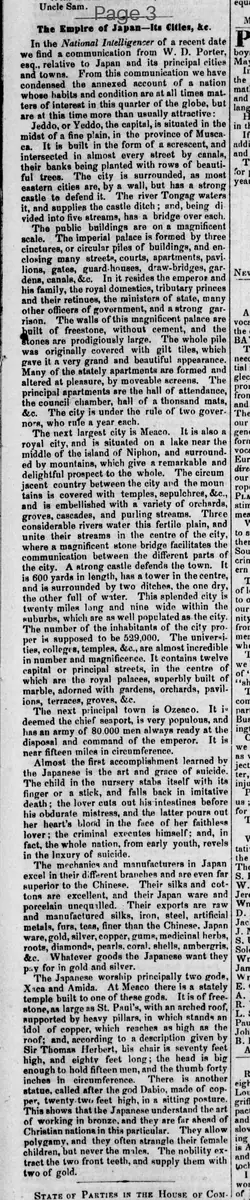
In the National Intelligencer of a recent date we find a communication from W. D. Porter, esq., relative to Japan and its principal cities and towns. From this communication we have condensed the annexed account of a nation whose habits and condition are at all times matters of interest in this quarter of the globe, but are at this time more than usually attractive:
Jeddo, or Yeddo, the capital, is situated in the midst of a fine plain, in the province of Muscaca. It is built in the form of a crescent, and intersected in almost every street by canals, their banks being planted with rows of beautiful trees. The city is surrounded, as most eastern cities are, by a wall, but has a strong castle to defend it. The river Tongag waters it, and supplies the castle ditch; and, being divided into five streams, has a bridge over each.
The public buildings are on a magnificent scale. The imperial palace is formed by three cinctures, or circular piles of buildings, and enclosing many streets, courts, apartments, pavilions, gates, guard-houses, draw-bridges, gardens, canals, &c. In it resides the emperor and his family, the royal domestics, tributary princes and their retinues, the ministers of state, many other officers of government, and a strong garrison. The walls of this magnificent palace are built of freestone, without cement, and the stones are prodigiously large. The whole pile was originally covered with gilt tiles, which gave it a very grand and beautiful appearance.
Many of the stately apartments are formed and altered at pleasure, by moveable screens. The principal apartments are the hall of attendance, the council chamber, hall of a thousand mats, &c. The city is under the rule of two governors, who rule a year each.
The next largest city is Meaco. It is also a royal city, and is situated on a lake near the middle of the island of Niphon, and surrounded by mountains, which give a remarkable and delightful prospect to the whole. The circumjacent country between the city and the mountains is covered with temples, sepulchres, &c., and is embellished with a variety of orchards, groves, cascades, and purling streams. Three considerable rivers water this fertile plain, and unite their streams in the centre of the city, where a magnificent stone bridge facilitates the communication between the different parts of the city. A strong castle defends the town. It is 600 yards in length, has a tower in the centre, and is surrounded by two ditches, the one dry, the other full of water. This splendid city is twenty miles long and nine wide within the suburbs, which are as well populated as the city.
The number of the inhabitants of the city proper is supposed to be 529,000. The universities, colleges, temples, &c., are almost incredible in number and magnificence. It contains twelve capital or principal streets, in the centre of which are the royal palaces, superbly built of marble, adorned with gardens, orchards, pavilions, terraces, groves, &c.
The next principal town is Ozenca. It is deemed the chief seaport, is very populous, and has an army of 80,000 men always ready at the disposal and command of the emperor. It is near fifteen miles in circumference.
Almost the first accomplishment learned by the Japanese is the art and grace of suicide. The child in the nursery stabs itself with its finger or a stick, and falls back in imitative death: the lover cuts out his intestines before his obdurate mistress, and the latter pours out her heart's blood in the face of her faithless lover; the criminal executes himself; and, in fact, the whole nation, from early youth, revels in the luxury of suicide.
The mechanics and manufacturers in Japan excel in their different branches and are even far superior to the Chinese. Their silks and cottons are excellent, and their Japan ware and porcelain unequalled. Their exports are raw and manufactured silks, iron, steel, artificial metals, furs, teas, finer than the Chinese, Japan ware, gold, silver, copper, gums, medicinal herbs, roots, diamonds, pearls, coral, shells, ambergris, &c. Whatever goods the Japanese want they pay for in gold and silver.
The Japanese worship principally two gods, Xaca and Amida. At Meaco there is a stately temple built to one of these gods. It is of freestone, as large as St. Paul's, with an arched roof, supported by heavy pillars, in which stands an idol of copper, which reaches as high as the roof; and, according to a description given by Sir Thomas Herbert, his chair is seventy feet high, and eighty feet long; the head is big enough to hold fifteen men, and the thumb forty inches in circumference. There is another statue, called after the god Dabio, made of copper, twenty-two feet high, in a sitting posture.
This shows that the Japanese understand the art of working in bronze, and they are far ahead of Christian nations in this particular. They allow polygamy, and they often strangle their female children, but never the males. The nobility extract the two front teeth, and supply them with two of gold.
What sub-type of article is it?
What keywords are associated?
What entities or persons were involved?
Where did it happen?
Foreign News Details
Primary Location
Japan
Key Persons
Event Details
Communication from W. D. Porter describes Japan's capital Jeddo in province of Muscaca, with imperial palace, ruled by two governors; royal city Meaco on island of Niphon with 529,000 inhabitants, universities, temples, royal palaces; seaport Ozenca with 80,000 army; Japanese customs of suicide, polygamy, infanticide, gold teeth for nobility; superior mechanics in silks, cottons, Japan ware, porcelain; exports including silks, metals, teas, gold, silver; worship of gods Xaca and Amida, with grand temples and idols in Meaco described by Sir Thomas Herbert.