Thank you for visiting SNEWPapers!
Sign up free
Editorial
October 1, 1959
The Camas Hot Springs Exchange
Hot Springs, Camas, Sanders County, Montana
What is this article about?
The editorial endorses the Senate's close vote to revive the Civilian Conservation Corps (CCC), a successful New Deal program, to employ 50,000-150,000 youths aged 16-21 in conserving natural resources and preventing unemployment-related delinquency, despite Republican opposition and predicted veto by President Eisenhower.
Clipping
OCR Quality
100%
Excellent
Full Text
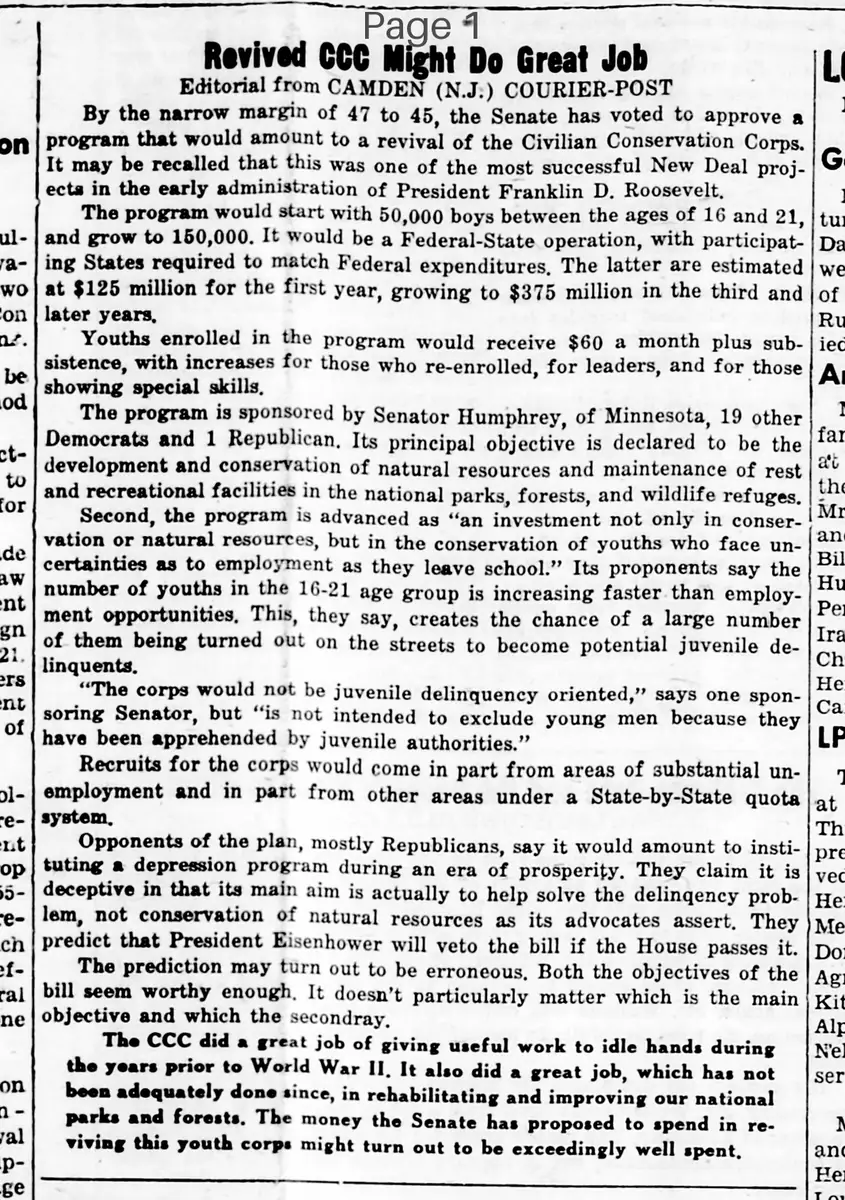
Revived CCC Might Do Great Job
Editorial from CAMDEN (N.J.) COURIER-POST
By the narrow margin of 47 to 45, the Senate has voted to approve a program that would amount to a revival of the Civilian Conservation Corps.
It may be recalled that this was one of the most successful New Deal projects in the early administration of President Franklin D. Roosevelt.
The program would start with 50,000 boys between the ages of 16 and 21, and grow to 150,000. It would be a Federal-State operation, with participating States required to match Federal expenditures. The latter are estimated at $125 million for the first year, growing to $375 million in the third and later years.
Youths enrolled in the program would receive $60 a month plus subsistence, with increases for those who re-enrolled, for leaders, and for those showing special skills.
The program is sponsored by Senator Humphrey. of Minnesota, 19 other Democrats and 1 Republican. Its principal objective is declared to be the development and conservation of natural resources and maintenance of rest and recreational facilities in the national parks, forests, and wildlife refuges.
Second, the program is advanced as "an investment not only in conservation or natural resources, but in the conservation of youths who face uncertainties as to employment as they leave school." Its proponents say the number of youths in the 16-21 age group is increasing faster than employment opportunities. This, they say, creates the chance of a large number of them being turned out on the streets to become potential juvenile delinquents.
"The corps would not be juvenile delinquency oriented," says one sponsoring Senator, but "is not intended to exclude young men because they have been apprehended by juvenile authorities.
Recruits for the corps would come in part from areas of substantial unemployment and in part from other areas under a State-by-State quota system.
Opponents of the plan, mostly Republicans, say it would amount to instituting a depression program during an era of prosperity. They claim it is deceptive in that its main aim is actually to help solve the delinquency problem. not conservation of natural resources as its advocates assert. They predict that President Eisenhower will veto the bill if the House passes it.
The prediction may turn out to be erroneous. Both the objectives of the bill seem worthy enough. It doesn't particularly matter which is the main objective and which the secondary.
The CCC did a great job of giving useful work to idle hands during the years prior to World War II. It also did a great job, which has not been adequately done since, in rehabilitating and improving our national parks and forests. The money the Senate has proposed to spend in reviving this youth corps might turn out to be exceedingly well spent.
Editorial from CAMDEN (N.J.) COURIER-POST
By the narrow margin of 47 to 45, the Senate has voted to approve a program that would amount to a revival of the Civilian Conservation Corps.
It may be recalled that this was one of the most successful New Deal projects in the early administration of President Franklin D. Roosevelt.
The program would start with 50,000 boys between the ages of 16 and 21, and grow to 150,000. It would be a Federal-State operation, with participating States required to match Federal expenditures. The latter are estimated at $125 million for the first year, growing to $375 million in the third and later years.
Youths enrolled in the program would receive $60 a month plus subsistence, with increases for those who re-enrolled, for leaders, and for those showing special skills.
The program is sponsored by Senator Humphrey. of Minnesota, 19 other Democrats and 1 Republican. Its principal objective is declared to be the development and conservation of natural resources and maintenance of rest and recreational facilities in the national parks, forests, and wildlife refuges.
Second, the program is advanced as "an investment not only in conservation or natural resources, but in the conservation of youths who face uncertainties as to employment as they leave school." Its proponents say the number of youths in the 16-21 age group is increasing faster than employment opportunities. This, they say, creates the chance of a large number of them being turned out on the streets to become potential juvenile delinquents.
"The corps would not be juvenile delinquency oriented," says one sponsoring Senator, but "is not intended to exclude young men because they have been apprehended by juvenile authorities.
Recruits for the corps would come in part from areas of substantial unemployment and in part from other areas under a State-by-State quota system.
Opponents of the plan, mostly Republicans, say it would amount to instituting a depression program during an era of prosperity. They claim it is deceptive in that its main aim is actually to help solve the delinquency problem. not conservation of natural resources as its advocates assert. They predict that President Eisenhower will veto the bill if the House passes it.
The prediction may turn out to be erroneous. Both the objectives of the bill seem worthy enough. It doesn't particularly matter which is the main objective and which the secondary.
The CCC did a great job of giving useful work to idle hands during the years prior to World War II. It also did a great job, which has not been adequately done since, in rehabilitating and improving our national parks and forests. The money the Senate has proposed to spend in reviving this youth corps might turn out to be exceedingly well spent.
What sub-type of article is it?
Infrastructure
Social Reform
Economic Policy
What keywords are associated?
Ccc Revival
Youth Employment
Natural Conservation
Juvenile Delinquency
New Deal
Senate Bill
What entities or persons were involved?
Senator Humphrey
President Franklin D. Roosevelt
President Eisenhower
Senate
Democrats
Republicans
Editorial Details
Primary Topic
Revival Of The Civilian Conservation Corps
Stance / Tone
Supportive Of The Ccc Revival
Key Figures
Senator Humphrey
President Franklin D. Roosevelt
President Eisenhower
Senate
Democrats
Republicans
Key Arguments
Ccc Was A Successful New Deal Project For Youth Employment And Conservation
Program Addresses Growing Youth Unemployment And Potential Delinquency
Focuses On Conserving Natural Resources In Parks And Forests
Federal State Partnership With Matching Funds
Opponents View It As Unnecessary In Prosperous Times And Predict Veto
Both Objectives Are Worthy Regardless Of Priority