Thank you for visiting SNEWPapers!
Sign up free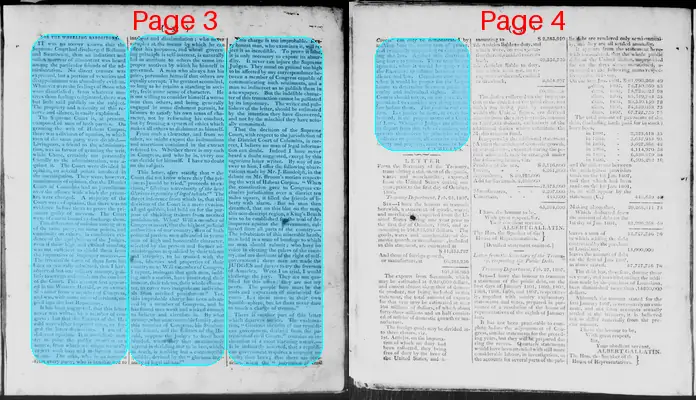
The Wheeling Repository
Wheeling, Ohio County, West Virginia
What is this article about?
An editorial defending the Supreme Court's discharge of Bollman and Swartwout due to lack of jurisdiction by the District Court of Columbia and insufficient evidence of treason. It criticizes discontent from administration supporters and a supposed congressional letter accusing the Court of evasion, praising judicial integrity and quoting J. Randolph on the District's unsuitability for trials.
Merged-components note: Continuation of the editorial on the Supreme Court decision regarding Bollman and Swartwout across pages 3 and 4, signed 'CAMILLUS' at the end.
Clippings
1 of 2
OCR Quality
Full Text
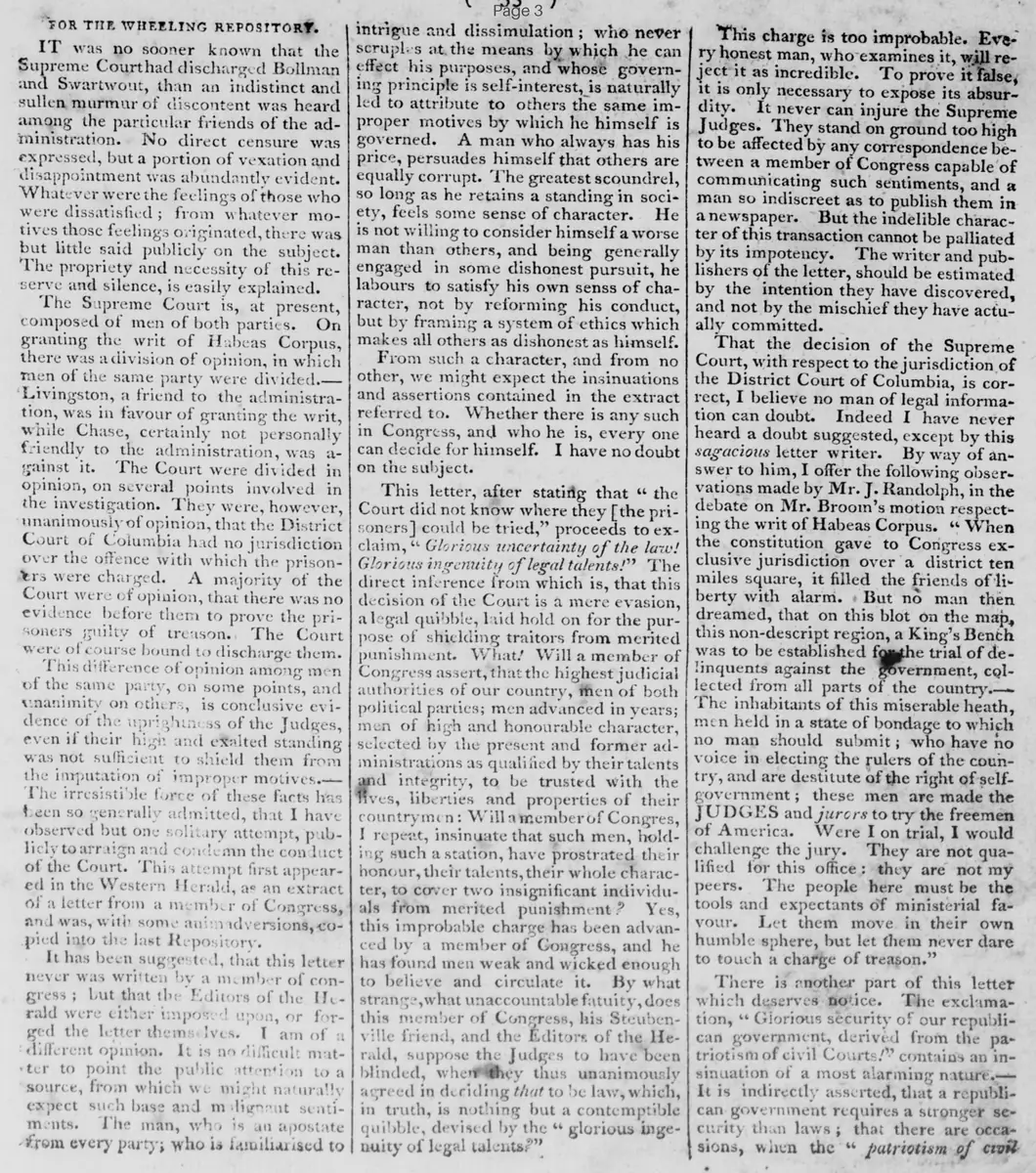
IT was no sooner known that the Supreme Court had discharged Bollman and Swartwout, than an indistinct and sullen murmur of discontent was heard among the particular friends of the administration. No direct censure was expressed, but a portion of vexation and disappointment was abundantly evident. Whatever were the feelings of those who were dissatisfied; from whatever motives those feelings originated, there was but little said publicly on the subject. The propriety and necessity of this reserve and silence, is easily explained. The Supreme Court is, at present, composed of men of both parties. On granting the writ of Habeas Corpus, there was a division of opinion, in which men of the same party were divided. Livingston, a friend to the administration, was in favour of granting the writ, while Chase, certainly not personally friendly to the administration, was against it. The Court were divided in opinion, on several points involved in the investigation. They were, however, unanimously of opinion, that the District Court of Columbia had no jurisdiction over the offence with which the prisoners were charged. A majority of the Court were of opinion, that there was no evidence before them to prove the prisoners guilty of treason. The Court were of course bound to discharge them. This difference of opinion among men of the same party, on some points, and unanimity on others, is conclusive evidence of the uprightness of the Judges, even if their high and exalted standing was not sufficient to shield them from the imputation of improper motives. The irresistible force of these facts has been so generally admitted, that I have observed but one solitary attempt, publicly to arraign and condemn the conduct of the Court. This attempt first appeared in the Western Herald, as an extract of a letter from a member of Congress, and was, with some amendments, copied into the last Repository. It has been suggested, that this letter never was written by a member of congress; But that the Editors of the Herald were either imposed upon, or forged the letter themselves. I am of a different opinion. It is no difficult matter to point the public attention to a source, from which we might naturally expect such base and malignant sentiments. The man, who is an apostate from every party; who is familiarised to intrigue and dissimulation; who never scruples at the means by which he can effect his purposes, and whose governing principle is self-interest, is naturally led to attribute to others the same improper motives by which he himself is governed. A man who always has his price, persuades himself that others are equally corrupt. The greatest scoundrel, so long as he retains a standing in society, feels some sense of character. He is not willing to consider himself a worse man than others, and being generally engaged in some dishonest pursuit, he labours to satisfy his own sense of character, not by reforming his conduct, but by framing a system of ethics which makes all others as dishonest as himself. From such a character, and from no other, we might expect the insinuations and assertions contained in the extract referred to. Whether there is any such in Congress, and who he is, every one can decide for himself. I have no doubt on the subject.
This letter, after stating that "the Court did not know where they [the prisoners] could be tried," proceeds to exclaim, "Glorious uncertainty of the law! Glorious ingenuity of legal talents!" The direct inference from which is, that this decision of the Court is a mere evasion, a legal quibble, laid hold on for the purpose of shielding traitors from merited punishment. What! Will a member of Congress assert, that the highest judicial authorities of our country, men of both political parties; men advanced in years; men of high and honourable character, selected by the present and former administrations as qualified by their talents and integrity, to be trusted with the lives, liberties and properties of their countrymen: Will a member of Congress, I repeat, insinuate that such men, holding such a station, have prostrated their honour, their talents, their whole character, to cover two insignificant individuals from merited punishment? Yes, this improbable charge has been advanced by a member of Congress, and he has found men weak and wicked enough to believe and circulate it. By what strange, what unaccountable fatuity, does this member of Congress, his Steubenville friend, and the Editors of the Herald, suppose the Judges to have been blinded, when they thus unanimously agreed in deciding that to be law, which, in truth, is nothing but a contemptible quibble, devised by the "glorious ingenuity of legal talents?"
This charge is too improbable. Every honest man, who examines it, will reject it as incredible. To prove it false, it is only necessary to expose its absurdity. It never can injure the Supreme Judges. They stand on ground too high to be affected by any correspondence between a member of Congress capable of communicating such sentiments, and a man so indiscreet as to publish them in a newspaper. But the indelible character of this transaction cannot be palliated by its impotency. The writer and publishers of the letter, should be estimated by the intention they have discovered, and not by the mischief they have actually committed.
That the decision of the Supreme Court, with respect to the jurisdiction of the District Court of Columbia, is correct, I believe no man of legal information can doubt. Indeed I have never heard a doubt suggested, except by this sagacious letter writer. By way of answer to him, I offer the following observations made by Mr. J. Randolph, in the debate on Mr. Broom's motion respecting the writ of Habeas Corpus. "When the constitution gave to Congress exclusive jurisdiction over a district ten miles square, it filled the friends of liberty with alarm. But no man then dreamed, that on this blot on the map, this non-descript region, a King's Bench was to be established for the trial of delinquents against the government, collected from all parts of the country. The inhabitants of this miserable heath, men held in a state of bondage to which no man should submit; who have no voice in electing the rulers of the country, and are destitute of the right of self-government; these men are made the JUDGES and jurors to try the freemen of America. Were I on trial, I would challenge the jury. They are not qualified for this office: they are not my peers. The people here must be the tools and expectants of ministerial favour. Let them move in their own humble sphere, but let them never dare to touch a charge of treason."
There is another part of this letter which deserves notice. The exclamation, "Glorious security of our republican government, derived from the patriotism of civil Courts!" contains an insinuation of a most alarming nature. It is indirectly asserted, that a republican government requires a stronger security than laws; that there are occasions, when the "patriotism of courts
Courts can only be demonstrated by making bare the strong arm of power, and arbitrarily suspending or disregarding the law.
Against this doctrine I beg leave to protest. There may be exigencies, when it would be proper for the Executive to balance between expedience and law. Occasions may occur when it would be proper for the Legislature to determine between public security and individual rights. But the Courts should never, on any pretext, be permitted to consider anything but the law before them. Fiat justitia ruat caelum. Let justice be done, at every hazard, is the proper motto of a Court of Law.
Whenever Judges are allowed to depart from this rule of conduct, and govern themselves by principles of expedience or policy, all security for life, liberty and property, must soon be lost.
CAMILLUS.
What sub-type of article is it?
What keywords are associated?
What entities or persons were involved?
Editorial Details
Primary Topic
Defense Of Supreme Court Discharge Of Bollman And Swartwout
Stance / Tone
Strongly Supportive Of Judicial Integrity And Decision
Key Figures
Key Arguments