Thank you for visiting SNEWPapers!
Sign up free
Daily National Intelligencer
Washington, District Of Columbia
What is this article about?
House committee report recommends admitting Mississippi Territory as a state into the Union, citing population estimates exceeding 60,000, precedents like Ohio and Louisiana, and addressing concerns over division, representation, and land claims. Bill prepared for this purpose.
Clipping
OCR Quality
Full Text
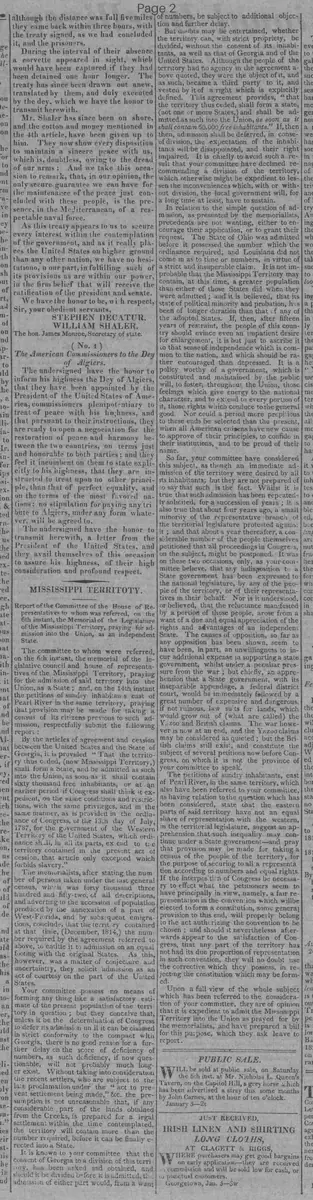
Report of the Committee of the House of Representatives to whom was referred, on the 6th instant, the Memorial of the Legislature of the Mississippi Territory, praying for admission into the Union, as an independent State.
The committee to whom were referred, on the 6th instant, the memorial of the legislative council and house of representatives of the Mississippi Territory, praying for the admission of said territory into the Union, as a State: and, on the 14th instant the petitions of sundry inhabitants east of Pearl River in the same territory, praying that provision may be made for taking a census of its citizens previous to such admission, respectfully submit the following report:
By the articles of agreement and cession between the United States and the State of Georgia, it is provided 'That the territory thus ceded, (now Mississippi Territory,) shall form a State, and be admitted as such into the Union, as soon as it shall contain sixty thousand free inhabitants, or at an earlier period if Congress shall think it expedient, on the same conditions and restrictions, with the same privileges, and in the same manner, as is provided in the ordinance of Congress, of the 13th day of July, 1787, for the government of the Western Territory of the United States, which ordinance shall, in all its parts, extend to the territory contained in the present act of cession, that article only excepted which forbids slavery.'
The memorialists, after stating the number of persons taken under the last general census, which was forty thousand three hundred and fifty-two, of all descriptions, and adverting to the accession of population produced by the annexation of a part of West-Florida, and by subsequent emigrations, conclude, that the territory contained at that time, (December, 1814,) the number required by the agreement referred to above, to entitle it to admission on an equal footing with the original States. As this, however, was a matter of conjecture and uncertainty, they solicit admission as an act of courtesy on the part of the United States.
Your committee possess no means of forming any thing like a satisfactory estimate of the present population of the territory in question; but they conceive that, unless it be the determination of Congress to defer its admission until it can be claimed in strict conformity to the compact with Georgia, there is no good reason for a further delay on the score of deficiency of numbers, as such deficiency, if now questionable, will not probably much longer exist. Without taking into consideration the recent settlers, who are subject to the late proclamation under the 'act to prevent settlement being made,' &c. the presumption is not unreasonable that, if any considerable part of the lands obtained from the Creeks, is prepared for a legal settlement within the time contemplated, the territory will contain more than the number required, before it can be finally erected into a State.
It is known to your committee that the consent of Georgia to a division of this territory has been asked and obtained, and should it be divided before it is admitted, the admission of either part would, from a want of numbers, be subject to additional objection and further delay.
But doubts may be entertained, whether the territory can, with strict propriety, be divided, without the consent of its inhabitants, as well as that of Georgia and of the United States. Although the people of the territory had no agency in the agreement above quoted, they were the object of it, and as such, became a third party to it, and vested by it of a right which is explicitly defined. This agreement provides, 'that the territory thus ceded, shall form a state, (not one or more States.) and shall be admitted as such into the Union, as soon as it shall contain 60,000 free inhabitants.' If, then, admission shall be deferred, in consequence of division, the expectation of the inhabitants will be disappointed, and their right impaired. It is chiefly to avoid such a result that your committee have declined recommending a division of the territory, which otherwise might be expedient to lessen the inconveniences which, with or without division, the local government will, for a long time at least, have to sustain.
In relation to the simple question of admission, as presented by the memorialists, precedents are not wanting, either to encourage their application, or to grant their request. The State of Ohio was admitted before it possessed the number which the ordinance required, and Louisiana did not come in as to time or numbers, in virtue of a strict and insuperable claim. It is not improbable that the Mississippi Territory may contain, at this time, a greater population than either of those States did when they were admitted; and it is believed, that its state of political minority and probation, has been of longer duration than that of any of the adopted States. If, then, after fifteen years of restraint, the people of this country should evince even an impatient desire for enlargement, it is but just to ascribe it to that sense of independence which is common to the nation, and which should be rather encouraged than depressed. It is a policy worthy of a government, which is constituted and maintained by the public will, to foster, throughout the Union, those feelings which give energy to the national character, and to extend to every portion of it, those rights which conduce to the general good. Nor could a period more propitious to these ends be selected than the present, when all American citizens have new cause to approve of their principles, to confide in their institutions, and to be proud of their name.
So far, your committee have considered this subject, as though an immediate admission of the territory were desired by all its inhabitants; but they are not prepared to say that such is the fact. Whilst it is true that such admission has been repeatedly solicited, for a succession of years; it is also true that about four years ago, a small minority of the representative branch of the territorial legislature protested against it: and that about a year thereafter, a considerable number of the people themselves petitioned that all proceedings in Congress, on the subject, might be postponed. It was on these two occasions, only, as your committee believe, that any indisposition to a State government has been expressed to the national legislature, by any of the people of the territory, or of their representatives in their behalf. Nor is it understood, or believed, that the reluctance manifested by a portion of those people, arose from a want of a due and equal appreciation of the rights and advantages of an independent State. The causes of opposition, so far as any opposition has been shown, seem to have been, in part, an unwillingness to incur additional expense in supporting a state government, whilst under a peculiar pressure from the war; but chiefly, an apprehension that a State government, with its inseparable appendage, a federal district court, would be immediately followed by a great number of expensive and dangerous, if not ruinous, law suits for lands, which would grow out of (what are called) the Yazoo and British claims. The war however is now at an end, and the Yazoo claims may be considered as quieted; but the British claims still exist, and constitute the subject of several petitions now before Congress, on which it is not the province of your committee to speak.
The petitions of sundry inhabitants, east of Pearl River, in the same territory, which also have been referred to your committee, as having relation to the question which has been considered, state that the eastern parts of said territory have not an equal share of representation with the western, in the territorial legislature, suggest an apprehension that such inequality may continue under a State government—and pray that provision may be made for taking a census of the people of the territory, for the purpose of securing to all a representation according to numbers and equal rights.
If the interposition of Congress be necessary to effect what the petitioners seem to have principally in view, namely, a fair representation in the convention which will be elected to form a constitution, some general provision to this end, will properly belong to the act authorizing the convention to be chosen; and should it nevertheless afterwards appear to the satisfaction of Congress, that any part of the territory has not had its due proportion of representation in such convention, they will no doubt use the corrective which they possess, in rejecting the constitution which may be formed.
Upon a full view of the whole subject which has been referred to the consideration of your committee, they are of opinion that it is expedient to admit the Mississippi Territory into the Union as prayed for by the memorialists, and have prepared a bill for this purpose, which they ask leave to report.
What sub-type of article is it?
What keywords are associated?
Where did it happen?
Domestic News Details
Primary Location
Mississippi Territory
Event Date
December 1814
Outcome
committee recommends admission into the union and prepares a bill; addresses population, representation, and land claim concerns.
Event Details
House of Representatives committee reviews memorial from Mississippi Territory legislature for statehood admission and petitions from inhabitants east of Pearl River for census and fair representation. Cites agreement with Georgia requiring 60,000 free inhabitants, estimates population met via census, annexations, and emigrations. Discusses precedents, potential division, opposition due to expenses and land suits, and concludes admission is expedient.