Thank you for visiting SNEWPapers!
Sign up free
Story
August 10, 1906
The Olneyville Times
Providence, Providence County, Rhode Island
What is this article about?
The turbot fish, often unremarkable when dead, displays striking vigilance and intelligence when alive due to its black-and-gold ball-and-socket eyes that move independently, allowing it to survey surroundings while camouflaging perfectly on the ocean bottom.
Clipping
OCR Quality
98%
Excellent
Full Text
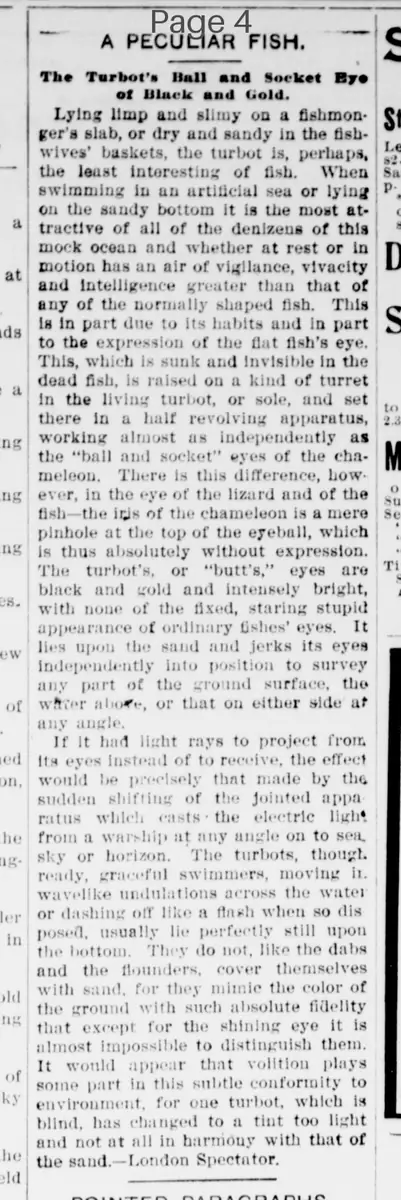
A PECULIAR FISH.
The Turbot's Ball and Socket Eyes of Black and Gold.
Lying limp and slimy on a fishmonger's slab, or dry and sandy in the fishwives' baskets, the turbot is, perhaps, the least interesting of fish. When swimming in an artificial sea or lying on the sandy bottom it is the most attractive of all of the denizens of this mock ocean and whether at rest or in motion has an air of vigilance, vivacity and intelligence greater than that of any of the normally shaped fish. This is in part due to its habits and in part to the expression of the flat fish's eye.
This, which is sunk and invisible in the dead fish, is raised on a kind of turret in the living turbot, or sole, and set there in a half revolving apparatus, working almost as independently as the "ball and socket" eyes of the chameleon. There is this difference, however, in the eye of the lizard and of the fish-the iris of the chameleon is a mere pinhole at the top of the eyeball, which is thus absolutely without expression.
The turbot's, or "butt's," eyes are black and gold and intensely bright with none of the fixed, staring stupid appearance of ordinary fishes' eyes. It lies upon the sand and jerks its eyes independently into position to survey any part of the ground surface, the water above, or that on either side at any angle.
If it had light rays to project from its eyes instead of to receive, the effect would be precisely that made by the sudden shifting of the jointed apparatus which casts the electric light from a warship at any angle on to sea sky or horizon. The turbots, though ready, graceful swimmers, moving in wavellike undulations across the water or dashing off like a flash when so disposed, usually lie perfectly still upon the bottom. They do not, like the dabs and the flounders, cover themselves with sand, for they mimic the color of the ground with such absolute fidelity that except for the shining eye it is almost impossible to distinguish them.
It would appear that volition plays some part in this subtle conformity to environment, for one turbot, which is blind, has changed to a tint too light and not at all in harmony with that of the sand.-London Spectator.
The Turbot's Ball and Socket Eyes of Black and Gold.
Lying limp and slimy on a fishmonger's slab, or dry and sandy in the fishwives' baskets, the turbot is, perhaps, the least interesting of fish. When swimming in an artificial sea or lying on the sandy bottom it is the most attractive of all of the denizens of this mock ocean and whether at rest or in motion has an air of vigilance, vivacity and intelligence greater than that of any of the normally shaped fish. This is in part due to its habits and in part to the expression of the flat fish's eye.
This, which is sunk and invisible in the dead fish, is raised on a kind of turret in the living turbot, or sole, and set there in a half revolving apparatus, working almost as independently as the "ball and socket" eyes of the chameleon. There is this difference, however, in the eye of the lizard and of the fish-the iris of the chameleon is a mere pinhole at the top of the eyeball, which is thus absolutely without expression.
The turbot's, or "butt's," eyes are black and gold and intensely bright with none of the fixed, staring stupid appearance of ordinary fishes' eyes. It lies upon the sand and jerks its eyes independently into position to survey any part of the ground surface, the water above, or that on either side at any angle.
If it had light rays to project from its eyes instead of to receive, the effect would be precisely that made by the sudden shifting of the jointed apparatus which casts the electric light from a warship at any angle on to sea sky or horizon. The turbots, though ready, graceful swimmers, moving in wavellike undulations across the water or dashing off like a flash when so disposed, usually lie perfectly still upon the bottom. They do not, like the dabs and the flounders, cover themselves with sand, for they mimic the color of the ground with such absolute fidelity that except for the shining eye it is almost impossible to distinguish them.
It would appear that volition plays some part in this subtle conformity to environment, for one turbot, which is blind, has changed to a tint too light and not at all in harmony with that of the sand.-London Spectator.
What sub-type of article is it?
Curiosity
Animal Story
What themes does it cover?
Nature
What keywords are associated?
Turbot Fish
Ball And Socket Eyes
Camouflage
Chameleon Comparison
Natural Mimicry
Where did it happen?
Sandy Bottom Of The Ocean
Story Details
Location
Sandy Bottom Of The Ocean
Story Details
The turbot fish has unique ball-and-socket eyes that are black and gold, allowing independent movement for vigilance; it camouflages perfectly on the sand, unlike a blind specimen that fails to match.