Thank you for visiting SNEWPapers!
Sign up free
Daily National Intelligencer
Washington, District Of Columbia
What is this article about?
On February 17, 1820, Mr. Rich of Vermont delivered a speech in the House of Representatives opposing the extension of slavery into Missouri. He argued that slavery contradicts the Declaration of Independence's principles of equality and natural rights, is not a legitimate attribute of sovereignty, and that Congress has the power to restrict it in new states to prevent national calamity and preserve the Union's moral character.
Clipping
OCR Quality
Full Text
IN THE
HOUSE OF REPRESENTATIVES
[Continued.]
FEBRUARY 17, 1820,
SPEECH OF MR. RICH, OF VERMONT.
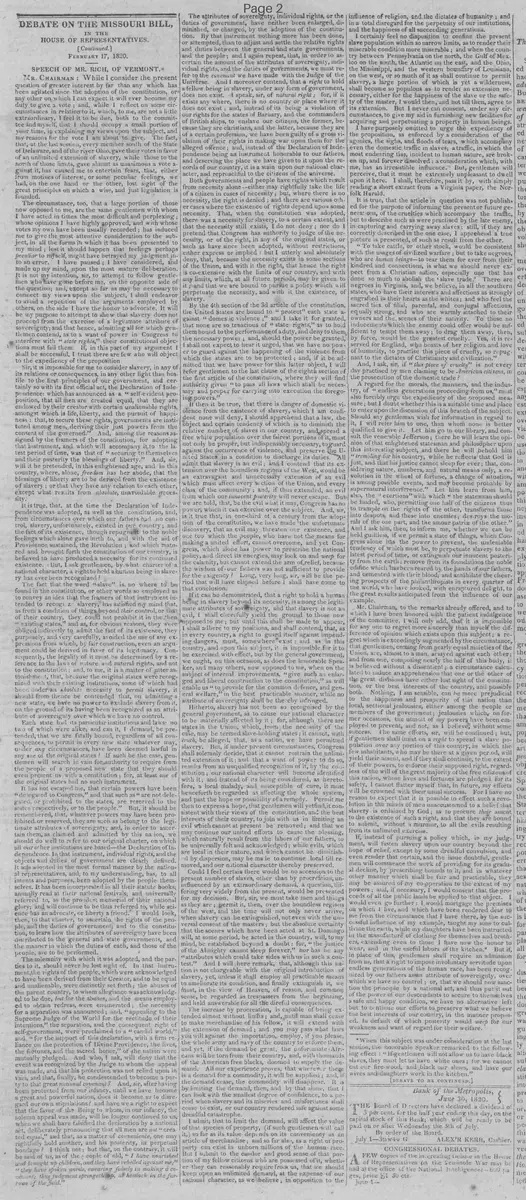
MR. Chairman: While I consider the present question of greater interest by far than any which has been agitated since the adoption of the constitution, or any other on which I can expect it will ever become my duty to give a vote: and, while I reflect on some circumstances in relation to it, which, to me, are not a little extraordinary, I feel it to be due, both to the committee and myself, that I should occupy a small portion of your time, in explaining my views upon the subject, and my reasons for the vote I am about to give. The fact, that, at the last session, every member south of the State of Delaware, and of the river Ohio, gave their votes in favor of an unlimited extension of slavery, while those to the north of those limits, gave almost as unanimous a vote against it, has caused me to entertain fears, that, either from motives of interest, or some peculiar feelings, we had, on the one hand or the other, lost sight of the great principles on which a wise, and just legislation is founded.
The circumstance, too, that a large portion of those now opposed to me, are the same gentlemen with whom I have acted in times the most difficult and perplexing; whose opinions I have highly approved, and with whose votes my own have been usually recorded; has induced me to give the most attentive consideration to the subject, in all the forms in which it has been presented to my mind; lest it should happen that feelings perhaps peculiar to myself, might have betrayed my judgment into an error. I have paused: I have considered, and made up my mind, upon the most mature deliberation.
It is not my intention, sir, to attempt to follow gentlemen who have gone before me, on the opposite side of the question; and, except so far as may be necessary to connect my views upon the subject, I shall endeavor to avoid a repetition of the arguments employed by others, on the side I have the honor to advocate. It will be my purpose to attempt to show that slavery does not proceed from the exercise of a legitimate attribute of sovereignty; and that hence, admitting all for which gentlemen contend, as to a want of power in Congress to interfere with "state rights," their constitutional objections must fail them. If, in this part of my argument I shall be successful, I trust there are few who will object to the expediency of the proposition.
Sir, it is impossible for me to consider slavery, in any of its relations or consequences, in any other light than hostile to the first principles of our government, and certainly so with its first official act, the Declaration of Independence: which has announced as a "self-evident proposition, that all men are created equal, that they are endowed by their creator with certain unalienable rights, amongst which is life, liberty, and the pursuit of happiness: that, to secure these rights, governments are instituted among men, deriving their just powers from the consent of the governed." And, among the reasons assigned by the framers of the constitution, for adopting that instrument, and which will accompany it to the latest period of time, was that of "securing to themselves and their posterity the blessings of liberty." And, sir, will it be pretended, in this enlightened age, and in this country, where, alone, freedom has her abode, that the blessings of liberty are to be derived from the existence of slavery; or that they have any relation to each other, except what results from absolute, unavoidable necessity.
It is true, that, at the time the Declaration of Independence was adopted, as well as the constitution, and, from circumstances over which our fathers had no control, slavery, unfortunately, existed in our country; and the fact of its existence, though repugnant to the noble feelings which alone gave birth to, and with the aid of Providence sustained, the Revolution; and which matured and brought forth the constitution of our country, is believed to have produced a necessity for its continued existence. But, I ask gentlemen, by what charter of a national character, a right to hold a human being in slavery has ever been recognized?
The fact that the word "slave" is no where to be found in the constitution, or other words so employed as to convey an idea that the framers of that instrument intended to recognize slavery, has satisfied my mind that, as from a condition of things beyond their control, or that of their country, they could not prohibit it in the "existing states," and as, for obvious reasons, they were obliged indirectly to admit the fact of its existence, they purposely, and very carefully, avoided the use of any expressions from which, by fair construction, even an argument could be derived in favor of its legitimacy. Consequently, the legality of it must be determined by a reference to the laws of nature and natural rights, and not to the constitution; and, to me, it is a matter of utter astonishment, that, because the original states were recognized with their existing institutions, some of which had been under an absolute necessity to permit slavery, it should from thence be contended that, on admitting a new state, we have no power to exclude slavery from it, on the ground of its having been recognized as an attribute of sovereignty over which we have no control.
Each state had its particular institutions and laws: no two of which were alike; and can it, I demand, be pretended, that we are fatally bound, regardless of all consequences, to permit in every new state whatever may, under any circumstances, have been deemed lawful in any one of the original states? If such be the case, gentlemen will search in vain for authority to require from the people of a proposed new state that they should even present us with a constitution; for, at least one of the original states had no such instrument.
It has not escaped me, that certain powers have been "delegated to Congress," and that such as "are not delegated, or prohibited to the states, are reserved to the states respectively, or to the people." But, it should be remembered, that, whatever powers may have been prohibited or reserved, they are such as belong to the legitimate attributes of sovereignty; and, in order to ascertain them, as claimed and admitted by this nation, we should do well to refer to our original charter, on which all our other institutions are based—the Declaration of Independence. In that instrument, individual rights, and the objects and duties of government are clearly defined.
It was adopted in the most formal manner by the national representatives, and, to my understanding, has, to all intents and purposes, been adopted by the people themselves. It has been incorporated in all their statute books; annually read at their national festivals; and universally referred to, as the proudest memorial of their national glory; and will continue to be thus referred to, while science has an advocate, or liberty a friend. I would look, then, to that charter, to ascertain the rights of the people, and the duties of government; and to the constitution, to learn how the attributes of sovereignty have been distributed to the general and state governments, and the manner in which the duties of each, and those of the people, are to be performed.
The solemnity with which it was adopted, and the parties to it, should never be lost sight of. In that instrument, the rights of the people, which were acknowledged to have been derived from their Creator, and to be equal and unalienable, were distinctly set forth: the abuses of the parent country, to whom allegiance was acknowledged to be due, but for the abuses, and the means employed to obtain redress, were enumerated; the necessity for a separation was announced; and, "appealing to the Supreme Judge of the World for the rectitude of their intentions," the separation, and the consequent right of self-government, were proclaimed to a "candid world;" and, "for the support of this declaration, with a firm reliance on the protection of Divine Providence, the lives, the fortunes, and the sacred honor," of the nation were mutually pledged. And who, I ask, will deny that the event was recognized by the Judge to whom the appeal was made, and that his protection was not relied upon in vain, and that, finally, he condescended to become a party to that great national covenant? And, sir, after having been protected from our infancy, until we have become a great and powerful nation, does it become us to disregard our own stipulations? and have we a right to expect that the favor of the Being to whom, in our infancy, the solemn appeal was made, will be longer continued to us, when we shall have falsified the declaration by a national act, deliberately pronouncing that all men are not "created equal," and that, as a matter of convenience, one may rightfully hold another, and his posterity, in perpetual bondage? I think not; but that, on the contrary, it will be said of us, as of the people of old, "I have nourished and brought up children, and they have rebelled against me;" "they have spoken words, swearing falsely in making a covenant; thus judgment springeth up, as hemlock in the furrows of the field"
The attributes of sovereignty, individual rights, or the duties of government, have neither been enlarged, diminished, or changed, by the adoption of the constitution. By that instrument nothing more has been done, or attempted, than to adjust and settle the relative rights and duties between the general and state governments, and the people; and I again repeat, that, in order to ascertain the amount of the attributes of sovereignty, individual rights, and the duties of governments, we must refer to the covenant we have made with the Judge of the Universe. And I moreover contend, that a right to hold a fellow being in slavery, under any form of government does not exist. I speak, sir, of natural right; for, if it exists any where, there is no country or place where it does not exist; and, instead of its being a violation of our rights for the states of Barbary, and the commanders of British ships, to enslave our citizens, the former, because they are christians, and the latter, because they are of a certain profession, we have been guilty of a gross violation of their rights in making war upon them for the alleged offence; and, instead of the Declaration of Independence being an instrument honorable to our fathers, and deserving the place we have given to it upon the records of our country, it is a stain upon our national character, and reproachful to the citizens of the universe.
Both governments and people have rights which result from necessity alone—either may rightfully take the life of a citizen in cases of necessity; but, where there is no necessity, the right is denied; and there are various other cases where the existence of rights depend upon some necessity. That, when the constitution was adopted, there was a necessity for slavery, to a certain extent, and that the necessity still exists, I do not deny; nor do I pretend that Congress has authority to judge of the necessity, or of the right, in any of the original states, or such as have since been adopted, without restrictions, either express or implied: but I utterly and absolutely deny, that, because the necessity exists in some sections of the Union, and with it the right, that hence the right is co-extensive with the limits of our country, and with any limits, which, at all future periods, may be given to it; and that we are bound to pursue a policy which will perpetuate the necessity, and with it the existence, of slavery.
By the 4th section of the 3d article of the constitution, the United States are bound to "protect" each state against "domestic violence;" and I take it for granted, that none are so tenacious of "state rights," as to hold them bound to the performance of a duty, and deny to them the necessary power: and, should the power be granted, I shall not expect to hear it urged, that we have no power to guard against the happening of the violence from which the states are to be protected; and, if it be admitted that we have power for this latter object, I will refer gentlemen to the last clause of the eighth section of the first article of the constitution, where they will find authority given "to pass all laws which shall be necessary and proper for carrying into execution the foregoing powers."
If then it be true, that there is danger of domestic violence from the existence of slavery, which I am confident none will deny, I should apprehend that a law, the object and certain tendency of which is to diminish the relative number of slaves in our country, and spread a free white population over the fairest portions of it, must not only be proper, but indispensably necessary, to guard against the occurrence of violence, and preserve the United States in a condition to discharge its duties. All admit that slavery is an evil; and I contend that its extension over the boundless regions of the West, would be an extravagant and unnecessary extension of an evil which must affect every section of the Union, and every class of the community: and, if thus extended, an evil from which our innocent posterity will never escape. But we are told, that, be the evil what it may, Congress has no power, which it can exercise over the subject. And, sir, is it true that, in one-third of a century from the adoption of the constitution, we have made the unfortunate discovery, that an evil may threaten our existence, and one too which the people, who have not the means for making a united effort, cannot overcome, and yet Congress, which alone has power to prescribe the national policy, and direct its energies, may look on and weep for the calamity, but cannot extend the arm of relief, because the wisdom of our fathers was not sufficient to provide for the exigency? Long, very long, sir, will be the period that will have elapsed before I shall have come to that conclusion.
If it can be demonstrated, that a right to hold a human being in slavery beyond its necessity, is among the legitimate attributes of sovereignty, and that slavery is not an evil, I shall cheerfully yield the ground to those now opposed to me; but until this shall be made to appear, I shall adhere to my positions, and shall contend, that, as in every country, a right to guard itself against impending dangers, must, somewhere exist: and as in this country, and upon this subject, it is impossible for it to be exercised with effect, but by the general government, we ought, on this occasion, as does the honorable Speaker, and many others, now opposed to me, when on the subject of internal improvements, "give such an enlarged and liberal construction to the constitution," as will enable us "to provide for the common defence, and general welfare," in the best practicable manner, while no attribute of sovereignty shall be thereby infringed.
Hitherto, slavery has not been so recognised by the general government, as to cause our national character to be materially affected by it; for, although there are states in the Union, which, from the necessity of the case, may be termed slave-holding states; it cannot, with truth, be alleged, that, as a nation, we have permitted slavery. But, if under present circumstances, Congress shall solemnly decide, that it cannot restrain the unlimited extension of it: and that a want of power to do so, results from an unqualified recognition of it, by the constitution; our national character will become identified with it; and instead of its being considered, as heretofore, a local malady, and susceptible of cure, it must henceforth be regarded as affecting the whole system, and past the hope or possibility of a remedy. Permit me then to express a hope, that gentlemen will yet find it consistent with their views of the constitution, and the best interests of their country, to join with us in limiting an evil which cannot at present be removed; and that we may continue our united efforts to cause the blessing, which naturally result from the labors of our fathers, to be universally felt and acknowledged; while evils, which are local in their nature, and which cannot be diminished by dispersion, may be made to continue local till removed, and our national character thereby preserved.
Could I feel certain there would be no accession to the present number of slaves, other than by procreation, uninfluenced by an extraordinary demand, a question, differing very widely from the present, would be presented for my decision. But, sir, we must take men and things as they are; permit it, then, over the boundless regions of the west, and the time will not only never arrive, when slavery can be extinguished, not even with the universal consent of the masters; but the absolute certainty that the scenes which have been acted at St. Domingo will, at some period, be acted in this country, will, to my mind, be established beyond a doubt: for, "the justice of the Almighty cannot sleep forever," nor has he any "attributes which could take sides with us in such a contest." And I will here remark, that, although this nation is not chargeable with the original introduction of slavery, yet, unless it shall employ all practicable means to ameliorate its condition, and finally extinguish it, we must, in the view of Heaven, of reason, and common sense, be regarded as trespassers from the beginning, and held answerable for all the direful consequences.
The increase by procreation, is capable of being extended almost without limits; and, until man shall cease to make merchandise of his fellow, it will extend with the extension of demand; and you may pass what laws you will against the importation, employ, if you please the whole army and navy of the country to enforce them, and yet, if the demand be great, the unfortunate Africans will be torn from their country, and, with thousands of the American free blacks, doomed to supply the demand. All our experience proves, that wherever there is a demand for a commodity, it will be supplied; and, if the demand cease, the commodity will disappear. It is by limiting the demand, then, and by that alone, that I can look with the smallest degree of confidence, to a period when slavery and its miseries and misfortunes shall cease to exist, or our country rendered safe against some dreadful catastrophe.
I admit, that to limit the demand, will affect the value of that species of property, (if such gentlemen will call it,) so far as its value depends on its conveniency as an article of merchandise; and so far also, as a right of property can exist in unborn millions of the human race. But I submit to the candor and good sense of that portion of my fellow citizens who are possessed of it, whether they can reasonably require from us, that we should keep open an unlimited demand, at the expense of our national character, as we believe; in opposition to the influence of religion, and the dictates of humanity; and in a total disregard for the perpetuity of our institutions, and the happiness of all succeeding generations.
I certainly feel no disposition to confine the present slave population within so narrow limits, as to render their miserable condition more miserable; and when the country between Pennsylvania on the north, the Gulf of Mexico on the south, the Atlantic on the east, and the Ohio, the Mississippi, and the western boundary of Louisiana, on the west, or so much of it as shall continue to permit slavery, a large portion of which is yet a wilderness, shall become so populous as to render an extension necessary, either for the happiness of the slave or the safety of the master, I would then, and not till then, agree to its extension. But I never can consent, under any circumstances, to give my aid in furnishing new facilities for acquiring and perpetuating a property in human beings.
I have purposely omitted to urge the expediency of the proposition, as enforced by a consideration of the agonies, the sighs, and floods of tears, which accompany even the domestic traffic in slaves; a traffic, in which the most endearing ties, incident to human nature, are broken up, and forever dissolved: a consideration which, with me, has an irresistible influence. But, gentlemen will perceive, that it must be extremely unpleasant to dwell upon it here. I shall, therefore, pass it by, with simply reading a short extract from a Virginia paper, the Norfolk Herald.
It is true, that the article in question was not published for the purpose of informing the present or future generations, of the cruelties which accompany the traffic, but to describe such as were practised by the late enemy, in capturing and carrying away slaves: still, if they are correctly described in the one case, I apprehend a true picture is presented, of such as result from the other.
"To take cattle, or other stock, would be consistent with the usages of civilized warfare; but to take negroes, who are human beings—to tear them for ever from their kindred and connections, is what we should never expect from a Christian nation, especially one that has done so much to abolish the 'slave trade.' There are negroes in Virginia, and, we believe, in all the southern states, who have their interests and affections as strongly engrafted in their hearts as the whites; and who feel the sacred ties of filial, parental, and conjugal affections, equally strong, and who are warmly attached to their owners and the scenes of their nativity. To those no inducements which the enemy could offer would be sufficient to tempt them away; to drag them away, then, by force, would be the greatest cruelty. Yes, it is reserved for England, who boasts of her religion and love of humanity, to practise this piece of cruelty, so repugnant to the dictates of Christianity and civilization."
And, I ask, sir, if "this piece of cruelty" is not every day practised by men claiming to be American citizens, in the prosecution of the domestic trade?
A regard for the morals, the manners, and the industry, of "endless generations proceeding from us," must also forcibly urge the expediency of the proposed measure; but I doubt whether this is a suitable time and place to enter upon the discussion of this branch of the subject. Should any gentleman wish for information in regard to it, I will refer him to one, than whom none is better qualified to give it. Let him go to our library, and consult the venerable Jefferson; there he will learn the opinion of that enlightened statesman and philosopher upon this interesting subject, and there he will behold him "trembling for his country, while he reflects that God is just, and that his justice cannot sleep for ever; that, considering nature, numbers, and natural means only, a revolution in the wheel of fortune, a change of situation, is among possible events, and may become probable by supernatural interference." Let him learn from him, also, the "exertions" with which "the statesman should be loaded, who, permitting one half of the citizens thus to trample on the rights of the other, transforms those into despots, and these into enemies; destroys the morals of the one part, and the amour patriot of the other." And I ask him, then, to inform me, whether we can be held guiltless, if we permit a state of things, which Congress alone has the power to prevent, the undeniable tendency of which must be, to perpetuate slavery, to the latest period of time, or extinguish our innocent posterity from the earth; remove from its foundations the noble edifice which has been reared by the hands of our fathers, and cemented with their blood; and annihilate the cheering prospects of the philanthropists in every quarter of the world, who have looked, with enraptured delight, to the great results anticipated from the influence of our example.
Mr. Chairman, to the remarks already offered, and to which I have been honored with the patient indulgence of the committee, I will only add, that it is impossible for any one to regret more sincerely than myself the difference of opinion which exists upon this subject; a regret which is exceedingly augmented by the circumstance, that gentlemen, coming from nearly equal moieties of the Union, are, almost to a man, arrayed against each other; and from one, composing nearly the half of this body, it is believed without a dissentient; a circumstance calculated to induce an apprehension that one or the other of the great divisions have either lost sight of the constitution, or the best interests of the country, and possibly both. Nothing, I am sensible, can be more prejudicial to the happiness and prosperity of this nation than local, sectional jealousies, either among the people or members of the government; jealousies which, on former occasions, the utmost of my powers have been employed to prevent, and not, as I believe, without some success. The same efforts, sir, will be continued; but, if gentlemen shall insist on a right to spread a slave population over any portion of this country, in which the few inhabitants, who may be there at a given period, will yield their assent, and if they shall continue, to the extent of their powers, to enforce their supposed right, regardless of the will of the great majority of the free citizens of this nation, whose lives and fortunes are pledged for its safety, I cannot flatter myself that, in future, my efforts will be crowned with their usual success. For I have no reason to expect that it is possible to effect such a revolution in the minds of men unaccustomed to a belief that slavery is ordained by God; as to procure their assent to the existence of such a right, and that they are bound to submit, without a murmur, to all the evils resulting from its unlimited exercise.
If, instead of pursuing a policy which, in my judgment, will fasten slavery upon our country beyond the hope of relief, except by some dreadful convulsion, and even render that certain, and the issue doubtful, gentlemen will commence the work of providing for its gradual decline, by prescribing bounds to it, and in whatever other manner which shall be fair and practicable, they may be assured of my co-operation to the extent of my powers; and, if necessary, I would consent that the proceeds of all the public lands be applied to that object. I would even go further: I would mortgage the premises on which I live, and which have been rendered dear to me from the circumstance that I have there, by the successful influence of my example, taught my sons to cultivate the earth, while my daughters have been instructed in the manufacture of clothing for themselves and brothers, extending even to those I have now the honor to wear, and in the useful labors of the kitchen. But if, in place of this, gentlemen shall require an admission from us, that a right to impose involuntary servitude upon endless generations of the human race, has been recognized by our fathers as an attribute of sovereignty, over which we have no control; or, that we should now sanction the principle by a national act, and thus put it out of the power of our descendants to secure to themselves a safe and happy condition, we have no alternative left but to continue our efforts to preserve what we believe the best interests of our country, in the manner proposed. In default of which posterity would weep for our weakness and want of regard for their welfare.
*When this subject was under consideration at the last session, the honorable Speaker remarked to the following effect: "If gentlemen will not allow us to have black slaves, they must let us have white ones; for we cannot cut our fire-wood, and black our shoes, and have our wives and daughters work in the kitchen."
[DEBATE TO BE CONTINUED.]
What sub-type of article is it?
What themes does it cover?
What keywords are associated?
What entities or persons were involved?
Where did it happen?
Story Details
Key Persons
Location
House Of Representatives
Event Date
February 17, 1820
Story Details
Mr. Rich argues that slavery is incompatible with the Declaration of Independence and natural rights, not recognized in the Constitution as a legitimate sovereignty attribute, and Congress should restrict its extension to new states like Missouri to prevent violence, preserve national character, and allow gradual extinction, warning of potential catastrophe if extended.