Thank you for visiting SNEWPapers!
Sign up free
Burlington Free Press
Burlington, Chittenden County, Vermont
What is this article about?
An editorial preface thanks a correspondent and clarifies views on Southern anti-slavery sentiment, followed by a letter from 'Observer' critiquing broad accusations against the South for injecting slavery into Congress, highlighting Northern complicity in past events like Texas annexation and the Mexican War, and urging conciliatory language to preserve the Union amid threats of disunion.
Clipping
OCR Quality
Full Text
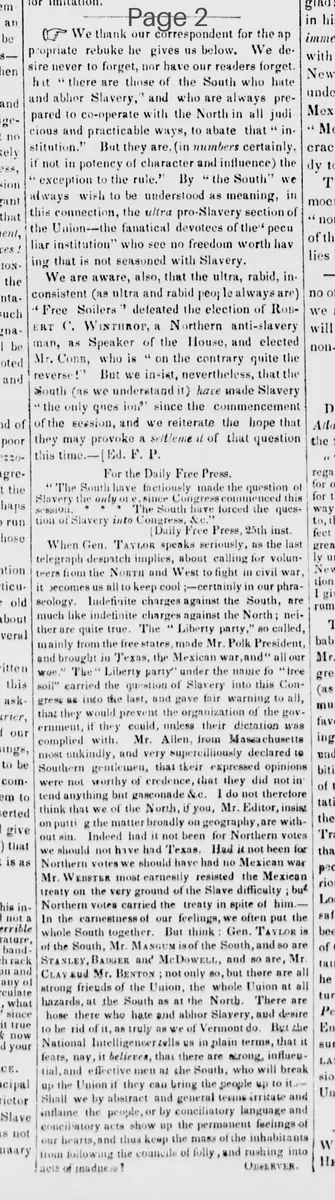
By "the South" we always wish to be understood as meaning, in this connection, the ultra pro-Slavery section of the Union—the fanatical devotees of the "peculiar institution" who see no freedom worth having that is not seasoned with Slavery.
We are aware, also, that the ultra, rabid, inconsistent (as ultra and rabid people always are) "Free Soilers" defeated the election of Robert C. Winthrop, a Northern anti-slavery man, as Speaker of the House, and elected Mr. Cobb, who is "on the contrary quite the reverse!" But we insist, nevertheless, that the South (as we understand it) have made Slavery "the only question" since the commencement of the session, and we reiterate the hope that they may provoke a settlement of that question this time.—[Ed. F. P.
For the Daily Free Press.
"The South have factiously made the question of Slavery the only one, since Congress commenced this session."
The South have forced the question of Slavery into Congress, &c." [Daily Free Press, 25th inst.
When Gen. Taylor speaks seriously, as the last telegraph despatch implies, about calling for volunteers from the North and West to fight in civil war, it becomes us all to keep cool;—certainly in our phraseology. Indefinite charges against the South, are much like indefinite charges against the North; neither are quite true. The "Liberty party," so called, mainly from the free states, made Mr. Polk President, and brought in Texas, the Mexican war, and "all our woe." The "Liberty party" under the name of "free soil" carried the question of Slavery into this Congress as into the last, and gave fair warning to all, that they would prevent the organization of the government, if they could, unless their dictation was complied with. Mr. Allen, from Massachusetts most unkindly, and very superciliously declared to Southern gentlemen, that their expressed opinions were not worthy of credence, that they did not intend anything but gasconade &c. I do not therefore think that we of the North, if you, Mr. Editor, insist on putting the matter broadly on geography, are without sin. Indeed had it not been for Northern votes we should not have had Texas. Had it not been for Northern votes we should have had no Mexican war. Mr. Webster most earnestly resisted the Mexican treaty on the very ground of the Slave difficulty; but Northern votes carried the treaty in spite of him.—
In the earnestness of our feelings, we often put the whole South together. But think: Gen. Taylor is of the South, Mr. Mangum is of the South, and so are Stanley, Badger and McDowell, and so are, Mr. Clay and Mr. Benton; not only so, but there are all strong friends of the Union, the whole Union at all hazards, at the South as at the North. There are those there who hate and abhor Slavery, and desire to be rid of it, as truly as we of Vermont do. But the National Intelligencer tells us in plain terms, that it fears, nay, it believes, that there are strong, influential, and effective men at the South, who will break up the Union if they can bring the people up to it.— Shall we by abstract and general terms irritate and inflame the people, or by conciliatory language and conciliatory acts show up the permanent feelings of our hearts, and thus keep the mass of the inhabitants from following the councils of folly, and rushing into acts of madness?
OBSERVER.
What sub-type of article is it?
What themes does it cover?
What keywords are associated?
What entities or persons were involved?
Letter to Editor Details
Author
Observer
Recipient
Mr. Editor
Main Argument
the north shares responsibility for slavery-related conflicts through past actions like supporting texas annexation and the mexican war; broad accusations against the south overlook southern unionists who oppose slavery, and conciliatory language is needed to prevent disunion.
Notable Details